Table of contents

No published benchmark scores mental health ad creative on its own terms, so this page starts where the real constraint sits: the advertising platforms' own rules for health content. Only after those rules are mapped does the closest available cross-industry performance data become useful, and it's labeled as cross-industry throughout.
Key Takeaways
- Google restricts addiction-services ads to 4 countries: US, Australia, Ireland, New Zealand.
- Addiction-services advertisers need LegitScript certification to bid on the category at all.
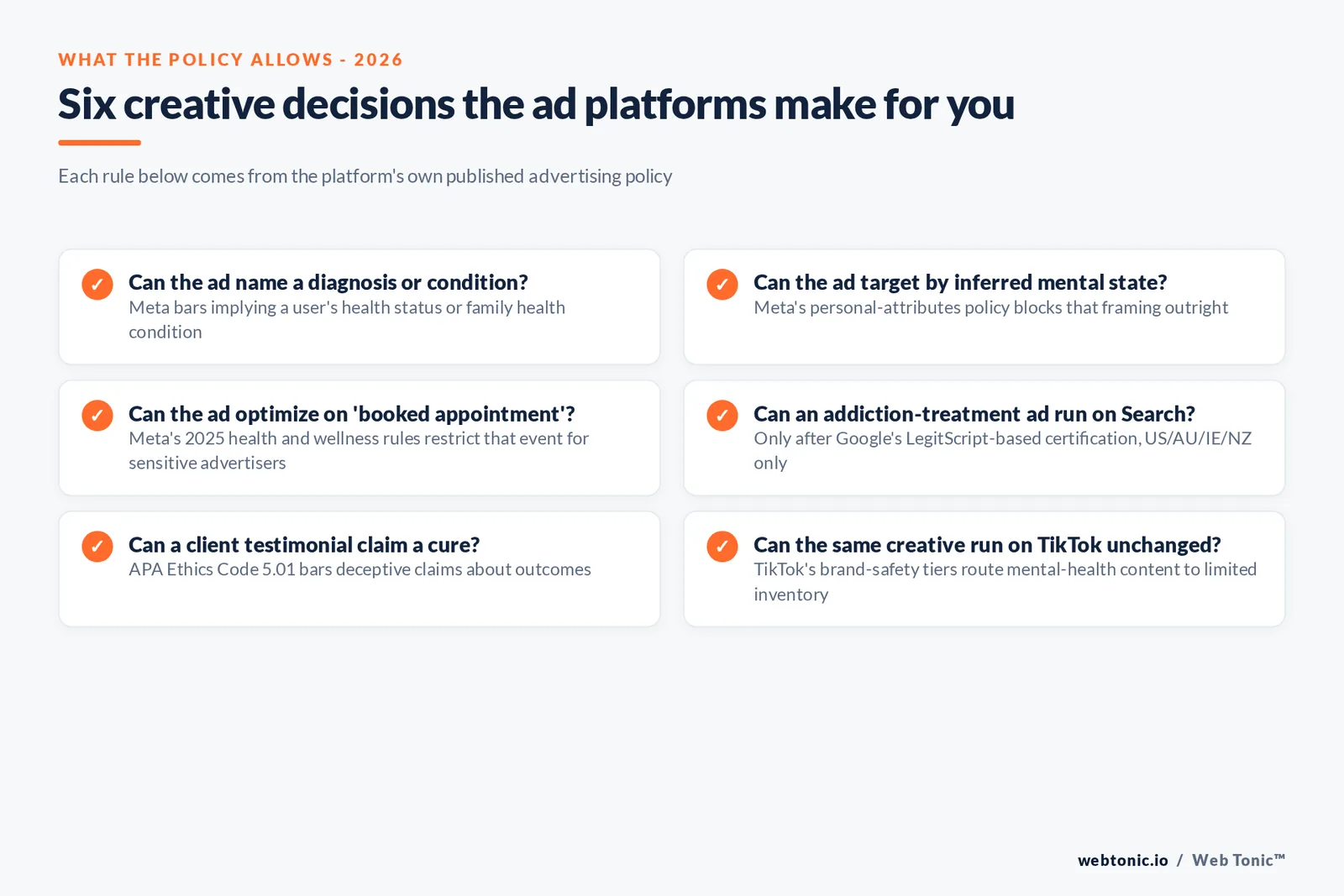
- Meta's 2025 health-and-wellness rules restrict optimizing toward named health conversion events.
- APA Ethics Code 5.01 bars deceptive claims about a service's results or success rate.
- APA Ethics Code 5.02 makes psychologists responsible for testimonials they solicit.
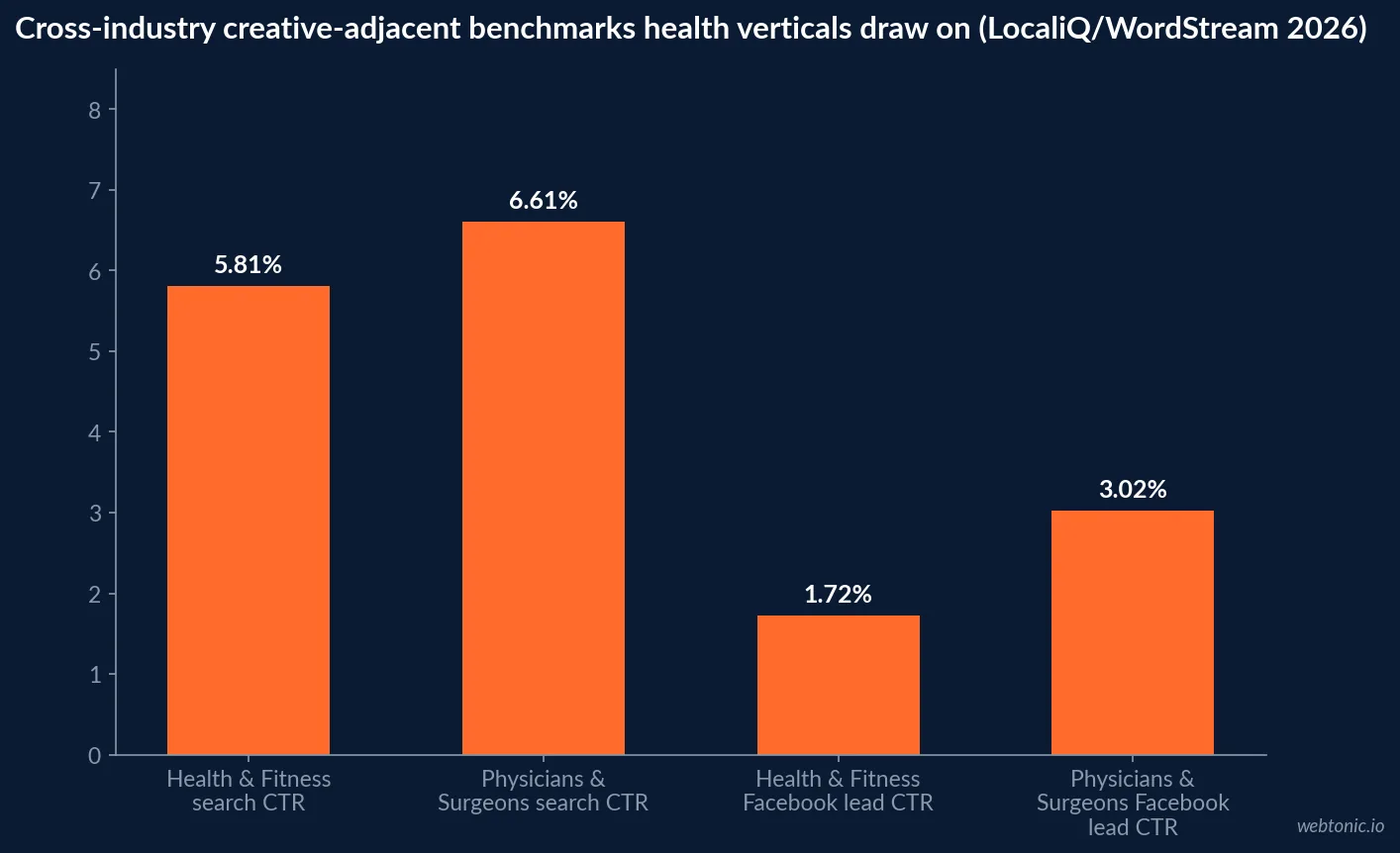
- Health & Fitness search ads average a 5.81% click-through rate in 2026.
- Physicians & Surgeons search ads average 6.61% CTR, above the 6.64% all-industry line.
- Health & Fitness Facebook lead ads run a 1.72% CTR, among the lowest tracked.
- Physicians & Surgeons Facebook lead ads run 3.02% CTR, near the category top.
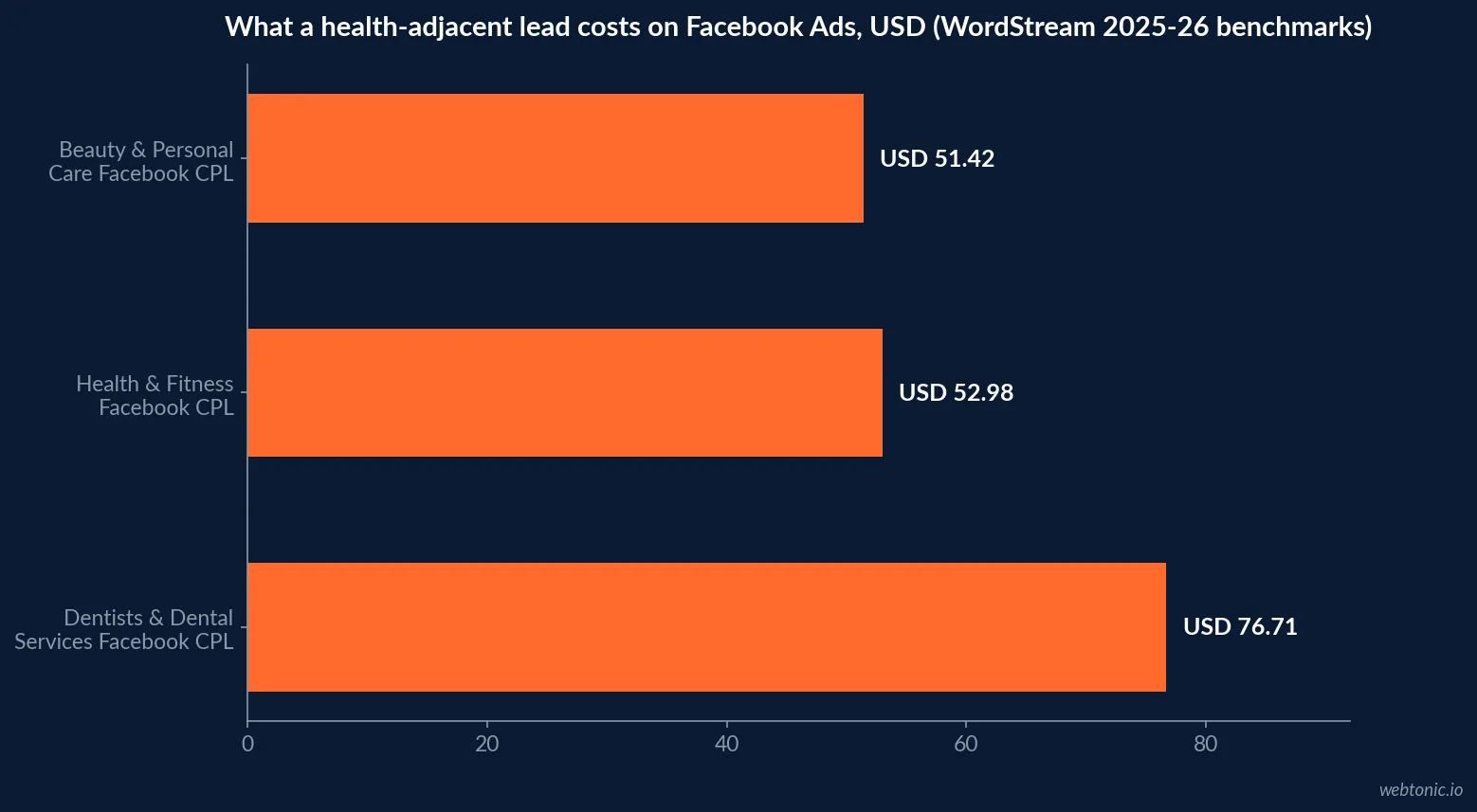
- Health & Fitness Facebook leads cost USD 52.98 per lead on average.
- Dentists & Dental Services, the priciest health-adjacent category, run USD 76.71 per Facebook lead.
- 91% of businesses overall now use video as a marketing tool, Wyzowl found.
- 69% of video marketers have made a social media video, the top single use case.
- Psychology Today lists over 180,000 therapist profiles, saturating directory creative.
- TikTok routes mental-and-behavioral-health content to its limited inventory tier by default.
The rulebook comes before the creative brief
For most industries, a creative brief starts with an audience and a hook. For mental health advertising, it starts with what the platform will allow. Google's Healthcare and medicines policy singles out addiction services for the strictest treatment: certified advertisers only, and only in four countries - the United States, Australia, Ireland and New Zealand. Certification runs through LegitScript's Healthcare Merchant Certification Program. Uncertified advertisers cannot bid on addiction-related keywords in any market, which makes "what's the CTR benchmark" a secondary question to "are we even eligible to run this."
| Platform rule (2025-26) | What it restricts | Source |
|---|---|---|
| Google addiction-services certification | Only certified advertisers may bid on the category, 4 countries only | Google Ads healthcare and medicines policy |
| Google general healthcare certification | Health insurance and prescription-drug advertisers need certification too | Google Ads healthcare and medicines policy |
| Meta 2025 health-and-wellness event limits | Bars optimizing toward named health-adjacent conversion events | Meta Advertising Standards - Health and Wellness policy |
| Meta personal-attributes policy | Bars ads implying a user's own or family's health condition | Meta advertising standards |
| APA Ethics Code 5.01/5.02 | Bars deceptive result claims and testimonials that imply a cure | American Psychological Association Ethics Code |
| TikTok brand-safety inventory tiers | Routes mental-and-behavioral-health content to limited inventory by default | TikTok Brand Safety and Suitability Playbook |
What the messaging can and can't claim
The American Psychological Association's Ethics Code, Section 5.01, bars psychologists from making "false, deceptive, or fraudulent" public statements about the results or degree of success of their services - and defines "public statements" broadly enough to cover paid advertising, directory listings and social posts. Section 5.02 goes further: a psychologist who engages someone else to create or place a public statement "retains professional responsibility for such statements," which covers a client testimonial the practice solicits and republishes as an ad.
That combination rules out the two easiest creative shortcuts in most verticals - a before/after framing and an unprompted glowing review - unless both are handled with unusual care about what they imply.
The Meta event-optimization change that reshapes bottom-funnel creative
Meta's health-and-wellness policy update, rolled out through 2025, restricts advertisers it categorizes as sensitive - including mental health - from optimizing campaigns around specific health-adjacent conversion events, such as an appointment booked for a named condition. The concern, per Meta's own Health and Wellness advertising policy, is that pairing a named health event with Meta's own targeting signals could reconstruct something close to protected health information. Since most Meta campaigns are built around bottom-funnel optimization, this forces a shift toward broader creative that earns attention and clicks without relying on Meta's algorithm to chase a health-specific action.
The closest performance data that exists, labeled honestly
Because no vendor publishes a "mental health and counseling" line, the closest available figures come from LocaliQ/WordStream's 2026 search benchmarks ("Health & Fitness" averages a 5.81% CTR and USD 6.17 CPC; "Physicians & Surgeons" averages 6.61% CTR and USD 4.76 CPC) and WordStream's 2025-26 Facebook Ads benchmarks ("Health & Fitness" lead campaigns run a 1.72% CTR and USD 52.98 cost per lead; "Physicians & Surgeons" run a stronger 3.02% CTR). None of these categories is counseling specifically, and creative that works for a gym membership or an urgent-care visit won't automatically transfer to a therapy intake form.
| Cross-industry category (2026) | Search CTR | Search CPC | Facebook lead CTR | Facebook cost per lead |
|---|---|---|---|---|
| Health & Fitness | 5.81% | USD 6.17 | 1.72% | USD 52.98 |
| Physicians & Surgeons | 6.61% | USD 4.76 | 3.02% | not published separately |
| Beauty & Personal Care | 6.75% | USD 4.62 | not published separately | USD 51.42 |
| Dentists & Dental Services | 5.66% | USD 8.00 | 1.05% | USD 76.71 |
| All-industry average | 6.64% | USD 5.42 | 2.59% | USD 27.66 |
Video is the format most likely to carry the message safely
Wyzowl's 2026 State of Video Marketing survey (266 respondents, late 2025) found 91% of businesses now use video as a marketing tool and 69% of video marketers have created a social media video - the single most common use case. Video creative built around a clinician's credentials, a practice's approach, or general psychoeducation content sidesteps the testimonial and claims risk almost entirely, while still filling the top of a funnel that paid search and social increasingly can't optimize toward a named health outcome.
| Video marketing signal (Wyzowl 2026, n=266) | Figure |
|---|---|
| Businesses using video as a marketing tool | 91% |
| Marketers who see video as important to strategy | 93% |
| Video marketers who've made a social media video | 69% (top use case) |
| Marketers planning to start using video in 2026 | 67% of current non-users |
| Video created mostly in-house | 59% |
The directory-listing environment creative competes inside
Psychology Today now lists over 180,000 therapist profiles in the United States, and a single specialty search in a major metro can return hundreds of competing listings. Directory creative - the profile photo, headline and bio - operates under the same APA claims rules as a paid ad, and in a market this saturated, differentiation has to come from specificity (named modality, named population served) rather than from claims about outcomes.
Google classifies counseling itself as a sensitive interest category
Beyond addiction-services certification, Google's Health in personalized advertising policy names "counseling services for mental health issues like depression, anxiety, and addiction" as an explicit example of a sensitive interest category, alongside disabilities and chronic condition management. Advertisers in this category cannot use advertiser-curated audiences, similar audiences, or most demographic and life-event targeting - only predefined Google audiences and customer match are permitted, because the platform automatically strips sensitive signals from those specific lists. That rules out a wide swath of standard remarketing tactics before creative is even considered.
| Targeting feature | Usable for mental health / counseling ads? | Why |
|---|---|---|
| Advertiser-curated audiences | No | May inadvertently carry sensitive user signals |
| Predefined Google audiences | Yes | Sensitive signals excluded automatically |
| Customer match | Yes, with restrictions | First-party list, not inferred from browsing |
| Similar/lookalike audiences | No | Built by inference from sensitive-adjacent behavior |
| Demographic and life-event targeting | Limited, with exceptions | Some categories excluded by policy |
Creative economics: what a booked session is worth against the media cost
Set against the cost data above, a Health & Fitness Facebook lead at USD 52.98 or a Dentists & Dental Services lead at USD 76.71 only pencils out if the resulting client relationship is worth meaningfully more than a single session - which, for ongoing counseling, it typically is. The risk is testing creative fast enough to find that out before the sensitive-category targeting restrictions above make broad-audience testing slower and more expensive than in an unrestricted vertical.
Building a creative test plan inside the rules
Start with format, not claim: video and static creative that describes approach, credentials and who the practice serves, tested across broader Meta objectives rather than named health events. Keep testimonials, if used at all, reviewed against APA 5.01/5.02 before publishing. Budget for Google certification lead time if addiction services are part of the offering. And benchmark performance against the labeled cross-industry data above, not against an unpublished mental-health-specific number that doesn't exist. Our performance creative practice builds test plans this way for regulated verticals; see our breakdown of whether Facebook ads are worth it for the general ROI math behind the platform choice, or talk to us about a compliant creative brief.
Frequently Asked Questions
Is there a benchmark study for mental health ad creative specifically?
No. WordStream/LocaliQ's 2026 benchmarks track 'Health & Fitness' and 'Physicians & Surgeons' as categories, and Meta's own advertising research doesn't break out counseling or therapy ads separately. What is directly documented is the rulebook: Google's healthcare and medicines policy, Meta's health-and-wellness restrictions, and the American Psychological Association's ethics code on advertising claims. Those rules shape what a mental health ad is allowed to say well before creative performance data becomes relevant.
Can a mental health ad show a client testimonial about their results?
Only within limits. The APA's Ethics Code, Section 5.01, bars psychologists from making 'false, deceptive, or fraudulent statements' about the results or degree of success of their services, and Section 5.02 holds them responsible for statements made by others on their behalf - including a client testimonial they solicit and publish. A testimonial that implies a guaranteed outcome or a cure crosses that line regardless of the platform's own ad-review rules.
Can addiction-treatment ads run on Google the same way a general counseling ad does?
No. Google's healthcare and medicines policy restricts 'recovery-oriented drug and alcohol addiction services' to certified advertisers only, and even then only in the United States, Australia, Ireland and New Zealand. Certification runs through LegitScript's Healthcare Merchant Certification Program or an equivalent process; uncertified addiction-services advertisers cannot bid on the category's keywords at all, in any country.
What changed on Meta in 2025 that affects mental health creative?
Meta introduced new health-and-wellness policies in early 2025 that restrict advertisers in sensitive categories - including mental health - from optimizing campaigns around named health-adjacent conversion events, such as an appointment booking tied to a specific condition, because combining that event type with Meta's targeting data could reconstruct protected health information. Health advertisers were told to rebuild campaigns around less specific conversion events rather than the bottom-funnel actions most campaigns were previously optimized toward.
What creative data can a mental health advertiser borrow from, if none exists for the category?
The closest documented proxies are WordStream/LocaliQ's 'Health & Fitness' and 'Physicians & Surgeons' categories for CTR, CPC and cost-per-lead, and Wyzowl's video marketing survey for format performance generally. These are cross-industry benchmarks, not mental-health-specific data, and should be labeled as such in any internal reporting rather than presented as a category match.
Sources
Google Ads - Healthcare and medicines advertising policy
Google Ads - Health in personalized advertising (sensitive interest categories)
Google Ads - Healthcare and medicines: Addiction services policy
Meta Advertising Standards - Health and Wellness policy
American Psychological Association - Ethical Principles and Code of Conduct
TikTok - Community Guidelines, mental and behavioral health
LocaliQ/WordStream - 2026 Search Advertising Benchmarks by Industry
WordStream - 2025-26 Facebook Ads Benchmarks
Wyzowl - Video Marketing Statistics 2026
Psychology Today - Find a Therapist directory