Table of contents
LinkedIn charges a median $8.00 per click and roughly $80 per lead in healthcare while blocking its own Insight Tag on health-related domains — so for a med spa it is a weak patient-acquisition channel and a strong hiring, supplier and investor channel. Here is the 2026 data, and the three jobs LinkedIn actually does well in aesthetics.
Key Takeaways
- Healthcare/life-sciences LinkedIn CPC runs $6.00–$10.50 (median $8.00); healthcare CPL runs $60–$115 (median $80).
- Platform-wide CPC is $5.26–$8.50, spanning $2.29 (Thought Leader / Text Ads) to $24+ for C-suite targeting.
- Average LinkedIn CPM is about $39.20, with healthcare B2B segments at $33–$65 and outliers to $125.
- Sponsored Content CTR sits at 0.44–0.65%; median CPL across the platform is about $110.
- Thought Leader Ads deliver 2.68% CTR at $2.29 CPC — 6.4x the CTR and 77% cheaper than single-image ads, with 6.63s dwell versus 3.66s.
- Lead Gen Forms convert at 10–18% (median 13%) versus 2–6% (median 3.5%) for landing pages — but form leads convert to SQL at 25–40% against 40–55% for landing-page leads.
- LinkedIn’s 2026 health advertising policy restricts ads implying sensitive health information and limits health-inference targeting.
- Since 2025, LinkedIn blocks its Insight Tag on healthcare-related domains — conversion tracking stops where it is disabled.
- Med spa patient leads cost $80–$250 on Meta and $150–$400 per booked consult on Google; organic delivers new patients at $20–$80.
- Overall med spa patient acquisition cost runs $185–$320 per new patient.
- 58% of med spa owners report difficulty hiring qualified aesthetic providers; roughly 40% report unfillable staffing shortages.
- Average med spa staff turnover was about 24%, and replacing a provider costs 50–200% of annual salary.
- 48% of med spas hired a new medical director within the past year.
- Multi-location groups now average 9 locations (2024), up from 6 in 2022 — a 50% increase in group size in two years.
- LinkedIn reports $19.8B full-year revenue, +12% YoY, with 1.3B members and roughly 310M monthly active users.
- 89% of B2B marketers use LinkedIn for lead generation and 40% rate it their most effective high-quality lead channel.
- For medical-device style B2B journeys, LinkedIn click-to-form conversion runs 2–4% and needs time-decay or linear attribution.
The Cost Structure: Why Patient Acquisition Fails Here
MetadataONE’s Q1 2026 aggregation of B2B LinkedIn campaigns puts healthcare/life-sciences CPC at $6.00–$10.50 with a median of $8.00 and healthcare CPL at $60–$115 with a median of $80. Foundry CRO’s cross-source benchmark puts the platform average CPC at $5.26–$8.50, CPM near $39.20, and median CPL near $110.
Those numbers are defensible when a lead is worth $30K–$100K in annual contract value. They are not when the object is an injectable consult. Med spa acquisition benchmarks put Meta at $80–$250 per lead and $250–$600 per booked consult, Google Ads at $150–$400 per booked consultation, organic search at $20–$80 per new patient, and blended patient acquisition cost at $185–$320. A $110 LinkedIn lead that has no clinical intent is the most expensive way to fill a treatment room. The channels that do carry that intent are covered in our med spa Facebook Ads benchmarks and med spa Google Ads data.
| Channel | Typical med spa cost | Intent | Verdict for patient acquisition |
|---|---|---|---|
| LinkedIn Ads (healthcare) | $8.00 CPC / $80–$110 CPL | Professional, non-clinical | Wrong tool |
| Meta (Facebook/Instagram) | $80–$250 per lead | Treatment-curious | Primary volume channel |
| Google Ads | $150–$400 per booked consult | High, in-market | Primary intent channel |
| Organic search / local SEO | $20–$80 per new patient | High, in-market | Cheapest long-run CAC |
| Blended patient acquisition cost | $185–$320 | — | The number to beat |
The Policy Wall: Health Ads and the Blocked Insight Tag
Even a well-funded patient campaign runs into policy. LinkedIn’s 2026 health advertising policy update restricts ads that imply, reference or rely on sensitive health information, and limits audience-targeting options that could let an advertiser infer a member’s health status or treatment history. For aesthetics, that rules out the exact creative logic that works on Meta: naming a concern and promising a fix.
The measurement side is harder. Accelerated Digital Media documents that from 2025 LinkedIn began blocking use of its Insight Tag on healthcare-related domains, or any domain that may transmit what it classifies as sensitive data — and conversion tracking stops once the tag is disabled. A med spa therefore cannot optimise LinkedIn campaigns toward on-site bookings the way it can on other platforms; capture has to happen in-platform, and outcomes have to be reconciled in a CRM. That is the same architecture problem described in our med spa analytics benchmarks.
Job One: Hiring the Providers You Cannot Find
The binding constraint in aesthetics is not demand — it is licensed hands. AmSpa survey data shows 58% of med spa owners report difficulty hiring qualified aesthetic providers, with average practice headcount around five people. Sector hiring data puts roughly 40% of operators facing shortages they cannot fill from current talent pipelines across 11,000+ locations and 100,000+ employees. Average staff turnover has run near 24%, and replacement costs land at 50–200% of annual salary once lost productivity, recruiting and training are counted. 48% of med spas hired a new medical director within the past year.
This is the one audience where LinkedIn’s premium is rational. Targeting nurse practitioners, RNs, PAs and licensed estheticians by title, skill and employer is exactly what the platform sells, and none of it touches patient health data. At a $2.29 CPC on Thought Leader Ads, a lead injector’s own post about the practice’s training protocol outperforms any clinic-branded recruiting creative — and one retained provider is worth multiples of a $2,339 median patient lifetime value.
| Staffing pressure | 2026 figure | LinkedIn relevance |
|---|---|---|
| Owners struggling to hire qualified providers | 58% | Title/skill targeting is native |
| Operators with unfillable shortages | ~40% | Passive-candidate reach |
| Average staff turnover | ~24% | Continuous, not campaign-based, recruiting |
| Cost to replace a provider | 50–200% of salary | Justifies premium CPCs |
| Med spas hiring a new medical director in past year | 48% | Medical-director search is B2B, not patient-facing |
| Average group size (multi-location operators) | 9 locations (2024) vs 6 (2022) | Multi-site hiring at scale |
Job Two: Suppliers, Device Partners and Referral Networks
The second legitimate use is business-to-business. Device manufacturers, pharma reps, training academies and referral partners (plastic surgeons, dermatologists, dentists) all live on LinkedIn, and none of that traffic implicates patient health data. Improvado’s lead-to-procedure attribution work notes LinkedIn is the standard channel for reaching practice owners, medical directors and practice managers, with 2–4% click-to-form conversion and a recommendation for time-decay or linear credit — because the B2B aesthetics journey is long and multi-touch.
The economics work in the other direction too: a practice group selling training, a franchise offering, or a white-label skincare line is a genuine B2B advertiser, and the healthcare CPL median of $80 is cheap against that deal size. Cross-industry LinkedIn data supports the channel choice: 89% of B2B marketers use it for lead generation and 40% rate it their most effective source of high-quality leads.
Job Three: Capital, M&A and the Consolidation Story
Aesthetics is consolidating, and consolidation is a LinkedIn audience. Multi-location operators now average nine locations, up from six in 2022 — a 50% increase in group size in two years. For an operator preparing a raise, a recap or a sale, the readers who matter are private-equity associates, corporate-development leads and lenders, and the format that reaches them is a founder’s own commentary, not an ad.
That is where the format data becomes decisive. Thought Leader Ads run at 2.68% CTR and $2.29 CPC — 6.4x the CTR and 77% cheaper per click than single-image ads, with dwell time of 6.63 seconds versus 3.66. Document Ads (median CTR 0.62%, the highest of the Sponsored Content formats) are the right vehicle for a franchise information pack or an investor one-pager.
| Format | Avg CTR | Avg CPC | Best med spa use |
|---|---|---|---|
| Thought Leader Ads | 2.68% | $2.29 | Medical director credibility, recruiting, investor reach |
| Document Ads | 0.50–0.80% (median 0.62%) | $4.50–$8.00 | Franchise pack, training curriculum, investor deck |
| Carousel | 0.45–0.70% (median 0.55%) | $5.00–$8.50 | Multi-location employer brand |
| Single image | 0.40–0.65% (median 0.50%) | $6.00–$10.00 | Baseline B2B offers |
| Video | 0.35–0.55% (median 0.44%) | $5.50–$9.00 | Clinic culture and training content |
| Message Ads (InMail) | 4.2% CTA click (42% open) | CPM-based | Direct provider outreach |
| Text / Dynamic Ads | 0.025% / 0.08% | $3.50–$7.50 | Cheap always-on employer visibility |

Lead Gen Forms vs Landing Pages for a Regulated Practice
With the Insight Tag unavailable on health-classified domains, in-platform capture stops being a preference and becomes the default. Lead Gen Forms convert at 10–18% (median 13%) against 2–6% (median 3.5%) for external landing pages — a three-to-fourfold gap created by pre-filled fields and zero navigation friction.
The trade-off is downstream quality: form leads convert to sales-qualified at 25–40% versus 40–55% for landing-page leads. For recruiting and supplier campaigns that is an acceptable trade, because volume is the constraint. For anything patient-adjacent, keep the destination non-clinical and let the CRM decide what a lead was worth. Our med spa landing page benchmarks cover the on-site side of that decision.
How to Run LinkedIn Ads for a Med Spa Without Wasting Budget
- Ring-fence the objective. Recruiting, B2B and capital only. Do not run treatment offers — they collide with the 2026 health-ads policy.
- Lead with a person, not the clinic. Thought Leader Ads at $2.29 CPC and 2.68% CTR are the cheapest credible reach on the platform.
- Capture in-platform. With the Insight Tag blocked on health domains, Lead Gen Forms plus CRM reconciliation is the only reliable measurement path.
- Budget against replacement cost, not CPL. A provider replacement costs 50–200% of salary; a $400 cost per qualified applicant is trivially profitable.
- Keep the audience non-inferential. Target titles, skills, employers and seniority — never anything that implies a health condition.
- Attribute with time-decay or linear for B2B journeys, and expect 2–4% click-to-form conversion.
- Send patient budget elsewhere — paid social and search at $80–$400 per booked consult beat LinkedIn on every patient metric.
Med Spa LinkedIn Benchmarks vs Other Industries
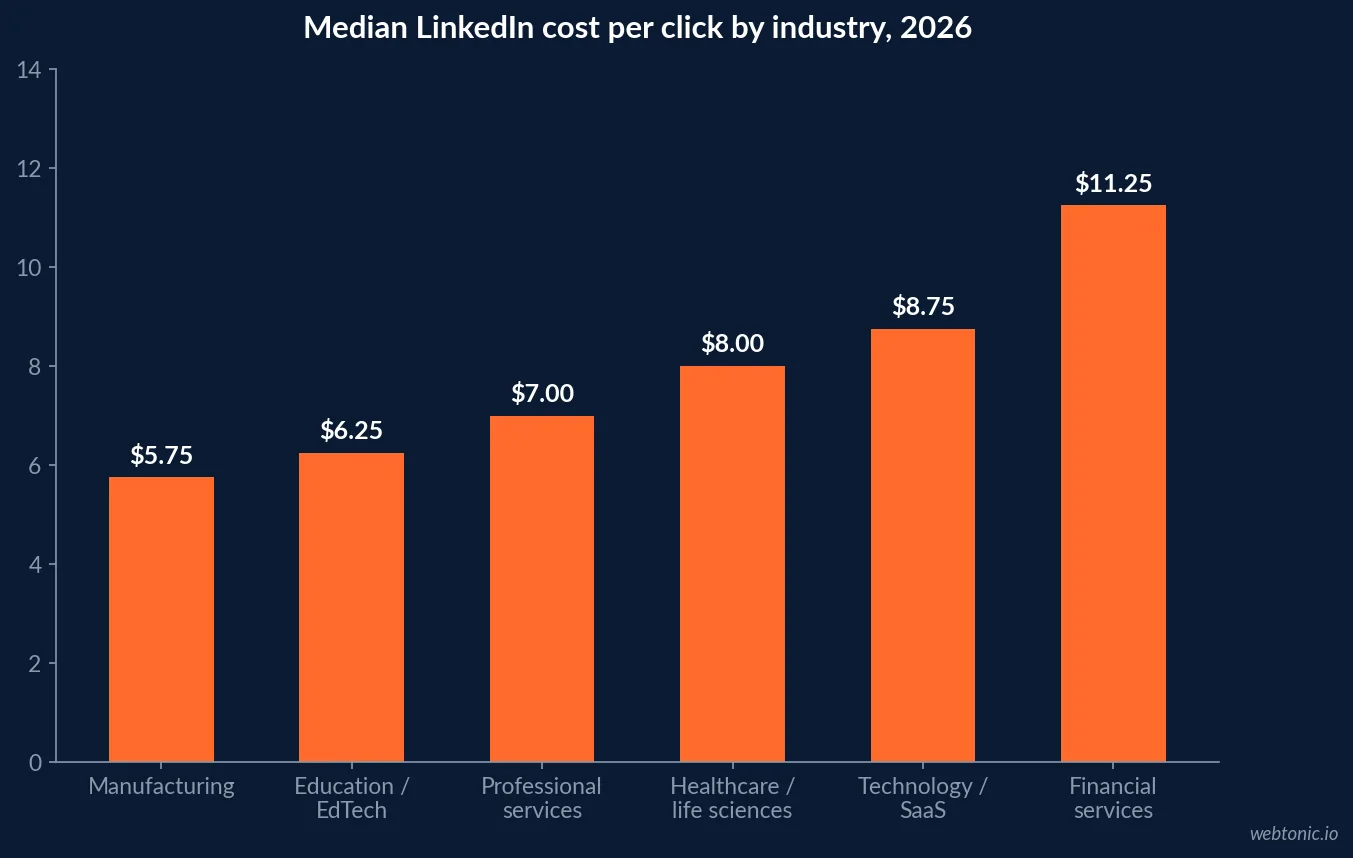
LinkedIn’s healthcare pricing sits mid-table — cheaper than cybersecurity or financial services, dearer than manufacturing and education. What makes aesthetics different is not the cost, it is that the deal on the other end of the click is usually a $500 first visit rather than a $50,000 contract.
| Industry | Median CPC | Median CPL | Typical deal on the other end |
|---|---|---|---|
| Healthcare / life sciences | $8.00 | $80 | $25K–$200K (B2B) — or a $527 visit (patient) |
| Technology / SaaS | $8.75 | $70 | $30K–$100K ACV |
| Financial services | $11.25 | $100 | $50K–$250K |
| Professional services | $7.00 | $60 | $20K–$100K |
| Manufacturing / industrial | $5.75 | $50 | $50K–$500K |
| Education / EdTech | $6.25 | $70–$90 | $15K–$80K |
Read the last column and the strategy writes itself: LinkedIn is priced for businesses selling five-figure contracts. A med spa qualifies only when it is selling something other than a treatment — a job, a partnership, a franchise or equity. LinkedIn’s own reporting — $19.8B full-year revenue, up 12% — and independent audience estimates of 1.3B members and roughly 310M monthly actives confirm the reach is real. The question is only whether the audience is yours.
Frequently Asked Questions
Should a med spa run LinkedIn Ads to get patients?
Almost never as a primary channel. Healthcare/life-sciences CPCs run $6.00–$10.50 with a median of $8.00 and healthcare CPL sits at a median $80, while Meta delivers med spa patient leads at $80–$250 and organic search delivers new patients at $20–$80. LinkedIn also restricts health-related targeting and, since 2025, blocks its Insight Tag on healthcare-related domains, so conversion tracking degrades exactly where you need it. Use LinkedIn for hiring, B2B and investor audiences, not for booking injectable consults.
What are LinkedIn Ads costs in 2026?
Platform-wide, CPC runs $5.26–$8.50 with a range from $2.29 for Thought Leader and Text Ads to $24+ for C-suite targeting, average CPM is about $39.20, CTR sits at 0.44–0.65%, and median CPL is around $110. In healthcare specifically, CPC medians reach $8.00 and CPMs for tightly targeted B2B segments run $33–$65. Lead Gen Forms convert at 10–18% (median 13%) against 2–6% for external landing pages.
What is the strongest LinkedIn format for an aesthetics business?
Thought Leader Ads by a wide margin: 2.68% CTR at a $2.29 CPC, roughly 6.4x the click-through and 77% cheaper per click than single-image ads, with 6.63 seconds of dwell time versus 3.66. For a med spa, that means promoting a medical director's or lead injector's own post — the format that carries clinical credibility — rather than a clinic-branded creative. Document Ads (0.62% median CTR) work for recruiting decks and franchise information packs.
Why does LinkedIn work for med spa recruiting?
Because the talent shortage is the sector's binding constraint and LinkedIn is where licensed providers keep their professional identity. 58% of med spa owners report difficulty hiring qualified aesthetic providers, roughly 40% report shortages they cannot fill from current pipelines, average staff turnover was about 24%, and replacing a provider costs 50–200% of annual salary. Against a $2,339 median patient lifetime value, one retained injector is worth more than a quarter of paid-social budget.
Can LinkedIn conversions be tracked compliantly for a medical practice?
Partially. LinkedIn's 2026 health advertising policy restricts ads that imply or rely on sensitive health information and limits targeting that could infer health status, and the Insight Tag is blocked on domains classified as transmitting sensitive data. The workable pattern is to keep LinkedIn campaigns pointed at non-clinical destinations — careers pages, supplier or investor content, gated reports — use in-platform Lead Gen Forms for capture, and reconcile outcomes in a CRM rather than in the ad platform.
Sources
MetadataONE — LinkedIn Ads Benchmarks 2026 (CTR, CPC, CPL by industry)
Foundry CRO — LinkedIn Ads Benchmarks by Industry 2026
Curve — LinkedIn Tightened Health Ads (2026 policy update)
Accelerated Digital Media — 2026 Health Advertising Policies on Social Media
LinkedIn — Q4 Earnings & Business Highlights
Martal — LinkedIn Statistics 2026: Key B2B Benchmarks
ScaleHaven — 47 Med Spa Industry Statistics for 2026
Aesthetic Hires — Med Spa Industry Statistics 2026
Spakinect — 2026 Med Spa Industry Growth Rate
FocusRunner — Med Spa Patient Acquisition Costs 2026
Improvado — Lead-to-Procedure Attribution for Medical Devices 2026