Table of contents
No published study prices "med spa marketing automation" as a single line item, so this budgets it from three real 2026 data points: what practices actually spend on marketing overall, what the leading automation and texting vendors charge on their own pricing pages, and what speed-to-lead data says the tooling has to achieve to be worth the invoice.
Key Takeaways
- 52% of med spa practices spend under $2,500 a month on marketing overall.
- The recommended marketing budget is 5% of revenue, about $5,800 a month for the average practice.
- Only 25% of practices meet or exceed $5,000 a month in marketing spend.
- Average cost per lead runs $39 and new-patient acquisition cost $132.
- Average visit value is $527, well above both acquisition figures.
- 47% of practices have adopted AI for content, communication or targeting.
- 53% have not adopted AI at all, a widening capability gap.
- Weave's texting and communication plans start at $199 a month, per its own pricing page.
- HubSpot's Starter tier runs $9 a seat a month billed annually.
- HubSpot Professional runs $800 a month annual, plus a $3,000 onboarding fee.
- HubSpot Enterprise runs $3,600 a month, plus a $7,000 onboarding fee.
- Practices responding to leads in under 13 minutes formed the fastest-growing group.
- A 15-minute response plus 30%+ online booking put a practice in the top half of growth.
- 87% of practices made significant marketing changes in 2026, up from 54% in 2025.
- 70% of practices cite Instagram as their most effective platform.
- Only 7% effectively leverage TikTok despite the Instagram concentration.
- 73% of revenue at a typical practice already comes from repeat patients.
- The industry is worth over $17 billion, growing more than $1 billion a year.
Start from the marketing budget, not the software quote
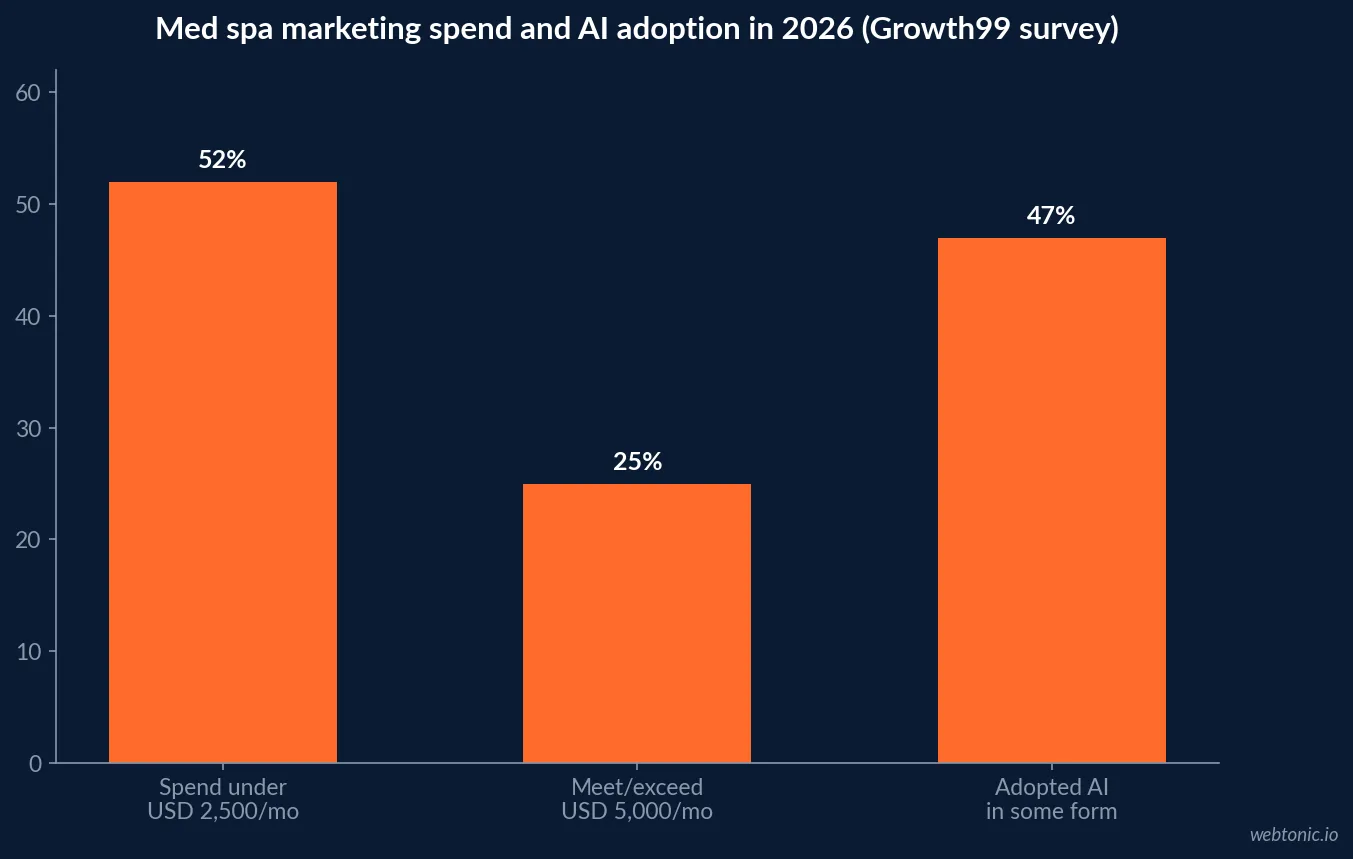
Growth99's 2026 State of Aesthetic & Elective Wellness Marketing Report, published via the American Med Spa Association, found 52% of med spa practices investing less than $2,500 a month in marketing overall, against a recommended 5% of revenue — roughly $5,800 a month for the average practice generating $1.39M annually. Only 25% of practices meet or exceed a $5,000 monthly threshold. Automation tooling is a slice of that number, not an addition to it.
| Marketing spend benchmark (2026) | Figure | Source |
|---|---|---|
| Practices spending under $2,500/mo on marketing | 52% | Growth99 2026 (via AmSpa) |
| Recommended marketing spend | 5% of revenue (~$5,800/mo avg.) | Growth99 2026 (via AmSpa) |
| Practices meeting/exceeding $5,000/mo | 25% | Growth99 2026 (via AmSpa) |
| Average cost per lead | $39 | Growth99 2026 (via AmSpa) |
| New-patient acquisition cost | $132 | Growth99 2026 (via AmSpa) |
| Average visit value | $527 | Growth99 2026 (via AmSpa) |
What patient communication and texting platforms actually cost
Weave's own pricing page lists plans starting from $199 a month, scaling through Pro, Elite and Ultimate tiers that add recall campaigns, online scheduling, digital forms, bulk texting allotments and AI-assisted call intelligence; enterprise pricing is quote-based. This is the category most medspas actually shop first, since missed-call texting, two-way messaging and appointment reminders are the automation that touches every patient, not just the acquisition funnel.
| Weave plan (own pricing page) | Starting price | What it adds |
|---|---|---|
| Pro | From $199/mo | VOIP phones, two-way texting, appointment reminders, online scheduling |
| Elite | Custom quote | Adds recall, reviews, text-to-pay, payments |
| Ultimate | Custom quote | Up to 15 phones, 1:1 training, premium analytics |
| Enterprise | Custom quote | Full suite across multiple locations |
What a full marketing automation platform costs
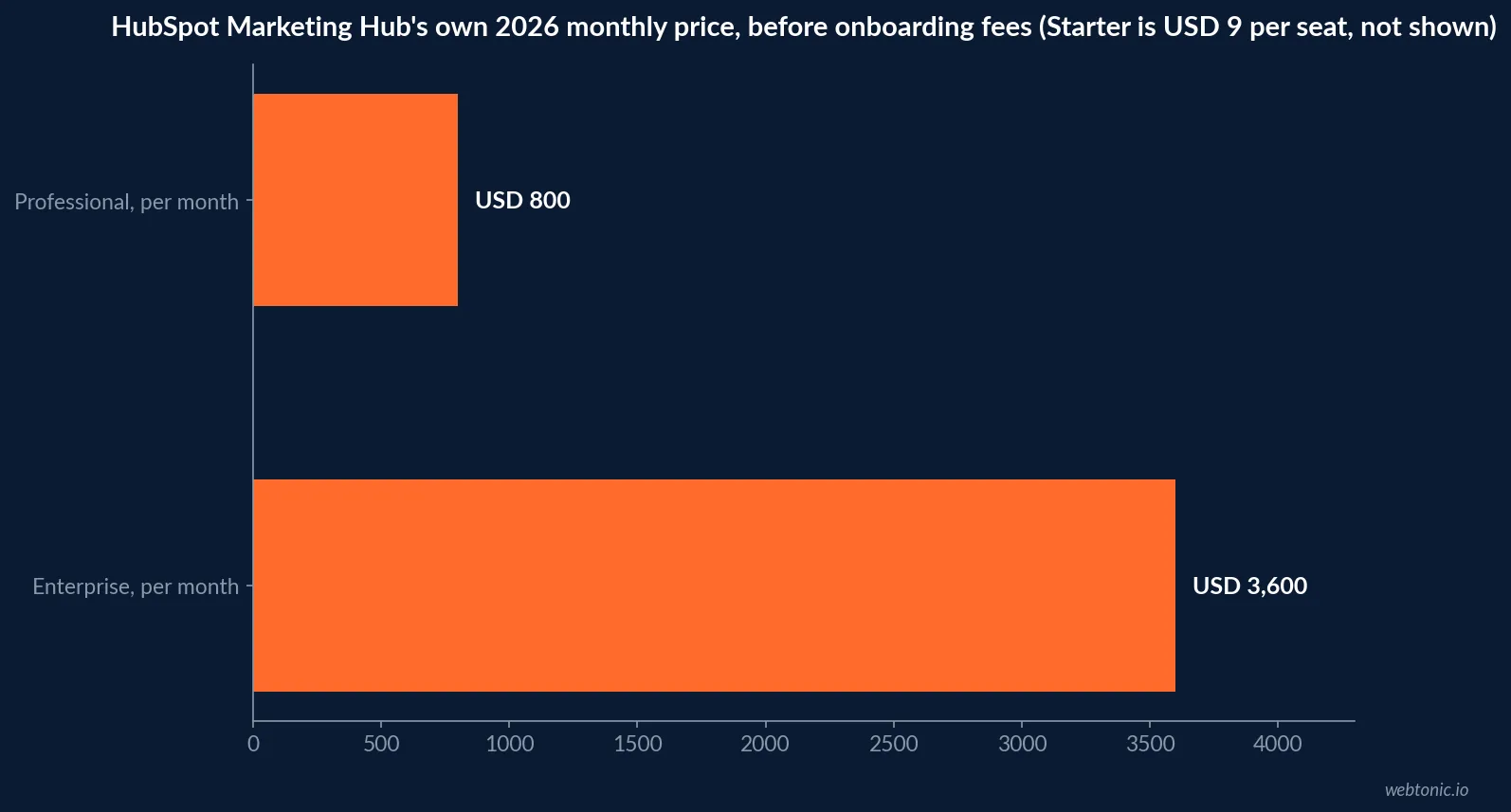
For practices running broader campaigns — email nurture, landing pages, lead scoring — HubSpot's own Marketing Hub pricing guide lists a free tier (up to 2 users, 2,000 marketing emails a month), Starter at $9 a seat monthly on annual billing ($10 monthly), Professional at $800 a month annual ($890 monthly) with 3 core seats and a $3,000 one-time onboarding fee, and Enterprise at $3,600 a month with 5 core seats and a $7,000 onboarding fee. Additional seats run $45 to $75 a month by tier.
| HubSpot Marketing Hub tier (own pricing page) | Monthly price | One-time onboarding |
|---|---|---|
| Free | $0 | None |
| Starter | $9/seat (annual) / $10/seat (monthly) | None |
| Professional | $800 (annual) / $890 (monthly) | $3,000 |
| Enterprise | $3,600 | $7,000 |
Why speed-to-lead outranks which platform you buy
CorralData's 2026 operational analysis of over 100 aesthetics and medspa brands found a small leading group of practices answering new leads in under 13 minutes, while the rest took anywhere from four hours to 24 days. Every practice that responded within 15 minutes and booked over 30% of appointments online landed in the top half of the growth rankings, regardless of location count, service mix, or which automation platform they used. The oldest dated study on this pattern, Harvard Business Review's "The Short Life of Online Sales Leads" (2011), found only 37% of companies across industries responding within an hour and 23% never responding at all — a cross-industry benchmark, not a medspa-specific one, but a reminder that the failure mode is old and industry-agnostic.
| Lead response window | Growth outcome | Source |
|---|---|---|
| Under 13 minutes | Fastest-growing practices in the cohort | CorralData, 2026 |
| Under 15 minutes + 30%+ online booking | Top half of growth rankings, any size | CorralData, 2026 |
| 4 hours to 24 days | The remainder of the cohort | CorralData, 2026 |
| Within 1 hour (cross-industry, 2011) | 37% of companies achieved this | Harvard Business Review |
| Never responded (cross-industry, 2011) | 23% of companies | Harvard Business Review |
Where AI adoption sits inside that budget
Growth99's 2026 survey found 47% of practices have adopted AI for content creation, patient communication, analytics or targeting, while 53% have not adopted it at all — a widening capability gap rather than a settled market. The same survey found 87% of practices making significant marketing changes in 2026 versus just 54% in 2025, and channel concentration is heavy: 70% cite Instagram as their most effective platform, while only 7% effectively leverage TikTok. None of that changes the tooling cost above; it changes how much of the automation budget should go to content generation versus messaging infrastructure.
| Adoption signal (2026, Growth99 via AmSpa) | Figure |
|---|---|
| Practices that have adopted AI in some form | 47% |
| Practices with no AI adoption | 53% |
| Practices making significant marketing changes in 2026 | 87% |
| Same figure for 2025 | 54% |
| Practices citing Instagram as most effective platform | 70% |
| Practices effectively leveraging TikTok | 7% |
The compliance line item that has no vendor invoice
SMS automation for U.S. patients runs under the FCC's Telephone Consumer Protection Act consent rules and CTIA's A2P 10DLC messaging principles for registered business texting, both of which gate deliverability before a single automated reminder goes out. Reminders that reference treatment specifics also sit inside HIPAA's privacy rule at 45 CFR Part 164, Subpart E (eCFR), which limits message content to the minimum necessary and preserves a patient's right to request an alternative communication channel. Budget the registration and review time for these, not just the software seat.
Building the automation line item
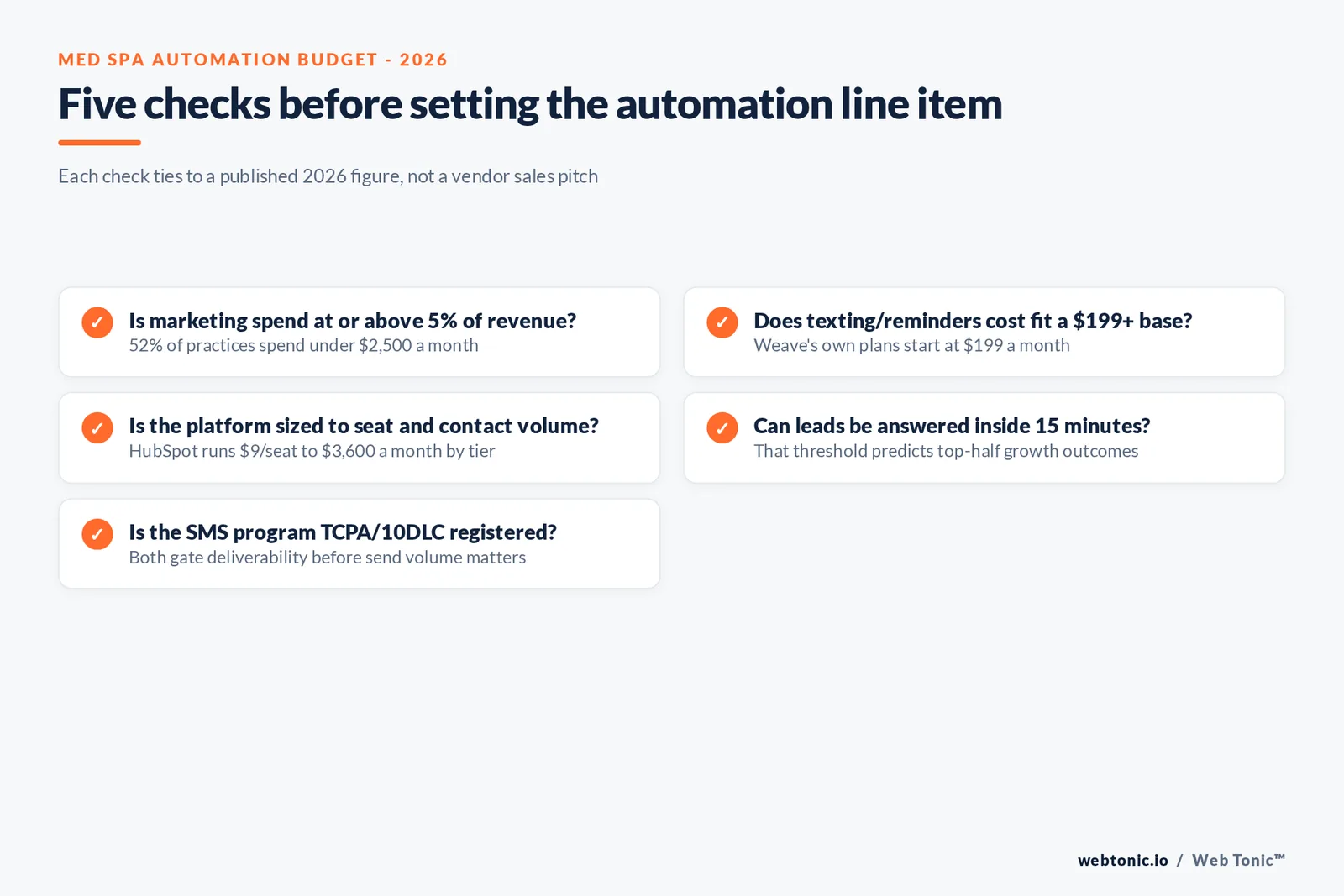
Put the numbers together and a defensible 2026 med spa automation budget looks like a texting and reminder base (from $199 a month on Weave's own pricing), a marketing automation platform sized to contact volume (HubSpot's own tiers run $9 a seat to $3,600 a month before onboarding), and a response-time commitment inside 15 minutes, since that threshold correlates with landing in the top half of growth outcomes regardless of platform spend. Our growth marketing team sizes exactly this stack against a practice's lead volume, and our marketing automation statistics hub tracks the same tooling questions across other industries. For the acquisition side of the funnel, see our guide to what paid search costs before adding automation on top of it.
What a budget review actually catches
Growth99's 2026 survey also found 87% of practices making significant marketing changes during the year, up from 54% in 2025, which suggests most of the industry is already mid-overhaul rather than static. That matters for automation budgeting specifically: a platform bought against last year's contact volume or lead flow is likely already undersized. A quarterly review against the figures in this article — spend as a share of revenue, cost per lead, response-time compliance and tool tier — catches that drift before the next invoice.
| Budget review checkpoint | Benchmark to check against | Frequency |
|---|---|---|
| Marketing spend as % of revenue | 5% of revenue (Growth99 2026) | Quarterly |
| Cost per lead trend | $39 average (Growth99 2026) | Monthly |
| Lead response time | Under 15 minutes (CorralData 2026) | Weekly spot-check |
| Automation platform tier vs. contact volume | HubSpot's own tier thresholds | At each renewal |
| SMS/TCPA registration status | Active A2P 10DLC campaign registration | Annually or on carrier change |
Where speed-to-lead intersects with the compliance line item
A fast automated response and a compliant one are not automatically the same thing. An auto-reply text sent before consent is registered under A2P 10DLC risks carrier filtering, which defeats the entire purpose of a 15-minute response commitment. Budgeting the registration and review time for TCPA and 10DLC compliance alongside the platform seat cost is what keeps the speed advantage from being undone by a blocked message.
What to skip until the budget is bigger
Not every automation feature earns its line item at every budget level. A practice still under the $2,500-a-month median does not need Enterprise-tier custom objects or multi-touch attribution; it needs the texting base and a Starter-to-Professional marketing platform that captures leads and sends the follow-up sequence. Save the higher HubSpot tiers and their onboarding fees for the point where contact volume, not feature envy, actually requires them — matching spend to the 25% of practices already meeting the $5,000 threshold is a more useful benchmark than matching feature lists.
Frequently Asked Questions
How much should a med spa spend on marketing automation?
There is no automation-specific benchmark, so build the number from two published 2026 data points. Growth99's State of Aesthetic & Elective Wellness Marketing Report puts the recommended marketing budget at 5% of revenue, or roughly $5,800 a month for the average $1.39M practice, and finds 52% of practices spending under $2,500 a month against that target. Automation tooling is a line inside that budget, not a separate pool, and the vendor pricing below shows what a realistic slice of it costs.
What does patient communication and texting software cost?
Weave's own pricing page lists plans starting from $199 a month, with tiered bundles (Pro, Elite, Ultimate) adding features like recall, online scheduling, digital forms and AI call intelligence at higher price points; enterprise pricing is quote-based. That base covers two-way texting, missed-call texting and appointment reminders, the core of a recall-driven aesthetics practice.
What does a marketing automation platform like HubSpot cost?
HubSpot's own pricing runs from free (up to 2 users, 2,000 marketing emails a month) to Starter at $9 a seat monthly (annual billing), Professional at $800 a month annual ($890 monthly) plus a $3,000 onboarding fee with 3 core seats included, and Enterprise at $3,600 a month plus a $7,000 onboarding fee with 5 core seats. Additional seats run $45 to $75 a month depending on tier.
Does speed of lead response matter more than the platform chosen?
The 2026 evidence says yes. CorralData's operational analysis of 100+ aesthetics and medspa brands found practices answering new leads in under 13 minutes forming the leading group, while the rest took four hours to 24 days; every practice responding within 15 minutes and booking over 30% of appointments online landed in the top half of growth rankings regardless of platform or budget. A cheap tool used within that window beats an expensive one used slowly.
What compliance rules apply to automated texting and reminders?
SMS automation for U.S. patients falls under the FCC's Telephone Consumer Protection Act (TCPA) consent rules and CTIA's A2P 10DLC registration and messaging principles for business texting. Automated appointment reminders that reference treatment or PHI also sit inside HIPAA's privacy rule at 45 CFR Part 164 (eCFR), which limits content to the minimum necessary and requires a patient's right to request an alternative communication channel.
Sources
American Med Spa Association / Growth99 - 2026 State of Aesthetic & Elective Wellness Marketing Report
Weave - Official pricing page
HubSpot - Marketing Hub pricing guide
American Med Spa Association / CorralData - Research from 100+ medspa brands, 2026
Harvard Business Review - The Short Life of Online Sales Leads, 2011
CTIA - Messaging Principles and Best Practices
eCFR - 45 CFR Part 164, Subpart E (HIPAA Privacy Rule)