Table of contents
A med spa can list the skincare it sells in Google Shopping, but not the treatments it performs. This page splits a typical menu line by line between a standard Shopping feed and dynamic remarketing, using Google's own policy pages and 2024 to 2026 industry data.
Key Takeaways
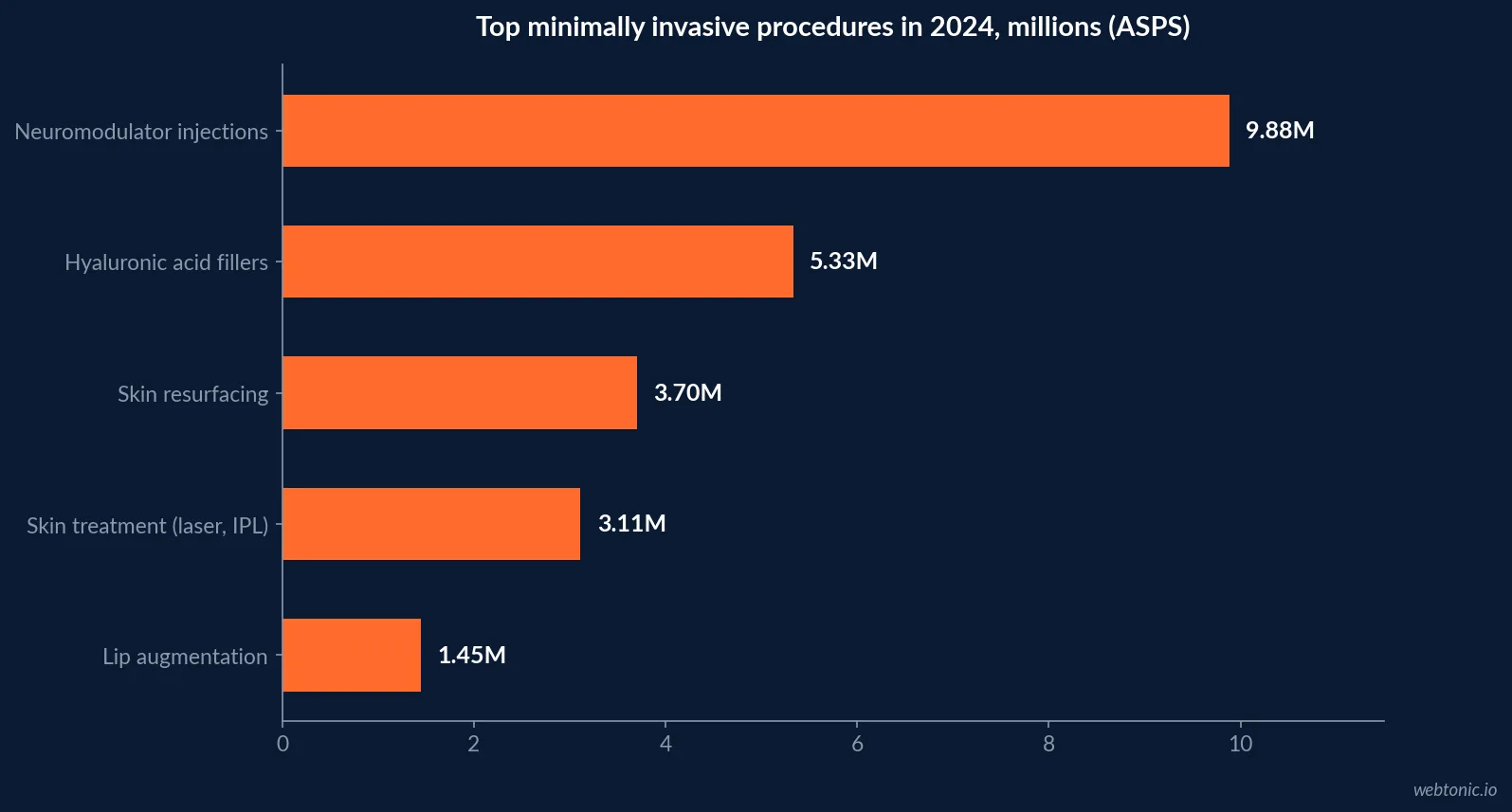
- ASPS counts over 28.5 million minimally invasive procedures in 2024; all are services.
- Neuromodulator injections led with 9,883,711 procedures.
- Hyaluronic acid fillers followed at 5,331,426.
- AmSpa describes an industry above USD 17 billion, growing USD 1 billion+ a year.
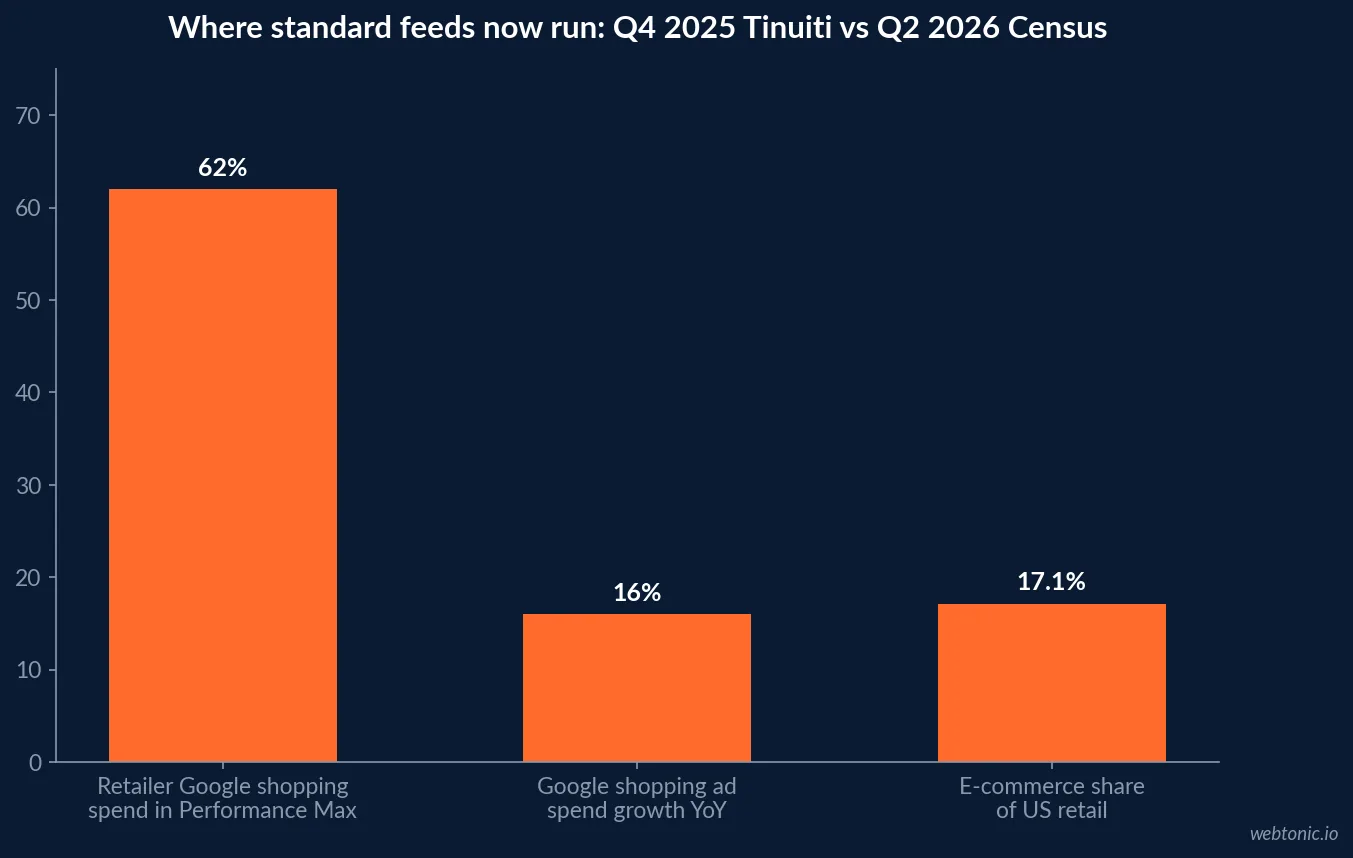
- Performance Max took 62% of retailer Google shopping spend in Q4 2025 (Tinuiti).
- Google shopping ad spending grew 16% year over year in that quarter.
- E-commerce was 17.1% of US retail sales in Q2 2026 (Census).
- MoCRA requires serious cosmetic adverse events to be reported within 15 business days.
- Google warns at least 7 days before an unsupported-content suspension.
- Local inventory ads run in 47 countries listed by Google.
The dividing line: treatment versus product
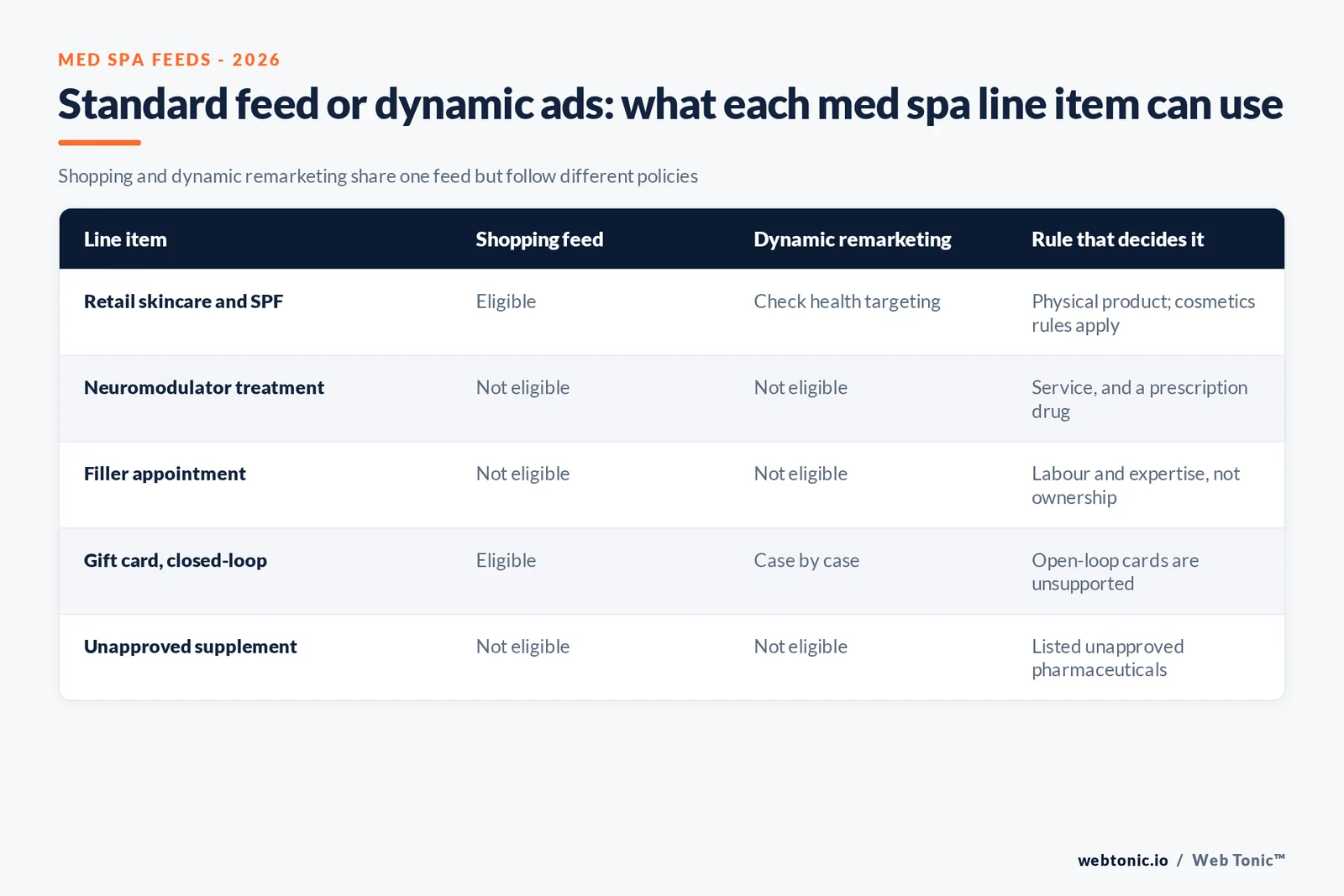
Google's Unsupported Shopping content policy excludes "labor, time, effort, expertise, or actions, which do not result in ownership of a tangible product," including "any services sold bundled with physical goods." A filler appointment, a laser package or a facial is a service under that wording. A tube of retinol cream the client takes home is a product.
That single sentence decides most of a med spa's feed. Everything on the treatment menu stays out; the retail shelf is where Shopping, free listings and dynamic ads become possible.
| Med spa line item | Standard Shopping feed | Dynamic remarketing | Deciding rule |
|---|---|---|---|
| Retail cleanser, serum, SPF | Eligible if claims comply | Possible, review health targeting | Tangible product |
| Neuromodulator treatment | Not eligible | Not eligible | Service and prescription drug |
| Hyaluronic acid filler session | Not eligible | Not eligible | Service |
| Laser package | Not eligible | Not eligible | Service, even if sold as a bundle |
| Closed-loop gift card | Allowed by policy | Case by case | Expiring card redeemable only at the business |
| Open-loop prepaid card | Not allowed | Not allowed | Card-network branded gift cards excluded |
How big the treatment side is, and why it stays off Shopping
The American Society of Plastic Surgeons 2024 report counts over 28.5 million minimally invasive procedures, led by neuromodulator injections at 9,883,711, hyaluronic acid fillers at 5,331,426, skin resurfacing at 3,703,305, skin treatments such as laser hair removal and IPL at 3,112,056 and lip augmentation at 1,449,565.
The American Med Spa Association describes a medical aesthetics industry that "has eclipsed USD 17 billion and is growing by more than USD 1 billion per year." Almost all of that value is procedure revenue, which no feed can carry.
Prescription products: a second, separate wall
Neuromodulators are prescription drugs. Google's healthcare and medicines policy says some prescription drugs are allowed in the United States only for online pharmacies accredited by the LegitScript Healthcare Merchant Certification and Monitoring Program, the NABP VIPPS programme or the Pharmacy Verified Websites Program, and then certified with Google. A clinic selling appointments is not an online pharmacy.
Google also maintains a list of unapproved pharmaceuticals and supplements that are not allowed in Shopping ads or free listings. Med spas that retail wellness supplements should check each SKU against it before it enters a feed.
| Product class | Google rule | Requirement named by Google | Practical outcome for a med spa |
|---|---|---|---|
| Prescription drugs | Healthcare and medicines policy | LegitScript, VIPPS or Pharmacy Verified Websites, plus Google certification | Not a route for a clinic |
| Unapproved supplements | Listed as not allowed | Named products on Google's list | Screen retail supplements SKU by SKU |
| Cosmetics and skincare | Allowed as products | Claims must meet Shopping policies | Core of the retail feed |
| Services bundled with goods | Unsupported content | No bundled services | Keep kits separate from treatments |
Standard Shopping feed: what it does for a skincare shelf
A standard feed sends product data to Merchant Center so products can appear when someone searches. The retail channel it plugs into is large and growing: the US Census Bureau estimates Q2 2026 e-commerce at USD 340.2 billion, 17.1% of total retail sales, up 12.2% year over year.
Tinuiti's Q4 2025 benchmark, based on its retail client base, reports Google shopping ad spending up 16%, shopping CPC down 1%, and Performance Max carrying 62% of retailer spending on Google shopping listings. For a small skincare shelf that means the feed will most often be consumed by Performance Max, not a stand-alone Shopping campaign.
Dynamic ads: the same feed, different rules
Google's dynamic remarketing for retail page explains that dynamic ads show "specific product information that is tailored to your customer's previous site activity," once the Dynamic Remarketing add-on is enabled in Merchant Center and the accounts are linked. The key line for a med spa follows: "although the source of product data is the same, dynamic ads and Shopping ads are subject to different policies. Therefore, a product could be promoted in Shopping ads, but not with dynamic remarketing, or vice versa."
Google's personalised advertising policy lists Health among its sensitive interest categories. Remarketing is personalised advertising, so a skincare remarketing list built from treatment-page visitors needs a policy check before launch, not after a disapproval.
| Dimension | Standard Shopping feed | Dynamic remarketing | Source |
|---|---|---|---|
| Who sees the product | People searching | Past site visitors | Google Ads Help |
| Data source | Merchant Center product data | Same Merchant Center product data | Google Ads Help |
| Policy set | Shopping ads policies | Google Ads and personalised ads policies | Google Ads Help |
| Setup step | Feed plus campaign | Dynamic Remarketing add-on plus site tag | Google Ads Help |
| Health sensitivity | Healthcare and medicines policy | Health listed as sensitive interest | Google policy pages |
Cosmetic regulation behind every skincare listing
The FDA's MoCRA page sets out new requirements for the "responsible person" whose name appears on a cosmetic label, including reporting serious adverse events to FDA within 15 business days. A med spa selling a private-label serum may be that responsible person.
Claims carry their own risk. The FTC's Health Products Compliance Guidance says claims about the health benefits or safety of health-related products require "competent and reliable scientific evidence." Product titles and descriptions in a feed are advertising claims, and "clinically proven" in a title needs the evidence behind it. Endorsements used in ad assets fall under the FTC's 16 CFR Part 255, including the disclosure of material connections in section 255.5.
| Rule | Issuer | Figure or requirement | Where it bites in a feed |
|---|---|---|---|
| MoCRA adverse event reporting | FDA | Within 15 business days | Private-label skincare |
| Health claim substantiation | FTC | Competent and reliable scientific evidence | Titles and descriptions |
| Endorsement disclosure | FTC, 16 CFR 255.5 | Disclose material connections | Review and creator assets |
| Unsupported content warning | At least 7 days before suspension | Treatment SKUs slipped into a feed |
Local inventory: selling the shelf to people nearby
Google's local inventory ads policy covers retailers with physical stores in 47 countries, requires "a local brick and mortar business location where customers can physically visit, view, and purchase the desired item," and waives the online checkout and shipping requirements because purchase happens in store. It also rules out membership exclusivity: if only members can buy, the store is ineligible, although tiered pricing is fine when the non-member price is submitted.
For a med spa with a retail counter that matters twice. Walk-in product sales can be shown locally, and membership-only skincare pricing must be restructured before those products can be listed.
Five Google surfaces one skincare feed can reach
One set of Merchant Center product data can serve several surfaces, each with its own gate. Standard Shopping ads and free listings need the product to pass Shopping policies. Local inventory ads add the store and membership requirements. Dynamic remarketing adds personalised advertising rules. Performance Max, which Google describes as reaching "all Google Ads inventory, including YouTube, Display, Search, Discover, Gmail, and Maps," in its campaign overview, uses the same feed as one input among its assets.
The practical consequence for a med spa is that feed quality is decided once and inherited everywhere. A treatment accidentally tagged as a product is not a single disapproval; it is a policy problem on every surface the feed touches, which is why the service-versus-product audit comes before any campaign choice. Tinuiti's 62% Performance Max share of retail shopping spend shows how often that feed now ends up inside an automated campaign rather than a hand-built one.
| Surface | Extra gate beyond Shopping policies | Med spa use | Google source |
|---|---|---|---|
| Shopping ads | None beyond product policies | Retail skincare searches | Merchant Center Help |
| Free listings | Some ad-only rules do not apply | Unpaid product visibility | Merchant Center Help |
| Local inventory ads | Physical store, no member-only buying | Walk-in retail counter | Local inventory ads policy |
| Dynamic remarketing | Personalised advertising policy | Re-engaging product viewers | Google Ads Help |
| Performance Max | Campaign-level goals and assets | Feed plus creative across inventory | Google Ads Help |
Where the treatments go instead
Treatments reach Google through Search, Performance Max without a product feed, and Local Services where a category fits: Google's Local Services category list includes Facial Spa and Dermatologist. Budget planning for those formats sits in our guide to Google Ads costs, and our med spa CTV report covers the awareness side.
A working split for a med spa's Google account
- Audit the menu: tag every item as service or product before any feed is built.
- Feed only the shelf: submit retail skincare, tools and closed-loop gift cards.
- Screen claims: remove unsubstantiated clinical language from titles and descriptions.
- Check supplements: compare each SKU with Google's unapproved list.
- Separate audiences: keep treatment-page visitors out of product remarketing unless the personalised ads policy has been reviewed.
- Price for everyone: submit non-member prices if the counter uses membership tiers.
Our performance creative team builds compliant product imagery and ad assets for that retail side; the Google Ads team handles the campaign structure.
Frequently Asked Questions
Can a med spa advertise Botox or filler treatments in Google Shopping?
No. Treatments are labour and expertise, which Google's Unsupported Shopping content policy excludes, and neuromodulators are prescription drugs, which Google's healthcare and medicines policy only allows for online pharmacies accredited by LegitScript, NABP's VIPPS programme or the Pharmacy Verified Websites Program and then certified by Google. A med spa booking page qualifies for neither.
What can a med spa put in a Google Shopping feed?
Physical retail products it sells and ships or stocks in a store: cleansers, serums, sunscreen, tools and similar cosmetics, provided the claims and ingredients meet the Shopping healthcare rules. Closed-loop gift cards with an expiration date that can only be redeemed at the business are also listed as allowed.
What is the difference between a standard feed and dynamic ads?
Both use the same Merchant Center product data. Shopping ads show products to people searching; dynamic remarketing shows products to past site visitors based on what they viewed. Google says the two are subject to different policies, so a product can be allowed in one and not in the other.
Does the health category limit remarketing for med spas?
It can. Google's personalised advertising policy lists Health among its sensitive interest categories, which restricts how audiences built on health interests may be targeted. Retail skincare remarketing should be set up and reviewed with that policy in mind rather than assumed to be allowed.
Is there a med spa Shopping ROAS or CTR benchmark?
No named study publishes one, and this page does not estimate one. The Shopping benchmarks that exist, such as Tinuiti's quarterly report, measure retail advertisers overall; AmSpa and ASPS measure treatments, not feeds.
Sources
Google Merchant Center Help - Unsupported Shopping content
Google Merchant Center Help - Healthcare and medicines
Google Merchant Center Help - Unapproved pharmaceuticals and supplements
Google Ads Help - About dynamic remarketing for retail
Google Ads Policy - Personalized advertising
Google Merchant Center Help - Local inventory ads policies
ASPS - 2024 Procedural Statistics release
American Med Spa Association - Medical Spa State of the Industry
Tinuiti - Digital Ads Benchmark Report Q4 2025
US Census Bureau - Quarterly Retail E-Commerce Sales, Q2 2026
FDA - Modernization of Cosmetics Regulation Act of 2022
FTC - Health Products Compliance Guidance
Google Ads Help - About Performance Max campaigns
eCFR - 16 CFR Part 255