Table of contents

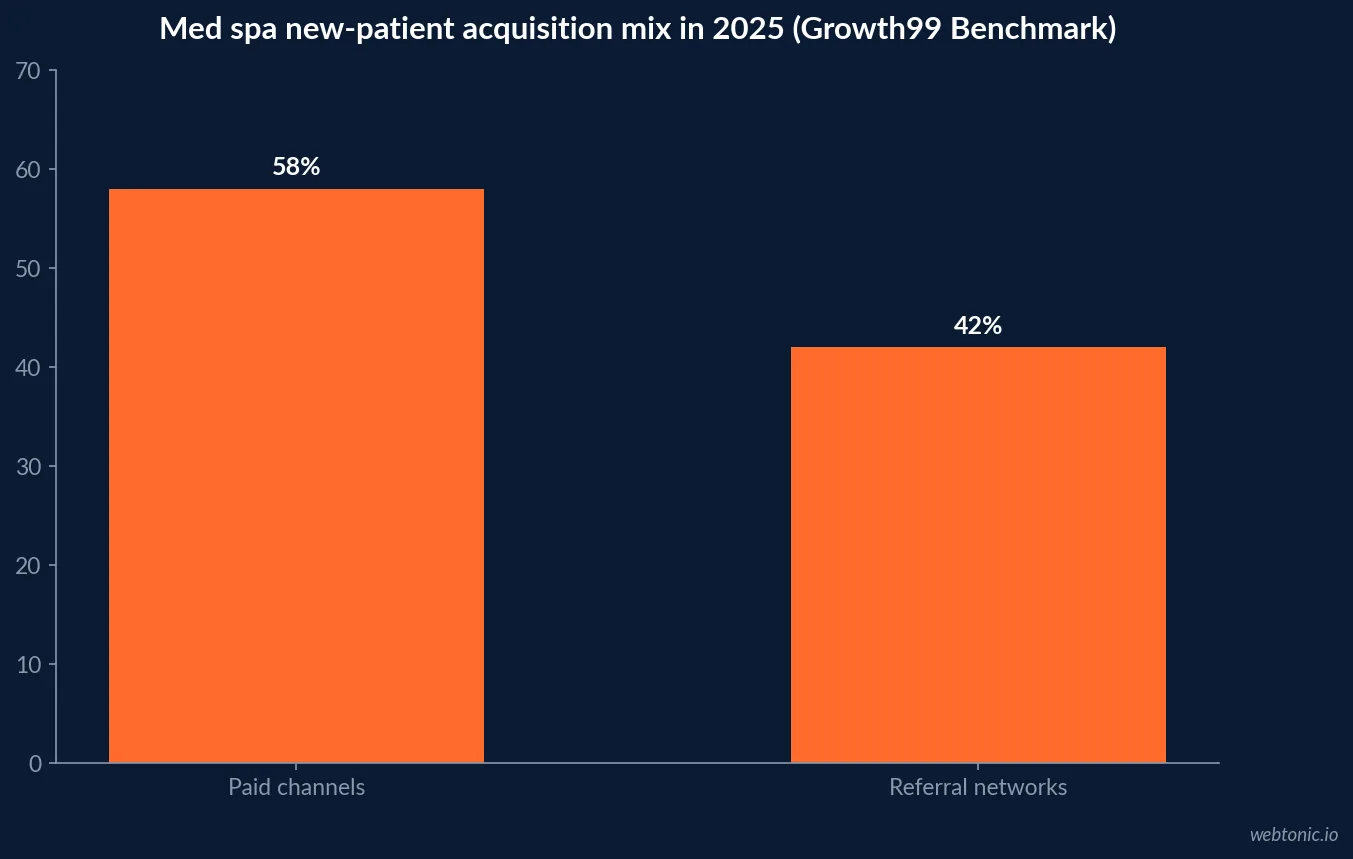
Forty-two percent of new medical spa patients still arrive through referral networks, not paid advertising, according to Growth99's 2025 category benchmark - yet no published study prices what a med spa affiliate or referral partnership is actually worth, because the channel sits on top of anti-kickback rules that cap what a practice can legally pay for one. This page prices the program from the numbers that do exist: skincare-brand affiliate commissions, referral-versus-paid patient mix, and the compliance ceiling that separates a discount code from a kickback.
Key Takeaways
- 42% of new med spa patients come from referral networks, not paid media.
- 58% still come from paid channels, about 460 patients a year per practice.
- Referral delivers roughly 333 new patients a year per practice on average.
- Practices average 2,940 patient visits a year, the volume the program has to serve.
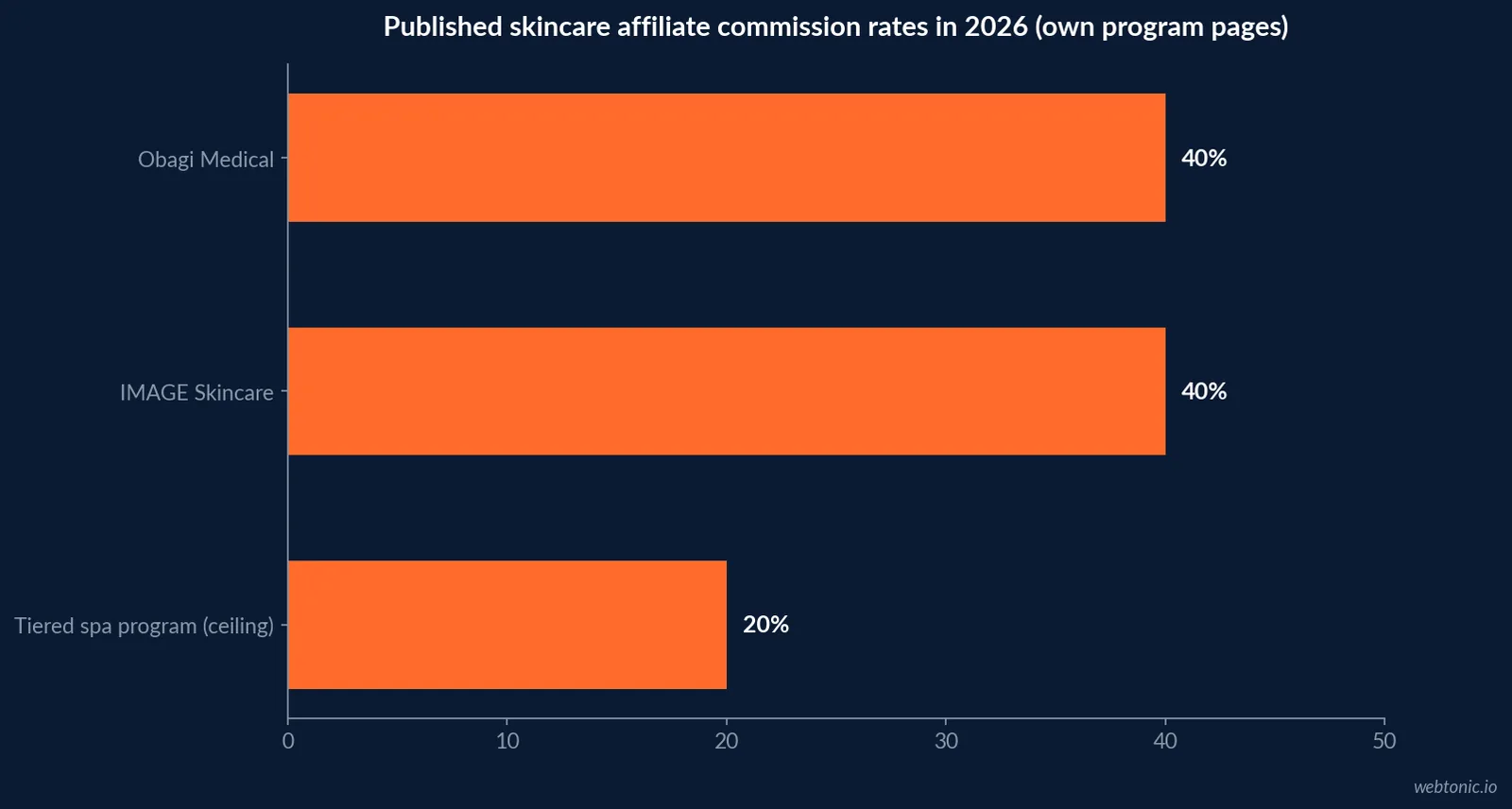
- Obagi Medical pays a 40.00% base affiliate commission on a 30-day cookie.
- IMAGE Skincare pays the same 40% commission, 30% for student affiliates.
- One tiered spa-affiliate program starts at 10% and steps to 20% after USD 5,000.
- The medical aesthetics industry has passed USD 17 billion in annual revenue.
- It is still growing by more than USD 1 billion a year, per AmSpa.
- Average med spa revenue reached USD 1,398,833 in AmSpa's 2023 survey year.
- Average patient spend is USD 245 per visit, per AmSpa's executive summary.
- 73% of patients are repeat patients, the base a referral program compounds against.
- Average cost per digital lead runs USD 39, against a USD 132 acquisition benchmark.
- That implies a 38% margin once a lead converts, per Growth99's benchmark data.
- 77% of practices call differentiation moderately to extremely challenging.
- 51% of advertisers manage affiliate programs in-house, 26% through an agency, 19% through a network (IAB Australia, cross-vertical benchmark).
- The FTC's 16 CFR Part 255 disclosure rule applies to every paid influencer post regardless of reimbursement status.
- The federal Anti-Kickback Statute prohibits paying for referrals of federally reimbursable services - the ceiling every med spa promo code has to stay under.
Why this channel has no published price list
Affiliate and referral marketing for medical aesthetics sits in an unusual gap. Consumer affiliate networks track commissions for skincare products, and hospital systems are tracked for Anti-Kickback Statute exposure, but the overlap - a med spa paying a patient, influencer or referral partner for a cosmetic booking - is not surveyed as its own category by either side. The American Med Spa Association (AmSpa) tracks the business economics; the FTC's Endorsement Guides and AmSpa's own ethics guidance track the legal ceiling. This page puts both halves on one table.
Med spa channel and program benchmarks at a glance
| Metric (2025 data) | Figure | Source |
|---|---|---|
| New patients via paid channels | 58% (~460/yr) | Growth99 2025 Benchmark |
| New patients via referral networks | 42% (~333/yr) | Growth99 2025 Benchmark |
| Average annual patient visits | 2,940 per practice | Growth99 2025 Benchmark |
| Average cost per digital lead | USD 39 | Growth99 2025 Benchmark |
| New-patient acquisition benchmark | USD 132 | Growth99 2025 Benchmark |
| Industry-wide profit margin benchmark | 38% | Growth99 2025 Benchmark |
What skincare and injectable brands actually pay affiliates
Where a brand publishes a rate, the pattern is consistent: high commission, short cookie window, product-only scope. Obagi Medical's own affiliate program pays a 40.00% base commission on processed online purchases with a 30-day attribution window. IMAGE Skincare's Pro Partnership program matches it at 40% commission, dropping to 30% for student affiliates, paid monthly through a personalised storefront. These numbers price product sales through an esthetician or spa partner's link - not a booked cosmetic procedure, which is where the anti-kickback line sits.
| Program (own page, 2026) | Published commission | Cookie / attribution | What it pays for |
|---|---|---|---|
| Obagi Medical Affiliate Program | 40.00% | 30 days | Online product purchase |
| IMAGE Skincare Pro Partnership | 40% (30% students) | Not disclosed publicly | Storefront product sale |
| Tiered spa-affiliate program (example) | 10% rising to 20% | Not disclosed publicly | Referred product sales |
| QuickBooks-style B2B SaaS benchmark (context) | PartnerStack top offers 20-30% | Varies by vendor | Recurring software, not a fair comparison |
The line a promo code cannot cross
AmSpa's own guidance states plainly that a practice cannot offer cash, gift cards or in-kind value to induce referral of a service reimbursable under a federal healthcare program - the federal Anti-Kickback Statute's core prohibition. Most med spa treatments are cash-pay and outside that reimbursement net, which is why refer-a-friend credit programs are common in the category. But AmSpa's separate guidance on paying commissions flags a second trap: paying staff a commission to upsell a patient to a different provider can itself be a kickback in states with their own anti-kickback statutes, independent of federal reimbursement status.
Layer the FTC's 16 CFR Part 255 Endorsement Guides on top: any influencer or affiliate paid or comped for a post promoting a treatment or product must disclose that material connection clearly and conspicuously, in every post, not just a bio link. A promo code without that disclosure is an FTC exposure independent of the AKS question.
| Legal guardrail | What it restricts | Who enforces it | Citation |
|---|---|---|---|
| Federal Anti-Kickback Statute | Paying for referral of federally reimbursable services | HHS-OIG / DOJ | AmSpa ethics guidance |
| State anti-kickback / fee-splitting laws | Commission to staff for internal referrals or upsells | State medical/nursing boards | AmSpa ethics guidance |
| FTC Endorsement Guides (16 CFR 255) | Undisclosed paid endorsements and affiliate links | Federal Trade Commission | ecfr.gov |
| HIPAA | Using patient health information in marketing without authorization | HHS Office for Civil Rights | AmSpa ethics guidance |
The industry backdrop the program has to justify itself against
Medical aesthetics is not a small category to run a referral line item against. AmSpa's Medical Spa State of the Industry Report puts the category past USD 17 billion in annual revenue and growing by more than USD 1 billion a year, with average practice revenue at USD 1,398,833 and average spend of USD 245 per patient visit and 73% of visits from repeat patients. A referral program is compounding against an already-large repeat base, and referrals still account for 42% of new volume without matching paid media's spend.
| Industry fact (2023-2025 data) | Figure | Source |
|---|---|---|
| Category revenue | USD 17B+ | AmSpa State of the Industry |
| Annual category growth | USD 1B+ | AmSpa State of the Industry |
| Average practice revenue | USD 1,398,833 | AmSpa 2024 Executive Summary |
| Average spend per patient visit | USD 245 | AmSpa 2024 Executive Summary |
| Repeat-patient share | 73% | AmSpa 2024 Executive Summary |
| Practices calling differentiation hard | 77% | Growth99 2025 Benchmark |
Who runs the program: in-house, agency or network
No US med spa-specific study publishes a management-structure split, so the honest benchmark is cross-vertical: IAB Australia's 2025 Affiliate & Partnership Marketing Industry Review found 51% of advertisers manage their programs in-house, 26% through an agency and 19% through a network, with the remainder split across combinations. For a category where every disclosure and every commission has a compliance reading attached, keeping message control in-house or with a marketing partner who understands the Anti-Kickback Statute is the more defensible default until a category-specific study exists.
Attribution and fraud realities for a cash-pay booking channel
A skincare product sale tracks cleanly through a 30-day cookie, the way Obagi and IMAGE Skincare both structure it. A booked consultation does not: it typically converts by phone or in person days or weeks after the click, which is why most med spa referral programs run on a manual code or gift-card redemption rather than a cookie-tracked affiliate link. That manual step is also the fraud control - it forces a human to verify the referred patient actually booked, rather than trusting click data that a cash-pay, appointment-based service cannot reliably generate.
Where to spend the marketing budget instead of a bigger promo
With paid channels still delivering 58% of new patients at a USD 39 cost per lead and a USD 132 acquisition benchmark, the arithmetic favours pairing a compliant referral program with disciplined paid spend rather than inflating either one. Our growth marketing practice builds that paid-and-referral mix, and our data and analytics practice is the one that can actually attribute a booked consultation back to a referral source without relying on a cookie that a phone-booked appointment will never fire.
Building a program that survives an audit
The workable structure separates the two legal risks instead of blending them: a patient refer-a-friend credit for cash-pay cosmetic services, screened against state anti-kickback law and never extended to reimbursable services; and a disclosed affiliate or influencer program for product sales, tracked the way Obagi and IMAGE Skincare track theirs, with the FTC disclosure baked into the content brief rather than left to the creator. Review both with counsel before the first payout, not after a complaint. See our affiliate marketing statistics hub for the cross-industry commission and disclosure benchmarks this page draws its comparisons from, or talk to us about building the paid-plus-referral acquisition mix.
Influencer post versus patient referral: two different disclosure jobs
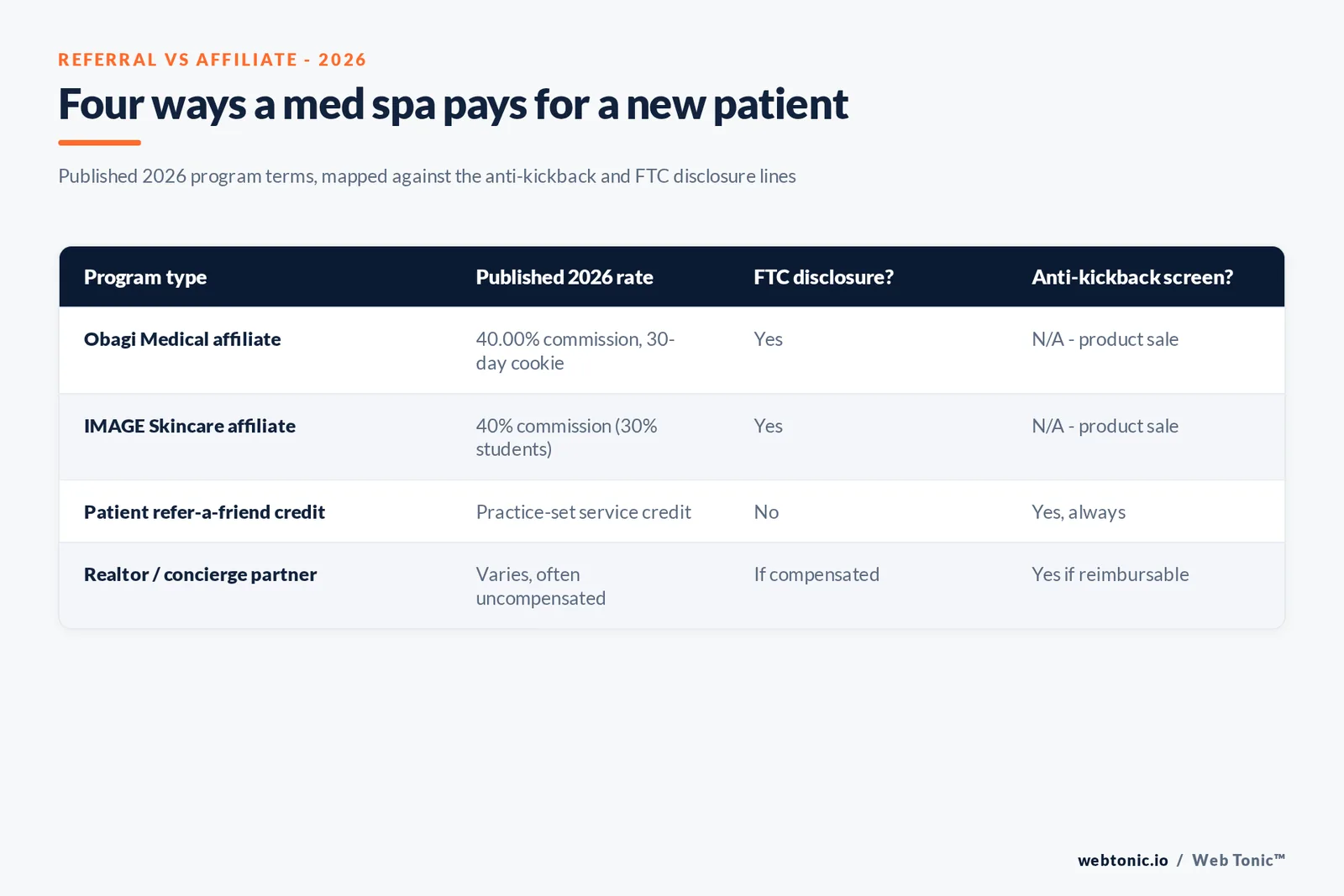
A paid skincare influencer post and a patient's refer-a-friend credit look similar from the outside - both move a new person toward a booking - but they trigger different obligations. The influencer post is commercial speech under the FTC's Endorsement Guides the moment value changes hands, so it needs a clear, unmissable disclosure on the post itself. A patient handing a friend a discount code is not commercial speech and carries no FTC disclosure duty, but if any part of what is being referred could be billed to a federal healthcare program, it still has to clear the anti-kickback screen described above. Treating both under one "referral policy" document is how a practice misses one or the other.
| Referral type | FTC disclosure required? | Anti-kickback screen required? | Typical reward |
|---|---|---|---|
| Paid influencer / affiliate post | Yes - 16 CFR 255 | Only if service is federally reimbursable | Commission or free product |
| Patient refer-a-friend credit | No | Yes, always screen against AKS/state law | Service credit or discount |
| Realtor / concierge partner referral | Only if compensated per referral | Yes if any reimbursable service involved | Varies, often uncompensated |
Budgeting a referral credit against the paid-lead benchmark
Growth99's own benchmark data gives a practice two numbers to budget a referral credit against: a USD 39 average cost per digital lead and a USD 132 new-patient acquisition benchmark. A referral credit priced anywhere under USD 132 in redeemed value is, on this arithmetic, still cheaper than the average acquisition benchmark for a channel that already delivers 42% of new volume - which is the argument for keeping the credit generous enough to move behaviour without turning it into a de facto discount on every booking.
| Acquisition cost reference (2025 data) | Figure | What it implies for a referral credit |
|---|---|---|
| Average cost per digital lead | USD 39 | Floor - a credit cheaper than this barely moves anyone |
| New-patient acquisition benchmark | USD 132 | Ceiling - a credit above this loses the cost advantage |
| Average spend per patient visit | USD 245 | Context - the revenue a converted referral protects |
Frequently Asked Questions
Can a med spa legally pay patients or influencers for referrals?
It depends what is being paid for. AmSpa's ethics guidance is direct: a practice cannot offer cash, gift cards or discounts to induce a referral of a service reimbursable under a federal healthcare program, because that triggers the federal Anti-Kickback Statute. Most med spa services (Botox, filler, laser, skincare) are cash-pay and not federally reimbursable, which is why refer-a-friend credit programs are common - but any practice offering both cosmetic and reimbursable medical services has to wall the two off, and every paid influencer post still needs an FTC-compliant disclosure under 16 CFR Part 255 regardless of reimbursement status.
What commission do skincare and injectable brands actually pay affiliates?
Where brands publish a rate, it clusters at 40%. Obagi Medical's own affiliate program pays a 40.00% base commission on a 30-day cookie window, and IMAGE Skincare's Pro Partnership program pays the same 40% (30% for students) on its storefront model. Smaller spa-focused programs run lower and tiered - one skincare-community program starts affiliates at 10% and steps them to 20% after USD 5,000 in referred sales. None of these numbers apply to referring a patient into a clinical procedure; they price product, not treatment.
How much of new patient volume actually comes from referrals versus paid ads?
Growth99's 2025 benchmark study of the category found paid channels generating 58% of new patients (about 460 a year per practice) against 42% from referral networks (about 333 a year), across an average 2,940 annual patient visits. Referral is the minority channel but still accounts for roughly two in five new patients, which is why practices keep both a paid-media budget and a referral program running side by side rather than picking one.
Is a promo code the same thing as an affiliate program for a med spa?
Functionally yes, legally it depends on the discloser and the service. A trackable promo code handed to a beauty influencer is an affiliate relationship under FTC rules the moment value changes hands, and the influencer must disclose the material connection clearly and conspicuously. A patient-to-patient refer-a-friend credit is the same mechanic aimed at existing patients rather than an audience, and it needs the same anti-kickback screening if any part of the referred service could be billed to a federal program.
Who manages the program in-house versus through a network?
No US-specific med spa study publishes this split, but the closest cross-vertical benchmark - IAB Australia's 2025 affiliate and partnership marketing industry review - found 51% of advertisers keep affiliate program management in-house, 26% use an agency and 19% use a network, with the remainder mixed. For a category this compliance-sensitive, in-house or agency control over disclosure language is the safer default until a med spa-specific benchmark exists.
Sources
American Med Spa Association - Medical Spa State of the Industry Report
AmSpa - Can I reward my medical spa patients for referring a friend?
AmSpa - Paying commissions in a medical spa
eCFR - 16 CFR Part 255, Guides Concerning Use of Endorsements and Testimonials
Obagi Medical - Official affiliate program terms
IMAGE Skincare - Pro Partnership Affiliate Program
Growth99 - 2025 State of Aesthetic and Elective Wellness Marketing Benchmark Report
AmSpa - 2023 Medical Spa State of the Industry Executive Summary
IAB Australia - Affiliate & Partnership Marketing Industry Review 2025