



Table of contents

Hybrid structures now lead B2B marketing at 35%, and 66% of client-side firms keep at least a quarter of the work in-house. The 2026 evidence does not settle the in-house versus agency debate - it dissolves it into a per-capability decision. Here are the numbers that decide each one.
Key Takeaways
- Hybrid structures lead B2B at 35%; projects 28%, retainers 24%, freelancers 12%.
- 66% of client firms keep at least 26% of marketing work in-house.
- 60% now have some in-house agency capability, up from 40% a year earlier.
- Capability emphasis splits 59.5% build, 38.5% partner and 1.9% buy.
- Partner mix: agencies 15.5%, consultancies 12.7%, other partners 10.4%.
- 33.6% of digital marketing activity is delivered externally.
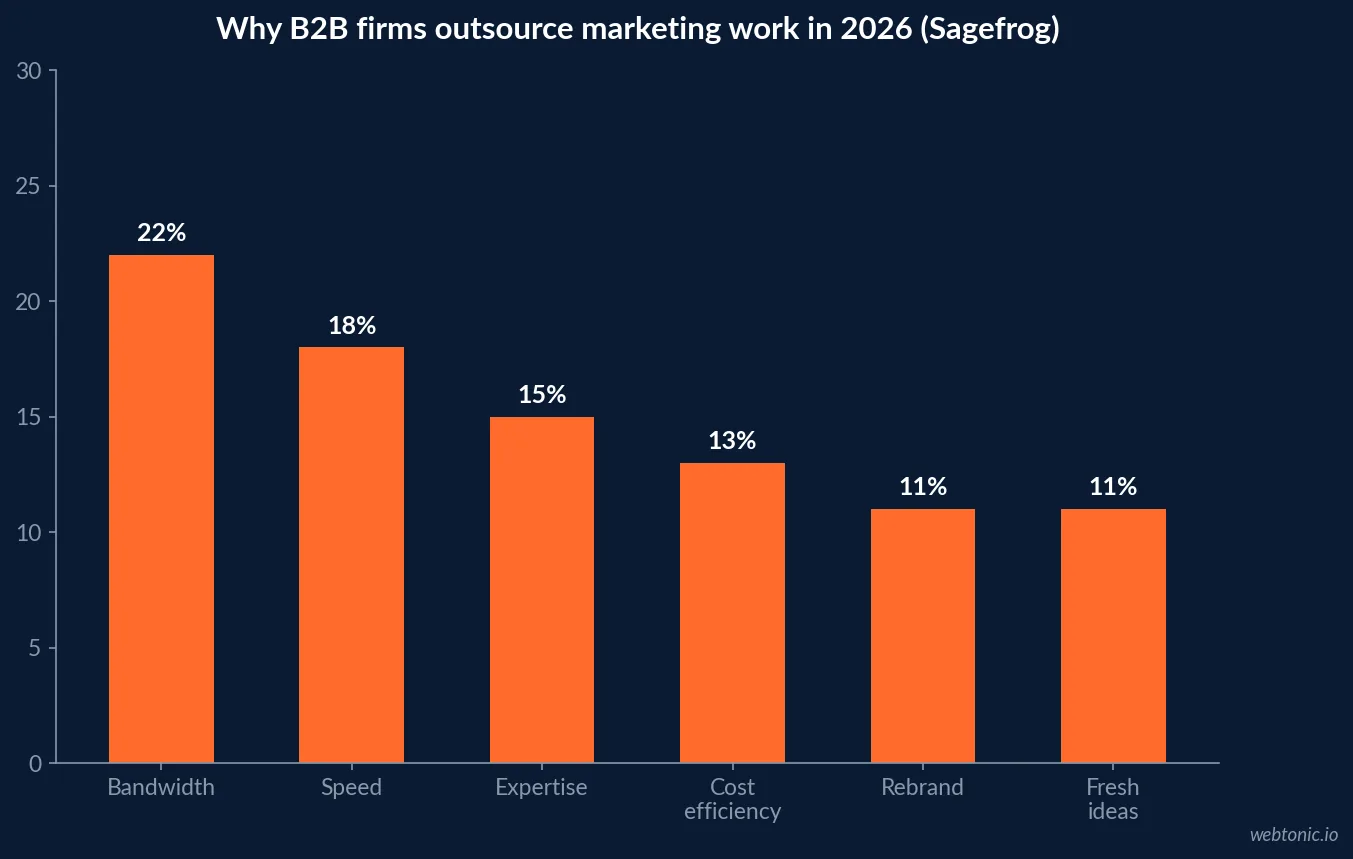
- Bandwidth drives 22% of outsourcing, speed 18%, expertise 15%, cost efficiency 13%.
- Education 83.0%, consumer services 73.3% and professional services 70.0% lean to building.
- Firms under USD 10M in revenue build internally 64.1% of the time.
- Retail outsources most at 57%, CPG 55%, technology 28%, media 10%, education 3%.
- About 61% of external agencies used generative AI in 2025, against 17% of in-house teams.
- Average S&P 500 CMO tenure is 4.1 years, against 5.0 across the C-suite.
- 31% of companies have no CMO at all; 77% of those hiring fill it within six months.
- A senior mis-hire can reach 213% of salary; the floor is 30% of first-year earnings.
The dominant structure is mixed
Sagefrog's 2026 B2B Marketing Mix Report reports the working mix as hybrid 35%, project 28%, retainer 24% and freelancers 12%. No single model holds a majority, and the largest category is explicitly a blend of internal and external delivery.
That is the first thing to accept before an org-design exercise. A structure that presents in-house and agency as alternatives is arguing about a question the market has already answered with "both", and the useful work is deciding which capability sits where.
| Structure | Share of B2B firms | What it is good at |
|---|---|---|
| Hybrid internal plus external | 35% | Continuity with rented depth |
| Project engagements | 28% | Finite, definable work |
| Retainers | 24% | Continuous programmes |
| Freelancers | 12% | Narrow specialist tasks |
How much stays inside
RSW/US's 2026 New Year Outlook reports that 66% of client-side firms keep at least 26% of their marketing work in-house and 60% now have some in-house agency capability, up from 40% a year earlier. Internal capability is expanding quickly, but it is expanding alongside external partners rather than replacing them.
The CMO Survey 2026 quantifies the same balance from the other side: capability emphasis at 59.5% build, 38.5% partner and 1.9% buy - within partnering, agencies 15.5%, consultancies 12.7% and other partners 10.4% - with 33.6% of digital marketing activity delivered externally, up from 31.6% in 2022.
| Measure | 2026 figure | Direction | Reading |
|---|---|---|---|
| Firms keeping 26%+ in-house | 66% | Stable | Internal core is the norm |
| Firms with in-house agency capability | 60% | Up from 40% | Fast internal build-out |
| Build emphasis | 59.5% | Up from 57.9% in 2020 | Preference for owning |
| Partner emphasis | 38.5% | Steady | External still a third of intent |
| Digital activity delivered externally | 33.6% | Up from 31.6% in 2022 | Slow, steady outsourcing |
| Buy emphasis | 1.9% | Marginal | Acquiring capability is rare |
Why firms outsource - and why cost is not the reason
Sagefrog ranks the drivers as bandwidth 22%, speed 18%, expertise 15%, cost efficiency 13%, a rebrand 11%, fresh ideas 11%, a launch 8% and a transition 2%. Cost efficiency sits fourth, behind two capacity reasons and one capability reason.
That ordering is worth taking seriously in a business case. Outsourcing justified on price invites an annual re-tender and treats the partner as interchangeable; outsourcing justified on bandwidth or specialist depth defines what "working" looks like and tends to survive a budget review.
| Reason to outsource | Share of firms | Right engagement shape |
|---|---|---|
| Bandwidth | 22% | Retainer with surge capacity |
| Speed | 18% | Project with a fixed end date |
| Expertise | 15% | Specialist retainer or advisory |
| Cost efficiency | 13% | Scoped project, measured |
| Rebrand | 11% | Project |
| Fresh ideas | 11% | Short advisory engagement |
| Product or market launch | 8% | Project |
| Team transition | 2% | Interim or fractional cover |
Sector and size change the answer
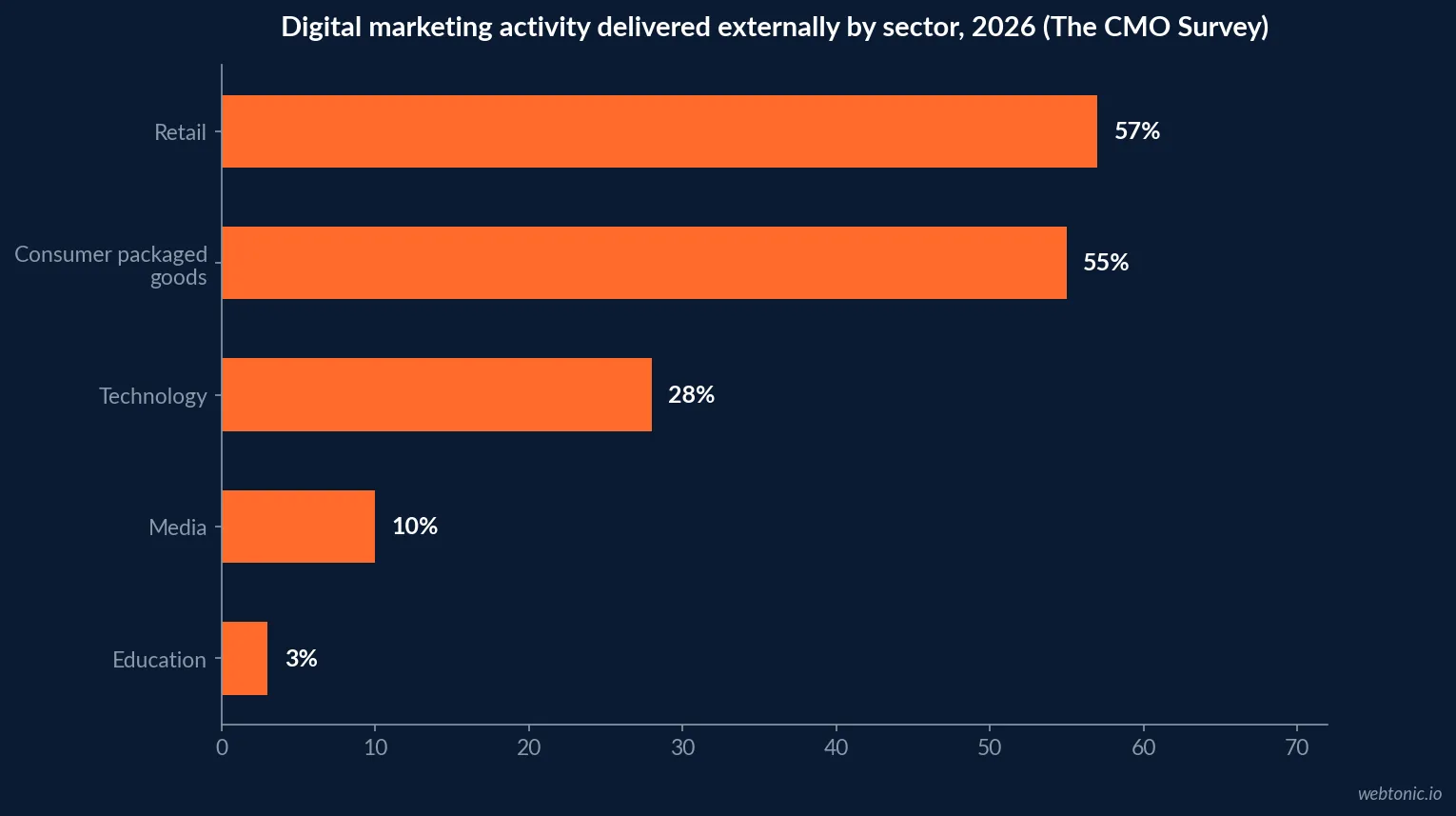
The CMO Survey shows the split is not uniform. Most likely to build internally: education at 83.0%, consumer services at 73.3% and professional services at 70.0%, with firms under USD 10 million in revenue building internally 64.1% of the time. External delivery of digital activity runs retail 57%, consumer packaged goods 55%, technology 28%, media 10% and education 3%, and by model B2C product 48%, B2C services 44%, B2B product 28% and B2B services 25%.
Two forces are visible. Sectors whose marketing is the product tend to own it; sectors whose marketing is high-volume production tend to rent it. Benchmark against your own sector rather than a market average.
The capability gap runs the other way
RSW/US reports that roughly 61% of external agencies used generative AI in 2025 against 17% of in-house agencies. The CMO Survey shows why that matters now: AI's share of marketing activities rose from 13.1% to 24.2% and generative AI from 7.0% to 22.4% - a 220% increase - with 55.9% projected within three years.
So the outsourcing case in 2026 is not mainly about cost or even capacity; it is about who has already absorbed a new toolset. Where the gap is capability rather than hours, renting is the faster route, which is exactly how we position performance creative work.
| Capability signal | External | In-house | Implication |
|---|---|---|---|
| Generative AI use in 2025 | About 61% | 17% | Rent the new capability first |
| In-house agency capability | - | 60% of firms | Internal build-out is real |
| Share of digital activity | 33.6% | 66.4% | Internal still does the bulk |
| Build emphasis | - | 59.5% | Preference is to own |
The hiring risk nobody prices
Spencer Stuart's 2026 CMO tenure snapshot reports average S&P 500 CMO tenure of 4.1 years against 5.0 across the C-suite, with 31% of companies having no CMO at all and 77% of those recruiting filling the seat within six months. Talentfoot puts the downside at up to 213% of salary for a senior mis-hire, on a 30% of first-year earnings floor.
Set that beside the CMO Survey's self-rating of 3.7 out of 7 for hiring the right people - the weakest capability it measures - and the sequencing argument makes itself. Rent the seniority while the scope is still moving; hire once it has stopped.
| Hiring signal | 2026 figure | What it should change |
|---|---|---|
| Average CMO tenure | 4.1 years | Assume the role will be re-scoped |
| C-suite average tenure | 5.0 years | Marketing turns over faster |
| Companies with no CMO | 31% | The seat is not automatic |
| Seats filled within six months | 77% | Cover the gap with interim help |
| Senior mis-hire cost | Up to 213% of salary | Prove the scope first |
| Self-rated hiring capability | 3.7 of 7 | Do not build a plan around it |
A per-capability decision, not a policy
Because hybrid leads at 35% and build emphasis sits at 59.5% against partner at 38.5%, the defensible output of this exercise is a table, not a verdict. Each capability is owned, rented on retainer, bought as a project, or explicitly uncovered - and the last column is the one most org charts hide.
Writing "uncovered" down is the highest-value five minutes in the process. It converts a silent gap into either a budget request or an accepted risk, and it is the same discipline behind our measurement engagements.
| Capability | Default in 2026 | Published anchor |
|---|---|---|
| Strategy and planning | Own | 59.5% emphasise building |
| Measurement and reporting | Own, build with help | 33.6% of digital delivered externally |
| Channel execution | Mixed | Hybrid leads at 35% |
| Content and creative volume | Rent surge capacity | Bandwidth drives 22% |
| Specialist technical work | Rent | Expertise drives 15% |
| New tooling capability | Rent first | 61% versus 17% generative AI use |
| Senior direction | Rent, then own | Tenure of 4.1 years |
Tests to apply before you hire
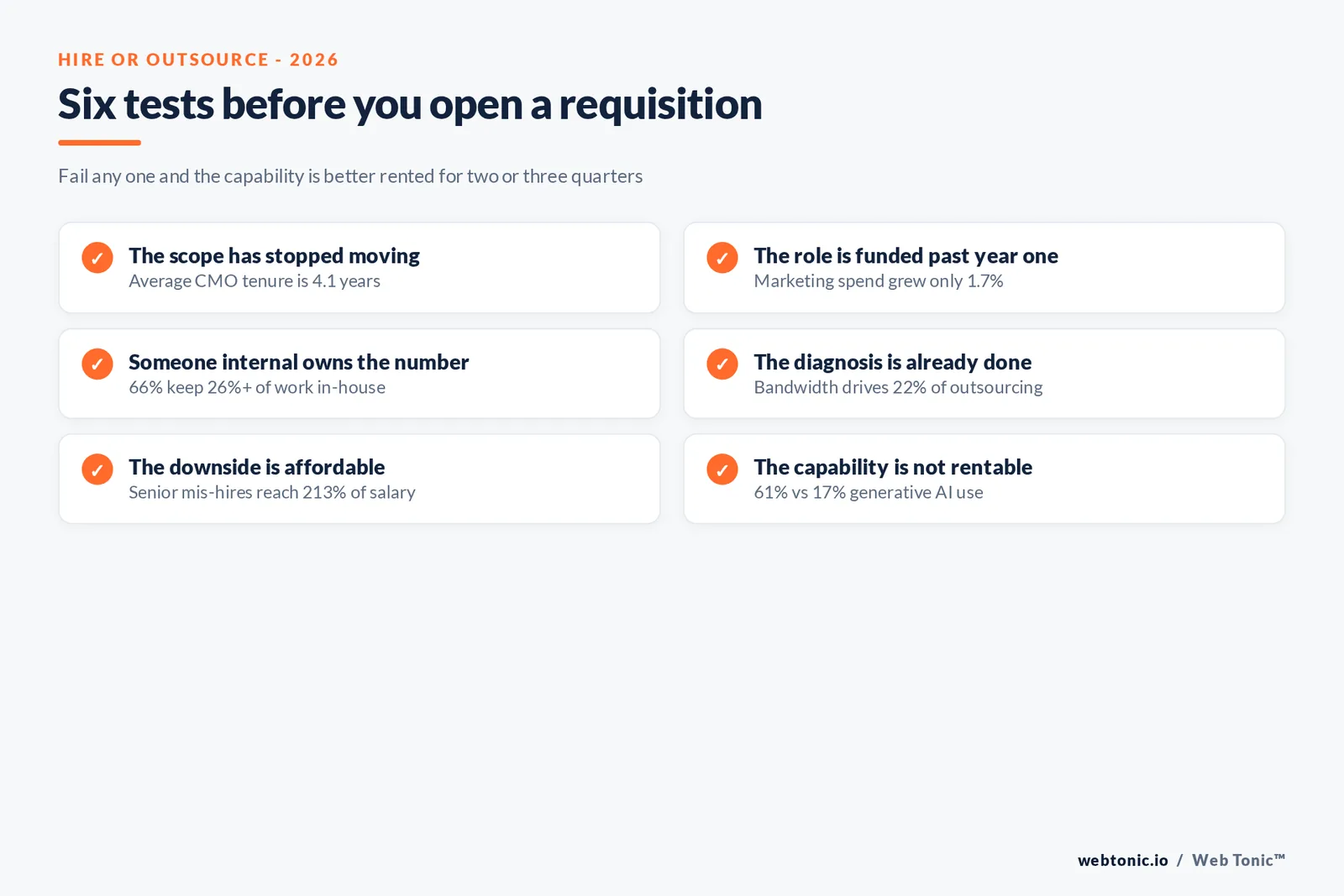
Five tests follow from the data above. Has the scope stopped moving, given 4.1 years of average tenure? Is the role funded past year one, when spend growth is 1.7% and headcount growth is down 50%? Does someone internal already own the number? Is the diagnosis done, or is the hire expected to produce it? And is the 213% of salary downside affordable if it goes wrong?
Fail any one and the seniority is better rented for two or three quarters. Pass all five and hiring is the cheaper option, because permanent staff are the lowest-cost way to run stable, continuous work.
How to run the transition
Most failures happen in the handover rather than the decision. With 77% of open CMO seats filled within six months and 60% of firms building in-house capability, the common pattern is a partner running the programme while an internal team is recruited around it - which only works if ownership of the number is explicit from day one.
Set the transition milestones with the same rigour as the campaign plan: what moves in-house, in which quarter, against which metric. Before scaling either side of the line, it is worth pressure-testing whether the channel deserves the money at all - see our analysis of paid social returns, or walk us through your current split.
Related reading
- Marketing Audit Statistics: Hiring Versus Outsourcing
- Marketing Operations Consulting Statistics: Hiring vs Outsourcing
- Fractional CMO Statistics: Hiring vs Outsourcing
- Marketing Strategy Consulting services at Web Tonic
Frequently Asked Questions
Is in-house or outsourced marketing more common in 2026?
Both, in the same organisation. Sagefrog's 2026 B2B Marketing Mix Report puts hybrid structures at 35%, project engagements at 28%, retainers at 24% and freelancers at 12%. RSW/US reports that 66% of client-side firms keep at least 26% of their marketing work in-house and 60% now have some in-house agency capability, up from 40% a year earlier. The realistic question is not whether to outsource but which capability sits where.
Why do companies outsource marketing work?
Capacity first, expertise second. Sagefrog ranks the reasons as bandwidth 22%, speed 18%, expertise 15%, cost efficiency 13%, a rebrand 11%, fresh ideas 11%, a launch 8% and a transition 2%. Cost efficiency is fourth, which matters: outsourcing decisions justified purely on price tend to be re-litigated within a year, while decisions justified on bandwidth or specialist depth survive.
What should never be outsourced?
The plan and the measurement. The CMO Survey 2026 shows capability emphasis splitting 59.5% build, 38.5% partner and 1.9% buy, while 33.6% of digital marketing activity is delivered externally. Firms most likely to build internally include education at 83.0%, consumer services at 73.3% and professional services at 70.0%. Own the strategy and the numbers; rent depth, surge capacity and specialist technical work.
When is hiring the right answer?
When the scope has stopped moving and the role is funded past year one. The counter-evidence is strong: Spencer Stuart reports average S&P 500 CMO tenure of 4.1 years against 5.0 for the wider C-suite, with 31% of companies having no CMO at all, and Talentfoot puts a senior mis-hire at up to 213% of salary. The CMO Survey also has marketers self-rating hiring the right people at just 3.7 out of 7.
Does external help still bring a capability advantage?
On the current evidence, yes, in tooling. RSW/US reports that roughly 61% of external agencies used generative AI in 2025 against 17% of in-house agencies, and the CMO Survey shows generative AI's share of marketing activities rising from 7.0% to 22.4% in a year. Where the gap is a new capability rather than a shortage of hours, renting it is usually faster than building it.
Sources
Sagefrog - 2026 B2B Marketing Mix Report
RSW/US - 2026 New Year Outlook Report
The CMO Survey - Highlights and Insights Report 2026
Spencer Stuart - CMO Tenure 2026 Snapshot
Talentfoot - Cost of a leadership mis-hire, 2026 data


