Table of contents
A structure engagement should end its first quarter with a written target org, a ranked hiring sequence and a scorecard per seat. If day 90 arrives with a slide deck and no decision, the quarter was spent, not invested.
Key Takeaways
- The quarter splits cleanly: days 1–30 diagnose, days 31–60 design, days 61–90 sequence and stress-test. Skipping the diagnosis is the single most common failure.
- The org being designed is small. Median marketing headcount is about 3 marketers at $1M ARR and 11 at $10–50M revenue, so one wrong seat is a large percentage of capacity.
- Each seat carries a real price. Fully loaded cost per marketer benchmarks at $180K–$420K, median $294K, against a marketing budget averaging 7.7% of revenue.
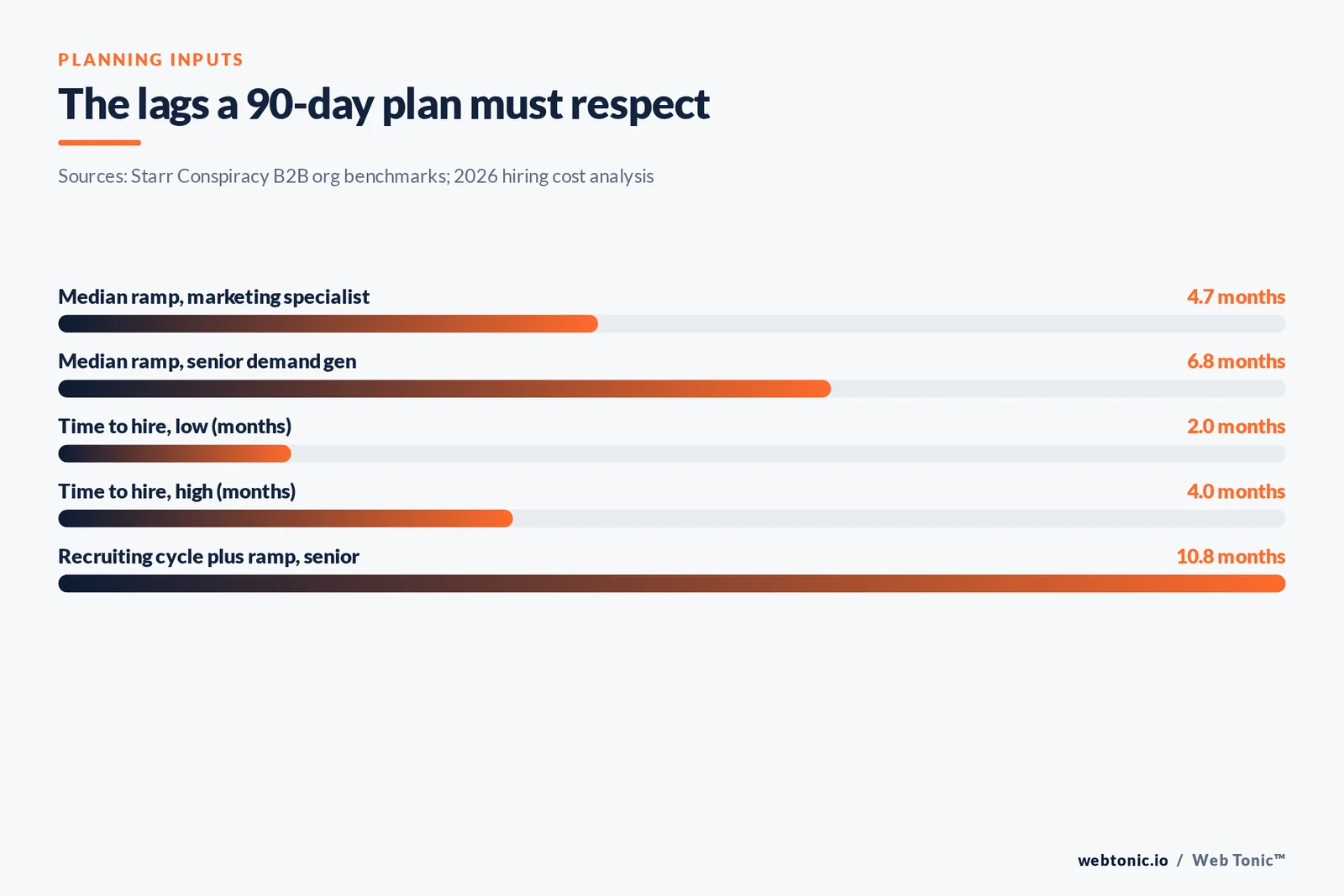
- Sequencing beats speed. Time to hire runs 60–120 days and median ramp to full productivity is 4.7 months, 6.8 months for senior demand-gen and product-marketing roles.
- Day 30 should produce a capacity baseline, not opinions: healthy in-house utilisation sits at 65–80%, and anything below that is leakage, not a headcount gap.
- Do not restructure in month one. Published 90-day playbooks converge on assessing before changing, then piloting one high-leverage change with a pre-agreed success condition.
- By day 90 you should be able to name every planned hire, its trigger, its owner and its 90-day success criteria — or the plan is a wish list.
Why the first quarter is the whole engagement
Structure advisory is unusual among advisory formats because the deliverable is a decision about people. That makes it slow to reverse and expensive to get wrong: replacement costs of 50–200% of salary are commonly cited, and senior mis-hire benchmarks reach 213%. So the first 90 days are not a warm-up. They are the period in which the reversible work happens.
The published playbooks for incoming marketing leaders agree on the shape more than they disagree. One week-by-week CMO template is explicit that month one means listen, do not fire and do not overhaul the tech stack. A 2026 SaaS playbook names changing too much too fast in the first 30 days as the most common failure mode, and ends the quarter with a scale, iterate or kill decision on one pilot. Advisory follows the same discipline with one difference: the adviser is not auditioning for the job, so the diagnosis can be blunter and faster.
Days 1–30: the baseline nobody has written down
Month one is measurement of the current organisation, not of the market. The questions are narrow and answerable: who does what in practice rather than on the org chart, how much of the team's week reaches productive output, which work is duplicated between in-house staff and vendors, and what the team is accountable for today.
Capacity is where most baselines break. A 2026 utilisation model for in-house teams puts the healthy target band at 70–80% for enterprise teams — below it capacity is leaking to non-productive activity, above it the team runs with no slack for an urgent request or a late approval. Companion capacity forecasting guidance puts healthy utilisation for most in-house roles at 65–75%. A team running at 50% productive time does not have a headcount problem; it has a process problem that a new hire will inherit and amplify.
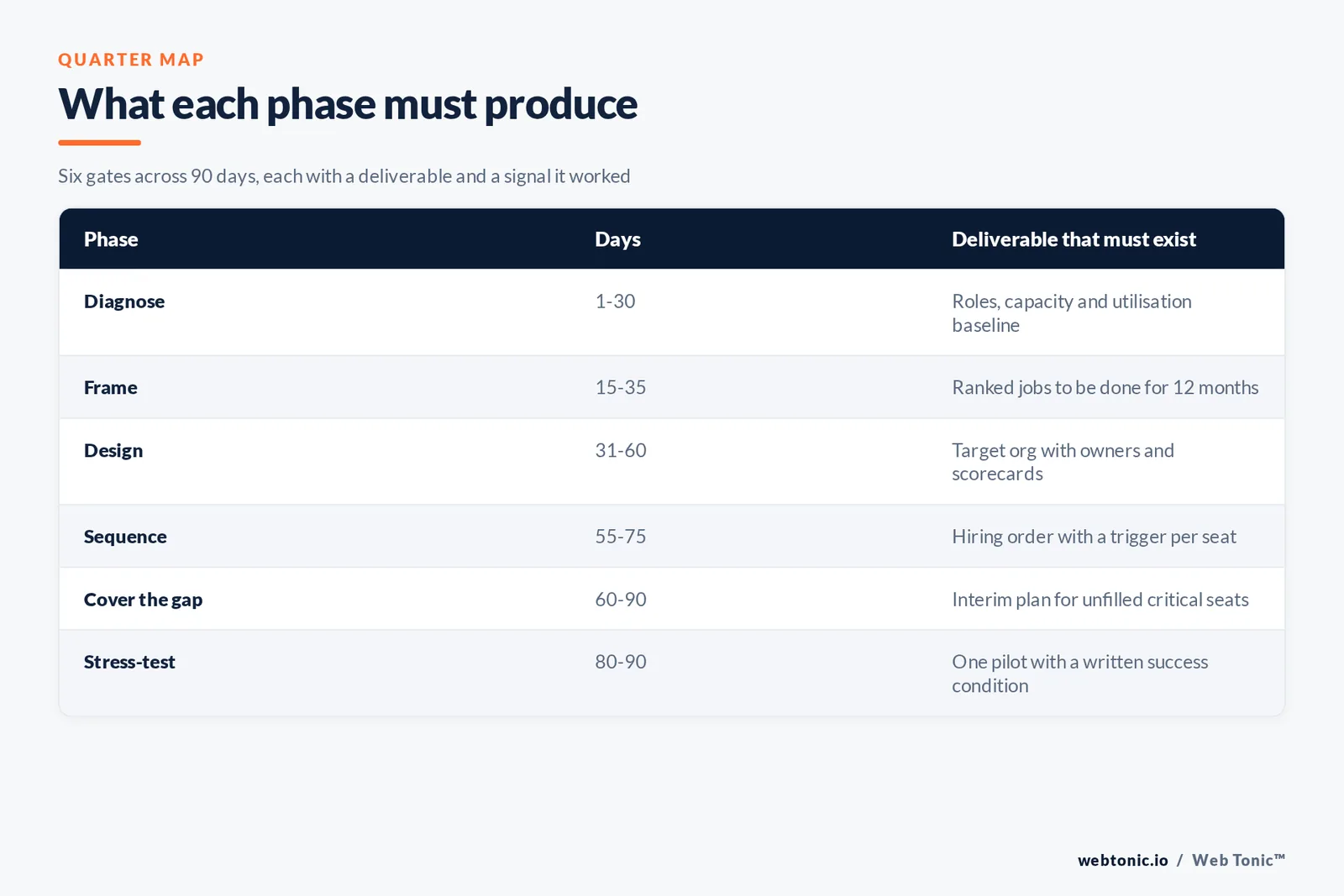
| Phase | Days | Deliverable that must exist | Signal it went well |
|---|---|---|---|
| Diagnose | 1–30 | Actual roles, capacity and utilisation baseline, vendor overlap map | Leadership is surprised by at least one finding |
| Frame | 15–35 | The jobs to be done for the next 12 months, ranked | Two initiatives get cut, not deferred |
| Design | 31–60 | Target org with owners, scorecards and decision rights | Every box maps to a job, not a title |
| Sequence | 55–75 | Hiring order with a trigger and budget per seat | Hire one is defensible without the rest of the plan |
| Cover the gap | 60–90 | Interim plan: borrowed leadership, vendors or deferral | No seat is left silently unowned |
| Stress-test | 80–90 | One pilot change with a written success condition | A scale, iterate or kill call is actually made |
Month one is also when the cost frame gets set. 2026 headcount benchmarks put fully loaded cost per marketer — salary, benefits, tools, training, allocated programme budget and agency augmentation — at $180K to $420K depending on segment, with a $294K median, and put median headcount at 3 marketers for $1–10M revenue, 11 at $10–50M, 26 at $50–250M and 62 above $250M. Against a marketing budget that B2B org benchmarks put at 7.7% of revenue on average, the arithmetic of how many seats you can actually fund is usually settled in week two.
Days 31–60: design the org, not the org chart
The design month starts from jobs to be done and works back to boxes. Practitioner guidance on marketing org design for scaling companies sets the bar for a usable output: for each planned role, define what it owns, its targets, its reporting line, what success looks like at 90 days, and what triggers the next hire. That last item is what separates a plan from a wish list — a hiring plan without triggers becomes a budget request.
Maturity framing helps here, because the same headcount can be arranged well or badly. One published org readiness model grades strategy and vision, data and infrastructure, and talent and organisation, then places the team in a tier from reactive to predictable with a 90-day action set attached. Structure guidance for 2026 makes the sequencing warning concrete: a wrong second or third hire creates structural problems that take years to unwind, because every later hire is recruited to fit it.
Design month is also where the generalist-versus-specialist call gets made honestly. At 3–6 people, most teams need broad operators plus bought-in specialism; the specialist ladder only pays once there is enough volume in a channel to keep it busy. The test is simple: if a proposed specialist seat cannot be described with a full week of work that only they can do, it is a vendor line, not a hire.
Days 61–90: sequence, cover, and prove one thing
The final month converts design into an order of operations. One 90-day transformation playbook is direct that new hires generally do not belong inside the first quarter at all — diagnostic and foundation work can be done with existing staff, while the hires get budgeted and planned into the roadmap that follows. That is the correct default. The quarter's job is to make the next four hires obvious, not to make them fast.
Then the gap gets covered explicitly. Week-by-week guidance for CEOs places team and infrastructure work at weeks 9–10, including hiring, retraining and the workflows needed for measurement. If the work is continuous and the seat is empty for another quarter, borrowed leadership or a vendor is a decision; leaving it unowned is not. This is also the natural hand-off point to bounded external cover, which is exactly what a fractional CMO engagement exists to do while a permanent seat is recruited.
Finally, one thing gets proven. Published 30-60-90 milestones for fractional leadership end the quarter with the highest-priority growth levers named, a 12-month roadmap with quarterly milestones, and recommendations on team structure, tools and budget allocation. Another 90-day playbook raises it further: by day 90, present a 12-month strategy with pipeline contribution targets by quarter, channel allocation with expected returns, and the milestones the team will be held to.
| Day-90 artefact | What good looks like | Red flag version |
|---|---|---|
| Target org | Every box has an owner, a job and decision rights | Titles with no owned outcome |
| Hiring sequence | Ordered, each seat with a trigger and a budget | A headcount list with no order or trigger |
| Scorecards | 3–5 measures per seat, reviewed monthly | Activity counts only |
| Capacity baseline | Utilisation measured, 65–80% band tested | "The team is at capacity" as an assertion |
| Interim cover plan | Named cover for every unfilled critical seat | Work informally absorbed by whoever is nearest |
| Pilot result | One change shipped, measured, decided on | Everything still "in progress" |
The signals that the quarter is being wasted
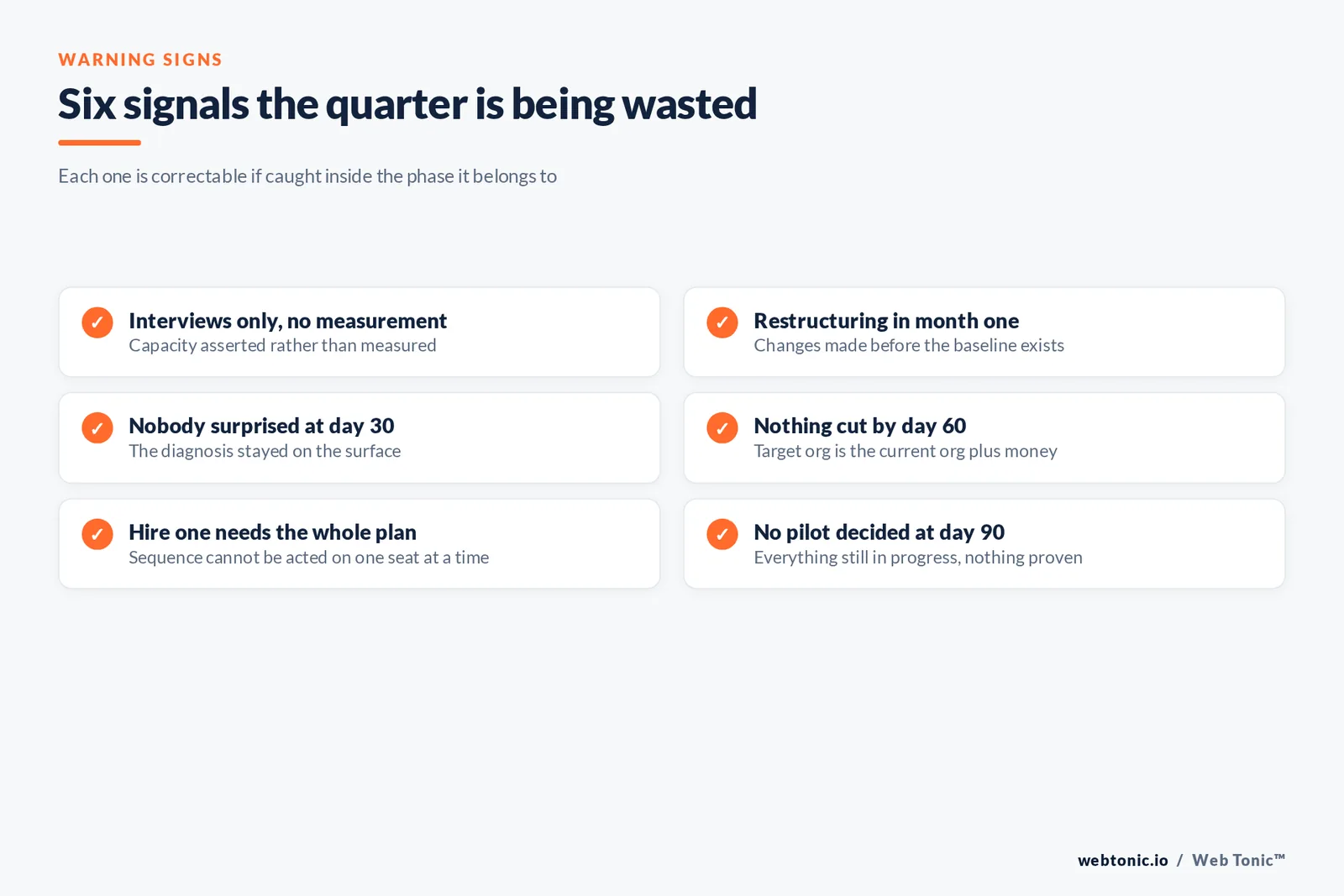
Three patterns show up early enough to correct. The first is diagnosis without instrumentation — interviews only, no capacity or output measurement, which produces a plan built on the loudest opinion in the room. The second is restructuring in month one, which onboarding roadmap research for VP-level marketing hires flags as the asymmetric risk: credibility built early compounds for years, and early mistakes are hard to unwind. The third is a plan whose first hire depends on all the others being approved.
Two further signals are worth naming. If nobody has been surprised by anything at day 30, the diagnosis stayed on the surface. And if no initiative has been cut by day 60, the design added capacity requests without resolving priorities — the target org is then simply the current org plus money.
A structure engagement also has a natural dependency: it is only as good as the performance baseline underneath it. Where measurement is unreliable, the honest first step is a diagnostic, whether that is our own marketing audit or a comparable independent read, before any seat is designed around numbers nobody trusts.
How Web Tonic runs it
We run this as a bounded quarter with three fixed gates: a written baseline at day 30, a target org and scorecards at day 60, and a sequenced hiring plan plus one measured pilot at day 90. Every seat in the plan carries a trigger, a budget line and a success condition before it is presented, and every number in the baseline is traceable to a source you can open — we do not estimate capacity we did not measure. Where a critical seat will stay empty past the quarter, we say so and name the cover. That combination of instrumented diagnosis and an explicit interim plan is what makes the design survive contact with a real hiring market, and it is how our growth and advisory work is scoped generally.

Frequently Asked Questions
Should hiring start inside the first 90 days?
Usually not. Published transformation playbooks put diagnostic and foundation work on existing staff and budget new hires into the following roadmap. With 60–120 days to hire and a 4.7-month median ramp, a hire started in month one lands its first real output roughly three quarters later — so the quarter is better spent making sure it is the right hire.
What is the single most important day-90 deliverable?
The ordered hiring sequence with a trigger per seat. A target org without an order is a budget request; the sequence is what lets you act on the plan one hire at a time, and stop if the trigger never fires.
How do we know the team needs seats rather than better process?
Measure utilisation first. Healthy in-house utilisation is benchmarked at 65–80%. If productive time sits well below that band, the constraint is workflow, approvals or duplicated vendor work, and adding a seat inherits the same friction.
Can a structure engagement work without reliable reporting?
Only partly. You can design roles and decision rights from qualitative evidence, but you cannot set scorecards or judge capacity without trustworthy measurement. When reporting is unreliable, fix the baseline first — otherwise every seat is sized against a number nobody defends.
What does a good scorecard per seat look like?
Three to five measures the person genuinely controls, reviewed monthly, with at least one output measure rather than activity counts. Strategic KPI sets for leadership are typically 3–5 metrics reviewed monthly or quarterly, with 8–15 operational metrics per channel sitting underneath for the owners.
Sources
10Louder CMO 90-day template · Growth Spree first-90-days SaaS playbook · Pedowitz utilisation and velocity model · Pedowitz capacity forecasting · Digital Applied 2026 headcount benchmarks · Starr Conspiracy B2B org benchmarks · Starr Conspiracy org readiness assessment · Marketing org design for scaling companies · Improvado marketing team structure guide · Pedowitz 90-day transformation playbook · Symbicore 90-day structure for CEOs · MarkCMO 30-60-90 milestones · JRG Partners VP marketing onboarding roadmap. More on our approach: Web Tonic blog.