



Table of contents
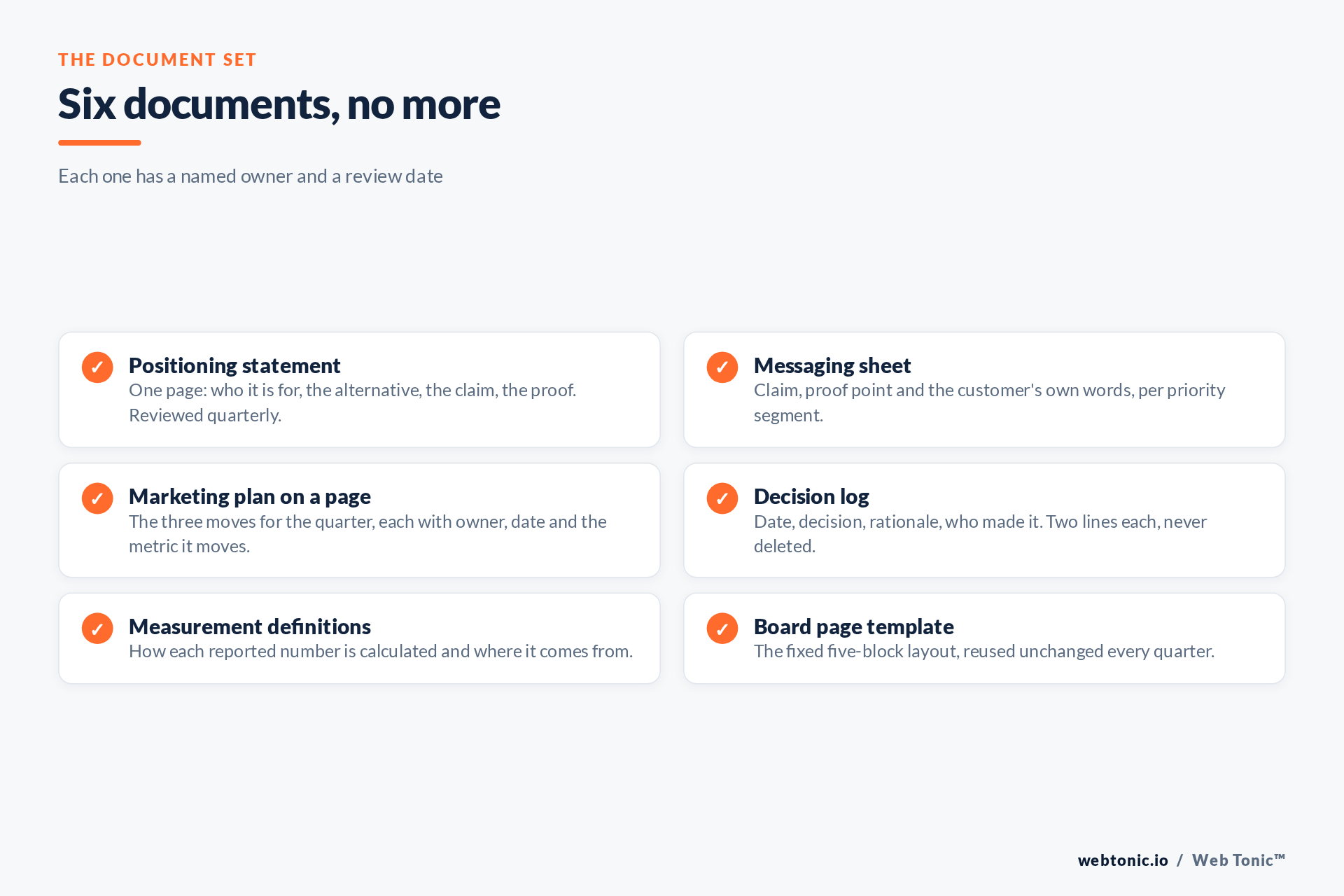
Quick answer: A marketing strategy consulting engagement needs six documents — positioning statement, messaging sheet, one-page plan, decision log, measurement definitions and a fixed board template — plus tools in six categories. Everything else is optional.
Last verified: 2026-09-06
Start with documents, not software
Most engagements begin by choosing tools and end up with a well-instrumented account nobody can explain. The order that works is the reverse: agree the six documents first, then pick the smallest set of tools that keeps them current. A tool exists to keep a document true, and a tool that feeds no document is overhead.
The test for every item below is whether someone would notice its absence within a quarter. If it could vanish unnoticed, it is busywork, and busywork in an advisory engagement is expensive because it consumes the client's attention, which is the scarcest input you have.
The positioning statement
One page holding four things: who it is for, what they would otherwise do, the claim, and the proof for the claim. Not a brand deck. The value is that it fits on a screen and can be quoted verbatim in a sales call, which is the only real test of a positioning document.
Give it a review date rather than treating it as permanent. Quarterly is right for most companies: often enough to catch a market shift, rarely enough that the team does not treat it as provisional.
The messaging sheet
One row per priority segment: the claim, the proof point that supports it, and the customer's own phrasing taken from real conversations. Keeping raw quotes rather than paraphrases is the difference between a messaging sheet and a wish list, and it follows the voice of the customer practice of preserving the source language.
Where a claim has no proof, mark it. An unproven claim is a project for the plan, not a line for the website, and marking it prevents it from being quietly promoted into copy.
The plan on a page and the decision log
The plan holds the three moves for the quarter with owner, date and the metric each should move. Anything longer stops being read; a marketing plan that runs to twenty pages is an artefact of the planning process rather than an instrument for running the quarter.
The decision log is two lines per decision — date, decision, rationale, who made it — and it is never deleted from. It is the cheapest document to maintain and the one that pays off hardest, because six months later nobody remembers why a segment was dropped, and without the log the argument restarts from zero.
Measurement definitions
Write down how each reported number is calculated and where it comes from. Which conversion action counts, which attribution setting produced the figure, whether a lead means a form fill or a qualified conversation. Google's own documentation on conversion tracking setup and analytics attribution models is the reference for the platform half.
This one page prevents the most common derailment of a strategy meeting: two people quoting different numbers for the same thing and spending the session reconciling them. If your definitions cannot be written, that is the first project, not a footnote — see our analytics and conversion tracking notes.
| Document | Owner | Review |
|---|---|---|
| Positioning statement | Founder or commercial lead | Quarterly |
| Messaging sheet | Marketing lead | Quarterly |
| Plan on a page | Marketing lead | Monthly |
| Decision log | Consultant | Continuous |
| Measurement definitions | Analytics owner | On any tracking change |
| Board page template | Consultant | Never — that is the point |
Choosing tools
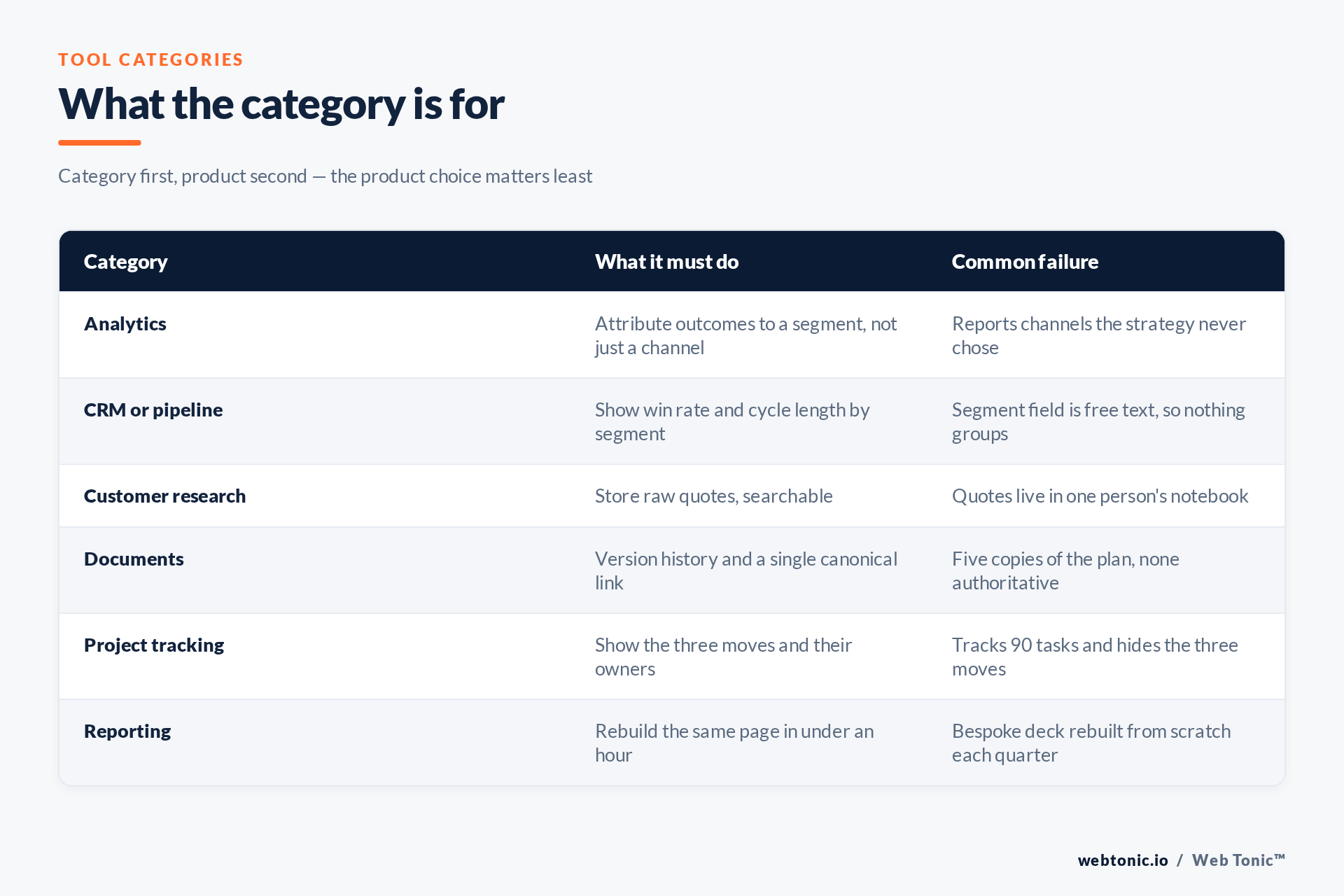
Pick the category before the product. Analytics has to attribute outcomes to a segment rather than only to a channel; the CRM has to report win rate and cycle length by segment, which usually means the segment is a controlled field rather than free text. Customer research needs searchable raw quotes. Documents need version history and one canonical link.
Prefer whatever the client already pays for and uses. A new tool costs weeks of adoption and produces its first useful report after the engagement's credibility window has closed. The exception is when an existing tool structurally cannot answer the question — a CRM with no segment field cannot produce win rate by segment no matter how it is queried.
What to skip
Persona decks with stock photography and invented names. Elaborate customer journey maps built before anyone has interviewed a customer. Competitive matrices with more than five rows. Anything requiring weekly manual data entry by someone whose job is not data entry, because it will be abandoned in week three and its absence will be discovered at the worst moment.
Also skip the second dashboard. If the board page can be rebuilt in under an hour from existing exports, that is sufficient; a bespoke live dashboard for a quarterly document is effort spent on the wrong cadence. Related setup guides sit in the help library.
What goes wrong
The failure mode: the document set grows and stops being read. A positioning statement becomes a brand book, the plan becomes a roadmap, and within two quarters nobody can point to the canonical version of anything. Cap the set at six, keep one canonical link each, and delete duplicates aggressively.
The second failure is unowned documents. Every item needs a named person, not a team, because a document owned by everyone is updated by nobody. The third is skipping measurement definitions, which is what turns every subsequent review into an argument about whose number is right.
Frequently Asked Questions
What tools does a marketing strategy consultant actually need?
Six categories: analytics, CRM or pipeline, customer research storage, documents with version history, light project tracking and a repeatable reporting format. Use whatever the client already pays for wherever possible.
How many documents should the engagement produce?
Six: positioning statement, messaging sheet, plan on a page, decision log, measurement definitions and a fixed board page template. Each needs a named owner and a review date.
Are persona documents worth building?
Only if built from real customer interviews and stored with raw quotes. Persona decks with invented names and stock photography are read once and never used in a sales conversation.
Should we buy new software for the engagement?
Usually not. Adoption costs weeks and the first useful report arrives too late. Buy only when an existing tool structurally cannot answer the question, such as a CRM with no controlled segment field.
Sources: Positioning, Marketing plan, Voice of the customer (Wikipedia); Google Ads Help; Google Analytics Help; MIT Sloan Management Review. Verified 2026-09-06.


