Table of contents
Bad strategy engagements follow one arc: an impressive first call, a confident proposal, six weeks of "discovery", and a deliverable that restates the problem you already knew you had. The invoice is not the expensive part — the lost quarter is. Almost all of it is predictable at the vetting stage.
Key Takeaways
- Test diagnosis before you test credentials. A provider who proposes solutions on the first call, before seeing your data, is pattern-matching to a playbook.
- Stage experience beats industry experience. The problems at $1M, $5M and $20M of revenue are structurally different, and enterprise machinery breaks an eight-person team.
- Buy a small scoped diagnostic first. Audits run $1,500 to $8,000 and bound your risk; a retainer pitched before any joint work is a red flag, not a discount.
- Being burned is the norm, not the exception: 46% of prospects arriving at one talent marketplace had already tried an agency or consultant, and a wrong hire wastes 3 to 6 months and $30,000 to $50,000 in fees.
- Ask how the provider measures their own work. In 2026, 62% of B2B leaders anchor ROI on pipeline contribution — a provider with no answer on measurement will not be able to prove the engagement either way.
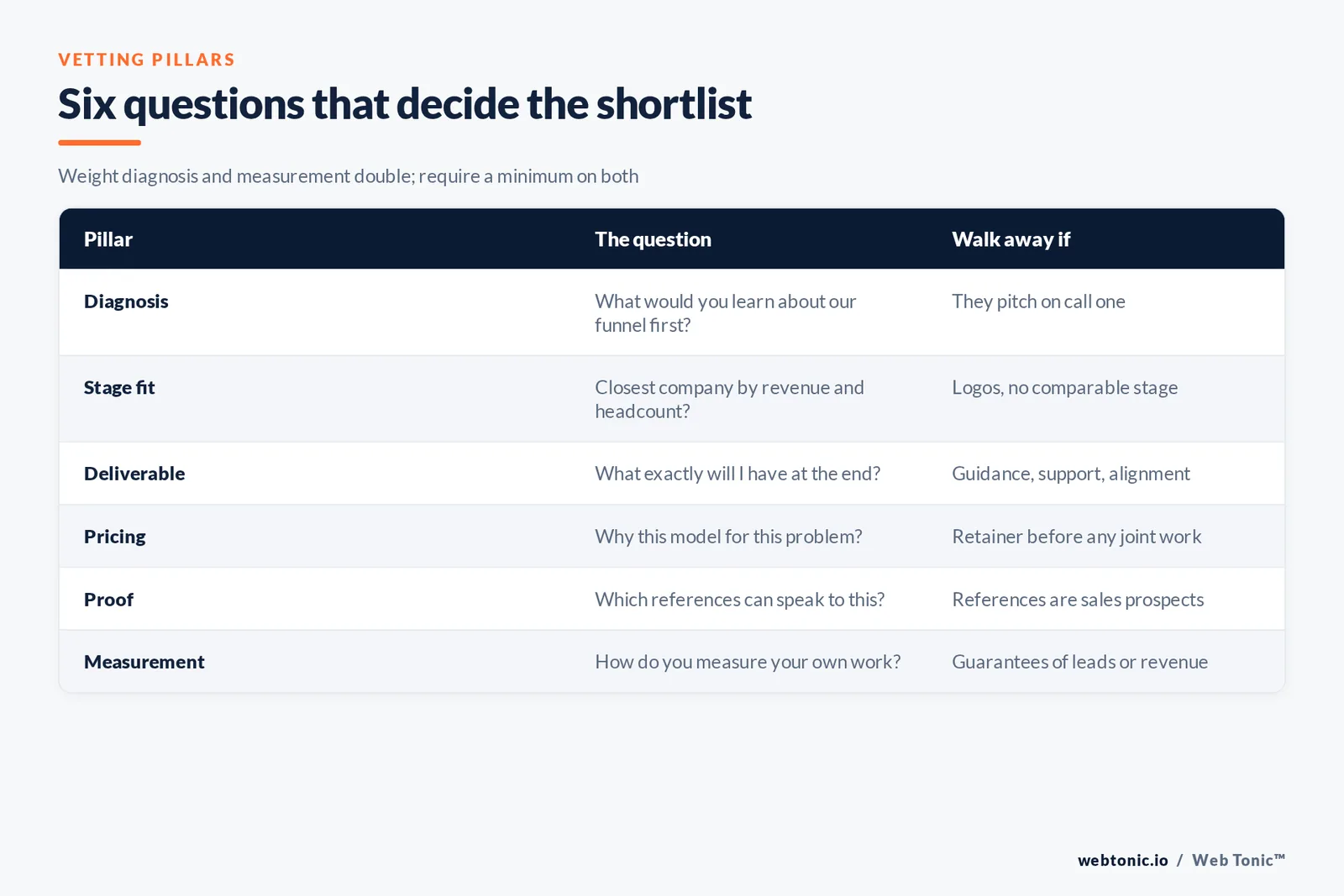
Six vetting pillars
1. Diagnosis before prescription. Jagatjeet's founder vetting checklist calls this the single most reliable signal, and gives a clean test: describe your situation briefly and vaguely, then watch. A weak provider starts proposing — more content, a rebrand, a new attribution tool. A strong one asks precise questions: what is your lead-to-opportunity rate, where does attribution break, where does pipeline stall.
2. Stage fit, then industry fit. The same checklist argues buyers over-weight industry and under-weight stage. Ask for the closest company by revenue and team size, and what specifically changed. MarketerHire's vetting guide makes the same point harder: someone who scaled paid social for a $100M DTC brand will not automatically succeed at a $2M B2B SaaS company, and a provider used to $500,000 budgets may not know how to operate at $20,000.
3. A deliverable you can evaluate. "Strategic guidance" is not a deliverable. Before signing, you should be able to say in one sentence what will exist at the end that does not exist now — a prioritised diagnosis, a rebuilt attribution model, a positioning document tested against real customer interviews. Two questions force it: what specifically will I have, and how will we both know whether it was worth it.
4. A pricing model that matches the problem. Defined problems deserve project pricing: fixed scope, fixed deliverable, fixed price. Independent rates run $150 to $400 an hour, $5,000 to $50,000 per project and $3,000 to $15,000 a month on retainer — but the model matters as much as the number, and a retainer proposed before you have worked together is premature by definition.
5. Proof you can verify. Christoph Olivier's hiring guide lists the reference questions that matter: what changed, how long it took, and whether the client would hire them again. It adds three live tests — do they own an attribution model, can they explain your funnel back to you, do they ask hard strategic questions without jargon.
6. Their own measurement. Ask how they measure whether their work worked. Gather's 2026 study of 114 B2B marketing leaders found ROI proof narrowing to a few defensible numbers — pipeline contribution at 62%, revenue influence and LTV at 49%, efficiency ratios at 41% — under pressure from CFOs (54%) and boards (47%). A provider who cannot name their two numbers is not ready for that conversation.
| Pillar | The question to ask | A good answer sounds like | Walk away if |
|---|---|---|---|
| Diagnosis | What would you need to learn about our funnel before recommending anything? | A list of specific data they want and why | They pitch a solution on call one |
| Stage fit | Closest company to ours by revenue and headcount — what did you change? | A named situation, a decision, a measured result | Only logos, no comparable stage |
| Deliverable | What exactly will I have at the end? | A named artefact plus its acceptance test | "Guidance", "support", "alignment" |
| Pricing | Why this model for this problem? | Fixed fee for a defined scope, trial before retainer | Retainer pushed before any joint work |
| Proof | Which references can speak to a similar engagement? | Contactable clients, including one that went badly | References are all current sales prospects |
| Measurement | How do you measure whether your own work worked? | Two or three metrics, defined, with a baseline | Guarantees of rankings, leads or revenue |
Know which of the four things you are buying
Jagatjeet's framing is the cheapest clarity available: an agency executes a known playbook at volume, a consultant diagnoses and designs the system the execution should serve, and a fractional CMO owns the function part-time inside the org chart. Hiring an agency when you need a diagnosis is the most common and most expensive mismatch — it puts more output into a broken funnel.
MarketerHire's hiring guide adds a fourth distinction inside "consultant": strategists who audit, plan and set KPIs, versus executors who run the ads or the SEO programme day to day. Both are legitimate; buying one while expecting the other is where relationships fail in month two. Its five triggers for hiring are a useful self-diagnosis: no strategy exists, an agency relationship failed, growth has plateaued, a headcount freeze left targets unchanged, or an acquisition inherited zero marketing infrastructure.
| Provider type | What they are good at | Typical 2026 cost | Wrong choice when |
|---|---|---|---|
| Strategy consultant | Diagnosis, positioning, channel and measurement design | $1,500–$8,000 audit; $5,000–$50,000 project | You need hands to run campaigns |
| Specialist executor | Owning one channel with senior skill | $3,000–$10,000 a month | The strategy itself is the open question |
| Fractional marketing leader | Owning the number and managing the team part-time | $5,000–$20,000 a month | There is no team or budget to lead yet |
| Agency | Volume execution across channels | $5,000–$25,000+ a month | Nobody has diagnosed why results stalled |
Which kind of firm fits the decision
Beyond provider type, the shape of the firm matters. Large strategy firms, boutique consultancies, digital agencies and independent operators sell overlapping services with very different delivery models, and the right choice depends on the size and reversibility of the decision.
Large strategy firms — the tier where BCG, McKinsey and Bain sit, along with the Big Four practices — are built for decisions with board and investor consequences: portfolio choices, market entry, post-merger planning. You get process rigour, benchmark data and a team, and you pay for the leverage model that supplies them. For a company doing under nine figures of revenue, that machinery is usually mismatched to the question.
Boutique consulting firms concentrate senior expertise in one domain or vertical. Their advantage is that the person who pitched is the person who delivers, and their sector fluency shortens the diagnosis. Their constraint is bench depth: if the engagement needs five workstreams at once, a small firm will either subcontract or slip.
Digital and performance agencies are strongest when the strategy is settled and the constraint is execution capacity across media, SEO and content production. Many now sell strategy as a front-end product, so ask which of their people do the planning and whether that planning is billed separately from media management.
Independent consultants and fractional operators give companies direct access to senior judgement at the lowest overhead, with month-to-month reversibility. The trade-off is single-threading — holidays, competing clients and one person's blind spots — which is manageable if the deliverables are written down and the client owns the systems.
A practical rule: match the provider's fixed costs to the decision's stakes. A GTM planning question worth millions justifies a firm with a research bench. A channel-mix argument inside a $2M marketing budget does not, and boutique or independent help will produce a better answer faster because nobody has to brief a team first.
Red flags, collected
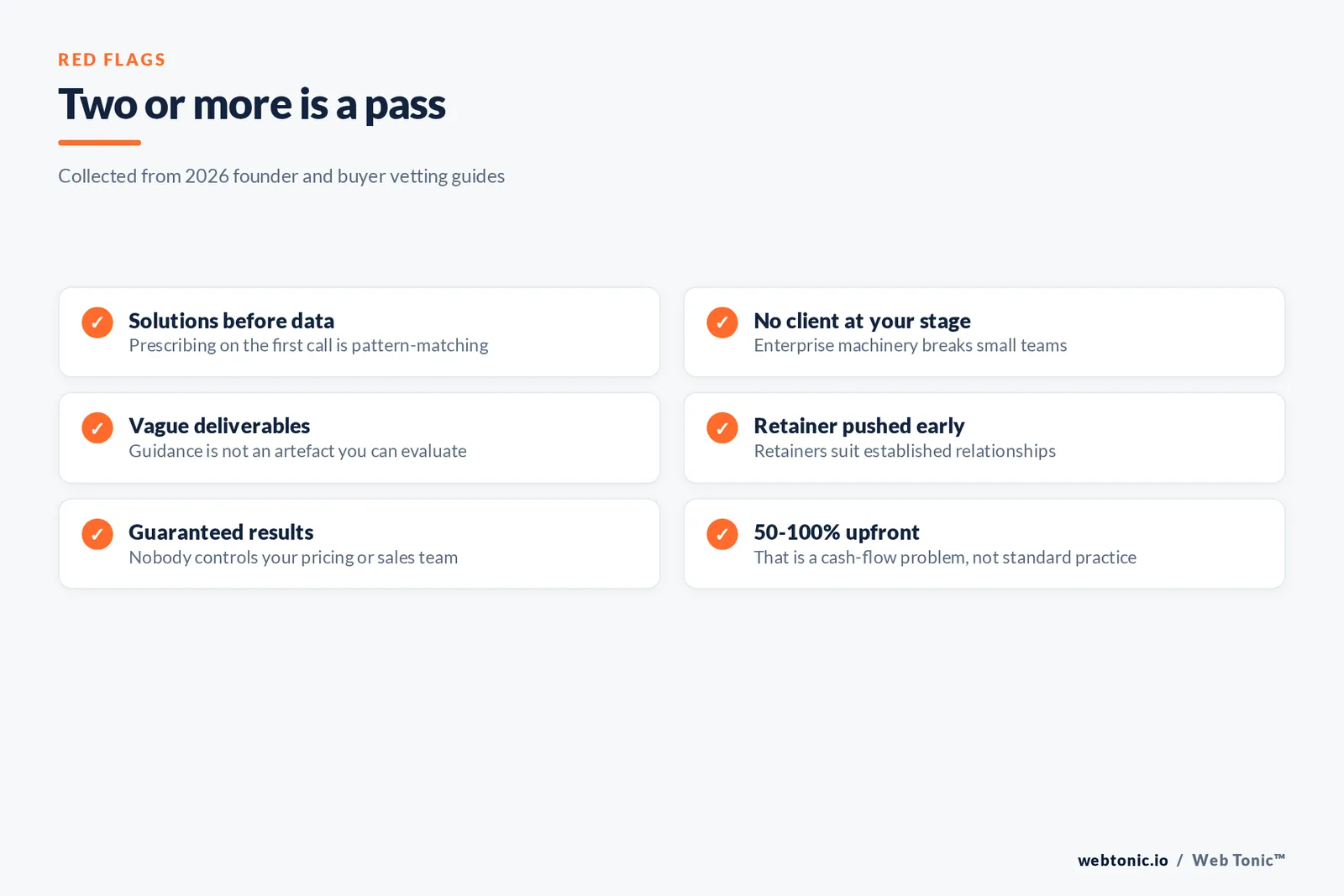
Any one of these is a conversation. Two or more is a pass.
Proposes solutions before seeing your data. Cannot name a client at your revenue stage. Describes deliverables as guidance, support or alignment. Pushes a retainer before any defined project. Guarantees rankings, leads or revenue. Will not explain how they would measure whether their own work worked.
Add two commercial ones. MarketerHire flags requests for 50 to 100% payment before work starts as a cash-flow problem rather than standard practice, and treats rates below $75 an hour as a junior signal while rates above $350 should come with proven results at scale. And Busylike's 2026 playbook adds a modern test: ask how they would inspect your current visibility. A strong answer in 2026 covers brand mentions, citation patterns, answer consistency across AI engines and whether your owned content is structured to be quoted — not just rankings.
Run a paid trial before the big commitment
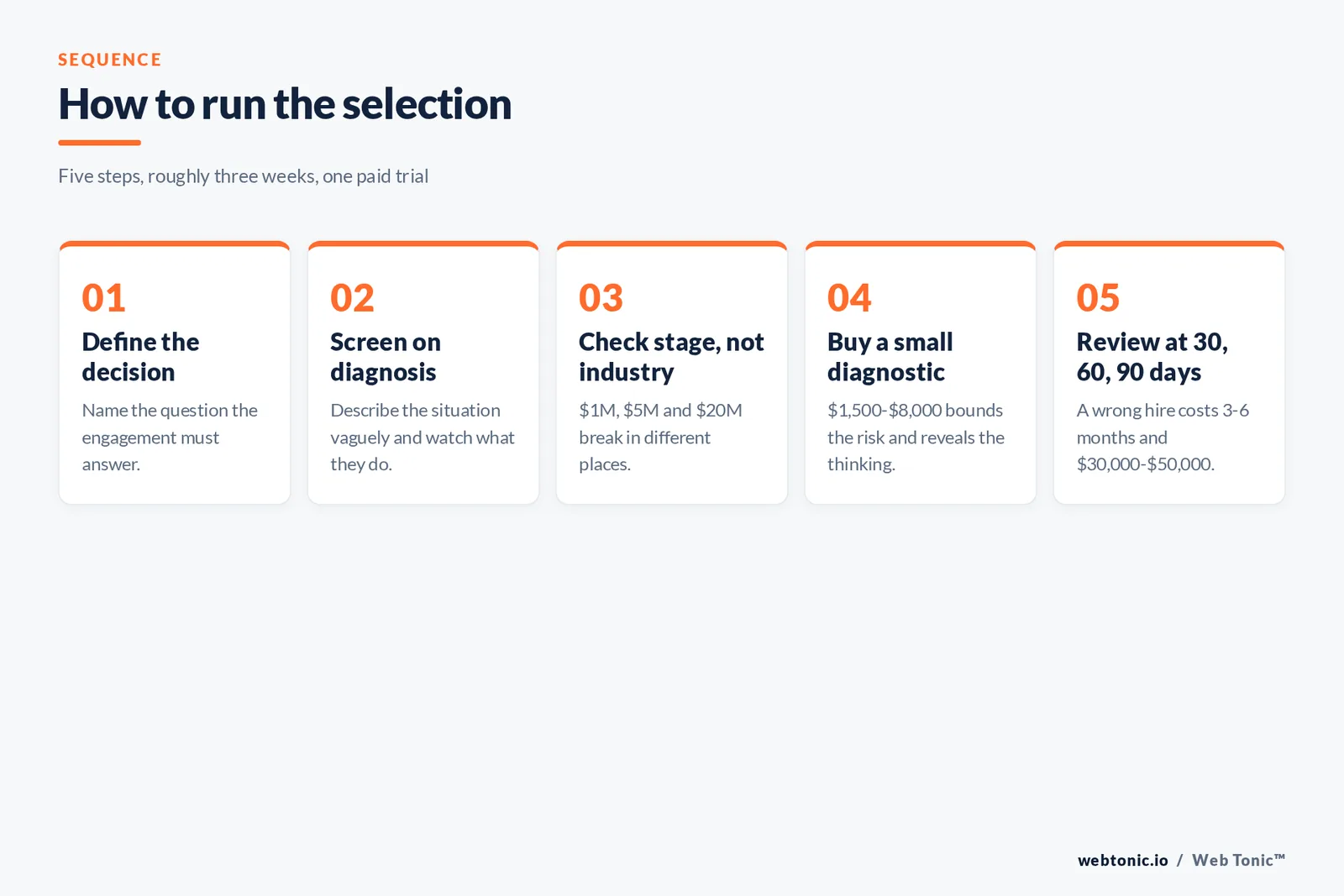
MarketerHire's six-step process — define scope, set budget, source candidates, evaluate portfolio and references, run a paid trial, measure at 30/60/90 days — exists because the trial is what a pitch cannot fake. The economics support it: the guide puts a wrong senior hire at $50,000 to $150,000 of waste and a right one as paying for itself inside 90 days, while its vetting guide puts a failed consultant engagement at 3 to 6 months and $30,000 to $50,000 in fees.
The trial should be a real deliverable, not a discounted retainer month. A diagnostic at $1,500 to $8,000 shows you how the provider thinks, produces something you can act on either way, and gives you a like-for-like comparison if you are testing two providers. This is how we scope first engagements too: a fixed-fee marketing audit before any marketing strategy consulting retainer, so the measurement layer and the priority order are agreed on evidence rather than on a pitch.
What good providers ask you
Vetting runs both ways, and a provider's questions reveal more than their case studies. Expect to be asked what happens to the plan after delivery, who inside the business will own each workstream, what has already been tried and abandoned, what your gross margin is, and what would make you cancel. Frostbite's 2026 selection guide lists four traits worth screening for on the same basis: measurable outcomes rather than activity reports, AI-engine optimisation built into the approach, first-party data ownership so you keep the customer list, and vertical specificity.
Two more checks are worth the time. Ask who personally does the work and what share of the hours they deliver — the bait-and-switch of a senior pitch and junior delivery is common enough that it should be a contract term. And ask what happens at the end: a written methodology, dashboards you own and named owners inside your team mean the engagement outlives the provider. Spencer Stuart's tenure research puts average S&P 500 CMO tenure at 4.1 years against 5.0 for the wider C-suite, so institutional memory has to live in documents rather than in people.
A scorecard you can use in one afternoon
Score each provider from 1 to 5 on the six pillars, weight diagnosis and measurement double, and require a minimum on both. Then sanity-check the shortlist against three facts about the market. First, most buyers have been burned before — 46% at one marketplace — so scepticism is the base rate, not rudeness. Second, only a small minority of independents charge four-figure hourly rates: in Consulting Success's study, about 4% charge $500 to $1,000 an hour and 0.5% charge more, so an unusual rate needs unusual proof. Third, the risk you are managing is business risk, not fee risk: CB Insights' post-mortems attribute 43% of failures to poor product-market fit, 29% to timing and 19% to unsustainable unit economics — the questions a good strategy provider should be pressing you on.
Web Tonic's differentiator on that scorecard is deliberate: the diagnosis and the measurement layer come first, the deliverable is written and acceptance-tested, and the dashboards stay with the client. Our data intelligence work is what makes the "how will we both know" question answerable in week one rather than in month six, and the blog covers the same evaluation for audits, scorecards and fractional leadership.

Frequently Asked Questions
What is the single best test of a marketing strategy consultant?
Describe your situation vaguely on the first call and see whether they diagnose or prescribe. Precise questions about your funnel, lead-to-opportunity rate and attribution mean they are diagnosing. An immediate recommendation means you are hearing the last client's plan.
Should I hire a consultant, a fractional CMO or an agency?
A consultant diagnoses and designs, a fractional leader owns the function part-time at $5,000 to $20,000 a month, and an agency executes a known playbook at volume from $5,000 to $25,000+. If nobody has established why results stalled, buy the diagnosis first — more execution into a broken funnel is the most expensive mismatch.
How big should the first engagement be?
Small and defined. An audit or diagnostic at $1,500 to $8,000 bounds your risk, gives you something actionable regardless of what happens next, and lets you evaluate the thinking before committing to a retainer. Compare that against $30,000 to $50,000 of fees and a lost quarter from a wrong long engagement.
What references should I ask for?
Two clients at your revenue stage and, ideally, one engagement that did not go well. Ask what changed, how long it took, and whether they would hire the provider again. Also ask each reference who actually delivered the work — that is where senior pitches and junior delivery get exposed.
Which red flag should end a conversation immediately?
A guarantee of rankings, leads or revenue. No provider controls your market, your pricing or your sales team, so a guarantee is either a misunderstanding of causality or a sales tactic. A demand for 50 to 100% of the fee before work begins is close behind.
Where to go next
Score the shortlist on diagnosis and measurement first, then buy the smallest engagement that produces a written answer. If you want to see how a provider thinks before signing anything larger, the contact page is where a fixed-scope diagnostic starts.
Sources: Jagatjeet, How to Choose a Marketing Consultant: A Founder's Vetting Checklist · MarketerHire, How to Vet a Marketing Consultant and How to Hire a Marketing Consultant · Christoph Olivier Consulting, How to Hire a Marketing Consultant · Busylike, Hiring a Marketing Consultant: A 2026 Playbook · Frostbite Marketing, Marketing Consultant: How to Choose in 2026 · Gather, How B2B Marketing Leaders Are Rewriting ROI (114 respondents) · Consulting Success, Consulting Hourly Rate study · Spencer Stuart, CMO Tenure Study · CB Insights, Top Reasons Startups Fail. All figures accessed September 2026.