Table of contents
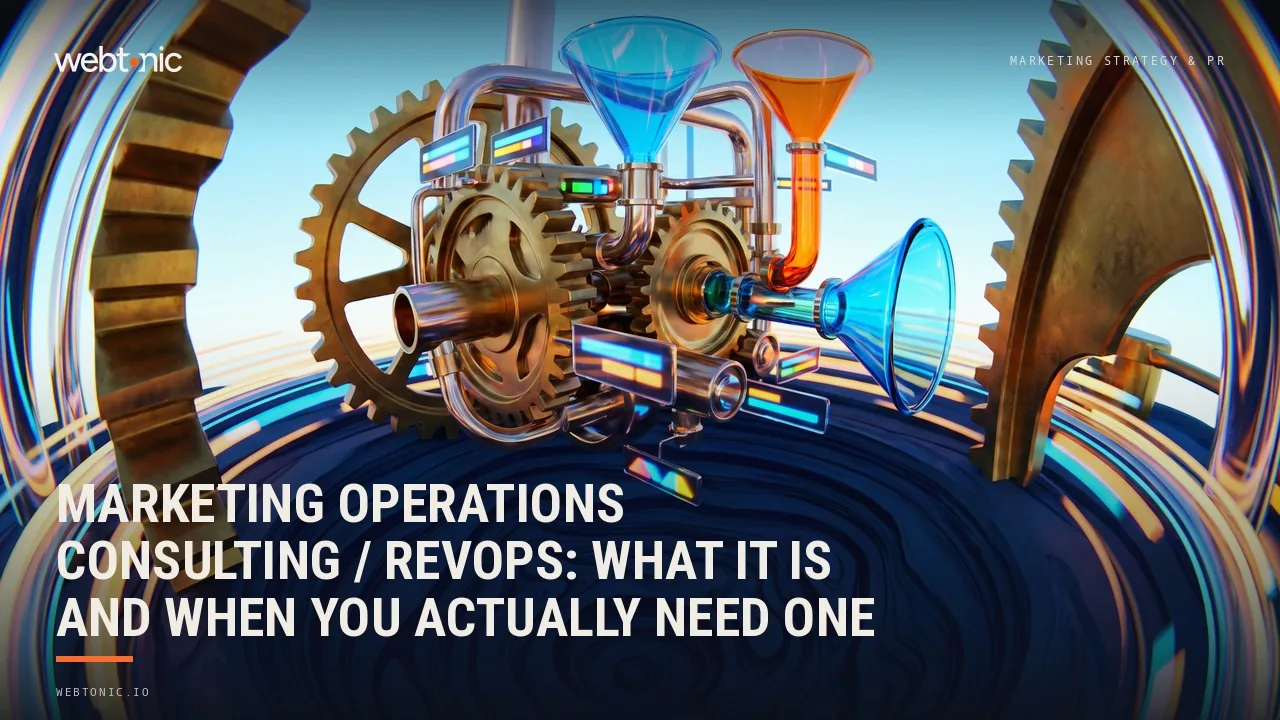
Marketing operations consulting buys one thing: a revenue system whose numbers can be trusted and whose handoffs actually work. Everything else — tools, dashboards, automations — is a by-product.
Key Takeaways
- Marketing operations consulting (and its wider sibling, RevOps consulting) owns four pillars: process design, system integration, the data model, and reporting. Campaign creative is explicitly not in scope.
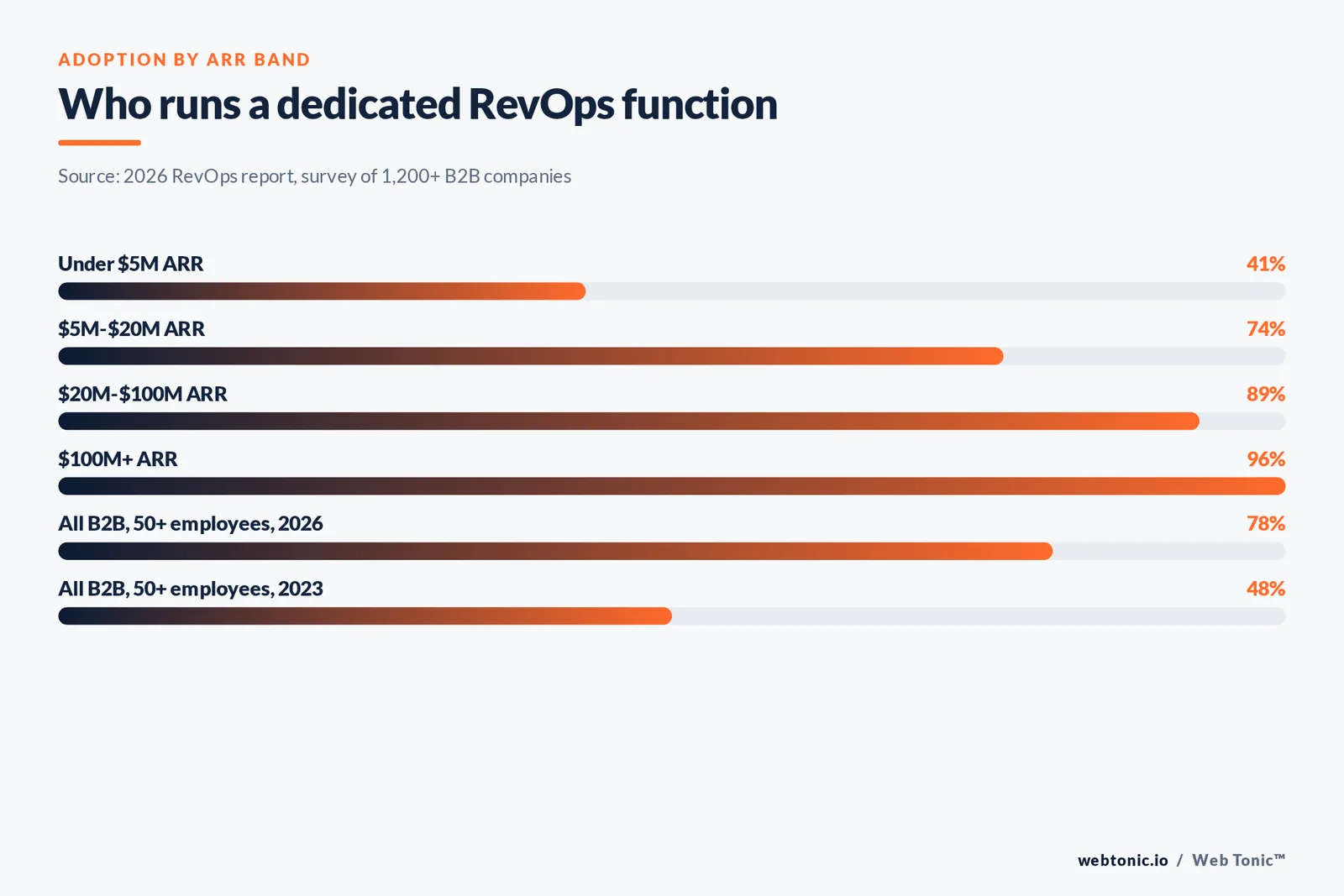
- The function has become standard. 78% of B2B companies with 50-plus employees now run a dedicated RevOps function, up from 48% in 2023, and adoption climbs from 41% under $5M ARR to 96% above $100M.
- Data quality is the usual trigger. 62% of organisations report losing revenue directly to poor CRM data, and nearly a third of teams burn 6+ hours a week reconciling it.
- Attribution is the second trigger. Single-model attribution maps spend to revenue at only 38–58% accuracy, and 30–50% of B2B pipeline starts in dark-funnel sources it cannot see.
- The market prices this like senior fractional work: broadly $3,500–$10,000 a month for a solo operator and $15,000–$27,000 for a full pod, with published rate cards clustering around $208–$227 an hour.
- You need it when the same number has three answers, when tools outnumber the people who understand them, or when a growth plan cannot be measured. You do not need it when the real gap is demand.
What marketing operations consulting actually covers
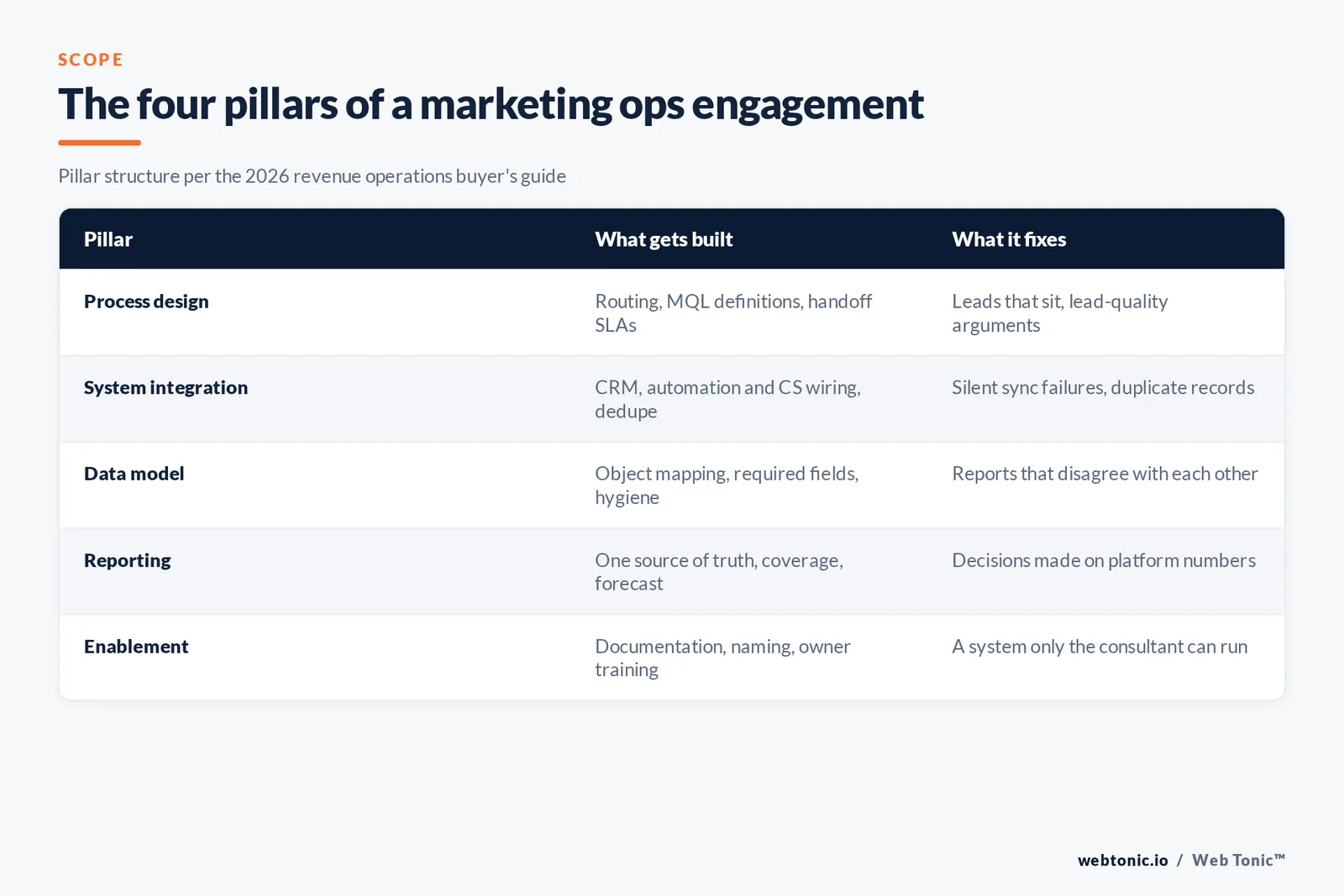
Most providers organise the work around four pillars, and the 2026 buyer's guide to revenue operations services lists them plainly: process design (lead routing, handoffs, lifecycle stages), system integration (CRM, marketing automation, CS tools), the data model and its maintenance (object mapping, deduplication, hygiene), and reporting and analytics (pipeline coverage, attribution, forecasting). Mature engagements stretch into finance — billing, revenue recognition, days sales outstanding — which is where "marketing ops" becomes "RevOps".
The distinction from older sales operations work is scope. Sales ops kept the CRM upright for one team. RevOps consulting deliberately spans marketing, sales and customer success, because the failures that cost the most money live in the seams between them. HubSpot's comparison of the two cites Deloitte Digital research showing organisations with a firmly established RevOps function were 1.4x as likely to exceed revenue goals by 10% or more.
What is not in scope matters just as much. A marketing operations consultant does not write your ads, own your brand, or invent demand. They make the machine that carries demand legible and repeatable. If you hire one expecting more leads next month, you will be disappointed for two months and grateful in the third — because the reason the leads were not converting usually turns out to be routing, definitions or timing.
| Pillar | What gets built | What it fixes |
|---|---|---|
| Process design | Lead routing, MQL/SQL definitions, handoff SLAs, lifecycle stages | Leads that sit, arguments about lead quality |
| System integration | CRM–automation–CS wiring, dedupe rules, sync monitoring | Silent sync failures, duplicate records, manual re-entry |
| Data model | Object mapping, required fields, hygiene automation, governance owner | Reports that disagree, unusable segments, AI acting on bad rows |
| Reporting | One source of truth, pipeline coverage, attribution, forecast | Channel decisions made on platform-reported numbers |
| Enablement | Documentation, naming conventions, internal owner training | A system only the consultant can operate |
| Commercial ops | Quote-to-cash hooks, renewal workflows, revenue reporting | Marketing numbers that finance refuses to accept |
Why this became a standard function
Ten years ago this work was absorbed by whoever was most patient with the CRM. That stopped scaling. A 2026 report drawn from 1,200-plus B2B companies puts dedicated RevOps adoption at 78% among companies with 50-plus employees, after 30% in 2021, 48% in 2023 and 65% in 2025. Adoption tracks revenue complexity almost perfectly: 41% under $5M ARR, 74% at $5M–$20M, 89% at $20M–$100M and 96% above $100M.
Analyst expectations pointed the same way earlier. Accenture's revenue operations paper cites the forecast that by 2026 75% of the highest-growth companies would have adopted a RevOps model, up from under 30% at the time of writing. The performance case is quoted widely and worth reading carefully: the same 2026 report attributes 19% faster revenue growth and 15% higher win rates to mature RevOps functions, while an often-cited analysis of RevOps adopters reports roughly 3x faster revenue growth. Those are correlations from self-selecting samples, not guarantees — companies disciplined enough to build RevOps tend to be disciplined elsewhere.
The tooling picture explains the demand from the other side. The 2026 martech landscape maps 15,505 products with 2,855 tools changing state in a single edition, while martech's share of marketing budget fell to 19.4% from 26.6% in 2021. Teams are being asked to get more out of stacks they already own — which is operations work, not procurement work.
The three problems that usually trigger the engagement
The first is data. Validity's 2026 survey of 500 marketing professionals found 62% of organisations losing revenue directly to poor CRM data quality, 67% reporting delayed or scrapped campaigns, and only 21% describing their CRM data as very well prepared to support AI. Only 41% have a dedicated data governance owner at all. The AI angle sharpens it: once agents act on records, a bad row stops being a passive error and becomes an instruction.
The second is attribution. 2026 attribution accuracy benchmarks put single-model attribution at 38–58% accuracy against 82–92% for a hybrid stack, and note that 30–50% of pipeline originates in dark-funnel sources no click model can see. Practitioner audits find the same wreckage: one teardown of post-Series-B pipelines reports 45–70% of pipeline sitting in unhelpful buckets like "direct" and another 20–30% with partial UTMs.
The third is stack sprawl. Consolidation is now the top RevOps priority, with 67% of leaders planning to cut tool count and top performers running 7–8 tools where the average is 12. A tech-stack audit checklist for ops teams notes enterprises averaging around 90 tools while leaving most capability unused. Treat the widely quoted utilisation figures with care: a 2026 review of martech benchmarks points out that the headline 49% utilisation number is published without sample details, and that the unused half is not automatically wasted spend.
Where the work happens: platforms and processes
In practice, marketing operations consulting is platform work as much as process work. The centre of gravity is your CRM and automation pairing — Salesforce with Marketo or Pardot in the enterprise mid-market, HubSpot end to end in most companies under a few hundred employees, with a data warehouse and a BI tool behind them once reporting outgrows native dashboards. A good MOps engagement is opinionated about that architecture, because the technology choices constrain which processes are even possible.
Certification depth is a reasonable proxy for whether a provider can do the build rather than only advise on it. Salary data shows practitioners certified in Marketo, Salesforce and at least one BI platform land in the top quartile of pay for their seniority band — the same skills are what make an external MOps team able to ship rather than recommend. Ask which platform each named person actually administers, not which logos appear on the agency website.
The other half is process documentation. Campaign request intake, naming conventions, QA steps before a send, and a change log for workflows. These sound bureaucratic until you watch a business run four campaigns a week without them: duplicate sends, untracked links, and a reporting layer that cannot tell two campaigns apart. Documented processes are what let a small team operate a complex technology stack without a specialist for every tool.
When you actually need one
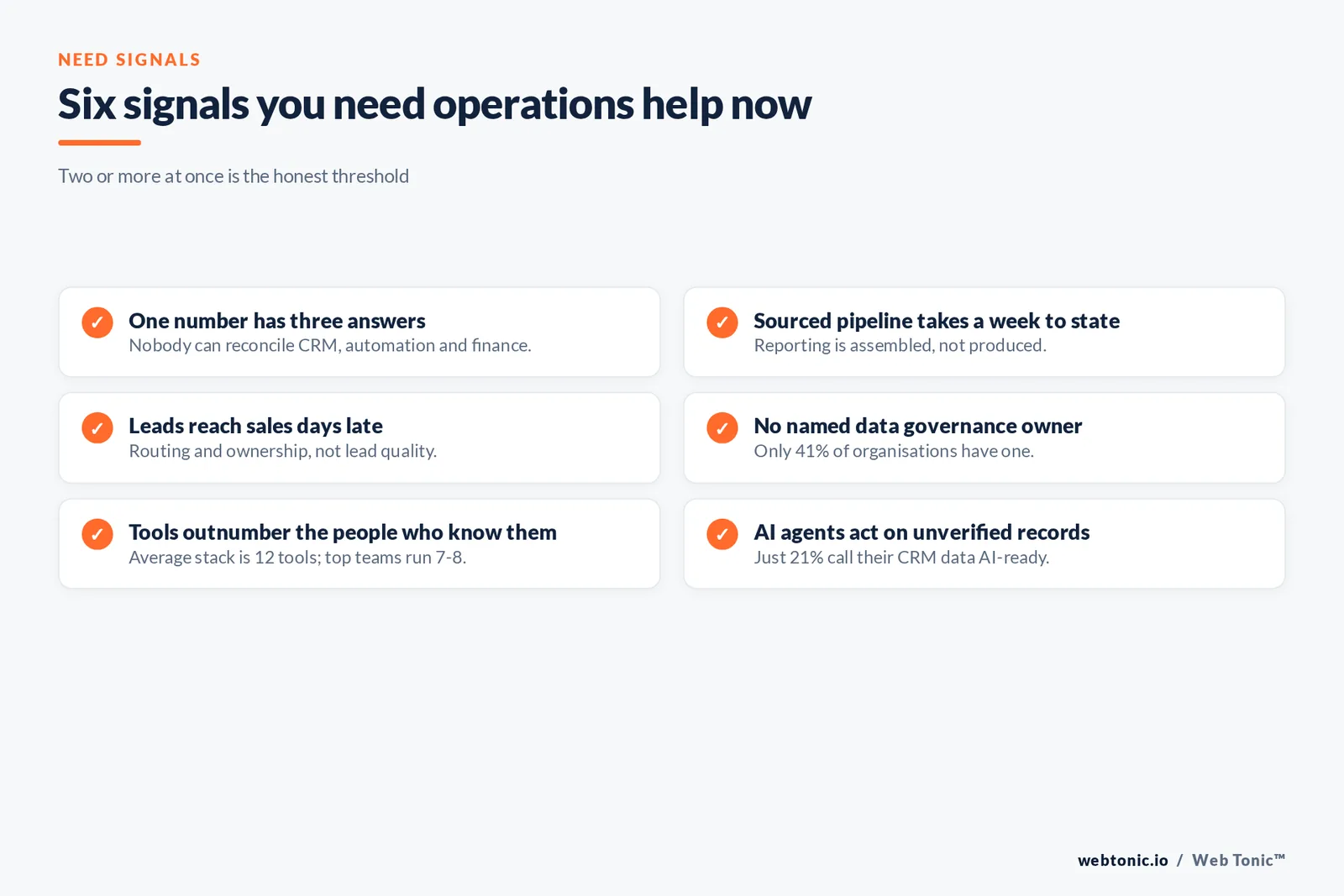
Two or more of the following at once is the honest threshold. One number has several answers depending on who exports it. Nobody can state, without a week of work, what pipeline your marketing sourced last quarter. Leads reach sales days after they convert, or reach the wrong owner. Your team spends more time assembling reports than reading them. A campaign cannot be launched without a manual list build. Finance and marketing disagree about revenue, and both are right within their own system.
There is a strong negative test too. If your problem is that not enough people know you exist, operations consulting will produce a beautifully instrumented view of a demand problem you already knew you had. Fix the constraint you actually have: demand generation belongs in growth marketing, message and offer belong in strategy, and operations belongs after there is something worth measuring — or alongside it, when spend is already large enough that measurement error is expensive.
Company stage shapes the answer. Under $5M ARR, a fractional operator for a defined build is usually right, and the 2026 buyer's guide recommends exactly that split — fractional under $5M, a service pod between $5M and $100M, in-house above it. Above that, the argument shifts from whether to buy the function to how much of it stays external. Either way, the sequencing rule is unchanged: fix the data before you buy anything that depends on it.
What it costs, roughly
Published pricing is unusually transparent for a consulting category, because a handful of firms publish rate cards. A 2026 study of seventeen named RevOps consultancies found only four publishing usable numbers and ten publishing nothing at all. Where hours are disclosed, the arithmetic is flat: five tiers from $9,850 a month for 10 hours a week to $27,000 for 30, working out to $208–$227 an hour, with the discount from the smallest tier to the largest only 8.6%. One firm publishes $5,499 a month for 32 hours, or $172 an hour.
Market bands from the same buyer's guide: solo fractional at $3,500–$10,000 a month for 3–10 hours a week, a mid-tier pod at $9,800–$15,000, a full pod at $15,000–$27,000, and one-time project consulting at $15,000–$75,000 for audits and migrations. The practical floor for ongoing support sits near $1,500–$2,000 a month, below which the included hours only cover small fixes.
Two buying notes that save money. First, ask what the retainer buys: capacity or outcomes. A flat hourly rate across tiers tells you it is capacity, which is fine if you know what to point it at. Second, insist the scope name the deliverables that stay yours — documented data model, named internal owner, reporting definitions — because an engagement that leaves no artefacts has to be repurchased every year.
| Situation | Right shape of help | Typical monthly band |
|---|---|---|
| Reports disagree, no owner | Fixed-scope audit and data model build | $15,000–$75,000 one-time project |
| Under $5M ARR, one system | Solo fractional operator | $3,500–$10,000 |
| $5M–$100M, multi-system | Small pod with strategist plus specialist | $9,800–$15,000 |
| Migration or replatform | Full pod, fixed end date | $15,000–$27,000 |
| Light maintenance only | Capped support retainer | $1,500–$3,750 |
| Above $100M ARR | In-house team, external specialists | Blended |
How a good engagement is sequenced
The order is not negotiable, and it is the clearest signal of a serious provider. Access and inventory first: systems, integrations, field definitions, who owns what. Then measurement: verify that conversions, pipeline stages and revenue tie out before touching a workflow, because every later decision inherits this arithmetic. Then the data model and hygiene, then process and routing, then reporting, then automation. Automation built on an unverified model simply industrialises the error.
Governance is the step teams skip. With only 41% of organisations having a named data governance owner, most engagements have to create the role as part of delivery — a person, a cadence, and a short list of rules about required fields and record creation. Continuous automated monitoring is what marketers themselves say would raise their confidence most, cited by 39% overall and 47% of C-suite respondents, ahead of platform consolidation at 23%.
Finally, insist on a handover. The measure of a finished engagement is that your own team can run the month-end reporting, explain each definition, and change a routing rule without a support ticket. That is how we scope marketing operations consulting, sitting on top of the measurement work in data intelligence — and it is why the first deliverable is usually a document, not a dashboard.
What good looks like six months in
You should be able to answer four questions from one place: what did we spend, what did it produce, which of that closed, and how long it took. Pipeline coverage and velocity — pipeline generated per dollar of sales and marketing spend, named the top RevOps metric for 2026 — should be reportable without a manual export. Lead response should be measured in minutes, not days. And the number of tools should have gone down or stayed flat while the number of things you can prove has gone up.
Expect the diagnostic phase to be uncomfortable. Audits routinely reveal that a well-liked channel was over-credited by last-touch, or that a segment everyone believed in is 30% duplicates. The teams that get value are the ones that treat those findings as savings rather than accusations. The teams that do not usually end up with the outcome practitioners complain about most: more meetings and more dashboards, and the fundamentals untouched.
One structural warning. AI does not reduce the need for this work; it raises the price of skipping it. With two out of three organisations increasing the marketing decisions delegated to autonomous agents in the past year, and only 21% confident their CRM data is ready, an unmanaged data model is now an execution risk rather than a reporting inconvenience. More on the operating side of growth sits across the blog, and if you want a read on your own stack, start there.

Related reading
- Fractional CMO for SaaS: what it is and when you actually need one
- Marketing Audit / Growth Audit: what it is and when you actually need one
- Marketing Strategy Consulting: what it is and when you actually need one
- Marketing Strategy Consulting services at Web Tonic
Frequently Asked Questions
Is marketing operations consulting the same as RevOps consulting?
They overlap heavily. Marketing operations focuses on the marketing system — automation, lead lifecycle, campaign infrastructure and marketing reporting. RevOps extends the same discipline across sales and customer success, and often into billing and revenue reporting. Most providers sell both under one name, so read the scope rather than the label.
How long does an engagement take to show results?
Diagnostic findings arrive in weeks; trustworthy reporting usually takes one quarter; changes in win rate, cycle length and cost per acquisition show up over two or three. There is no neutral market survey on typical engagement length — every published duration comes from a provider's own contract terms, so treat quoted norms with scepticism.
Do we need clean data before hiring a consultant?
No, but you need to expect data work to be the first phase and to be funded. Survey data puts 99% of RevOps teams struggling with technical data issues, and 71% of those who rated their data "good enough" still said quality hurt execution. Anyone who promises attribution before hygiene is selling the wrong sequence.
Can a small company justify this?
Under roughly $5M ARR, usually as a bounded project rather than a retainer: one operator, a defined build, a documented handover. The fixed cost of a full pod rarely makes sense before the revenue complexity does — and only 41% of companies under $5M ARR run a dedicated function at all.
What should the contract contain?
A written scope tied to deliverables, exit criteria, published or disclosed hours, a named internal owner on your side, and the artefacts you keep: data dictionary, reporting definitions, process documentation and admin access. Demand published pricing and a statement of work with exit criteria before signing anything.
Sources
Prospeo (Revenue Operations Services: 2026 Buyer's Guide), SyncGTM (2026 RevOps Report, 1,200+ companies), RevPack (fractional RevOps pricing study, seventeen consultancies, July 2026), Validity via PR Newswire (State of CRM Data Management in 2026, 500 respondents), GrowthSpree (B2B SaaS attribution accuracy benchmarks 2026), EOI Digital (attribution audit findings 2026), HubSpot (RevOps vs Sales Ops; marketing operations tech stack audit checklist), Digital Applied (Martech Statistics 2026), Konabayev (martech stack benchmarks 2026), Accenture (Simplify and Scale with Revenue Ops), Fullcast (RevOps growth analysis). Accessed September 2026.