Table of contents

A single-channel marketing audit generally runs $2,500 to $7,500 in 2026, and a genuine multi-channel audit $8,000 to $25,000 or more. The useful question is not the fee but what the audit is expected to find — measured against audited accounts, the waste it recovers is usually larger than the price.
Key Takeaways
- Market ranges: $2,500–$7,500 for one channel, $8,000–$25,000+ for a comprehensive audit across paid, organic, email and analytics.
- Bought by the unit instead of the project, the same work prices at $150–$500 an hour (average near $325), $1,500–$3,500 a day, or $12,000–$30,000 as a four-to-eight-week sprint.
- The benchmark finding is waste: 34.0% average wasted spend across 104 B2B SaaS Google Ads accounts and $78.5M of spend, with the best-managed quartile at 13.2% and the worst at 49%.
- Waste is concentrated. Two root causes — broad match without negatives, and Performance Max without offline conversions — account for 56% of it.
- Measurement is the usual culprit: 91% of audited accounts had no click-ID-to-CRM connection, and default 7-day attribution captured only 5–15% of revenue against an 84-day median sales cycle.
- Older large-sample data agrees on direction: across 2,167 audited accounts, 57.7% had conversion tracking and only 50.1% of those tracked anything meaningful.
- Scale decides the verdict. On $920K of annual spend, a 34% waste rate is roughly $313K a year — which reframes a five-figure audit as a rounding error.
The published price bands
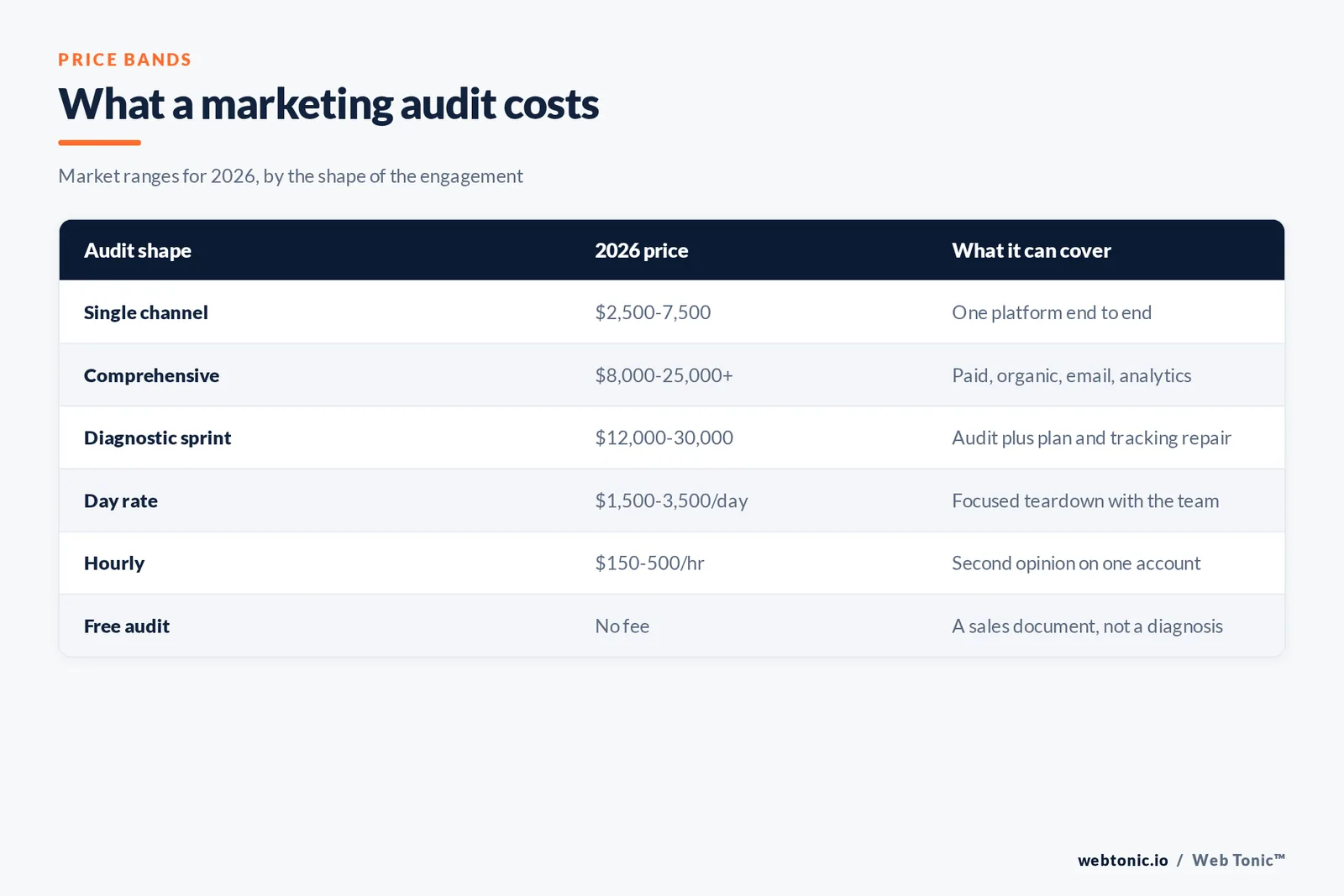
Audit pricing is more transparent than most consulting because the scope is finite. One 2026 cost breakdown puts a single-channel review — paid media only, or SEO only — at $2,500 to $7,500, and a comprehensive multi-channel audit covering paid, organic, email and the analytics layer at $8,000 to $25,000 or more. The gap between those bands is not thoroughness within a channel; it is how many systems have to be reconciled against each other.
The same work is also sold by the unit, which is how to sanity-check a project quote. 2026 rate data prices audits and planning sessions at $1,500–$3,500 a day and advisory hours at $200–$500, while broader consultant fee data puts senior growth rates at $150–$500 an hour with an average near $325. Mid-market benchmark data prices a defined four-to-eight-week diagnostic sprint at $12,000–$30,000 total. Divide any project fee by plausible hours: an $8,000 audit implies roughly 25–40 senior hours, which is a real review. A $1,200 audit implies a tool export with a cover page.
| Audit shape | 2026 price | What it can honestly cover |
|---|---|---|
| Single channel | $2,500–$7,500 | One platform end to end: structure, targeting, creative, tracking |
| Comprehensive, multi-channel | $8,000–$25,000+ | Paid, organic, email, analytics and how they reconcile |
| Diagnostic sprint, 4–8 weeks | $12,000–$30,000 | Audit plus a prioritised plan and measurement repair |
| Day rate | $1,500–$3,500 / day | A focused teardown with the team in the room |
| Hourly | $150–$500 / hr | Second opinion on a specific account or metric |
| Free audit | No fee | A sales document; useful only as a sample of judgement |
What the fee is measured against
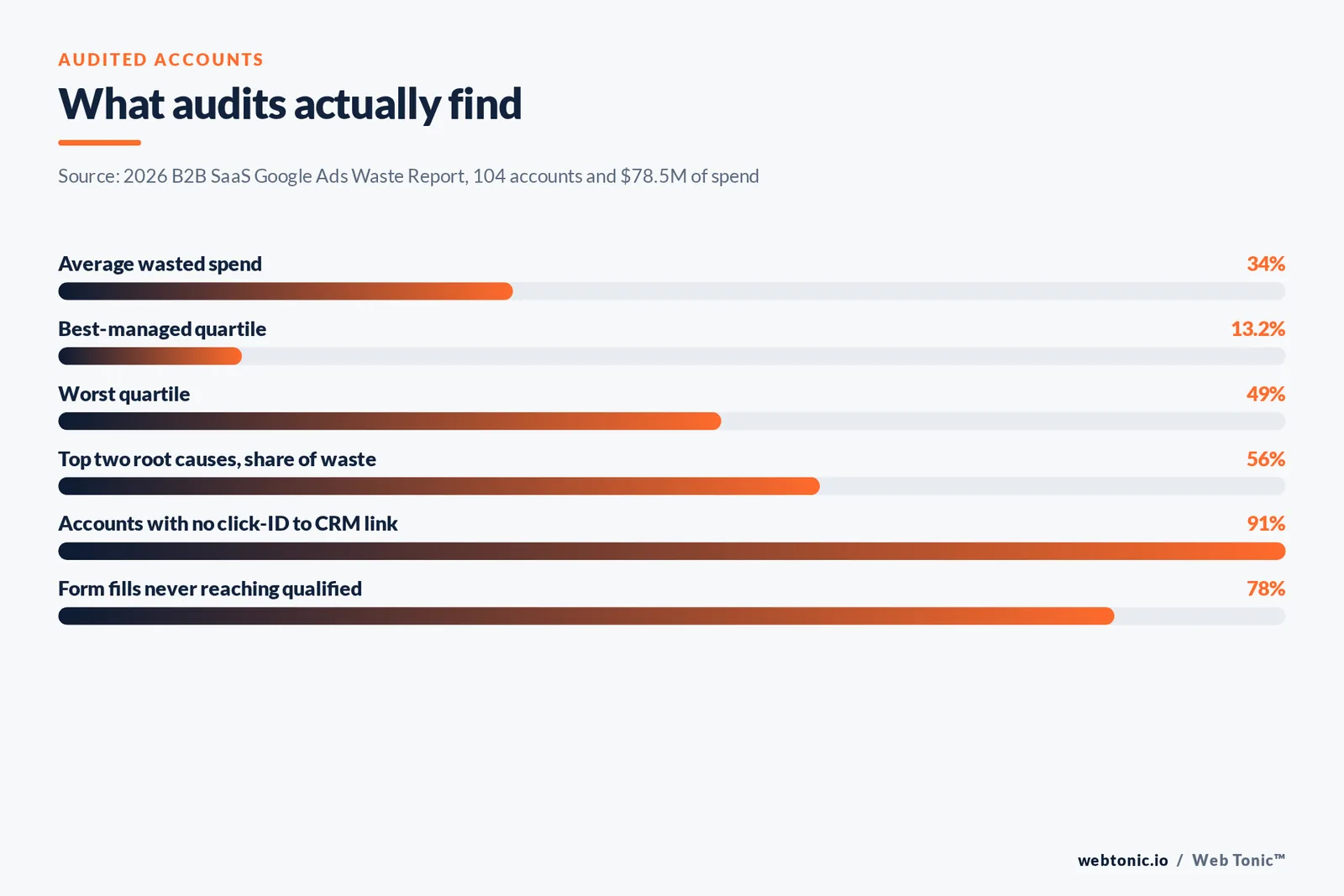
An audit is only worth its price if it finds money. The clearest current dataset is the 2026 B2B SaaS Google Ads Waste Report, built on 104 enterprise accounts and $78.5M of spend: average waste of 34.0%, with the best-managed quartile at 13.2% and the worst at 49%. Its own framing is the important part — waste is a management problem rather than a platform problem, which is exactly what a diagnostic can act on.
The waste is also concentrated enough to be fixable. Two causes, broad match without negative-keyword discipline and Performance Max without offline conversions, are 56% of the total. Measurement failures dominate the rest: 91% of accounts had no click-ID-to-CRM connection before audit, default 7-day attribution captured only 5–15% of revenue against an 84-day median sales cycle, and 78% of form fills never reached sales-qualified status — so bidding was trained on the wrong signal. By funding stage, Series A accounts averaged 42% waste; by vertical, AI/ML SaaS led at 39.5%.
| Audited-account benchmark | Figure | What it implies for the fee |
|---|---|---|
| Average wasted spend | 34.0% of spend | On $920K a year, roughly $313K is recoverable |
| Best vs worst quartile | 13.2% vs 49% | Management discipline, not budget size, sets the gap |
| Top two root causes | 56% of all waste | A narrow audit can still recover most of it |
| No click-ID-to-CRM link | 91% of accounts | Measurement repair belongs in scope, not after it |
| Conversion tracking quality | 57.7% tracked, half meaningfully | Assume the baseline is wrong until proven |
| Waste-to-CPA sensitivity | +10% waste, +44–72% cost per conversion | Small waste reductions move efficiency hard |
Why tracking quality drives the price
The single biggest variable in an audit quote is whether the measurement layer can be trusted. A study of 2,167 audited Google Ads accounts found 57.7% had some conversion tracking, but only 50.1% of those were tracking anything meaningful — and it quantified the consequence: for every 10% increase in wasted ad spend, cost per conversion rose 44–72%. When tracking is broken, an auditor cannot simply read the account; they have to rebuild the baseline first, and that is billable work.
The same problem shows up further upstream. Conversion-tracking guidance catalogues the failure modes an audit has to rule out before any recommendation is safe — duplicate tags, unfiltered internal traffic, goals that count form views rather than qualified outcomes. And wasted-spend research puts the macro picture around it: an industry study of log-level data from 21 major advertisers found only 36 cents of every dollar entering a demand-side platform reaches the consumer, an efficiency gap sized at $22 billion, while 59% of CMOs report insufficient budget against marketing budgets flat at 7.7% of company revenue.
What a fair quote includes
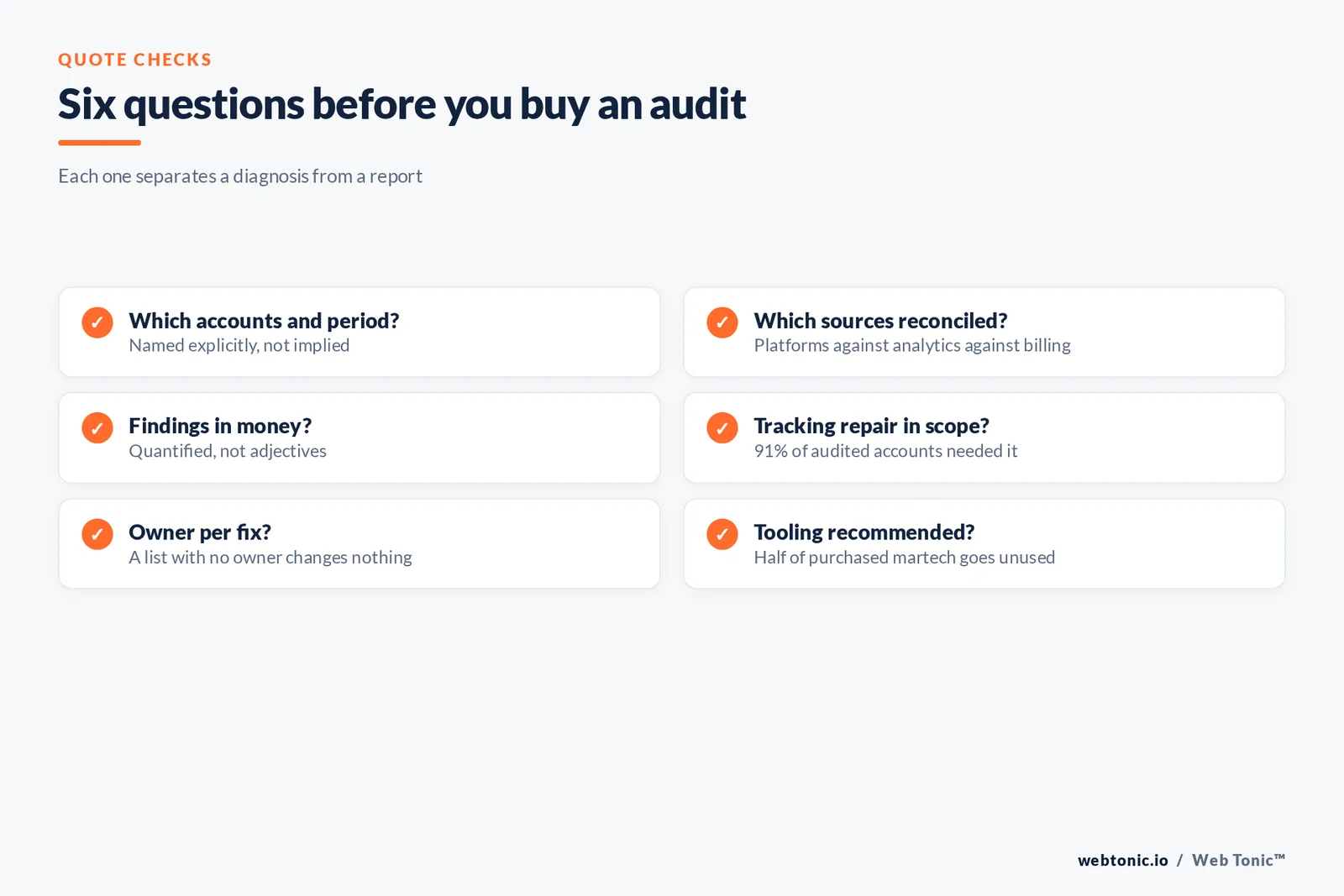
Scope, not adjectives, decides value. A defensible audit states the period reviewed, the platforms and accounts in scope, and the data sources it will reconcile — ad platforms against analytics against billing. It quantifies findings rather than listing them: not "negative keywords need work" but "broad match consumed this share of spend and produced this share of qualified leads". Marketing audit frameworks and practitioner guides both converge on the same deliverable: severity-ranked findings, an owner per fix, and a sequence.
Two exclusions to watch. Tooling is frequently sold as a finding — the same 2026 analysis cites joint academic and industry research that companies spend nearly 20% of marketing budget on martech while only about half of the tools purchased are used, so "buy this platform" is rarely the honest conclusion. And implementation is not an audit: if the fee includes execution, you are buying a retainer with a diagnostic attached, which may be right, but should be priced and judged as such. Our own growth audit is deliberately fixed-fee and time-boxed to seven days so the finding list arrives before anyone spends on fixes.
Buy or run it yourself?
There is a third option worth naming: a paid diagnostic from the provider you are considering for ongoing work. It costs more than a free audit and less than a full comprehensive review, and it tells you two things at once — what is wrong, and whether you want to work with the people who found it. Treat the written output as the sample: quantified findings and honest uncertainty are the signal; confident recommendations with no evidence attached are the opposite.
Doing it internally is legitimate and costs time instead of fee. Budget 25–40 hours of senior attention for one channel, plus access to billing, every ad platform, analytics and the CRM. The two things internal audits usually miss are the ones an outsider is paid for: comparison against many accounts, and the willingness to write down an uncomfortable finding about a channel someone internally championed.
The decision usually turns on spend. Below roughly $10,000 a month in media, a single-channel review at $2,500–$7,500 is proportionate and a comprehensive audit is not. Between $10,000 and $100,000 a month, the waste benchmark of 34% makes even the top of the comprehensive band an easy arithmetic case. Above that, the audit is usually less about recovering media waste and more about the measurement chain feeding it, which is where our data intelligence work sits. See our full service list for how a diagnosis hands off to execution, and read more in our marketing resources.
Five things that move an audit quote
Account count comes first. One ad account on one platform is a bounded review; five accounts across three platforms, two regions and a legacy analytics property is a reconciliation project, and reconciliation is where the hours go. History depth is second: reviewing 90 days is enough to judge current management, but judging a trend against an 84-day median sales cycle needs 12 to 24 months of data, which multiplies the export and cleaning work.
Tracking state is the biggest swing factor and the hardest to see from outside — with 91% of audited accounts missing a click-ID-to-CRM connection, assume repair is in scope until someone proves otherwise. Lead-quality access matters for anything B2B: an audit that cannot see which leads became qualified is grading form fills, and 78% of form fills never reach qualified status in the benchmark dataset. Deliverable depth closes the list: findings alone sit at the bottom of the band, while findings plus a sequenced 90-day plan and rebuilt measurement sit at the top.
Two of these five you can cut for free. Narrow the platforms to the ones carrying real spend, and hand over clean access on day one rather than in week two — access delays are the most common reason a two-week audit becomes a five-week invoice.
Reading the quote you have in hand
Ask four questions before signing. Which accounts and which period, named explicitly? Which data sources will be reconciled against each other, and what happens if they disagree? Will findings be quantified in money rather than described? And who owns the fixes afterwards — because an audit that hands over a list with no owner produces a document, not a recovery.
Then judge the fee against your own scale rather than against other quotes. At $920K of annual media, the worked example in the waste dataset puts recoverable spend near $313K, and rising click costs make the gap compound rather than stay flat. Against that, the difference between a $6,000 and a $14,000 audit is not the decision that matters; whether the audit rebuilds the measurement layer is.
Which channels belong in scope
Most quotes are really a list of channels, so decide the list before reading the price. A PPC audit covers account structure, keyword and search-term hygiene, negatives, bidding and conversion actions. An SEO audit splits into technical crawl issues on the website, content quality and internal linking, and the keyword-to-page mapping that decides whether traffic has any commercial intent. A website and analytics review checks the conversion paths and whether the tracking behind them survives inspection.
Two others are frequently skipped and frequently where the money is. Email and lifecycle work is cheap to audit and often carries the best recoverable revenue per hour of analysis. And vendor review — what agencies and tools are contracted to deliver against what they report — is uncomfortable but belongs in a professional diagnosis. If a provider's scope covers only the channel they also sell, treat their strategic insights accordingly: the useful audit is the one willing to conclude that a channel should shrink.

Frequently Asked Questions
How much should a small business pay for an audit?
For one channel, $2,500–$7,500 is the market band. Ask what portion of the fee covers rebuilding tracking; if the answer is none and your tracking is broken, the findings will inherit the errors.
Are free audits worth taking?
As a sample of judgement, sometimes. As a diagnosis, no — a free audit is a sales document, and the checks that take real hours (reconciling platforms to billing, cohort-level retention) are exactly what gets skipped.
How long should an audit take?
One channel: one to two weeks. Multi-channel: two to four. A defined sprint that includes measurement repair and a plan runs 4–8 weeks. Anything promising a full audit in 48 hours is reading dashboards, not data.
What deliverable should we insist on?
Severity-ranked findings with the evidence attached, a named owner per fix, and a sequence. A slide deck with no owners produces no change, regardless of the quality of the analysis.
How do we know it paid for itself?
Set the baseline before the work starts — cost per qualified outcome and the waste share by channel — then re-measure at 90 days. Given that 10% less waste can cut cost per conversion by 44–72%, the effect should be visible. Talk to our team if you want the baseline defined first.
Sources
What a marketing audit actually costs · 2026 B2B SaaS Google Ads Waste Report · Lessons from 2,167 audited Google Ads accounts · Wasted marketing spend research · Marketing audit framework · Marketing audit guide · Google Ads conversion tracking failures · 2026 advisory rate data · Growth consultant cost benchmarks · 2026 mid-market pricing benchmark.