



Table of contents
In-house marketing capability is expanding fast, yet hybrid structures still lead B2B at 35%. That combination is the whole hire-or-outsource question, and a marketing audit sits on the one side of it where outsourcing is structurally justified. Here is the 2026 data.
Key Takeaways
- 66% of client firms keep at least 26% of marketing work in-house.
- 60% now have some in-house agency capability, up from 40%.
- Capability emphasis splits 59.5% build, 38.5% partner, 1.9% buy.
- Hybrid structures lead B2B outsourcing at 35%.
- Project engagements are 28%, retainers 24%, freelancers 12%.
- Bandwidth at 22% and speed at 18% are the top outsourcing reasons.
- Expertise is cited by 15% and cost efficiency by 13%.
- 33.6% of digital marketing activity is delivered externally.
- Average CMO tenure is 4.1 years against 5.0 for the C-suite.
- 31% of companies have no CMO; 77% of hires land within six months.
- Fractional demand grew 149% year on year.
- External agencies used generative AI at 61% against 17% in-house.
- Marketing headcount growth fell 50% year on year.
The in-housing trend is real, and it is not the whole story
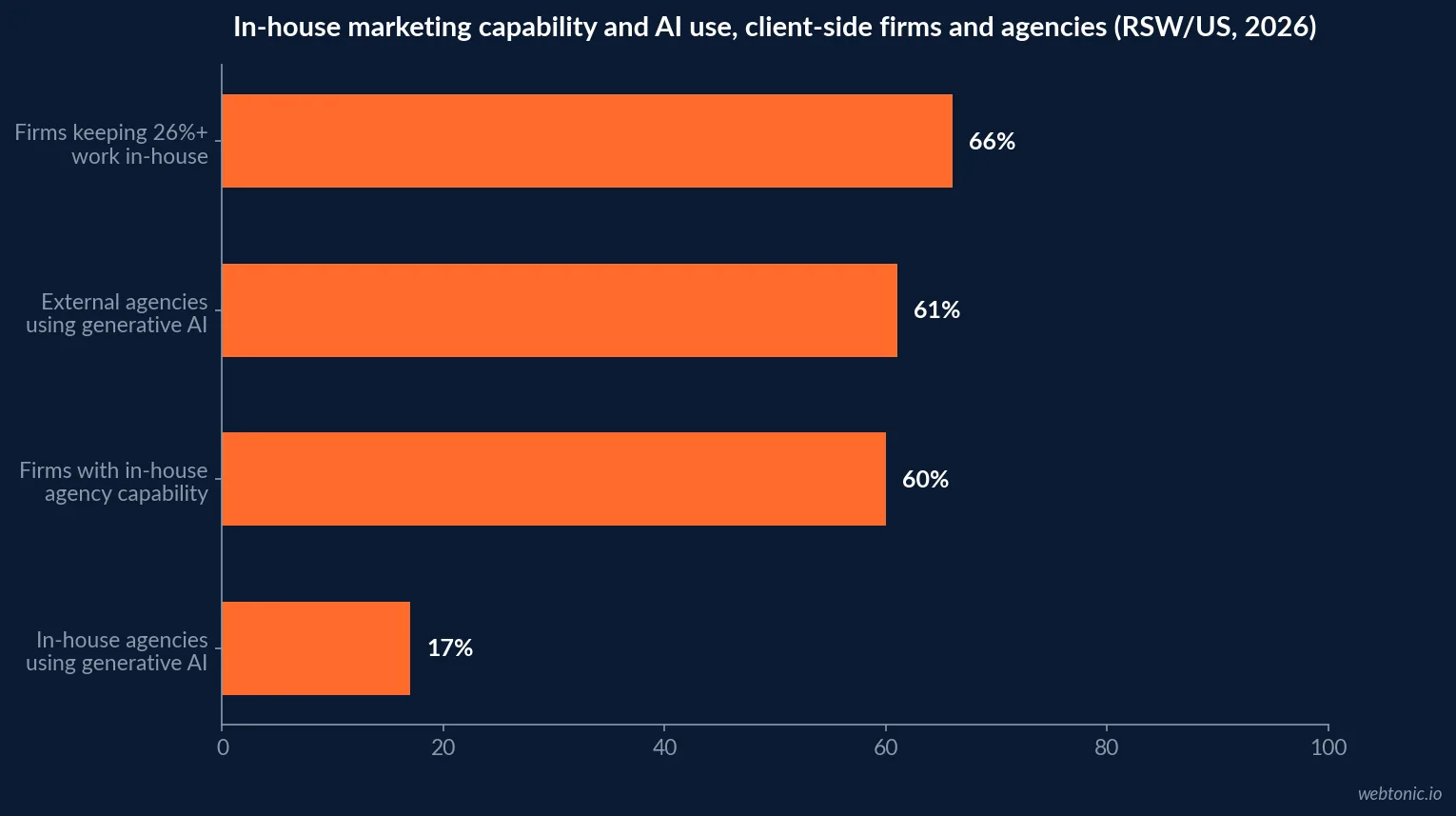
RSW/US's 2026 New Year Outlook reports 66% of client-side firms keeping at least 26% of their marketing work in-house and 60% now having some in-house agency capability against 40% a year earlier. The same report finds roughly 61% of external agencies used generative AI in 2025 against 17% of in-house agencies.
That last pair is the nuance that gets lost. Capacity moved inside faster than capability did, which is precisely the condition an audit is designed to test: whether the team now owning the work has the tooling and the measurement to run it.
| Measure | Prior year | 2026 | Direction |
|---|---|---|---|
| Firms keeping 26% or more work in-house | Not reported | 66% | Capacity moving inside |
| Firms with in-house agency capability | 40% | 60% | Up 20 points |
| External agencies using generative AI | Not reported | About 61% | Ahead of in-house |
| In-house agencies using generative AI | Not reported | 17% | Behind by a wide margin |
| Capability emphasis on building internally | 57.9% in 2020 | 59.5% | Slow structural shift |
What the capability split actually looks like
The CMO Survey 2026 puts capability emphasis at 59.5% building internally, 38.5% partnering and 1.9% buying, with the partner share splitting into agencies at 15.5%, consultancies at 12.7% and other partners at 10.4%. Build emphasis has risen from 57.9% in 2020. Externally delivered digital activity stands at 33.6%, up from 31.6% two years ago and projected at 34.3% in two years.
By business model the spread is wide: B2B product 28%, B2B services 25%, B2C product 48% and B2C services 44%, and by sector retail 57%, consumer packaged goods 55%, technology 28%, media 10% and education 3%. Sectors most likely to build internally are education at 83.0%, consumer services at 73.3%, professional services at 70.0% and firms under USD 10 million in revenue at 64.1%.
| Segment | Externally delivered digital activity | Implication for an audit |
|---|---|---|
| All firms | 33.6% | A third of the data sits with partners |
| B2C product | 48% | Audit partner reporting first |
| B2C services | 44% | Reconcile agency and internal numbers |
| B2B product | 28% | Most data is internal and auditable |
| B2B services | 25% | Internal ownership dominates |
| Retail | 57% | Partner contracts drive performance |
Why teams outsource, ranked
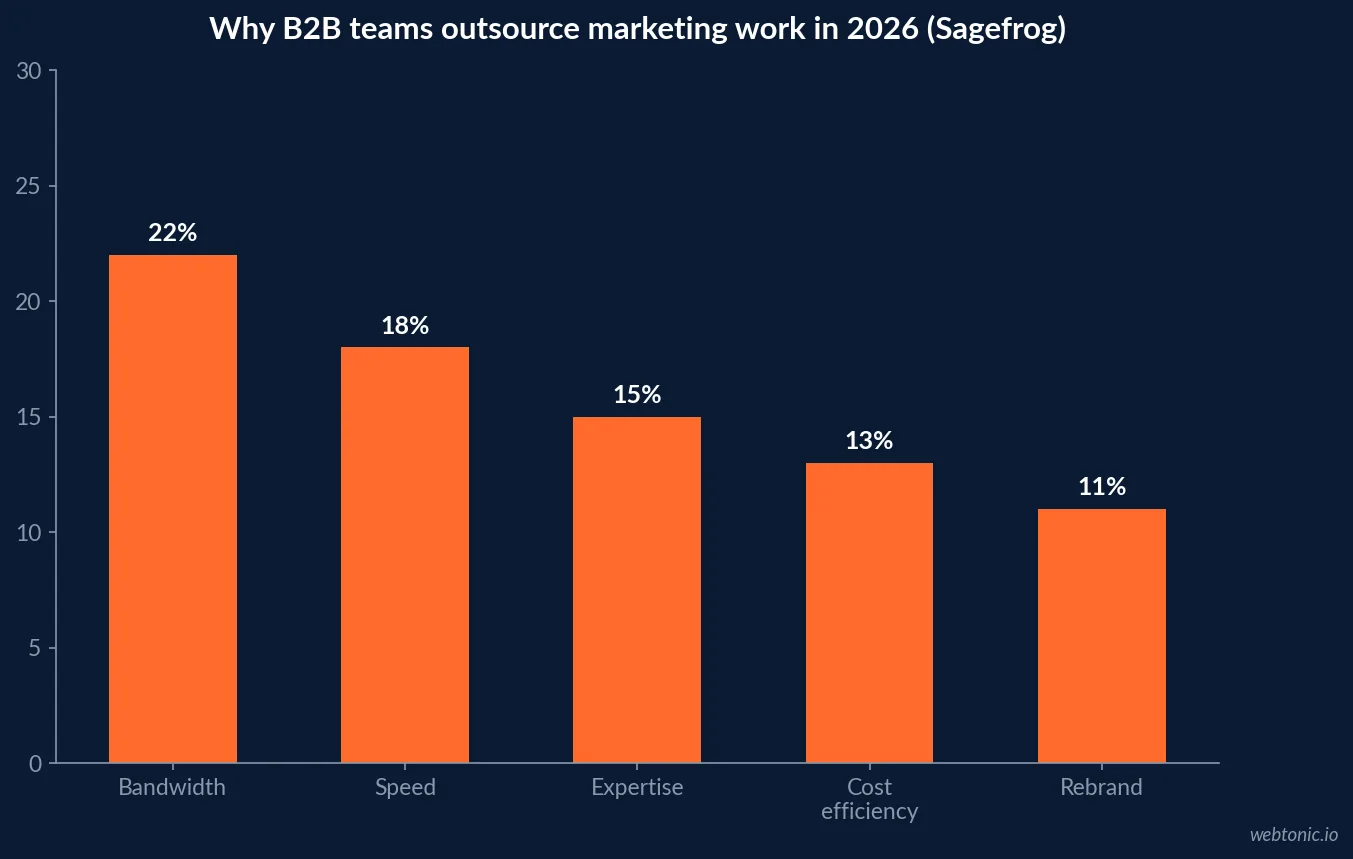
Sagefrog's 2026 B2B Marketing Mix Report reports the structures in use - hybrid 35%, project 28%, retainer 24% and freelancers 12% - and the reasons: bandwidth 22%, speed 18%, expertise 15%, cost efficiency 13%, a rebrand 11%, fresh ideas 11%, a launch 8% and a transition 2%.
Note what is missing from the top of that list: cost. Bandwidth and speed together make up 40% while cost efficiency sits at 13%. Outsourcing in 2026 is a capacity decision, not a savings decision - which is why a cheap partner that consumes internal management time fails on the actual criterion.
| Reason to outsource | Share of B2B teams | Better bought as |
|---|---|---|
| Bandwidth | 22% | Retainer or embedded support |
| Speed | 18% | Project with a fixed end date |
| Expertise | 15% | Project or hourly advisory |
| Cost efficiency | 13% | Scoped project, never open-ended |
| Rebrand | 11% | Project engagement |
| Fresh ideas | 11% | Short diagnostic or audit |
The audit is the exception that favours outsourcing
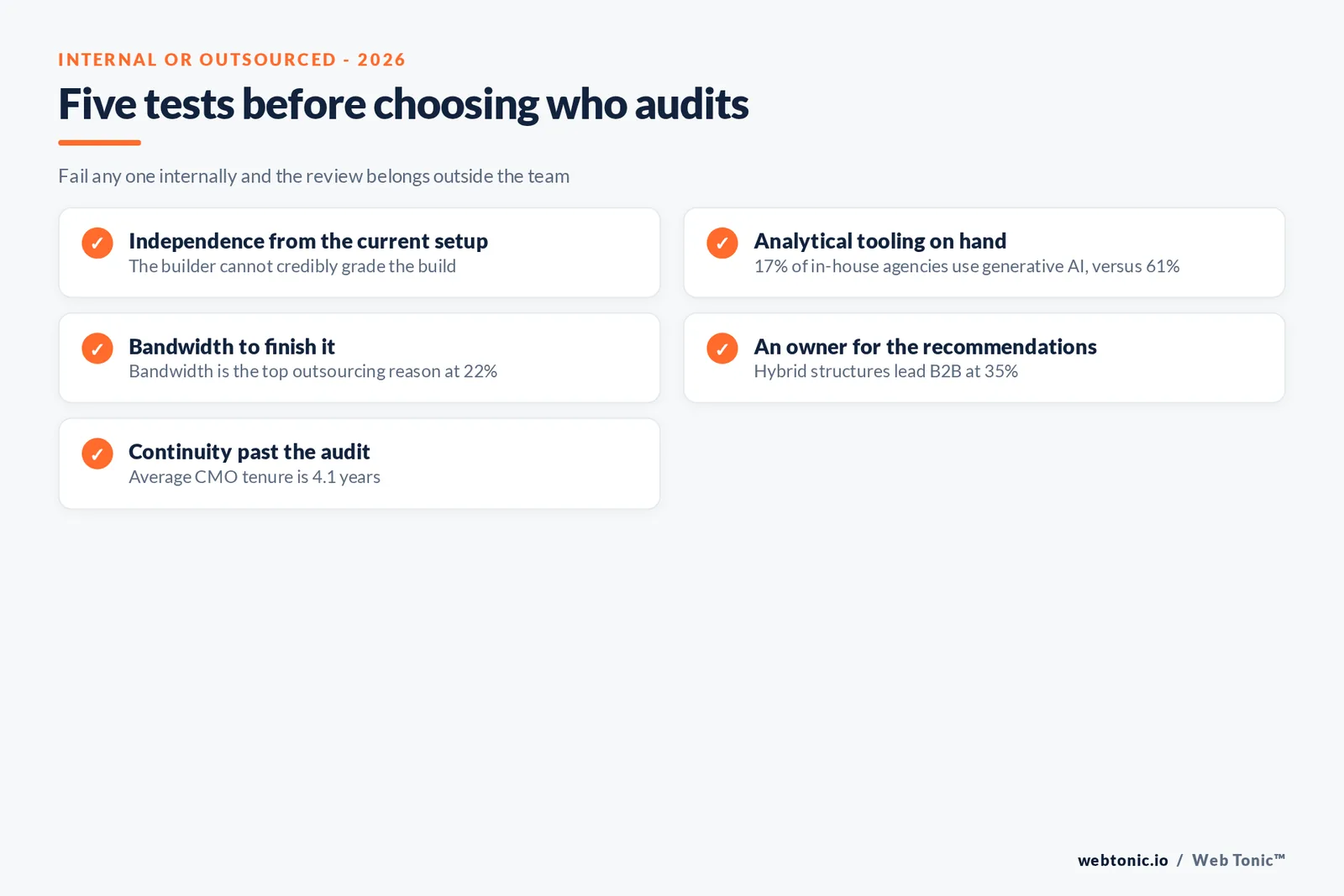
Most marketing work benefits from internal ownership. An audit does not, for one structural reason: the person who built the current setup cannot credibly grade it. Independence is the deliverable, and it is the only marketing output that gets worse when produced by the team being reviewed.
The secondary argument is tooling. With 17% of in-house agencies using generative AI against about 61% of external agencies, and training compressed to 3.8% of marketing spend, the analytical capacity for a thorough review is frequently missing inside. That is the gap our data intelligence practice is built to cover, without taking ownership of the plan away from the internal team.
| Work type | Better internal | Better external | Why |
|---|---|---|---|
| Owning the marketing plan | Yes | No | Continuity and institutional memory |
| Auditing the plan | No | Yes | Independence is the deliverable |
| Daily channel operations | Yes | Either | Speed of iteration |
| Specialist technical work | No | Yes | Depth is rented more cheaply |
| Measurement architecture | Either | Yes | Requires cross-account tooling |
| Brand and positioning reset | No | Yes | Outside view plus fixed scope |
The hiring side of the decision
If the conclusion is to hire, the tenure data should set expectations. Spencer Stuart's 2026 CMO tenure snapshot reports average tenure of 4.1 years against 5.0 years for the wider C-suite, with 31% of companies having no CMO and 77% of appointments filled within six months. The CMO Survey adds that marketing headcount growth fell 50% year on year.
Read together: the role turns over faster than the strategy it owns, and it is frequently vacant. A documented audit is the artefact that survives that turnover - which is a governance argument as much as an analytical one.
| Hiring data point | 2026 figure | What it means for the decision |
|---|---|---|
| Average CMO tenure | 4.1 years | Document the plan outside the person |
| Wider C-suite tenure | 5.0 years | Marketing turns over fastest |
| Companies with no CMO | 31% | Interim and fractional fill the gap |
| Appointments within six months | 77% | Define the role before the search |
| Marketing headcount growth | Down 50% year on year | Approval is harder than last year |
Auditing the partners you already have
Before the hire-or-outsource question is even live, most companies already have partners, and their performance is auditable. The CMO Survey 2026 puts the partner share of capability emphasis at 38.5%, split into agencies at 15.5%, consultancies at 12.7% and other partners at 10.4%, while 71% of leaders call agility a key capability and growth spending concentrates on market penetration at 56.4%, product development at 22.9% - up from 19.2% - and new markets at 14.1%, down from 17.0%, with 47.1% returning to established markets.
Two audit questions follow. First, is each partner scoped to the strategy the business is actually running - penetration work is a different brief from new-market entry. Second, can partner-reported numbers be reconciled against internal data, given that a third of digital activity sits outside. That reconciliation is the practical first step in any paid search relationship, internal or external.
| Partner type | Share of capability emphasis | Audit question to ask |
|---|---|---|
| Agencies | 15.5% | Are results reconciled against internal data? |
| Consultancies | 12.7% | Did the advice become an owned plan? |
| Other partners | 10.4% | Is the scope still current? |
| All external partners | 38.5% | Who is accountable for the total number? |
| Internal build | 59.5% | Does capability match the new capacity? |
The fractional middle ground
Between hiring and outsourcing sits rented seniority, and it is no longer a niche. The Fractional Work Report cites 149% year-on-year demand growth, roughly 150,000 US practitioners, marketing at about 20% of demand, 87% with 11 or more years of experience, 64% working with multiple clients and 90% saying they will not return to full-time work. Gartner has projected that more than 30% of midsize companies will use fractional executives by 2027.
For audit follow-through this matters: the recommendations need an owner. A fractional owner is often the cheapest way to hold a plan for two or three quarters while the business decides whether the permanent role is justified.
A decision sequence that avoids the expensive mistakes
The sequence below is the one supported by the data rather than by preference. It puts the diagnosis first because that is the cheapest step, and the permanent hire last because it is the most expensive to reverse. Channel-level questions - whether to run paid media internally, for example, as covered in our analysis of Facebook Ads ROI - only become answerable after step three.
If any step cannot be completed, stop there rather than skipping ahead. Independence, tooling and continuity are the three things to check in whoever runs the review, in that order.
| Step | Question to answer | Supporting 2026 data |
|---|---|---|
| 1. Diagnose | What is actually broken? | 33% cannot measure results properly |
| 2. Assign ownership | Who holds the plan weekly? | Hybrid structures lead at 35% |
| 3. Fill capability gaps | Bandwidth or expertise? | Bandwidth 22%, expertise 15% |
| 4. Rent seniority if needed | Is the role fundable yet? | Fractional demand up 149% |
| 5. Hire permanently | Is the scope proven and stable? | Tenure averages 4.1 years |
Related reading
- Marketing Audit / Growth Audit: vs hiring in-house
- Marketing Strategy Consulting Statistics: Hiring vs Outsourcing
- Marketing Team Structure Statistics: Hiring vs Outsourcing
- Marketing Strategy Consulting services at Web Tonic
Frequently Asked Questions
Should a marketing audit be done internally or externally?
Both have a place, but they answer different questions. An internal review is cheaper and better informed; an external audit supplies independence, which is the part that cannot be manufactured internally. The 2026 structural data explains why hybrids dominate: 35% of B2B teams use a hybrid structure, 28% run project engagements, 24% use retainers and 12% use freelancers. The pattern that works is an internal owner accountable for the plan with the diagnosis bought from outside.
Is in-house marketing capability still growing?
Sharply. RSW/US's 2026 New Year Outlook reports 66% of client-side firms keeping at least 26% of their marketing work in-house, and 60% now having some in-house agency capability against 40% the year before. The CMO Survey 2026 shows the same direction: 59.5% capability emphasis on building internally, 38.5% on partnering and 1.9% on buying.
What do companies actually outsource, and why?
Sagefrog's 2026 B2B Marketing Mix Report ranks the reasons: 22% bandwidth, 18% speed, 15% expertise, 13% cost efficiency, 11% a rebrand, 11% fresh ideas, 8% a launch and 2% a transition. Bandwidth and speed together account for 40% - which is an argument for outsourcing bounded work such as an audit, and against outsourcing the ownership of the plan.
Does hiring solve the problem an audit would diagnose?
Often not, and it is the most expensive way to find out. Spencer Stuart's 2026 data puts average CMO tenure at 4.1 years against 5.0 for the wider C-suite, with 31% of companies having no CMO at all and 77% of appointments filled within six months. Combined with mis-hire costs reaching 213% of salary and a Department of Labor floor of 30% of first-year earnings, the sequence that reduces risk is diagnose, define the role, then hire.
Is the fractional market a real alternative?
It is now large enough to treat as one. The Fractional Work Report cites 149% year-on-year demand growth and roughly 150,000 US practitioners, with marketing accounting for about 20% of demand, 87% of practitioners holding 11 or more years of experience, 64% working with multiple clients and 90% saying they will not return to full-time work. Gartner has also projected that more than 30% of midsize companies will use fractional executives by 2027.
Sources
RSW/US - 2026 New Year Outlook Report
The CMO Survey - Highlights and Insights Report 2026
Sagefrog - 2026 B2B Marketing Mix Report
Spencer Stuart - CMO Tenure 2026 Snapshot
Fractional Jobs - The Fractional Work Report
Vendux - Ten Numbers on Fractional Executives in 2026


