Table of contents
No vendor publishes an SMS engagement benchmark for manufacturing or industrial senders - every public report is built from ecommerce data. What is published, and verifiable, is what the channel costs per message, what registration costs before the first text ever goes out, and which compliance rules gate a plant-alert or delivery-notification program.
Key Takeaways
- One outbound SMS segment costs USD 0.0083 on Twilio's own long-code rate card.
- One outbound MMS costs USD 0.022 - roughly 2.7x an SMS segment.
- Carrier fees add about USD 0.0025 to USD 0.0045 per message on top of the segment price.
- A2P 10DLC Brand registration is a one-time USD 4.50 fee (The Campaign Registry).
- Standard Brand vetting adds a one-time USD 41.50 for most for-profit senders.
- Monthly campaign fees run about USD 1.50 to USD 10 depending on campaign type.
- SimpleTexting's entry plan is USD 39/mo for 500 credits, billed annually.
- Textedly's entry plan is USD 29/mo for 500 messages, scaling to USD 5,520/mo at 300,000.
- No SMS engagement benchmark exists for manufacturing or industrial senders - published data is ecommerce-only.
- The FCC's 2023 "one-to-one consent" SMS rule was vacated on January 24, 2025 and is not in force.
- The rest of the TCPA, including quiet hours, remains fully enforceable under 47 CFR 64.1200.
- CTIA's own Messaging Principles treat transactional texts as lower-friction than promotional broadcasts.
- Dedicated short codes start around USD 1,000/mo and take 6-8 weeks to provision (SimpleTexting).
- A failed-message processing fee of USD 0.001 applies only to messages that terminate as "Failed" (Twilio).
- Local number activation runs about USD 10/mo plus a USD 4 one-time fee on SimpleTexting.
What the industrial SMS budget line actually contains
Unlike email, SMS bills per message and per registration step, which means the real budget question for a plant, distributor, or industrial supplier is not "what does a text cost" but "what does it cost to be allowed to send one at volume." That is a different comparison than the general SMS marketing statistics hub covers for consumer brands, because industrial senders are almost always sending transactional traffic - dispatch confirmations, delivery windows, safety notices - rather than promotional campaigns.
On Twilio's own US pricing page, a single outbound SMS segment on a long code costs USD 0.0083, and an outbound MMS costs USD 0.022. Carrier fees are added on top and vary by destination: AT&T charges USD 0.0035, T-Mobile USD 0.0045, and most other carriers land near USD 0.004 per message, all per Twilio's own published carrier fee table.
| Message type (Twilio, long code) | Segment price | Typical carrier fee add-on | Effective per-message cost |
|---|---|---|---|
| Outbound SMS | USD 0.0083 | ~USD 0.0025-0.0045 | ~USD 0.011-0.013 |
| Inbound SMS | USD 0.0083 | ~USD 0.0025-0.0045 | ~USD 0.011-0.013 |
| Outbound MMS | USD 0.022 | ~USD 0.009-0.01 | ~USD 0.031-0.032 |
| Inbound MMS | USD 0.0165 | ~USD 0.009-0.01 | ~USD 0.025-0.026 |
| Failed message (any type) | USD 0.001 processing fee | n/a | Applies only to Failed status |
What a managed SMS platform costs instead of raw carrier rates
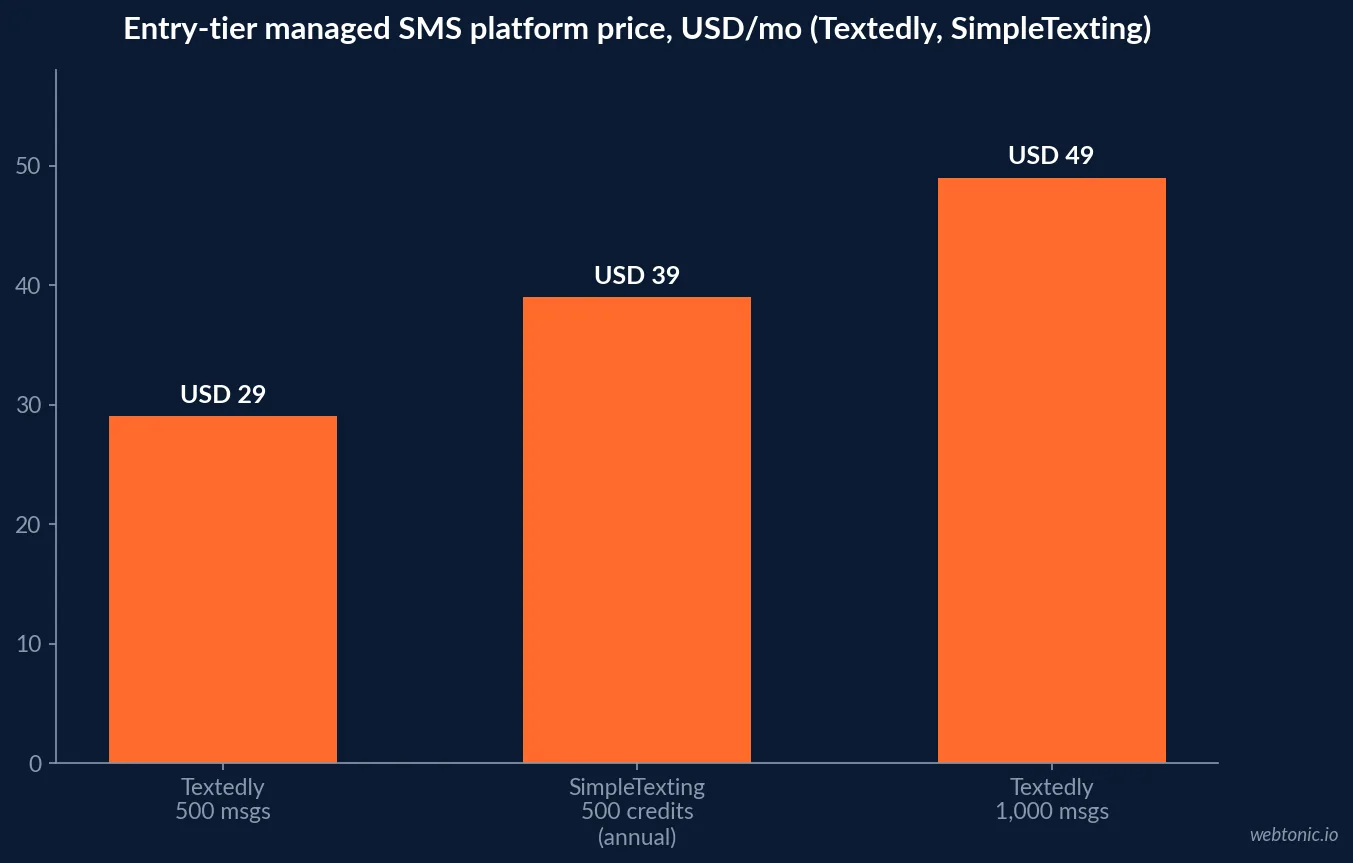
Most industrial senders do not build directly on Twilio; they buy a managed platform that bundles the segment cost into a flat monthly plan. On SimpleTexting's own pricing page, the entry plan runs USD 39 a month for 500 credits when billed annually, plus a local number at USD 10 a month and a USD 4 one-time activation fee; extra credits bill at 5.5 cents each. Textedly's own pricing page starts at USD 29 a month for 500 messages and scales in fixed steps up to USD 5,520 a month for 300,000 messages, with every tier including the same feature set.
| Plan (500-1,000 msg tier) | Monthly price | Notes | Source |
|---|---|---|---|
| Textedly Basic | USD 29/mo for 500 msgs | 20% more messages if billed yearly | Textedly |
| Textedly Bronze | USD 49/mo for 1,000 msgs | Same feature set as every tier | Textedly |
| SimpleTexting entry plan | USD 39/mo for 500 credits (annual) | +USD 10/mo local number, +USD 4 one-time | SimpleTexting |
| SimpleTexting dedicated short code | From USD 1,000/mo | 6-8 week provisioning | SimpleTexting |
| Extra SimpleTexting credits | 5.5 cents each | Rollover credits on monthly plans | SimpleTexting |
Registration is its own line item, and it comes before the first send
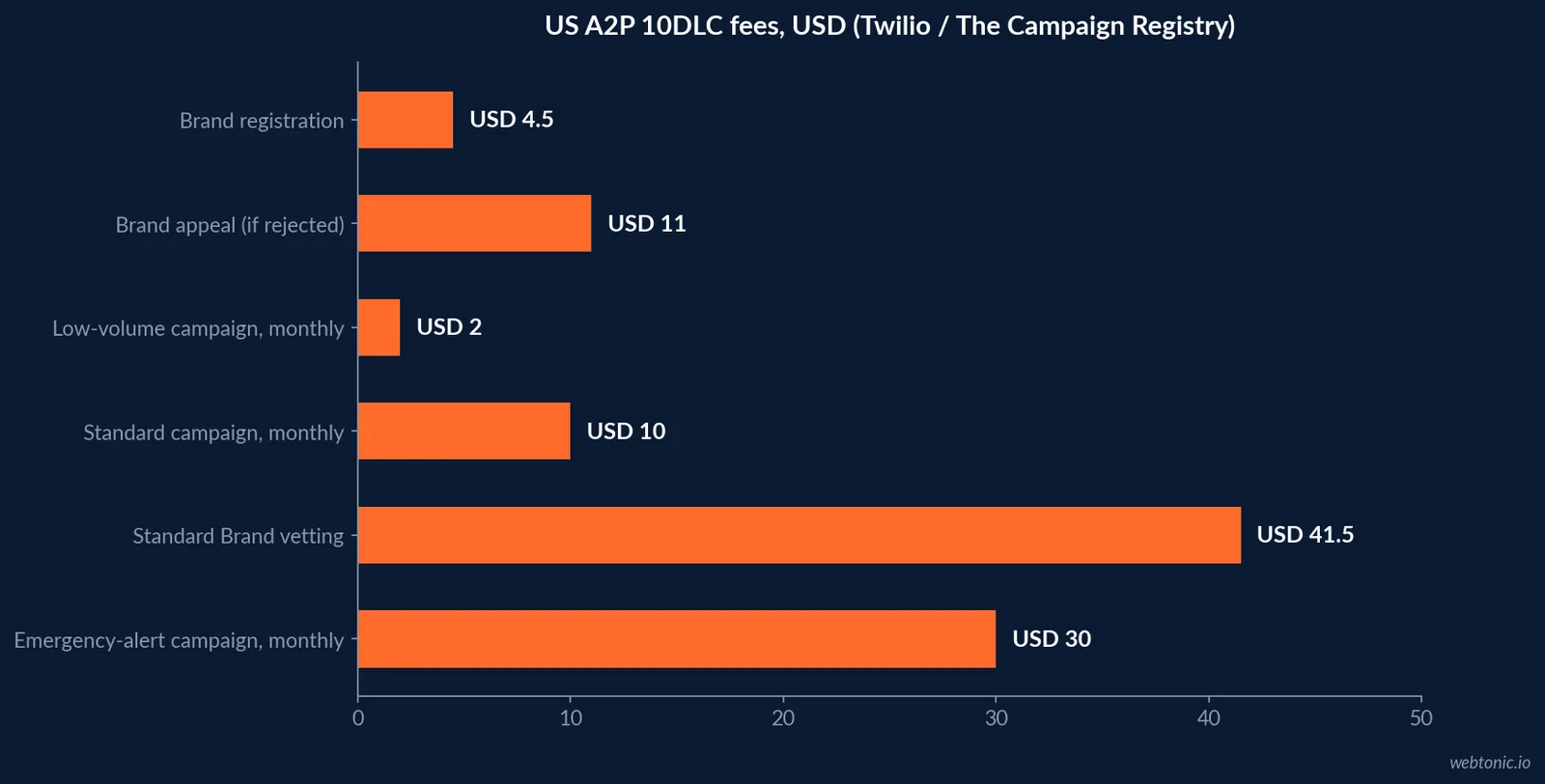
US carriers require every application-to-person sender on a long code to register under the A2P 10DLC framework before traffic is allowed through at meaningful volume. Per Twilio's own Brand registration documentation, creating a Brand carries a one-time USD 4.50 fee, and Standard Brand vetting - the tier most for-profit companies need - adds a one-time USD 41.50. On top of that, The Campaign Registry's own fee schedule charges an ongoing monthly Campaign fee that runs from about USD 1.50 for low-volume campaigns to USD 10 for most standard campaigns, and up to USD 30 for higher-scrutiny use cases like emergency alerts.
| Registration step | Fee | Frequency | Source |
|---|---|---|---|
| Brand registration | USD 4.50 | One-time | Twilio / The Campaign Registry |
| Standard Brand vetting | USD 41.50 | One-time | Twilio |
| Brand appeal (if rejected) | USD 11 | Per request | Twilio |
| Low-volume standard campaign | ~USD 2.00/mo | Monthly | The Campaign Registry |
| Standard (all other) campaign | ~USD 10.00/mo | Monthly | The Campaign Registry |
| Emergency-alert campaign | ~USD 30.00/mo | Monthly | The Campaign Registry |
The consent rule that changed, and the ones that did not
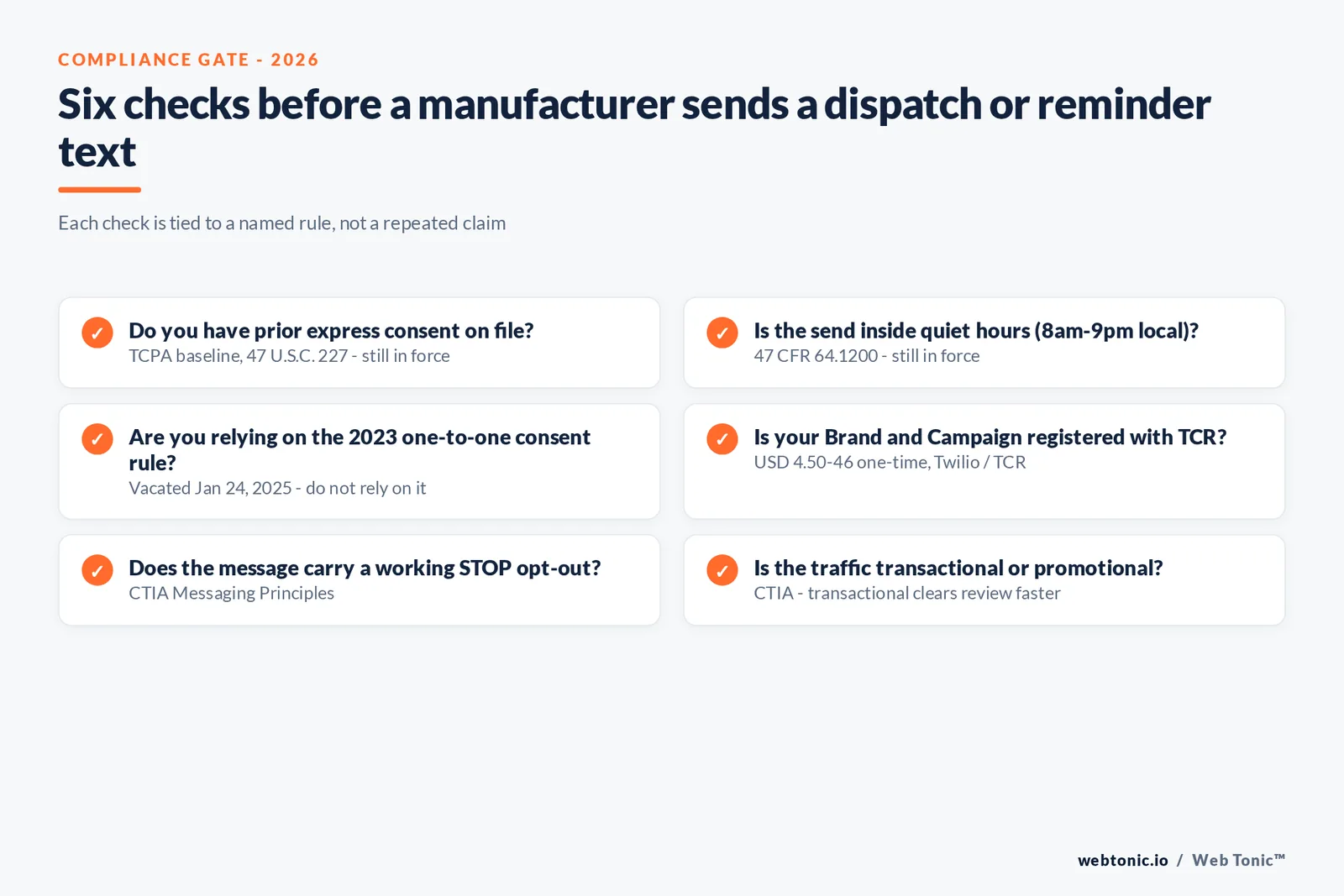
The single most-repeated compliance claim in SMS marketing content right now is wrong, or at least badly dated: the FCC's 2023 order requiring "one-to-one consent" for lead-generated SMS was vacated by the 11th Circuit Court of Appeals in Insurance Marketing Coalition v. FCC on January 24, 2025. The court found the provision conflicted with how the Telephone Consumer Protection Act itself defines consent. That means the one-to-one requirement is not currently in force - but nothing else about the TCPA changed. The underlying statute (47 U.S.C. 227, via Cornell Law School's Legal Information Institute) and its implementing rule, 47 CFR 64.1200, still govern quiet hours, required opt-out language, and the baseline consent standard every industrial sender has to meet.
Separately, CTIA's own Messaging Principles and Best Practices guide how carriers themselves police content, and they draw a clear line between transactional/informational traffic - dispatch confirmations, delivery updates, safety notices - and promotional campaigns, with the former facing materially less registration friction.
| Rule | Status as of this page | Governs | Source |
|---|---|---|---|
| FCC 2023 one-to-one consent order | Vacated Jan 24, 2025 - not in force | Lead-gen consent sharing across sellers | 11th Cir., Insurance Marketing Coalition v. FCC |
| TCPA baseline consent (47 U.S.C. 227) | In force | Prior express consent to receive texts | Cornell LII |
| 47 CFR 64.1200 quiet hours / opt-out | In force | Send-time windows, STOP handling | ecfr.gov |
| CTIA Messaging Principles | In force (carrier self-governance) | Content review, transactional vs. promotional | ctia.org |
| A2P 10DLC registration | In force | Sender identity verification before carrier delivery | Twilio / The Campaign Registry |
Where manufacturers actually use the channel
The recurring, defensible use cases in industrial SMS are almost all transactional rather than promotional, which also happens to be the traffic CTIA's own principles treat as lower-friction to register and send - talk to our team before you register a Brand if you are unsure which campaign type applies:
- Field-service dispatch and appointment confirmation - a technician's arrival window sent as a single segment.
- Shipment and delivery status - order and freight updates that displace an inbound support call.
- Plant and safety alerts - time-sensitive notices where a sub-second delivery speed matters more than open-rate optimization.
- Maintenance-visit reminders - the industrial equivalent of the appointment reminders that dental and med-spa senders run under their own HIPAA-adjacent rules.
- Two-way order confirmation - a reply-STOP-compliant thread that keeps a purchase order status visible without a portal login.
None of those five use cases has a published industrial engagement benchmark. Ecommerce vendors report figures like Klaviyo's 5.6% campaign click rate or Postscript's 17,000-store dataset, but those numbers describe consumer promotional texting, not a B2B dispatch confirmation - citing one for the other would be presenting an unrelated number as if it were a benchmark.
Building the per-message budget without an invented benchmark
Because no vendor prices "industrial SMS" as its own category, the responsible way to budget the channel is the same rate-card math carriers themselves use: segment cost, plus carrier fee, plus the registration cost amortized over your expected send volume, plus whatever the managed platform charges for the software layer on top. Our own data intelligence team builds that math per account rather than quoting a stock per-message price.
| Budget input | Published figure | Source | Role in the estimate |
|---|---|---|---|
| Per-segment carrier cost | USD 0.0083 + ~USD 0.003 carrier fee | Twilio | Variable cost per send |
| One-time registration (Brand + vetting) | USD 46.00 | Twilio | Amortize over first-year volume |
| Ongoing campaign registration | USD 1.50-10.00/mo | The Campaign Registry | Fixed monthly overhead |
| Managed platform software fee | USD 29-49/mo (500-1,000 msgs) | Textedly / SimpleTexting | Fixed monthly overhead |
| Published industrial engagement rate | None found | n/a | Do not substitute an ecommerce figure |
Manufacturing SMS budget at a glance
| Line item | Typical figure | Source |
|---|---|---|
| Cost per outbound SMS segment | USD 0.0083 + carrier fee | Twilio |
| Cost per outbound MMS | USD 0.022 + carrier fee | Twilio |
| A2P 10DLC one-time registration | USD 4.50-46.00 | Twilio / The Campaign Registry |
| Monthly campaign registration fee | USD 1.50-10.00 | The Campaign Registry |
| Entry managed-platform plan | USD 29-39/mo | Textedly / SimpleTexting |
| Published industrial engagement benchmark | None found | n/a |
Frequently Asked Questions
How much does it cost to send one SMS as a manufacturer?
On Twilio's own US pricing page, a single outbound SMS segment on a long code number costs USD 0.0083, plus a carrier fee that averages roughly USD 0.0025 to USD 0.0045 depending on the destination carrier. MMS (picture messages) cost USD 0.022 outbound. Platforms built on top of that infrastructure, like SimpleTexting and Textedly, bundle the segment cost into a monthly plan instead of billing per message.
What does 10DLC registration cost for an industrial sender?
Per Twilio's own A2P 10DLC brand documentation, a Brand registration carries a one-time USD 4.50 fee, and Standard Brand vetting - required above low-volume thresholds - adds a one-time USD 41.50. The Campaign Registry's own published fee schedule then charges an ongoing monthly campaign fee that runs from about USD 1.50 to USD 10 for most standard use cases, on top of whatever the messaging platform charges for the software itself.
Is the FCC's 'one-to-one consent' SMS rule in force?
No. The FCC adopted a one-to-one consent requirement in its 2023 order, but the 11th Circuit Court of Appeals vacated that specific provision in Insurance Marketing Coalition v. FCC (January 24, 2025), finding it conflicted with the Telephone Consumer Protection Act's own definition of consent. The rest of the TCPA - including quiet-hours and opt-out rules under 47 CFR 64.1200 - remains fully in force; only the 2023 one-to-one provision was struck down.
What SMS engagement rate should an industrial marketer expect?
There isn't a published one. Every SMS benchmark report we could verify - Klaviyo, Postscript, Omnisend - is built from ecommerce sending data, not B2B industrial dispatch or maintenance-reminder traffic. Publishing an ecommerce click rate as an industrial one would be presenting an unrelated number as a benchmark, so this page prices the channel instead of guessing at engagement.
What do manufacturers actually use SMS for?
The recurring use cases are operational, not promotional: field-service dispatch and appointment confirmations, shipment and delivery status updates, plant or safety alerts, and maintenance-visit reminders. Those are exactly the transactional and informational message types CTIA's own Messaging Principles and Best Practices treat as lower-friction to register and send than promotional broadcast campaigns.
Sources
Twilio - US SMS/MMS pricing
Twilio - A2P 10DLC Brand registration
The Campaign Registry - fees and pricing
SimpleTexting - pricing
Textedly - pricing
eCFR - 47 CFR 64.1200 delivery restrictions
CTIA - Messaging Principles and Best Practices
11th Circuit - Insurance Marketing Coalition v. FCC (Jan. 24, 2025)