Table of contents
An industrial purchase is decided by a group, not a person, and the group is bigger than most marketing plans assume. This page lines up Gartner and Forrester's own buying-group research against ITSMA's ABM budget and pipeline benchmarks to size an account-based program for manufacturing and industrial sellers, where the named account is a plant or an OEM, not a consumer.
Key Takeaways
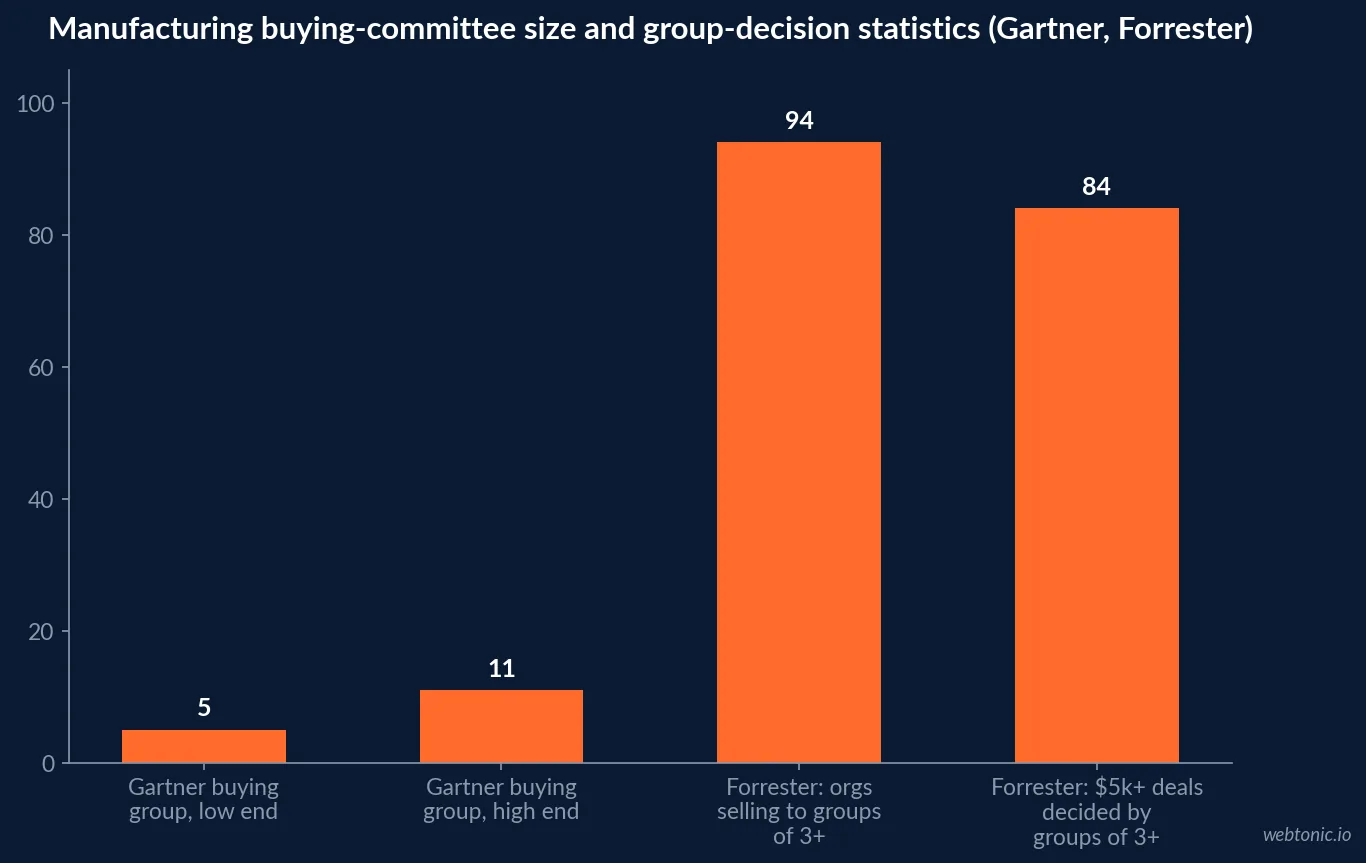
- The average enterprise B2B buying group spans 5 to 11 stakeholders, per Gartner.
- That group represents 5 distinct business functions on average.
- 94% of B2B organizations sell to groups of three or more, per Forrester.
- 84% of purchases over $5,000 are decided by a group of three or more.
- Mature ABM programs dedicate 30% of the marketing budget to the practice, per ITSMA.
- 66% of those programs planned to increase ABM spend the following year.
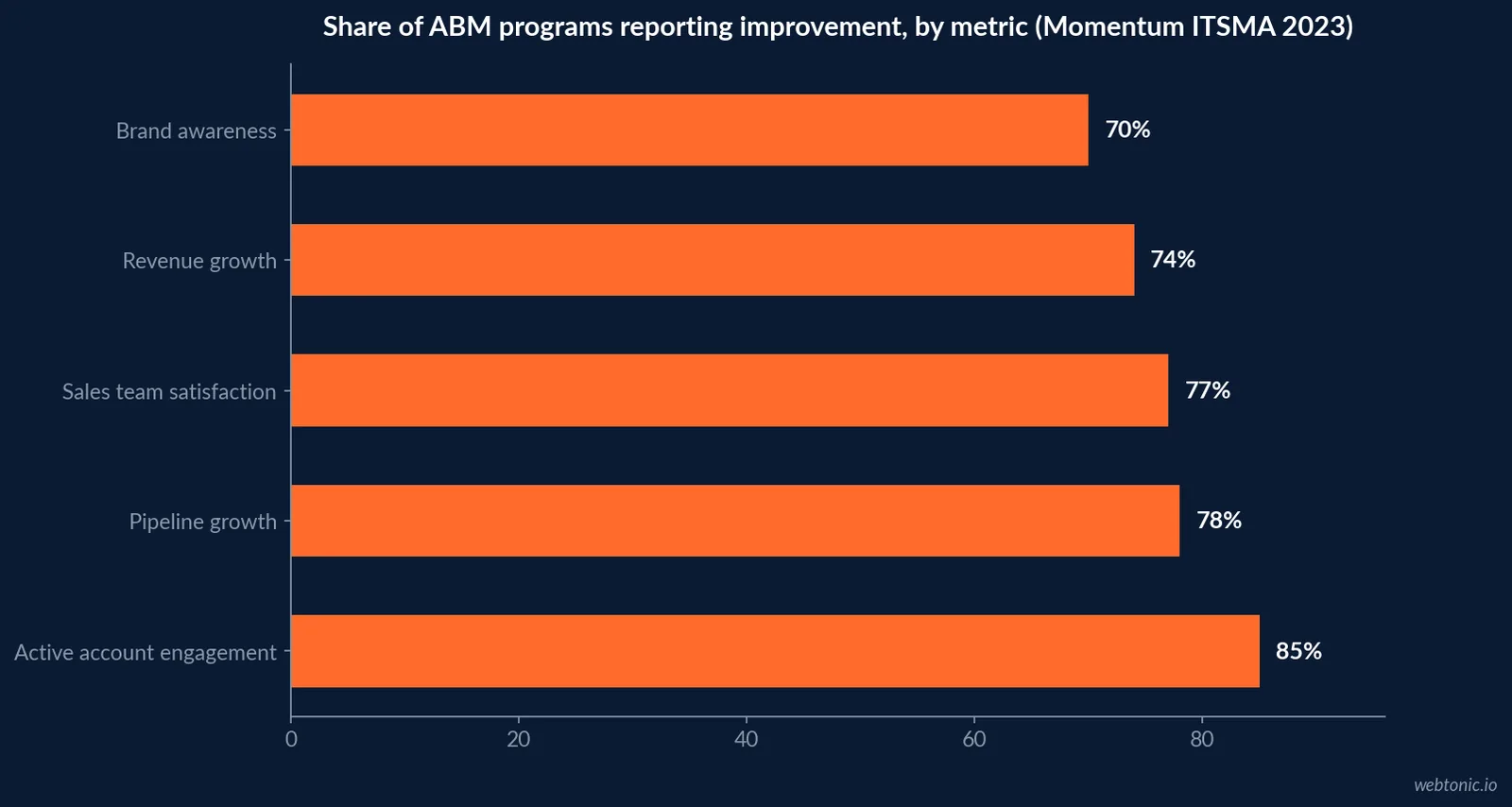
- 85% of ABM programs report improved account engagement.
- 78% report improved pipeline growth attributable to ABM.
- 74% report improved revenue growth.
- 81% rate ABM's ROI as equal to or better than traditional marketing.
- Only 52% of ABM programs formally measure that ROI.
- The US has 284,452 manufacturing establishments with paid employees, per the Census Bureau.
- 78.9% of manufacturers reported a positive business outlook in NAM's Q3 2026 survey.
- ABM platform pricing is unpublished across Demandbase, 6sense and the former Terminus.
- Demandbase's own model is a platform fee plus a flat per-user fee, with no published tiers.
| Metric | Figure | Source |
|---|---|---|
| Average buying-group size | 5-11 stakeholders | Gartner B2B Buying Report |
| Distinct functions represented | 5 functions on average | Gartner B2B Buying Report |
| Orgs selling to groups of 3+ | 94% | Forrester revenue-ops survey |
| Purchases over $5,000 decided by 3+ | 84% | Forrester revenue-ops survey |
| Marketing budget share for mature ABM | 30% | Momentum ITSMA / ABM Leadership Alliance |
| Programs planning to increase ABM spend | 66% | Momentum ITSMA / ABM Leadership Alliance |
Why the account, not the contact, is the right unit
An industrial capital-equipment or long-term-supply decision is rarely made by one signature. Gartner's own B2B buying research puts the average enterprise buying group at 5 to 11 stakeholders across 5 distinct business functions - plant operations, engineering, procurement, finance and an executive sponsor are the common cast on a manufacturing deal. Separately, Forrester found 94% of B2B organizations report selling to groups of three or more, and for anything over $5,000 in spend, 84% of buyers confirm the decision was made by a group. ABM's core premise - build the plan around the account, not the lead - follows directly from that math.
How much of the budget mature programs actually spend
The Momentum ITSMA and ABM Leadership Alliance benchmark study - the seventh annual edition, surveying marketers already running ABM - found those programs dedicate an average of 30% of the 2023 marketing budget to the practice, and 66% planned to increase that spend the following year. That is a mature-program number, not a starting point: a manufacturer piloting ABM on its first ten named accounts should size a proportional test budget, not carve out three-tenths of the marketing line before the first quarter of results comes in.
| ABM program metric (N=111-208) | % reporting improvement | Source |
|---|---|---|
| Active engagement with selected accounts | 85% | Momentum ITSMA / ABM Leadership Alliance |
| Pipeline growth | 78% | Momentum ITSMA / ABM Leadership Alliance |
| Sales team satisfaction | 77% | Momentum ITSMA / ABM Leadership Alliance |
| Revenue growth | 74% | Momentum ITSMA / ABM Leadership Alliance |
| Brand awareness / knowledge | 70% | Momentum ITSMA / ABM Leadership Alliance |
ROI is reported as strong - and rarely measured formally
Among the same respondent set, 81% rated ABM's return on investment as the same as or better than traditional marketing initiatives, with 36% saying significantly higher. The caveat that matters for a plant-and-supplier sales cycle: only 52% of programs formally measure that ROI at all, and self-reported results from companies that chose to keep the program running will skew positive. Treat the 81% as directional evidence that ABM is worth testing on a defined account list with its own tracked pipeline, not as a guaranteed return.
Sizing the addressable account list
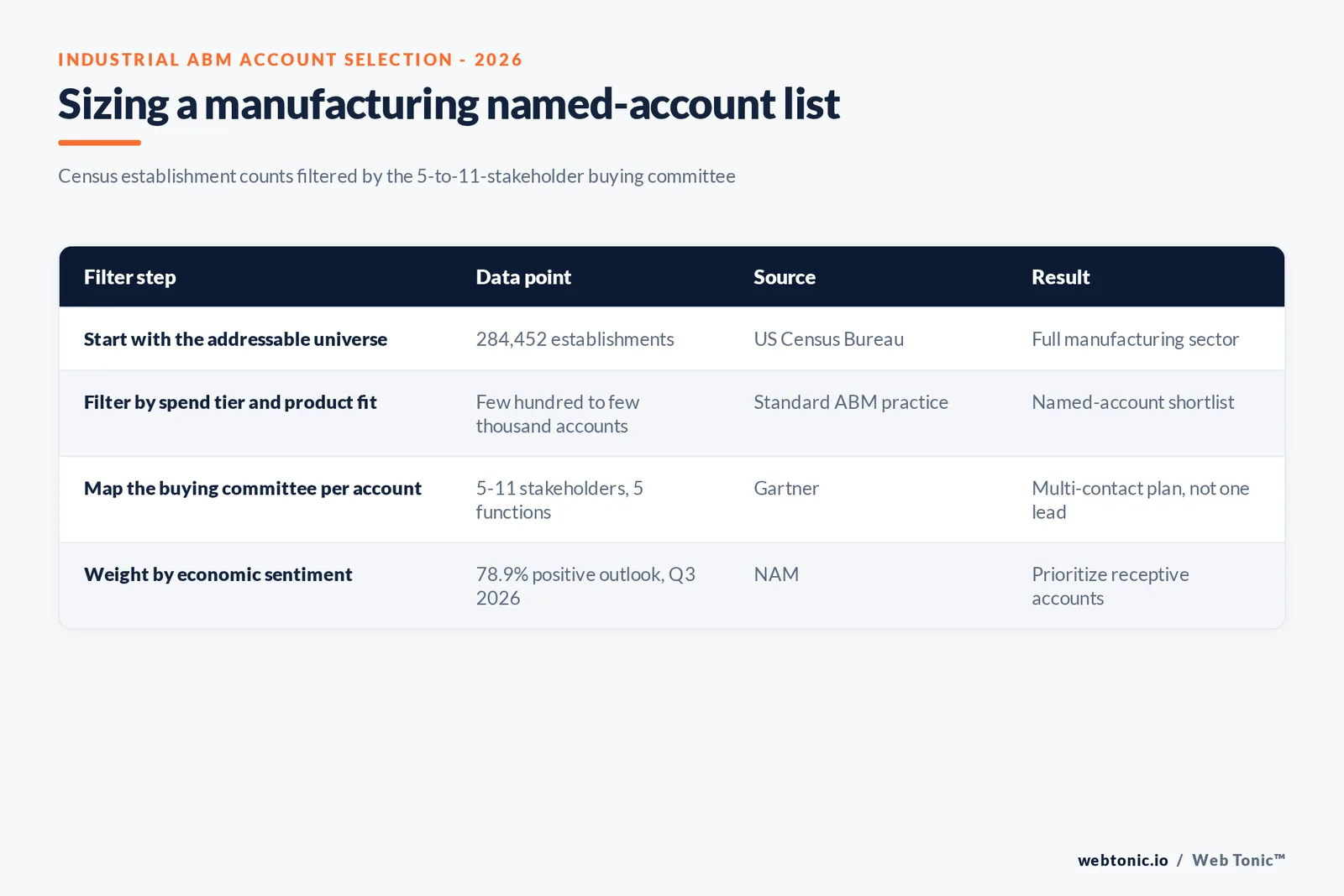
Industrial ABM lists are unusually countable. The Census Bureau's most recent economic census puts the US manufacturing sector at 284,452 establishments with paid employees - a finite pool that most named-account lists filter down to a few hundred or a few thousand accounts by spend tier, product fit and existing relationship. Economic sentiment is a live input to that filter too: the National Association of Manufacturers' Q3 2026 survey found 78.9% of manufacturers positive about their own company's outlook, up from 74.2% in Q2 - a tailwind for capital-equipment and long-term-supply pitches this year versus a more defensive posture in a down quarter.
| Account-selection input | Data point | Source |
|---|---|---|
| Total addressable establishments | 284,452 | US Census Bureau, 2022 Economic Census |
| Manufacturer outlook, Q3 2026 | 78.9% positive | NAM Q3 2026 Outlook Survey |
| Manufacturer outlook, Q2 2026 | 74.2% positive | NAM Q2 2026 Outlook Survey |
| Manufacturers citing fuel cost pressure | 74.1% | NAM Q3 2026 Outlook Survey |
| Manufacturers depending on trucking | 98.6% | NAM Q3 2026 Outlook Survey |
What ABM tooling actually costs
No platform in this category publishes a rate card. Demandbase's own pricing page describes the model - a platform fee covering the software and services, plus a flat fee per user - without listing figures, and states plainly that a custom plan is built per buyer. 6sense follows the same custom-quote pattern on its own site. Terminus, the integrated-ABM platform once compared directly against Demandbase, merged into DemandScience in November 2024 and no longer publishes standalone ABM pricing. An industrial buyer should expect a scoping call - built around account-list size, ad-spend commitment and which modules (intent data, advertising, sales intelligence) are included - before any number appears.
Who else already touches these accounts
A named-account list rarely starts from zero. The National Institute of Standards and Technology's Manufacturing Extension Partnership (MEP) runs a network of centers across every US state specifically to help small and mid-sized manufacturers with technology adoption, process improvement and growth - which means a meaningful share of the 284,452-establishment universe already has a documented relationship with a public-sector advisor who can be a source of warm introductions or, at minimum, a signal of which plants are actively investing in upgrades right now.
The hidden buyer inside an industrial committee
Not every member of the 5-to-11-person buying group carries equal visible weight. LinkedIn's B2B Institute research on buyer groups, conducted with Bain & Company and NewtonX, found that "hidden buyers" - those without an obvious product-decision title - carry almost equal decision-making weight to product-focused "target buyers": 49% versus 51%. On an industrial deal, the hidden buyer is often a finance controller or a corporate procurement lead evaluating total cost of ownership, not the plant engineer who takes the first call - and a pitch built only for the engineer misses roughly half the real influence in the room.
| Committee role (industrial deal) | What they decide | Content they need |
|---|---|---|
| Plant operations / engineering | Technical fit, downtime risk | Spec sheets, uptime data, pilot results |
| Procurement | Vendor terms, total cost of ownership | Pricing tiers, volume discounts, contract terms |
| Finance (the hidden buyer) | Capital approval, ROI payback | Payback period math, budget-cycle timing |
| Executive sponsor | Strategic fit, risk tolerance | Case studies, peer references, risk mitigation |
Building the account list for a plant-and-OEM program
- Start from the 5-to-11-stakeholder committee, not a single procurement contact, and map plant operations, engineering, finance and the executive sponsor separately.
- Filter the 284,452-establishment universe by spend tier and product fit before naming accounts - a broad list defeats the point of ABM.
- Size the pilot budget to the account count, not to ITSMA's 30% mature-program average, which describes programs several years in.
- Track pipeline and revenue lift directly against the named list rather than relying on the self-reported 78%/74% improvement figures alone.
- Budget a scoping call, not a list price, when evaluating Demandbase, 6sense or a DemandScience-era Terminus deployment.
Frequently Asked Questions
How many people sign off on an industrial purchase?
Gartner's own B2B buying research puts the average enterprise buying group at 5 to 11 stakeholders, spanning an average of 5 distinct business functions - typically engineering, plant operations, procurement, finance and an executive sponsor on a capital-equipment deal. Forrester's separate revenue-operations survey found 94% of B2B organizations report selling to groups of three or more, and for any purchase over $5,000, 84% of buyers say a group of three or more decided it. Either way, a single named contact per account is the wrong unit for an industrial ABM list.
What share of the marketing budget should go to ABM?
Momentum ITSMA and the ABM Leadership Alliance's benchmark study of firms already running ABM found those programs dedicate an average of 30% of the 2023 marketing budget to ABM, and 66% planned to increase that spend the following year. That figure describes mature programs, not a starting allocation - a manufacturer running its first named-account pilot should size a test budget against a handful of accounts, not 30% of the whole marketing line, and grow the share as pipeline data justifies it.
Does ABM actually move pipeline for an industrial seller?
ITSMA's data, drawn from 111 companies already running ABM, found 78% saw pipeline growth improve and 74% saw revenue growth improve as a result of the program, with 85% reporting better active engagement with selected accounts. On ROI specifically, 81% of respondents rated ABM's return as the same or better than traditional marketing - but only 52% formally measure that ROI, so the honest caveat is that the improvement is self-reported by companies that chose to keep running the program.
How many manufacturing accounts are actually addressable?
The US Census Bureau's most recent County Business Patterns file counts 284,452 manufacturing establishments with paid employees - a finite, nameable universe that supports a true named-account list rather than a broad-match audience. Most industrial ABM programs work from a few hundred to a few thousand named accounts drawn from that pool, filtered by spend potential, existing relationship and fit with the seller's product line.
Do ABM platforms publish what they cost?
No - Demandbase's own pricing page states the model (a platform fee plus a flat per-user fee) but no numbers; 6sense and the former Terminus platform, now merged into DemandScience, keep the same custom-quote pattern. Every industrial buyer should expect a scoping call before a price, driven by account-list size, ad-spend commitment and which modules (intent data, advertising, sales intelligence) are included.
Sources
Gartner, B2B Buying Report
Forrester, Your Buyer Is A Group, Not A Person
Momentum ITSMA / ABM Leadership Alliance, Rethinking ABM 2023 Benchmark Study
US Census Bureau, 2022 Economic Census, NAICS Sector 31-33 Manufacturing
National Association of Manufacturers, Q3 2026 Outlook Survey
Demandbase, Pricing & Packaging
See the cross-industry ABM statistics hub for the platform-wide benchmarks referenced above, or explore Data Intelligence services for account-list build-out and get in touch to scope a pilot.