Table of contents
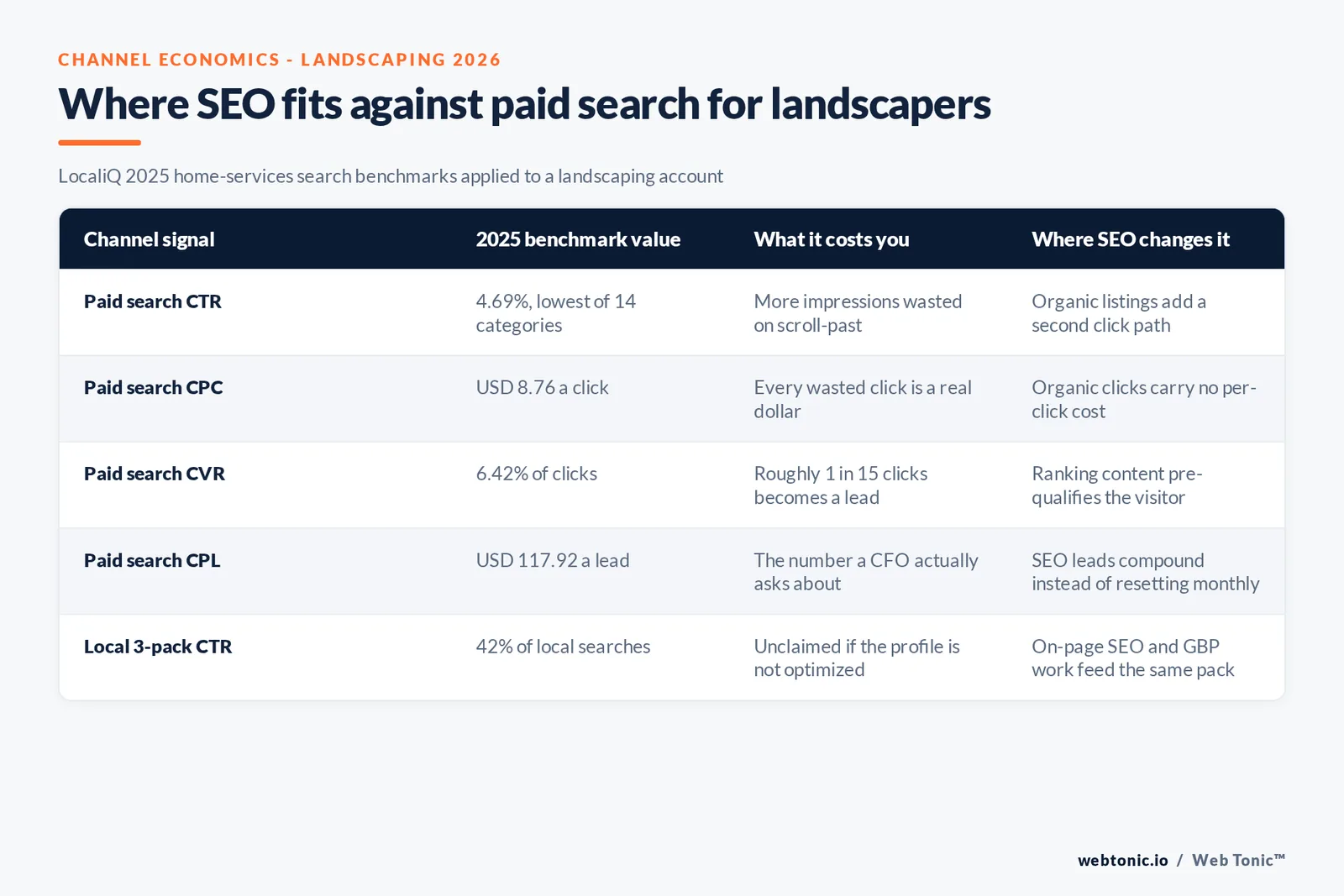
Landscaping has the lowest paid-search click-through rate of any home-services category LocaliQ tracked in its 2025 benchmarks - 4.69%, against a 6.64% cross-industry average. That single number is the business case for landscaping SEO: the category is expensive and hard to click on through paid media, and organic listings are the lever that does not charge per click.
Key Takeaways
- Landscaping's paid-search CTR is 4.69%, the lowest of 14 home-services categories.
- Average cost per click is USD 8.76 for landscaping search ads.
- Average cost per lead is USD 117.92 on Google Search for landscaping.
- Conversion rate on those clicks runs 6.42%.
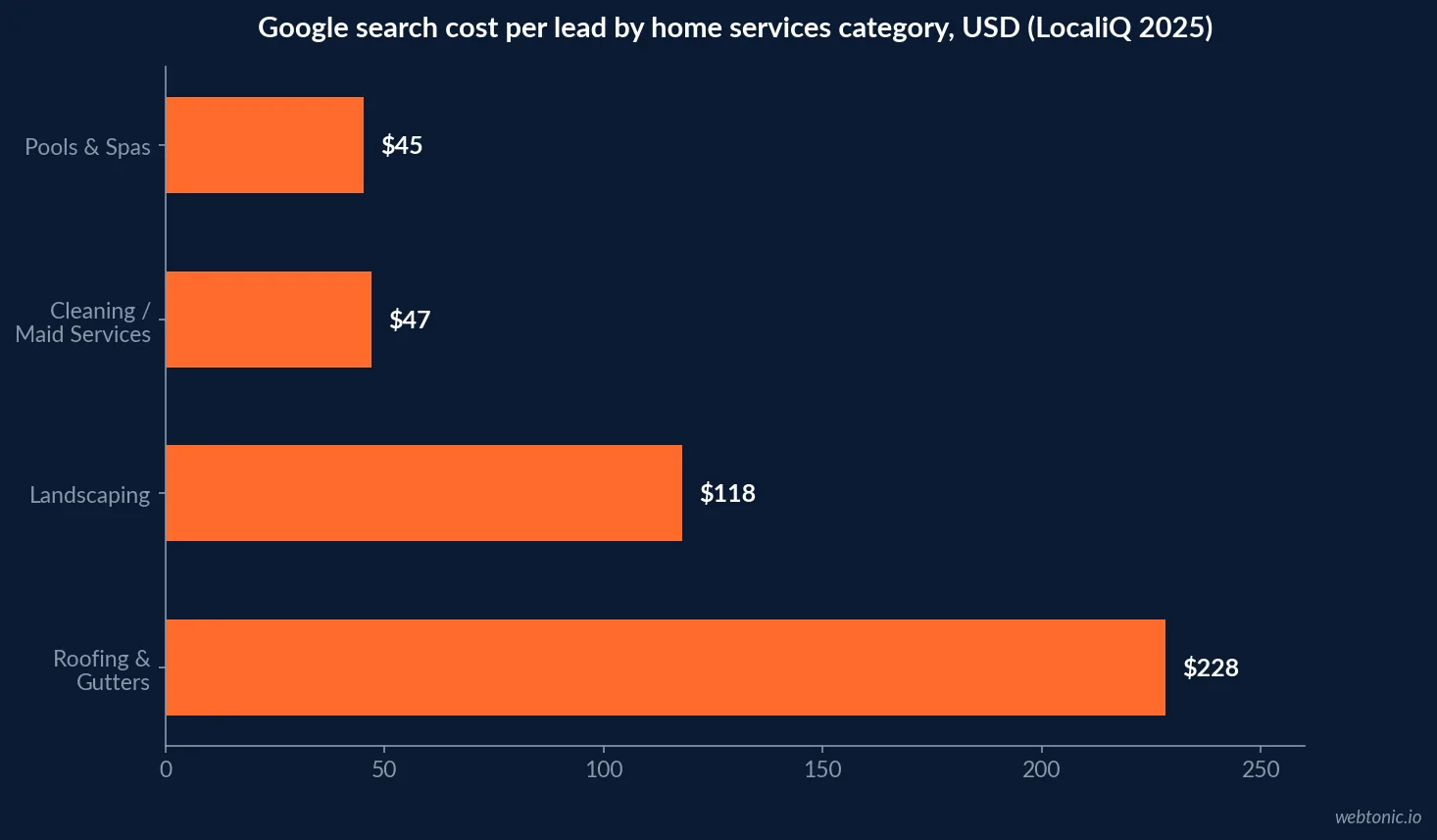
- Roofing & gutters pays USD 228.15 per lead, almost double landscaping's rate.
- Pools & spas pays only USD 45.15 per lead, the cheapest category studied.
- Cross-industry average CPC is USD 5.42, well below landscaping's USD 8.76.
- Cross-industry average CPL is USD 66.69, roughly USD 51 cheaper than landscaping's.
- 42% of local searchers click a Google Maps Pack result, per Backlinko.
- 98% of consumers search online for local businesses, per BrightLocal.
- There are roughly 1.5 billion "near me" searches a month across all categories.
- 75% of a business profile's views come from Search, not Maps, per BrightLocal.
- SEO leads reportedly close at far higher rates than cold outbound in landscaping.
- NALP's late-2023 survey found 51% of contractors naming staffing their top challenge.
- 29% of contractors named cost of equipment and products a top-three challenge.
- 64% of landscape companies expected profitability growth heading into the next year.
- Consulting Success reports fixed-price and value-based fees cover 45% of how service providers price project work, a pattern that also shows up in SEO retainers.
- A landscaping account's organic click carries no per-click cost, unlike its USD 8.76 paid alternative.
The channel landscaping is actually competing against
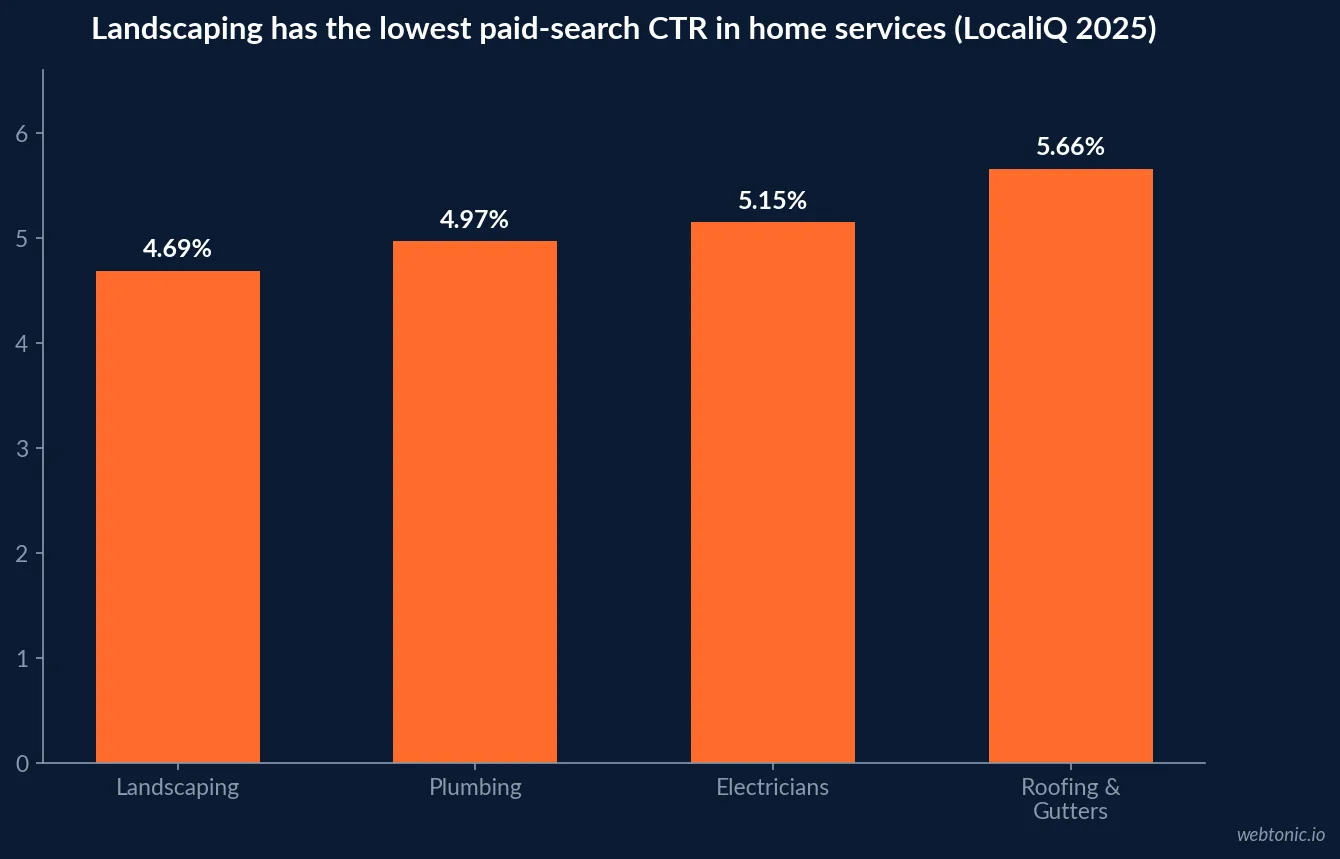
Any landscaping SEO conversation starts by pricing the alternative. LocaliQ's 2025 Search Ad Benchmarks for Home Services, drawn from 3,211 US search campaigns run between April 2024 and March 2025, put landscaping at a 4.69% click-through rate, a USD 8.76 cost per click, a 6.42% conversion rate and a USD 117.92 cost per lead. Landscaping's CTR is the lowest of the 14 home-services categories in the report; only plumbing (4.97%) and electricians (5.15%) come close.
That low CTR is not a targeting failure. Landscaping queries skew broad and seasonal, and Google Ads is charging for every scroll-past impression on a term like "lawn care" the same way it charges for a high-intent one. Organic listings do not carry that cost.
| Home services category | Paid CTR | Cost per click | Conversion rate | Cost per lead |
|---|---|---|---|---|
| Landscaping | 4.69% | USD 8.76 | 6.42% | USD 117.92 |
| Plumbing | 4.97% | USD 10.49 | 7.63% | USD 129.02 |
| Electricians | 5.15% | USD 12.18 | 9.08% | USD 93.69 |
| Roofing & Gutters | 5.66% | USD 10.70 | 3.70% | USD 228.15 |
| Pools & Spas | 5.41% | USD 5.81 | 10.89% | USD 45.15 |
What that CPL means for an SEO budget
WordStream's 2026 Digital Marketing Benchmarks, aggregated across more than 13,000 campaigns and 23 industries, report a cross-industry average click-through rate of 6.64%, average cost per click of USD 5.42 and average cost per lead of USD 66.69. Landscaping's paid metrics sit worse than that average on every dimension - a lower CTR, a higher CPC and a CPL roughly USD 51 above the norm.
That gap is the argument for shifting lead-generation weight toward organic. Every dollar an organic page saves against that USD 117.92 benchmark is a dollar that does not have to be re-spent the following month, which paid media always requires.
| Metric | Landscaping (LocaliQ 2025) | Cross-industry average (WordStream 2026) | Gap |
|---|---|---|---|
| Click-through rate | 4.69% | 6.64% | -1.95 points |
| Cost per click | USD 8.76 | USD 5.42 | +USD 3.34 |
| Cost per lead | USD 117.92 | USD 66.69 | +USD 51.23 |
| Conversion rate | 6.42% | 8.18% (all-industry avg.) | -1.76 points |
Where organic actually shows up first: the local pack
Backlinko's Local SEO Statistics report that 42% of people who conduct a local search click a result inside the Google Maps Pack. That pack draws on the same on-page and Business Profile signals SEO work touches, which is why landscaping SEO cannot be scoped as blog content alone - it has to include the profile that shows up beside the map.
BrightLocal's Google My Business Insights Study found the average local business profile receives 1,260 views a month, split 943 on Search and 317 on Maps - Search, not Maps, is doing three-quarters of the work. A landscaping SEO plan should be built assuming Search carries most of the visibility, with Maps as a second surface, not the other way around.
How landscaping demand actually searches
BrightLocal's 2026 consumer search behavior research reports that only 6% of local searchers "just click the top result" - most weigh several signals before committing to a click, which matters for landscaping because the decision (who mows my lawn, who redesigns my yard) usually carries a seasonal deadline and a home-visit trust factor that a generic ad rarely resolves on its own.
The category is also intensely seasonal. Search volume for "landscaping near me" and "lawn care company" swells in spring and again after storm season, which is a scheduling detail an SEO content calendar has to plan around instead of publishing at a flat monthly cadence.
| SEO content type | Seasonal trigger | Why it earns organic clicks |
|---|---|---|
| Spring startup / cleanup guide | First mow window | Highest seasonal search spike of the year |
| Drought or heat-stress lawn care | Mid-summer stress period | Urgent, high-intent local queries |
| Fall aeration & leaf cleanup | Leaf-drop season | Upsell intent from existing seasonal searchers |
| Service-area landing pages | Always-on | Captures "[service] near me" local intent directly |
| Before/after project pages | Always-on, design intent | Higher-value design-build searches convert |
The business context behind the SEO budget decision
The National Association of Landscape Professionals' 2023 Year-End Business Pulse Survey of 328 member contractor companies found 51% naming staffing their top business challenge, with lower customer demand and higher equipment costs tied at 17% each. 64% of respondents expected increased profitability the following year, and 40% reported higher-than-expected revenue in landscape maintenance specifically.
Read against those numbers, a paid-heavy acquisition strategy competes for the same limited crew capacity that staffing shortages are already straining. SEO's advantage is that it does not need a bigger ad budget to keep producing leads once a page ranks - it needs upkeep, which is a smaller and more predictable line than a monthly media spend.
| NALP 2023 Business Pulse Survey finding | Share of respondents |
|---|---|
| Named staffing the #1 business challenge | 51% |
| Named lower customer demand a top challenge | 17% |
| Named higher equipment/product cost a top challenge | 17% |
| Expect increased profitability next year | 64% |
| Reported higher-than-expected maintenance revenue | 40% |
How landscaping's numbers sit against broader search behavior
HubSpot's 2026 marketing statistics roundup, citing DataReportal, reports that 32.9% of internet users aged 16 and older discover new brands, products and services via search engines - not social feeds, not ads specifically, but search as a category. For a landscaping company, that is a third of the audience arriving through a channel that a well-built organic page can capture without a per-click charge attached.
Cross-referencing that against WordStream's 2026 cross-industry PPC benchmarks, the average conversion rate across all 23 tracked industries is 8.18%, noticeably above landscaping's own 6.42% paid conversion rate. Landscaping is underperforming the average on the paid side, which is one more reason organic capacity is worth building rather than trying to out-bid the category's already weak paid economics.
| Search behavior signal | Reported figure | Source |
|---|---|---|
| Internet users discovering brands via search | 32.9% | HubSpot / DataReportal, 2026 |
| Cross-industry average PPC conversion rate | 8.18% | WordStream, 2026 |
| Landscaping's own paid conversion rate | 6.42% | LocaliQ, 2025 |
| Landscaping's paid click-through rate | 4.69% | LocaliQ, 2025 |
What ranking-factor research says the SEO work should prioritize
Whitespark's 2026 Local Search Ranking Factors survey, compiled from a panel of local SEO practitioners, groups what actually moves local rankings into six signal families: Google Business Profile signals, on-page signals, review signals, link signals, behavioral signals (click-through rate, calls, dwell time), and citation signals. None of those families is a one-time task - each needs ongoing attention, which is the same argument for treating landscaping SEO as a program rather than a project.
Ahrefs' 2025 analysis of one million SERPs found that referring domains correlate with ranking at 0.33 for local queries - higher than the correlation Ahrefs found for non-local search overall. Its own explanation is that local service pages tend to look alike on-page, so links become one of the clearer differentiators between competing landscaping websites in the same market.
| Ranking signal family (Whitespark 2026) | What it covers | Landscaping SEO action |
|---|---|---|
| Google Business Profile signals | Proximity, categories, keywords in business name | Keep category and services current every season |
| On-page signals | NAP presence, title tag keywords, domain authority | Service-area pages with real local content |
| Review signals | First and third-party review volume and velocity | A steady post-job review request workflow |
| Link signals | Inbound anchor text, linking domain authority and volume | Local press, supplier, and association links |
| Citation signals | NAP consistency across directories | Audit directory listings each season |
What to measure once the SEO program is live
Track organic sessions into quote-request pages, blended cost per lead across paid and organic, and local pack visibility for the core service terms, rather than raw keyword rankings. Compare blended CPL against the USD 117.92 paid benchmark every quarter - that comparison is the only number that tells you whether the SEO investment is actually displacing paid spend or just adding traffic on top of it.
Landscaping is seasonal enough that a single quarter of data will mislead you. Plan the first real read at two full seasonal cycles, and budget SEO like a multi-season program rather than a monthly campaign.
Where this fits with the rest of the marketing mix
SEO rarely replaces paid search outright for a landscaping account in its first year; it reduces dependence on it. Local Services Ads and Google Search still matter for immediate-need queries during peak season, but organic content and a well-optimized Business Profile are what keep the USD 117.92 benchmark from being the account's floor forever. If you want a channel-by-channel read on your own account's cost per lead, our growth marketing team can build that comparison, and our guide on building a Google Ads strategy covers the paid side of the same budget, and our cost-per-lead benchmarks by industry page shows how landscaping's USD 117.92 figure compares to other trades.
Frequently Asked Questions
Why does landscaping have such a low paid-search CTR?
LocaliQ's 2025 Search Ad Benchmarks for Home Services, built from 3,211 campaigns run between April 2024 and March 2025, puts landscaping at a 4.69% average click-through rate, the lowest of the 14 home-services categories in the report, behind plumbing (4.97%) and electricians (5.15%). Landscaping queries are often broad and seasonal ("lawn care near me," "landscaper [city]"), which pulls in a lot of low-intent impressions that never turn into a click. That is a paid-search problem, not an organic one, since organic results are not paying for those impressions.
What does a landscaping lead actually cost through Google Ads?
LocaliQ's same report puts landscaping's average cost per click at USD 8.76 and its cost per lead at USD 117.92, against a 6.42% conversion rate. That CPL sits mid-pack among home services: cheaper than roofing & gutters at USD 228.15, but well above pools & spas at USD 45.15. Any landscaping SEO business case should start from that USD 117.92 number, because it is the real alternative cost of not building organic capacity.
Does SEO actually produce cheaper leads than paid search for landscapers?
Directionally yes, structurally: an organic click carries no per-click cost, so once a page ranks, its marginal lead cost falls toward the cost of maintaining the page rather than resetting every month like a media budget does. WordStream's 2026 benchmarks put the average cost per click across all 23 tracked industries at USD 5.42 and average CPL at USD 66.69, both of which a landscaping account still has to pay every month that its organic content is not doing the work instead.
How much of local search traffic goes to the local pack versus organic listings?
Backlinko reports that 42% of people who run a local search click a result inside the Google Maps Pack. That pack is populated by the same signals technical and on-page SEO influence, which is why a landscaping SEO plan has to include Business Profile optimization rather than treat it as a separate project.
What is a realistic first KPI for a landscaping SEO program?
Track organic sessions to quote-request pages and blended cost per lead across channels every month, not rankings. Given a USD 117.92 paid CPL as the comparison point, a landscaping account should expect organic to start contributing meaningfully to blended CPL within two to three seasonal cycles, not weeks, because the category's search volume itself is seasonal.
Sources
LocaliQ - 2025 Search Ad Benchmarks for Home Services
WordStream - 2026 Google Ads Industry Benchmarks
Backlinko - Local SEO Statistics
BrightLocal - Google My Business Insights Study
BrightLocal - Consumer Search Behavior Decisions (2026)
National Association of Landscape Professionals - 2023 Year-End Business Pulse Survey
HubSpot - 2026 Marketing Statistics (citing DataReportal)
WordStream - Digital Benchmarks by Industry: PPC
Whitespark - 2026 Local Search Ranking Factors Survey
Ahrefs - Do Links Still Matter? A Million-SERP Analysis