Table of contents
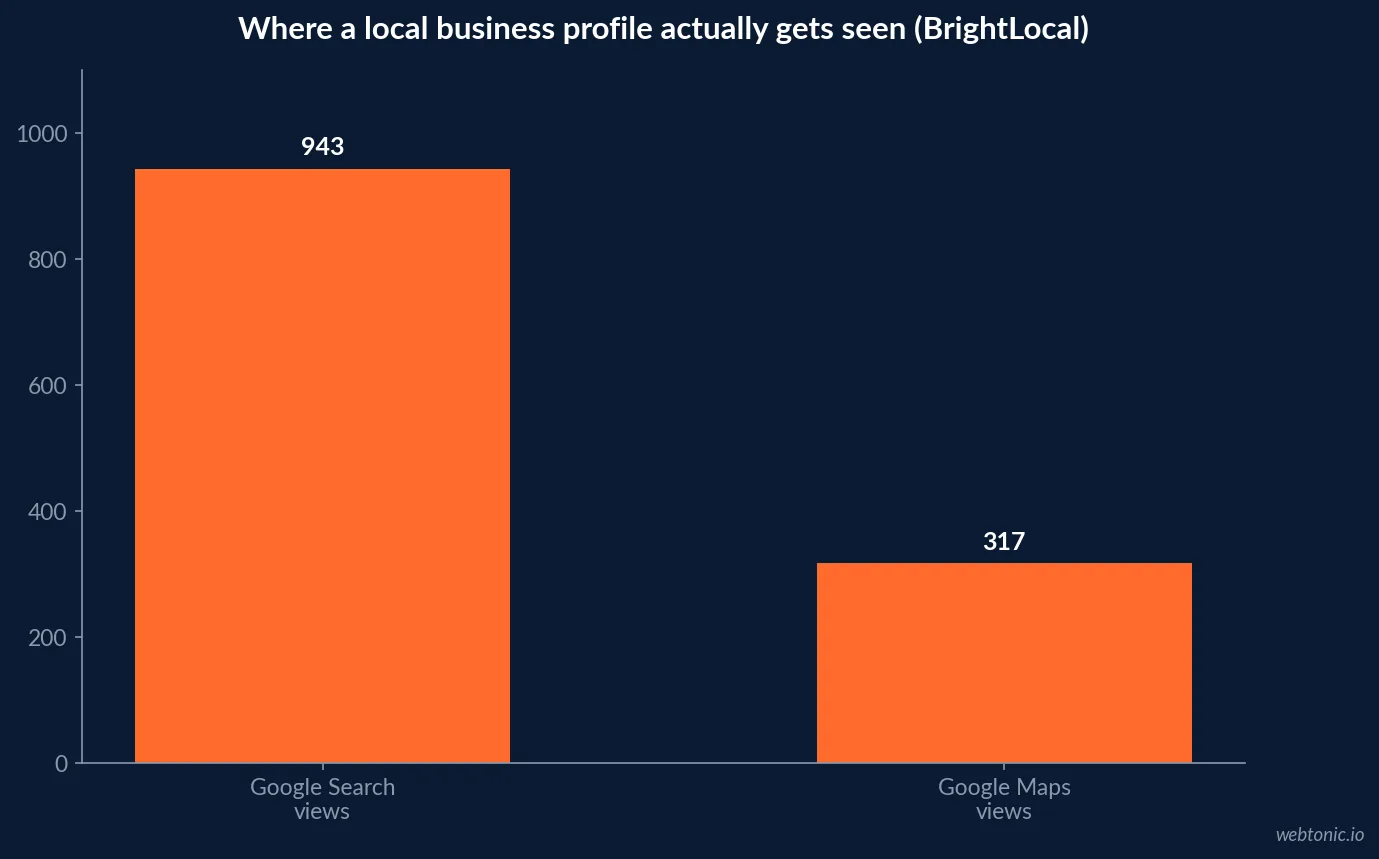
The average local business profile gets roughly three times more views from Google Search than from the Maps app - 943 versus 317 a month, per BrightLocal. For a landscaping company deciding where to spend local SEO effort, that split says the website's content and the profile's completeness matter more than Maps-specific tactics alone.
Key Takeaways
- The average business profile gets 1,260 views a month, per BrightLocal.
- 943 of those views come from Search, about 75% of the total.
- Only 317 views come from the Maps app itself.
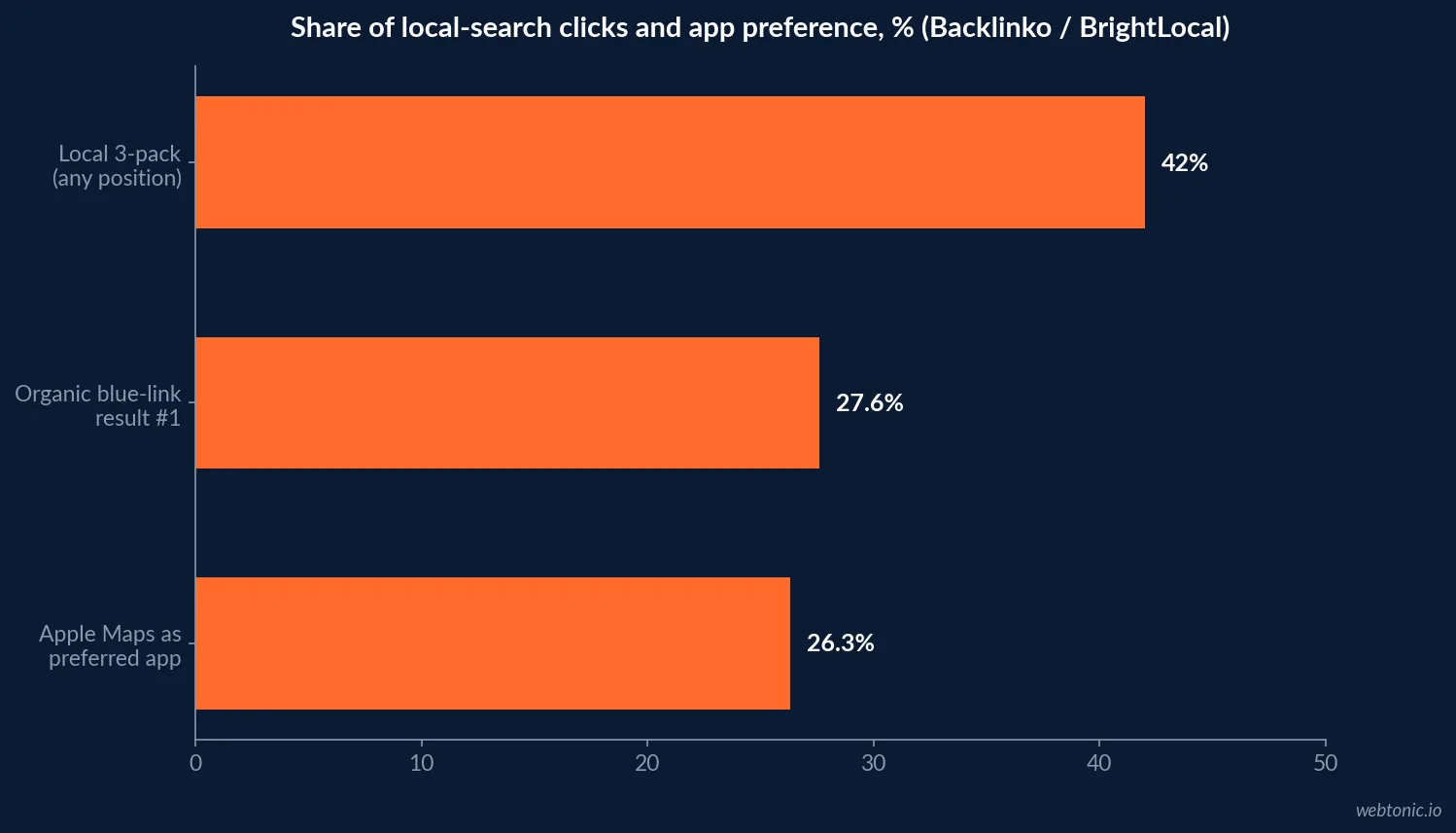
- 42% of local searchers click a Google Maps Pack result, per Backlinko.
- 58.6% of Apple device users still prefer Google Maps for local search.
- Only 26.3% of those same users prefer Apple Maps.
- 98% of consumers search online for local businesses, up from 90% in 2019.
- There are roughly 1.5 billion "near me" searches a month in the US.
- Only 6% of local searchers "just click the top result", per BrightLocal.
- Position #1 organic CTR runs around 27.6% when no local pack is present.
- That CTR drops when a local pack sits above the organic results.
- Roughly 97% of consumers read reviews before choosing a local business.
- Most review readers check six or more review sites before deciding.
- Landscaping's paid-search CTR sits at just 4.69%, the category's weakest paid signal.
- 51% of landscape contractors name staffing their top challenge, per NALP.
- Landscaping's average Google Ads CPL is USD 117.92, the alternative cost to organic and local visibility.
- 40% of landscape companies beat maintenance-revenue expectations in 2023.
Search, not Maps, is where a landscaping profile is actually seen
BrightLocal's Google My Business Insights Study found the average local business profile receives 1,260 views a month, split 943 on Search and 317 on Maps - Search accounts for about 75% of total profile views. That distribution matters for how a landscaping company allocates local SEO effort: the content, categories, and keywords that drive Search visibility carry more of the exposure load than the pin itself.
The practical read: optimizing a profile purely for "showing up on the map" undersells how most people actually find it, which is by searching a term and seeing the profile surface inside or beside the regular results page.
| Surface | Average monthly views | Share of total | What drives it |
|---|---|---|---|
| Google Search | 943 | ~75% | Keyword relevance, on-page content, review volume |
| Google Maps app | 317 | ~25% | Proximity, driving-direction intent, category match |
| Total profile views | 1,260 | 100% | Combined Search + Maps exposure |
What happens once someone actually searches
Backlinko's Local SEO Statistics report that 42% of people who run a local search click a result inside the Google Maps Pack, the block of three local listings that appears above organic results for local-intent queries. A landscaping company that is not inside that pack for its core service terms is giving that 42% of clicks to whoever is.
BrightLocal's device-preference research adds a second wrinkle for landscaping companies serving Apple-heavy suburban markets: even among Apple device owners, 58.6% still prefer Google Maps to find local businesses, against only 26.3% for Apple Maps. A Google Business Profile still matters more than an Apple-only listing strategy for the large majority of a landscaping company's mobile searchers.
| Local search behavior signal | Reported figure | Source |
|---|---|---|
| Consumers who search online for local businesses | 98% | BrightLocal |
| "Near me" searches per month, all categories | ~1.5 billion | Google, via BrightLocal citation |
| Local searchers who click a Maps Pack result | 42% | Backlinko |
| Apple users who still prefer Google Maps | 58.6% | BrightLocal |
| Local searchers who "just click the top result" | 6% | BrightLocal consumer research |
Why reviews decide the click even when ranking is equal
BrightLocal's long-running Local Consumer Review Survey research consistently finds that a large majority of consumers - commonly cited at 97% across recent survey years - read reviews for local businesses before making a decision, and that most read across six or more review sites rather than trusting a single source. For a landscaping company, that means two profiles ranking in the same local pack position will not convert at the same rate if one has ten recent reviews and the other has none from the past year.
BrightLocal's own consumer-decision research reinforces this: only 6% of local searchers "just click the top result" - the rest weigh review volume, recency, and rating alongside position before committing to a click.
| Review signal for local pack visibility | Why it matters for landscaping |
|---|---|
| Review recency | Signals the crew is still active and taking new work this season |
| Review volume | Feeds one of the highest-weighted local ranking signals |
| Star rating consistency | Directly affects click share even at an equal pack position |
| Response to reviews | Signals an owner who is actively managing the profile |
| Photo-backed reviews | Landscaping is visual; before/after proof outperforms text-only reviews |
The paid-search backdrop that makes local organic visibility worth the effort
Landscaping's paid-search click-through rate is the weakest of any home-services category LocaliQ's 2025 benchmarks tracked, at 4.69%, against an average landscaping cost per lead of USD 117.92. A local pack placement and a well-reviewed profile do not carry that per-click cost, which is why local SEO and Business Profile management earn a larger share of a landscaping budget than they might in a less expensive-to-advertise category.
The National Association of Landscape Professionals' 2023 Business Pulse Survey found 51% of contractors naming staffing their top business challenge - a constraint that makes local SEO's lower ongoing cost (versus a growing media budget) a more realistic fit for crews that are already stretched.
What ranking-factor research says decides Maps versus organic placement
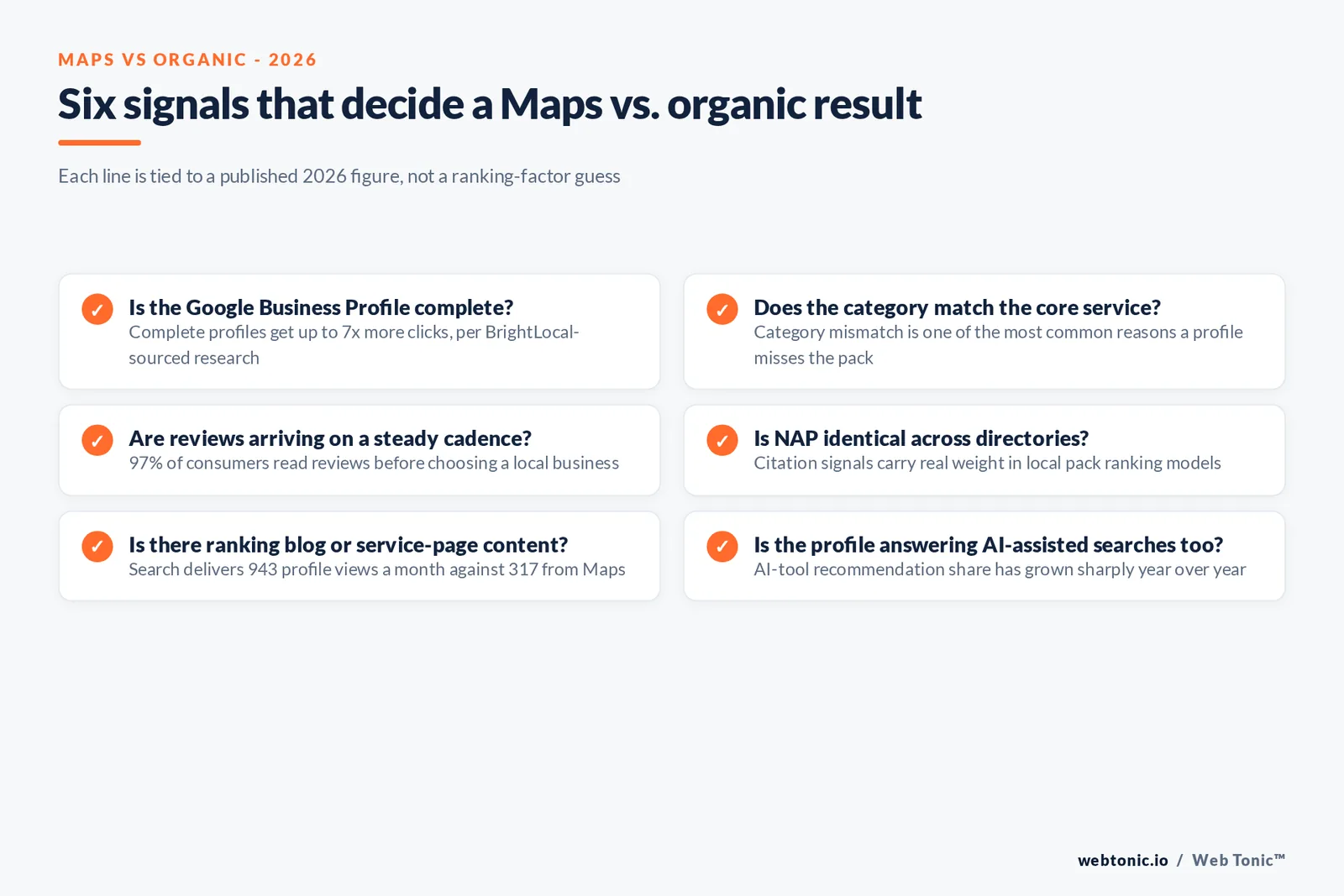
Whitespark's 2026 Local Search Ranking Factors survey groups what moves local pack and organic placement into Google Business Profile signals, on-page signals, review signals, link signals, behavioral signals, and citation signals - the same six families feed both the Maps pack and the organic listings beside it, which is why treating them as separate projects wastes effort.
Ahrefs' analysis of roughly one million SERPs found referring domains correlate with ranking at 0.33 for local queries, higher than the correlation it found for non-local search. For a landscaping company competing against similar-looking local sites, that link signal is one of the clearer ways to separate from a competitor with an identical service list.
| Ranking signal family | Feeds Maps pack? | Feeds organic listing? |
|---|---|---|
| Google Business Profile signals | Yes - primary driver | Partial - category and NAP overlap |
| On-page signals | Partial | Yes - primary driver |
| Review signals | Yes | Indirect, via trust and click behavior |
| Link signals | Indirect | Yes |
| Citation signals | Yes | Indirect |
How this compares to the broader search-discovery picture
HubSpot's 2026 marketing statistics, citing DataReportal, report that 32.9% of internet users aged 16 and older discover new brands, products and services via search engines. For a landscaping company that mostly serves a defined service radius, that discovery pathway runs almost entirely through the local pack and the Search results surrounding it, not through Maps navigation searches from people who already know the business exists.
What Google itself says about profile completeness
Google's own Business Profile help documentation states that businesses with complete and accurate information are more likely to show up in local search results, and that inaccurate information can keep a profile from surfacing for relevant searches in its own area at all. That is Google describing its own ranking behavior, not a third-party inference, and it is the simplest explanation for why the 943-versus-317 Search-to-Maps split above rewards a fully filled-out profile over a partially completed one.
For a seasonal business like landscaping, "complete and accurate" also means updated: service lists, hours, and photos need a seasonal refresh, not a one-time setup, to keep matching what Google's own guidance says it checks for.
Building the local SEO checklist around these numbers
Start with profile completeness and category accuracy, since those feed both the 75% Search share and the 42% pack-click share at once. Layer in a review-request workflow tied to job completion, not a one-time ask, since review recency shows up in both ranking signals and click behavior. Only after those are stable does it make sense to invest in Maps-specific tactics like driving-direction CTAs or service-area radius adjustments.
Measure success by tracking phone calls and quote-form submissions attributed to the profile month over month, alongside 3-pack visibility for the core service terms in each service area - not by Maps app installs or generic impression counts, which do not correlate cleanly with booked jobs.
Where this connects to the rest of the site's SEO work
Local pack visibility and organic content work reinforce each other rather than compete for budget; a service-area page that ranks organically also strengthens the profile's category relevance. Our data and analytics team can help attribute calls and form fills back to the profile versus the website directly, and our breakdown of average cost per lead by industry puts landscaping's paid benchmark in a wider context, and our team can review a specific profile's Search-versus-Maps split if you want a number for your own market.
What the paid-search backdrop costs if local visibility lags
WordStream's 2026 cross-industry PPC benchmarks report an average conversion rate of 8.18% across 23 industries, against landscaping's own 6.42% paid conversion rate on Google Search. A landscaping company that is invisible in the local pack is not just losing organic clicks - it is also paying a higher-than-average price to buy back the visibility a stronger profile and review set would have earned for free.
| Metric | Landscaping (LocaliQ 2025) | Cross-industry average (WordStream 2026) |
|---|---|---|
| Paid search conversion rate | 6.42% | 8.18% |
| Paid search cost per lead | USD 117.92 | USD 66.69 |
| Local pack click share (Backlinko) | 42% of local searches, category-agnostic | Same figure applies |
Frequently Asked Questions
Does Google Maps or Google Search send more traffic to a landscaping business profile?
Search does, by a wide margin. BrightLocal's Google My Business Insights Study found the average local business profile gets 1,260 views a month, split 943 on Search and 317 on Maps - Search accounts for roughly 75% of that total. For a landscaping company, that means the blog posts, service pages and reviews that feed Search visibility do more of the exposure work than the pin on the map itself.
How much of local search traffic goes to the 3-pack versus a plain organic listing?
Backlinko reports that 42% of people running a local search click a result inside the Google Maps Pack (the 3-pack). Separately, BrightLocal's research into Apple device users found 58.6% prefer Google Maps against 26.3% for Apple Maps when finding local businesses, which is one reason a Google Business Profile still outweighs Apple-only listings for a landscaping company.
How important are reviews to a landscaping company's local visibility?
Very. BrightLocal's Local Consumer Review Survey line of research, echoed across multiple 2026 citations of that survey, consistently reports that roughly 97% of consumers read reviews for local businesses before choosing one, and the majority read six or more review sites. A landscaping company with a stalled or inconsistent review cadence is handing that decision to a competitor with fresher reviews, independent of who ranks higher.
What actually gets a landscaping profile into the local pack?
A complete, correctly categorized Google Business Profile, consistent NAP (name, address, phone) data across directories, a steady flow of reviews, and on-page SEO signals from the website all factor in. Backlinko's ranking-factor survey work lists native review volume, category completeness, and profile verification among the highest-weighted signals - none of which are one-time fixes; they need ongoing maintenance the same way the website does.
Should a landscaping company optimize for Maps or for organic first?
Neither in isolation - they draw on the same signals. Because Search delivers roughly three times the profile views Maps does, the higher-leverage first move is usually completing and correctly categorizing the Business Profile (which feeds both surfaces) before spending on Maps-specific tactics like driving-direction CTAs.
Sources
Google Business Profile Help - Tips to Improve Your Local Ranking
WordStream - Digital Benchmarks by Industry: PPC
BrightLocal - Google My Business Insights Study
Backlinko - Local SEO Statistics
BrightLocal - Consumer Search Behavior Decisions (2026)
BrightLocal - Local Consumer Review Survey
LocaliQ - 2025 Search Ad Benchmarks for Home Services
National Association of Landscape Professionals - 2023 Year-End Business Pulse Survey
Whitespark - 2026 Local Search Ranking Factors Survey
Ahrefs - Do Links Still Matter? A Million-SERP Analysis
HubSpot - 2026 Marketing Statistics (citing DataReportal)