Table of contents

Dispatch boards, GPS-tracked trucks and digital payments are turning up in junk removal and dumpster rental faster than in most home-service trades, but the phone still starts most jobs. This page reads the operational data layer end to end: intake, routing, payment capture and the weight/disposal-fee math crews rarely put in a spreadsheet.
Key Takeaways
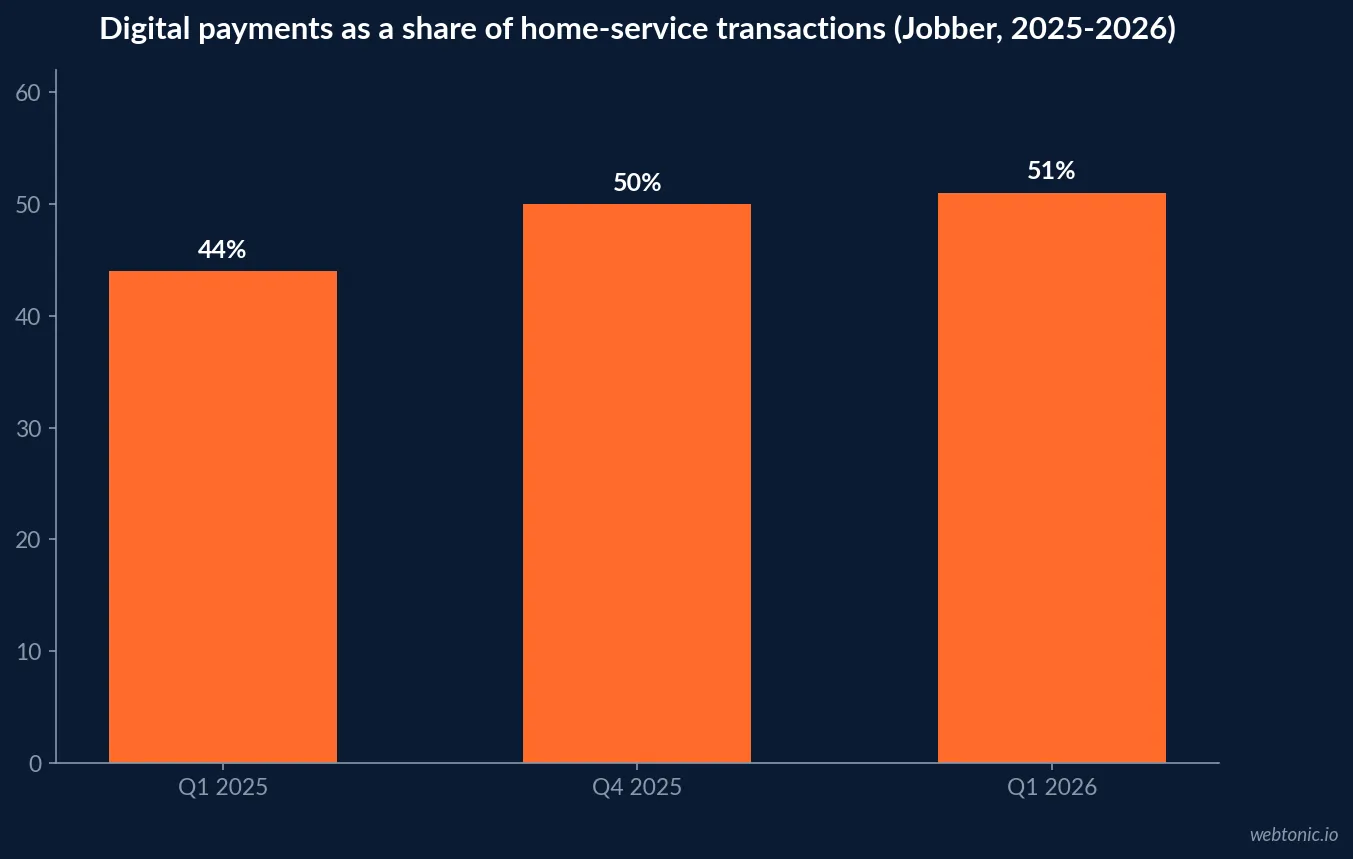
- Digital payments hit 51% of home-service transactions in Q1 2026, up 7 points year over year.
- Only 14% of operators cite online booking as their primary intake channel.
- 1 in 4 customers rank response speed as a key decision factor ahead of price alone.
- 292.4 million tons of municipal solid waste were generated nationally in the EPA's most recent full-year data.
- Only 23.6% of that stream was recycled and 8.5% composted.
- 147,900 refuse and recyclable material collectors were employed nationally in 2024 (O*NET/BLS).
- Median pay for that occupation is $23.89 an hour, or about $49,690 a year.
- A single junk removal job averages $133 to $372 on HomeAdvisor's cost data.
- 83% of consumers use Google specifically to read reviews before booking a local service.
- Only 42% now trust online reviews as much as a personal recommendation, down from 79% in 2020.
- The FTC's fake-review rule has been enforceable since October 21, 2024, with real penalty exposure.
- Home-service consumer confidence recovered from 44.8 to 49.5 between May and June 2026 on Jobber's index.
What "tracking and analytics" means for a same-day hauling business
A junk removal or dumpster rental operator does not run a sales funnel with a 30-day nurture cycle. A ticket is created, a truck is routed, a load is weighed against disposal-fee tiers, and a card is charged, often all inside the same hour. The data layer that matters is dispatch-to-payment, and the best public evidence for how that is changing comes from Jobber's 2026 Home Service Trends Report and its companion Home Service Economic Reports, which track more than 100,000 home and commercial service businesses on its platform across landscaping, cleaning, contracting and hauling-adjacent trades.
Booking channel: the phone still wins the ticket
Software vendors sell online booking widgets hard, but the category-wide data does not show customers using them as the default. Jobber's 2026 report finds only 14% of operators cite online booking as their primary intake channel, and it notes that value "jumps significantly among younger and high-confidence operators" rather than being the norm. Meanwhile 1 in 4 customers now cite response speed as a key decision factor in who gets the job, which argues for a fast phone pickup and a live dispatch board over a booking form nobody fills out at 9 p.m. when their garage is full.
| Intake / ops signal (2026) | Reported figure | Source | What it means for a hauling crew |
|---|---|---|---|
| Primary intake channel: online booking | 14% of operators | Jobber 2026 Home Service Trends Report | Phone and repeat referral still carry most volume |
| Customers ranking response speed as key | 1 in 4 | Jobber 2026 Home Service Trends Report | A missed call is a lost same-day job, not a delayed one |
| Digital payments, Q1 2026 | 51%+ of transactions | Jobber Q1 2026 Home Service Economic Report | Card-on-file at drop-off cuts collections calls |
| Digital payment growth, year over year | +7 percentage points | Jobber Q1 2026 Home Service Economic Report | Adoption is compounding, not plateauing |
| Consumer confidence index (home service) | 44.8 to 49.5, May to June 2026 | Jobber Q2 2026 Home Service Economic Report | Demand volatility a dispatch board should absorb, not amplify |
The volume behind the ticket: what actually gets hauled
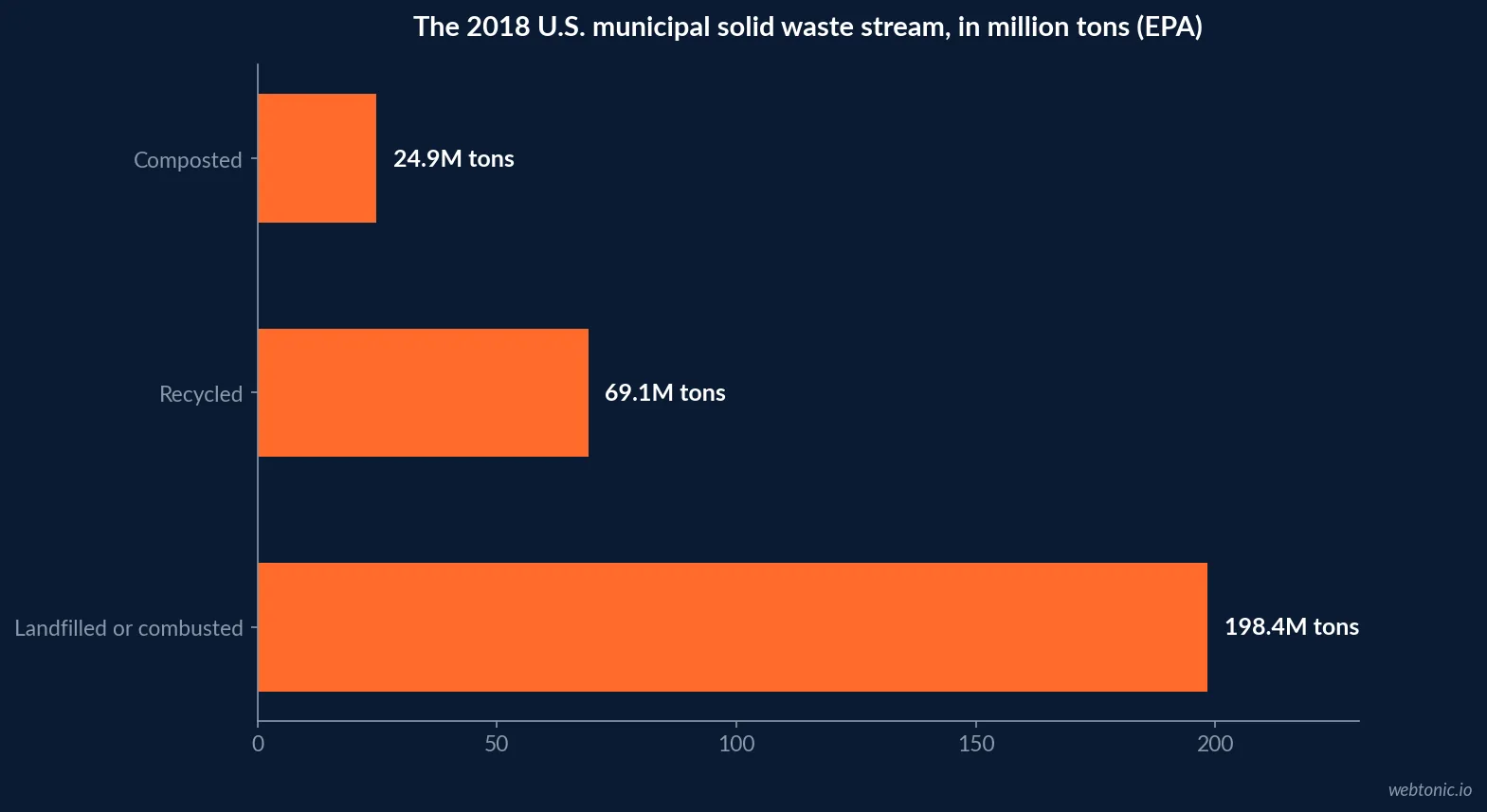
Every load a truck pulls off a driveway or a roll-off yard is a slice of a much larger materials stream. The EPA's national Facts and Figures overview puts total municipal solid waste generation at 292.4 million tons, or 4.9 pounds per person per day, in its most recent complete national dataset. Of that, 69.1 million tons were recycled and 24.9 million tons composted, meaning roughly half still moves to landfill or combustion. For an operator, that split determines disposal-fee tiers by material type, which is exactly the kind of per-load data a dispatch system should be capturing against the invoice, not reconstructing from a paper weigh ticket at month-end.
| Materials stream (EPA, national) | Tons | Share of MSW generated | Operational relevance |
|---|---|---|---|
| Total MSW generated | 292.4 million tons | 100% | Sets the addressable disposal-fee base |
| Recycled | 69.1 million tons | 23.6% | Lower-fee diversion tier, if sorted correctly |
| Composted | 24.9 million tons | 8.5% | Applies mainly to yard-waste and cleanout loads |
| Landfilled or combusted (residual) | ~198.4 million tons | ~67.9% | Highest disposal-fee tier, drives per-load margin |
What a job actually costs, and why per-job tracking pays for itself
HomeAdvisor's own cost database puts typical junk removal spend between $133 and $372 per job, driven by volume, material type and disposal fees, a range wide enough that a crew running blind on weight and fee data will misquote a meaningful share of jobs. The same logic applies to dumpster rental: rental length, tonnage allowance and overage fees are the three variables that determine whether a flat-rate quote makes money, and none of them are visible without a ticket-level tracking system tied to the scale or the estimated-weight chart at booking.
The workforce doing the tracked work
O*NET's occupational profile (built on U.S. Bureau of Labor Statistics data) counts 147,900 refuse and recyclable material collectors employed in 2024, with median pay of $23.89 an hour and projected growth of only 1% to 2% through 2034, classified as slower than average. That flat headcount outlook is itself an argument for analytics: if the labor pool is not growing much, route density and truck utilization data become the lever operators actually have left to add capacity.
| Workforce metric (2024, O*NET/BLS) | Value | Why it matters for tracking |
|---|---|---|
| Refuse & recyclable material collectors, employed | 147,900 | Sets the ceiling on adding headcount vs. adding routing efficiency |
| Median hourly wage | $23.89 | Cost basis for per-stop labor allocation in job costing |
| Median annual wage | $49,690 | Benchmark for crew cost when pricing a flat-rate job |
| Projected employment growth, 2024-2034 | 1% to 2% (slower than average) | Capacity has to come from routing, not hiring alone |
The construction-debris side of the ledger
Municipal solid waste is only half the tracking picture for an operator that also pulls roll-off construction and demolition (C&D) loads. The EPA's own Construction and Demolition Debris data page puts national C&D debris generation at 600 million tons in 2018 - more than twice the MSW total in the same year. A dumpster rental fleet serving both residential cleanouts and job-site roll-offs is really running two different tracking problems: light, mixed household debris on one route and heavy, material-specific C&D loads (concrete, drywall, wood) on the other, each with its own disposal-fee schedule.
| Debris stream (EPA, 2018 national data) | Tons generated | Relative to MSW |
|---|---|---|
| Municipal solid waste (MSW) | 292.4 million tons | Baseline |
| Construction & demolition (C&D) debris | 600 million tons | More than 2x MSW |
The private-sector trade group covering this space, the National Waste & Recycling Association, counts nearly 18,000 waste and recycling facilities and close to 700 member companies operating across all 50 states, a fragmented base of mostly independent operators for whom a shared tracking standard does not exist - each hauler is largely building its own.
Where Google's own lead-tracking mechanism fits in
For operators running Local Services Ads, Google's own help documentation confirms advertisers are charged per valid lead received, with lead prices varying by location and job type, which means the lead-tracking data inside that platform is already itemized by job before it ever reaches a dispatch board. Reconciling that per-lead billing against a dispatch system's own job-cost ledger is one of the more common gaps a tracking build should close first, since the two systems otherwise report cost per acquisition differently.
Reviews and trust data feed the same dashboard
Tracking is not only operational. BrightLocal's 2025 Local Consumer Review Survey finds 83% of consumers use Google specifically to read reviews before choosing a local service, but only 42% now trust reviews as much as a personal recommendation, down sharply from 79% in 2020. Since October 21, 2024 the FTC's rule banning fake reviews and testimonials has been enforceable with real penalty exposure, which makes an operator's own verified-review count and response-time log a compliance-relevant data point, not just a marketing one.
| Trust signal (2025) | Figure | Source |
|---|---|---|
| Consumers who read reviews on Google specifically | 83% | BrightLocal 2025 Local Consumer Review Survey |
| Consumers trusting reviews as much as personal recommendations | 42% | BrightLocal 2025 Local Consumer Review Survey |
| Same trust figure in 2020 | 79% | BrightLocal historical trends research |
| Fake review / testimonial rule in force since | October 21, 2024 | FTC final rule, 16 CFR Part 465 |
Building a minimum tracking stack
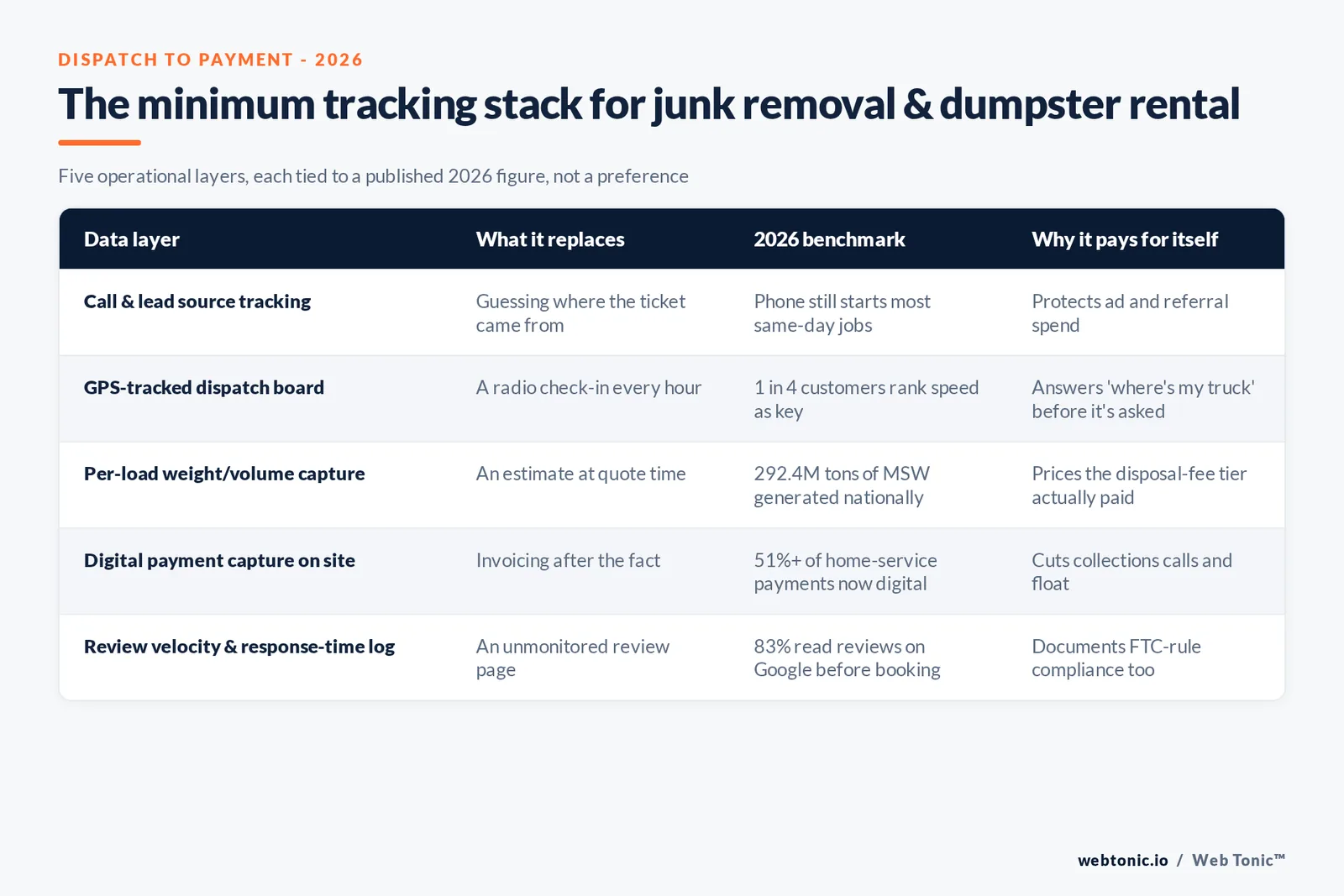
- Call and lead source tracking on every inbound number, since phone still starts most same-day jobs.
- GPS-tracked routing tied to a live dispatch board, so a crew running behind shows up before a customer calls to ask.
- Per-load weight or volume capture against the disposal-fee tier actually paid, not an estimate at quote time.
- Digital payment capture on site, matching the 51%-and-rising category trend instead of invoicing after the fact.
- Review velocity and response-time logging, both for reputation and for the FTC's documentation expectations under the 2024 rule.
Where this data layer fits in a broader marketing stack
Dispatch and payment data answer "did the job get done and paid for." They do not answer "which channel is worth the next marketing dollar," which is a separate question best handled alongside data intelligence work that ties call tracking and job records back to ad spend, and growth marketing planning that uses that same ticket-level data to decide where to add routes versus where to add ad budget. Web Tonic's own writeup on average cost per lead by industry is a useful cross-check once a hauling operator has enough tracked leads to compare against a category benchmark.
Frequently Asked Questions
Do most junk removal and dumpster rental jobs get booked online or by phone?
No published study isolates junk removal and dumpster rental booking channels specifically, so this is read from the broader home-service category. Jobber's 2026 Home Service Trends Report finds only 14% of surveyed operators say online booking is their primary intake channel, and a separate estimate of home-service bookings puts phone, in-person and word-of-mouth ahead of self-serve online forms for most trades. For a same-day dispatch trade like junk hauling, the phone call is still the workhorse.
What share of home-service payments are now digital?
Jobber, drawing on more than 100,000 home and commercial service businesses on its platform, reported digital payments accounted for more than 51% of all Jobber-processed transactions in Q1 2026, up 7 percentage points year over year, after crossing the 50% mark in the prior quarter. That is a platform-wide home-service figure, not a junk-removal-only one, but roll-off and same-day hauling jobs are exactly the kind of on-site, card-present transaction driving that shift.
How much municipal and construction debris does the volume actually come from?
The EPA's Advancing Sustainable Materials Management report puts municipal solid waste generation at 292.4 million tons nationally (2018 data, the most recent full national figures published), or 4.9 pounds per person per day, with about 69.1 million tons recycled and 24.9 million tons composted. Junk removal and dumpster rental operators move a slice of that stream plus construction and demolition debris, which is why per-load weight tracking against disposal-fee tiers is now a margin question, not an admin one.
Is response speed or price the bigger driver of who wins the job?
Jobber's 2026 Home Service Trends Report finds 1 in 4 customers cite response speed as a key decision factor, ahead of the operators who assume price wins every quote. For a category where the same 15-cubic-yard dumpster rental competes on same-day or next-day delivery, a dispatch board that shows real-time truck position answers a question customers are already deciding on before they call for a quote.
How big is the workforce actually doing this dispatched, tracked work?
O*NET's occupational data (sourced from the U.S. Bureau of Labor Statistics) lists 147,900 refuse and recyclable material collectors employed in 2024, with median wages of $23.89 an hour, a workforce size that sets the ceiling on how much of this can be solved by adding headcount instead of adding routing and tracking software.
Sources
Jobber, 2026 Home Service Trends Report
National Waste & Recycling Association, private-sector industry overview
U.S. EPA, Construction and Demolition Debris: Material-Specific Data
Google Local Services Help, How leads work
Jobber, Home Service Economic Reports (Q1-Q2 2026)
U.S. EPA, National Overview: Facts and Figures on Materials, Wastes and Recycling
HomeAdvisor, junk removal cost data
O*NET OnLine (BLS-sourced), Refuse and Recyclable Material Collectors
BrightLocal, 2025 Local Consumer Review Survey
Federal Trade Commission, final rule on consumer reviews and testimonials