Table of contents
The claim in this title checks out, but not the way most operators assume: Whitespark's 2026 Local Search Ranking Factors survey shows Google Business Profile signals and website signals genuinely pulling local rankings in different directions, with the same factor sometimes ranking dozens of positions apart between the map pack and organic results. This page lines up the actual rank gaps, not a guess, alongside how junk removal operators are categorized and reviewed in 2026.
Key Takeaways
- "Address Is Showing on GBP" ranks 7th for the map pack but 95th for organic, an 88-position gap, per Whitespark's 2026 survey of 47 local SEO experts.
- "Freshness of Content Across Entire Website" ranks 109th for the map pack but 25th for organic - the reverse pattern, website signals mattering more for organic.
- Whitespark's 2026 edition scored 187 total ranking factors, with 47 new factors added this year alone.
- Review and behavioural signal weight increased in the 2026 survey while on-page and link signal weight declined, per Whitespark's own year-over-year comparison.
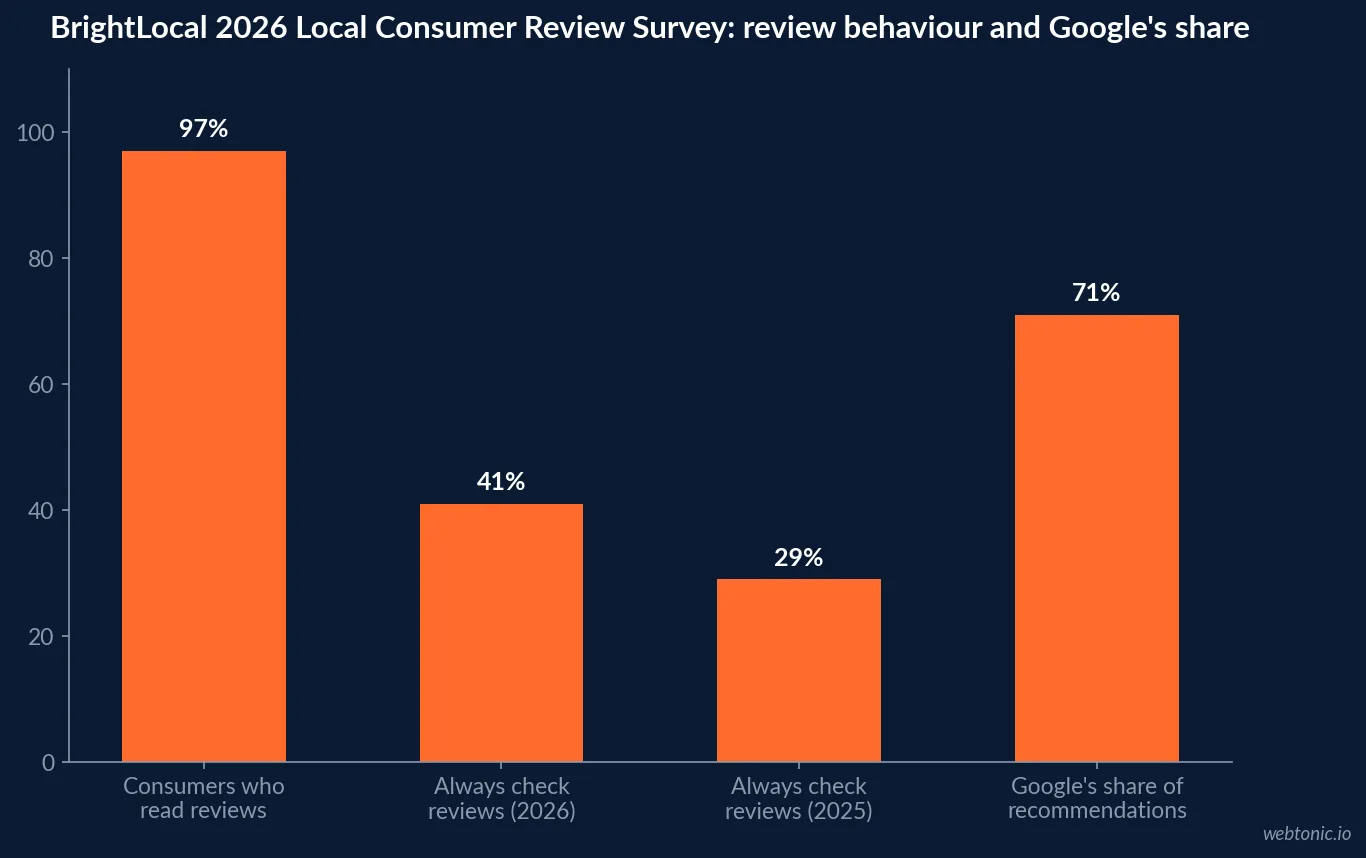
- 97% of consumers read reviews for local businesses in BrightLocal's 2026 survey, and 41% say they "always" check, up from 29% the year before.
- Google's own share of local recommendations fell from 83% to 71% year over year, per the same BrightLocal survey.
- ChatGPT and other AI tools jumped from 6% to 45% usage for local business recommendations in one year.
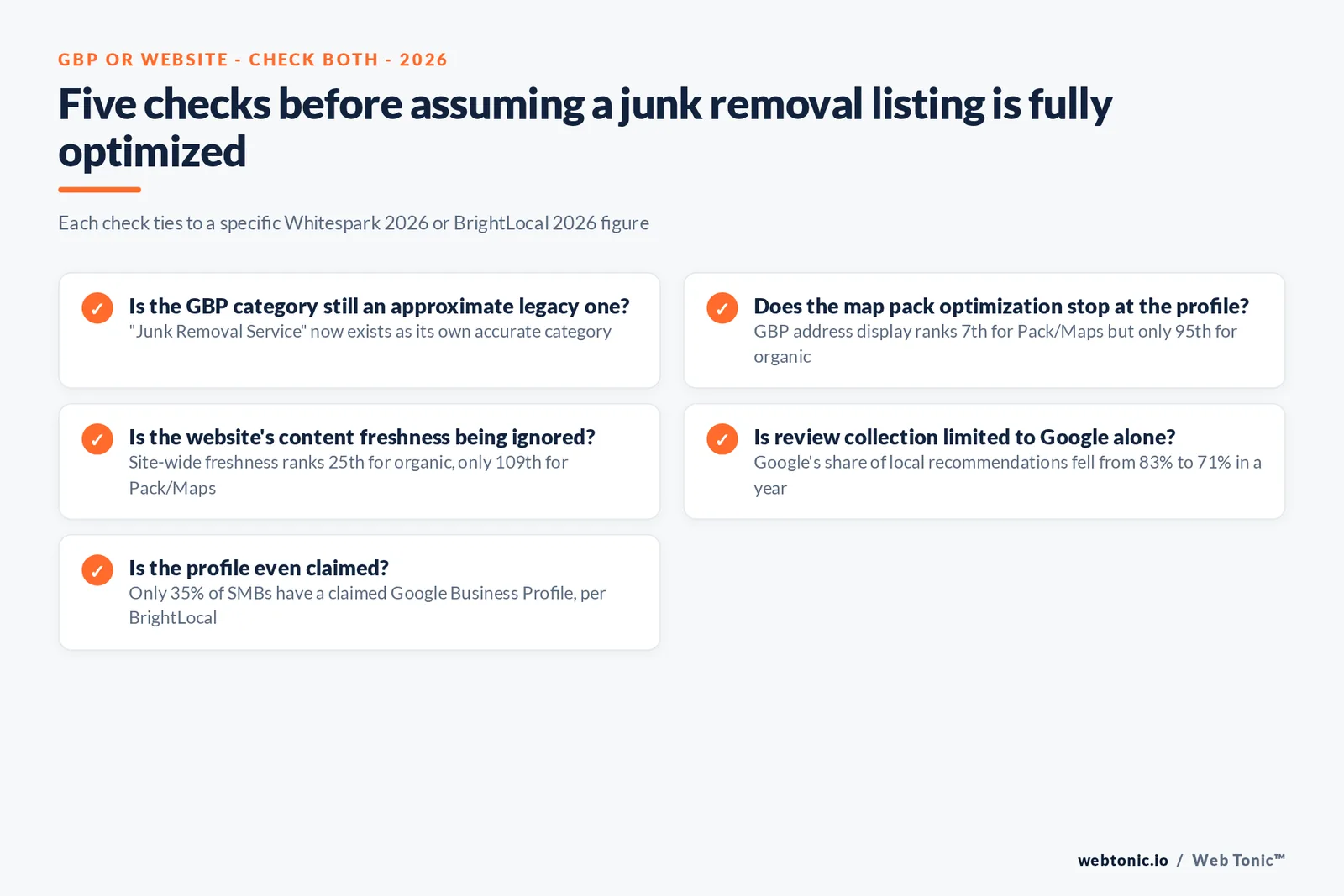
- Only 35% of SMBs have a claimed Google Business Profile, and only 40% have a dedicated website, per BrightLocal's 2025 SMB Marketing Report.
- Google added a dedicated "Junk Removal Service" GBP category, replacing approximate categories like Cleaning Service or Waste Management Service.
- The FTC's fake-review ban took effect October 21, 2024 and applies to GBP review responses and solicitation practices.
The core evidence: the same factor, two different ranks
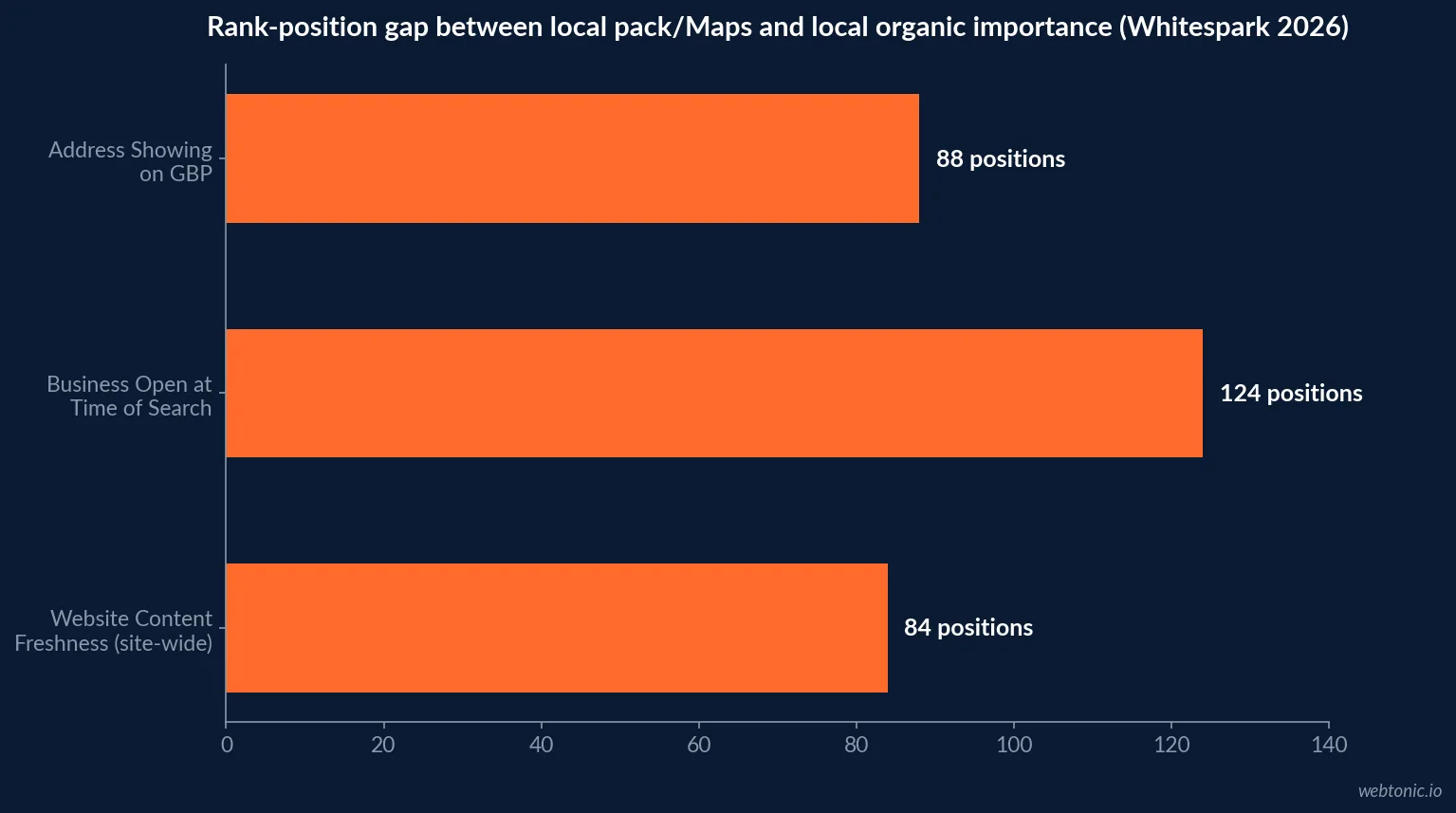
Whitespark's 2026 Local Search Ranking Factors report surveys 47 local search experts who each score 187 factors across four categories: local pack/Maps impact, local organic impact, AI Search visibility, and conversion impact. Because the survey scores the same factor separately for the map pack and for organic results, it is the clearest published evidence of where "GMB optimization" and "website optimization" actually diverge for a local business.
| Ranking factor (Whitespark 2026, rank out of 187) | Pack/Maps rank | Local Organic rank | Gap |
|---|---|---|---|
| Address Is Showing on GBP (Not SAB) | 7th | 95th | 88 positions - GBP-favoring |
| Business Is Open at Time of Search | 5th | 129th | 124 positions - GBP-favoring |
| Click-Through Rate from Local Pack/Maps | 13th | 93rd | 80 positions - GBP-favoring |
| Freshness of Content Across Entire Website | 109th | 25th | 84 positions - website-favoring |
| Scannable Content Structure Across Entire Website | 128th | 26th | 102 positions - website-favoring |
| Proper Site Architecture Organized Into Topic Areas | 133rd | 21st | 112 positions - website-favoring |
What this means in practice: two optimization checklists, not one
The pattern across every factor pair above is consistent: signals that live entirely inside the Google Business Profile (address display, open-now status, click-through behaviour from the map pack itself) rank far more important for the map pack than for organic results. Signals that live on the website (content freshness, page structure, site architecture) run the exact opposite direction. A junk removal or dumpster rental business chasing only one of these two rankings is leaving the other on the table.
| If the goal is... | Prioritize | De-prioritize (not unimportant, just lower-weighted) |
|---|---|---|
| Map pack / "near me" visibility | GBP address, hours, categories, photos, reviews, Q&A | Long-form website content depth |
| Organic "junk removal [city]" ranking | Site architecture, content freshness, internal linking | GBP-only signals with no organic equivalent |
| Both (most operators need both) | A GBP that is fully filled out AND a service-area page per city | Neither - both surfaces need distinct work |
The category itself changed: "Junk Removal Service" as a GBP option
Before Google added a dedicated "Junk Removal Service" category to Google Business Profile, operators had to select an approximate category such as Cleaning Service, Waste Management Service, or Garbage Collection Service - none of which maps precisely to a "junk removal near me" search. Whitespark's survey scores GBP category selection among the highest-weighted local pack/Maps relevance factors, which means a business still sitting on an approximate legacy category is under-optimized for exactly the query type it most wants to win.
| GBP category state | Match to "junk removal near me" | Risk if unchanged |
|---|---|---|
| Junk Removal Service (current, correct) | Direct match | None - correctly categorized |
| Cleaning Service (legacy approximate) | Partial match | Competes against maid/janitorial listings for relevance |
| Waste Management Service (legacy approximate) | Partial match | Reads as municipal/industrial, not consumer hauling |
| Garbage Collection Service (legacy approximate) | Weak match | Reads as curbside trash pickup, not on-demand removal |
Reviews carry more weight than a year ago, and Google alone isn't enough
BrightLocal's 2026 Local Consumer Review Survey reports 97% of consumers read reviews for local businesses, and 41% now say they "always" read reviews before choosing one - up sharply from 29% in the prior year's survey. At the same time, Google's own share of where consumers actually go for local recommendations fell from 83% to 71% year over year, while Facebook, Apple Maps, Tripadvisor and AI tools including ChatGPT all gained ground - AI-tool usage for local recommendations jumped from 6% to 45% in a single year. A junk removal business collecting reviews on Google only is missing a growing share of where the decision actually happens.
| Review/recommendation source | 2025 share | 2026 share | Direction |
|---|---|---|---|
| 83% | 71% | Down 12 points | |
| ChatGPT / AI tools | 6% | 45% | Up 39 points |
| Apple Maps | 14% | 27% | Up 13 points |
| Consumers who "always" read reviews | 29% | 41% | Up 12 points |
The unclaimed-territory problem
None of the ranking-factor work above matters if the profile isn't claimed in the first place. BrightLocal's 2025 SMB Marketing Report found only 35% of small and midsize businesses have a claimed Google Business Profile, and only 40% have a dedicated website - despite 89% saying they invest in organic SEO. No study isolates junk removal specifically, but there is no reason to expect this trade-services category to sit meaningfully above the cross-industry average; if anything, a category that only got its own accurate GBP listing type recently is more likely to have unclaimed or miscategorized profiles than a more established vertical.
The compliance layer: reviews since October 2024
The FTC's Trade Regulation Rule on the Use of Consumer Reviews and Testimonials became enforceable October 21, 2024. It bans a business from writing fake reviews of itself, paying for reviews, or suppressing genuine negative reviews through baseless legal threats. It does not restrict the practices Whitespark's survey scores highest for local pack ranking - responding to reviews, encouraging real customers to leave them, and keeping a Q&A section current - all of which remain both compliant and among the highest-weighted local ranking signals in the 2026 data.
How large is the market these rankings are actually competing for
The stakes behind a map-pack-versus-organic ranking gap scale with how big the underlying market is. IBISWorld's 2026 industry report values the Waste Collection Services industry at USD 83.1 billion, and the Census Bureau's County Business Patterns series - published annually under NAICS 562111 (Solid Waste Collection) and 562119 (Other Waste Collection) - is the standard public way to size how many competing establishments exist in a given metro area before deciding how much local SEO work a market actually justifies. The BLS separately tracks the Refuse and Recyclable Material Collectors occupation at a median hourly wage near USD 20.94-USD 22.00 depending on the survey year, a useful proxy for labor-cost pressure on any operator's marketing budget.
| Market backdrop data point | Figure | Source |
|---|---|---|
| US Waste Collection Services industry size (2026) | USD 83.1 billion | IBISWorld |
| Establishment counts, NAICS 562111/562119 | Published annually by county/metro | Census County Business Patterns |
| Refuse & Recyclable Material Collectors, median hourly wage | ~USD 20.94-22.00 | BLS Occupational Employment and Wage Statistics |
Building the right checklist for each surface
The honest takeaway from Whitespark's rank-gap data is that "local SEO" for a junk removal or dumpster rental business is really two separate optimization projects sharing one review and reputation layer. Our local SEO team builds GBP category, photo and review workflows for the map pack separately from the service-area page and content architecture work that moves organic rankings, because the Whitespark data shows those two surfaces respond to genuinely different signals. See our cost-per-lead data by industry for how local visibility ties back to lead cost, or talk to us about auditing which surface your listing is actually missing.
Frequently Asked Questions
Does Google actually treat map pack ranking and organic website ranking differently?
Yes, and Whitespark's 2026 Local Search Ranking Factors survey - 47 local SEO experts scoring 187 factors - measures the gap directly. "Address Is Showing on GBP (Not SAB)" ranks 7th in importance for the local pack/Maps but only 95th for local organic. "Freshness of Content Across Entire Website" runs the opposite way: 109th for the map pack, 25th for organic. A junk removal listing optimized only for one surface is under-optimized for the other.
Is there really a dedicated Google Business Profile category for junk removal now?
Yes. Google added "Junk Removal Service" as a distinct category; before that, operators had to choose an approximate category like Cleaning Service, Waste Management Service or Garbage Collection Service, none of which matches a "junk removal near me" search as precisely. Category selection is one of the factors Whitespark's experts score highest for local pack/Maps relevance.
How much do reviews actually matter for a junk removal or dumpster rental listing?
A lot, and rising. BrightLocal's 2026 Local Consumer Review Survey found 97% of consumers read reviews for local businesses, and 41% now say they "always" check reviews before choosing one - up from 29% a year earlier. Google's own share of where those reviews get read dropped from 83% in 2025 to 71% in 2026, with Facebook, Apple Maps and AI tools like ChatGPT gaining ground, which means a junk removal business now needs a review presence beyond Google alone.
What share of junk removal operators even have a claimed, complete profile to optimize?
No study measures this category specifically, but BrightLocal's broader 2025 SMB Marketing Report found only 35% of small and midsize businesses across all categories have a claimed Google Business Profile, and only 40% have a dedicated website - meaning most of the ranking factors this page covers are simply unclaimed territory for a majority of small operators, junk removal included.
Did the FTC's 2024 review rule change what a junk removal business can put in its GBP responses?
Yes. The FTC's Trade Regulation Rule on Consumer Reviews and Testimonials, effective October 21, 2024, bans a business from posting fake first-party reviews of itself, buying reviews, or suppressing genuine negative reviews through unfounded legal threats. Responding to and encouraging real reviews is unaffected and remains one of the highest-scored local pack factors in Whitespark's 2026 survey.
Sources
Whitespark - 2026 Local Search Ranking Factors Report
BrightLocal - Local Consumer Review Survey 2026
BrightLocal - SMB Marketing Report 2025
Google - Understand the screening and verification process (Local Services Help)
Federal Trade Commission - Trade Regulation Rule on Consumer Reviews and Testimonials (2024)
IBISWorld - Waste Collection Services in the US Market Size (2026)
US Census Bureau - County Business Patterns Data
US Bureau of Labor Statistics - Refuse and Recyclable Material Collectors (OES)