Table of contents
Writing an investor-ready growth plan and defending it are two different jobs, and the 2026 sourcing data says most teams should buy the first and keep the second. Here is what the published splits actually show.
Key Takeaways
- 59.5% of marketing activity is built in house.
- 38.5% is delivered by outside partners.
- Only 1.9% is bought as a finished product.
- Agencies deliver 15.5% of activity.
- Consultancies deliver 12.7%.
- Other partners deliver 10.4%.
- Hybrid structures lead at 35% of B2B teams.
- Project-based arrangements are 28%.
- Retainers are 24% and freelancers 12%.
- Bandwidth is the top outsourcing reason at 22%.
- Speed follows at 18% and expertise at 15%.
- Cost efficiency is only fourth at 13%.
- 33.6% of digital marketing activity is delivered externally.
- B2C product firms outsource 48% of digital activity.
- B2B services firms outsource just 25%.
- Retail outsources 57% and technology 28%.
- 31% of S&P 500 companies have no chief marketing officer.
- Median chief marketing officer tenure is 4.1 years.
- Fractional demand grew 149% year on year.
- 97% of B2B teams claim a content strategy, 13% call it very effective.
The market has already split the work
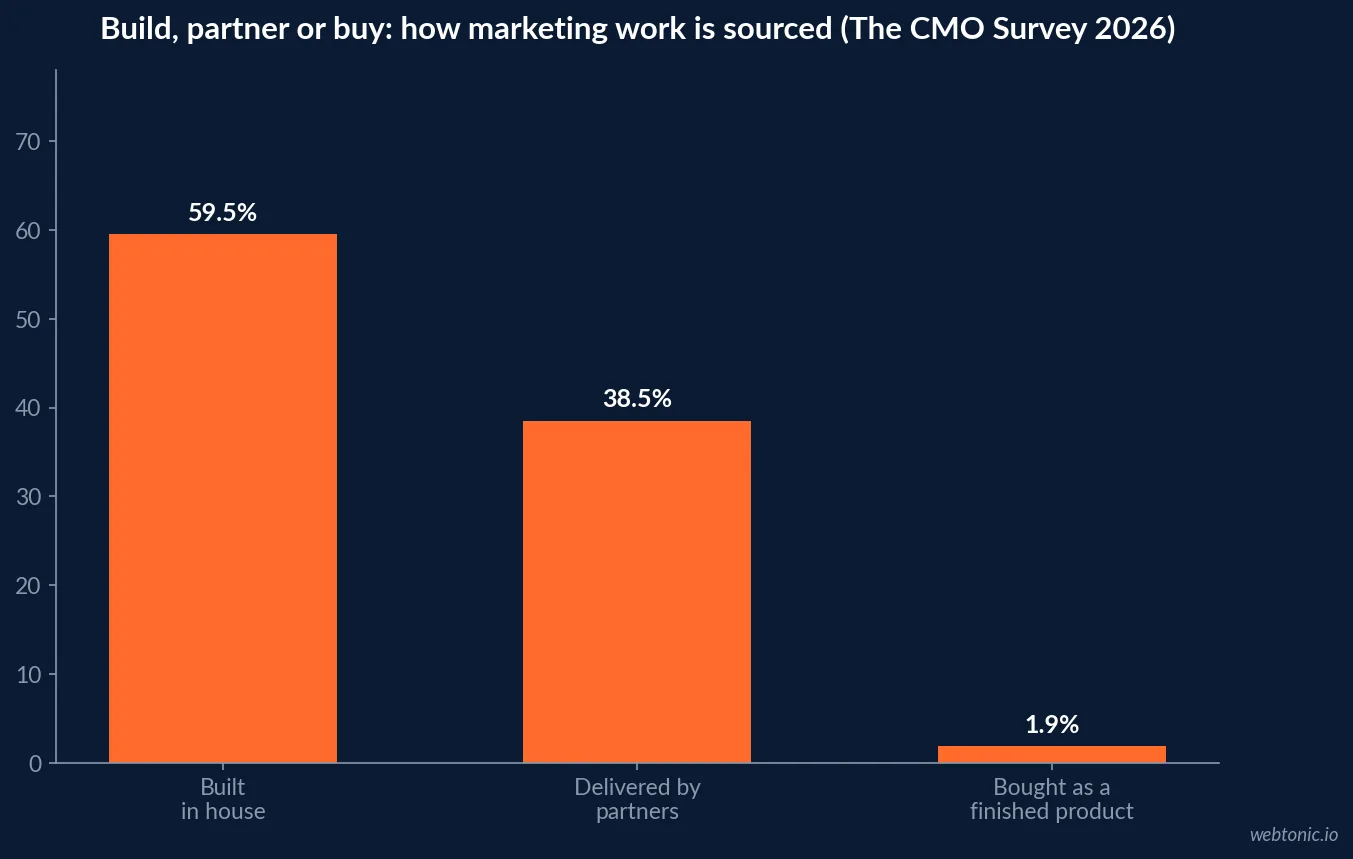
The CMO Survey 2026 reports a build, partner and buy split of 59.5%, 38.5% and 1.9%, with agencies at 15.5%, consultancies at 12.7% and other partners at 10.4%. The in-house share has climbed from 57.9% in 2020.
Read that as evidence against both extremes. Nobody outsources a plan wholesale, and almost nobody writes one entirely alone either.
| Sourcing route | Share of activity | Fit for plan authorship | Fit for plan defence |
|---|---|---|---|
| Built in house | 59.5% | Slow when the team is committed | The only durable option |
| Consultancies | 12.7% | Strong - priced by deliverable | Ends with the engagement |
| Agencies | 15.5% | Strong on channel modelling | Ends with the engagement |
| Other partners | 10.4% | Useful for specific data work | Not applicable |
| Bought as a product | 1.9% | Templates do not survive diligence | Not applicable |
Hybrid is the modal answer, not a compromise
Sagefrog's 2026 B2B Marketing Mix Report puts hybrid in-house and external arrangements at 35% of B2B teams, ahead of project-based at 28%, retainers at 24% and freelancers at 12%.
For a growth plan, hybrid has a specific meaning: an external author with an internal owner whose name is on the scorecard. That is the arrangement diligence rewards, because the person answering questions in the room is still employed there next quarter.
| Support structure | Share of B2B teams | What it looks like on a plan | Main failure mode |
|---|---|---|---|
| Hybrid | 35% | External author, internal owner | Ownership never formally handed over |
| Project-based | 28% | Fixed-scope pack with a date | No one defends it in month four |
| Retainer | 24% | Quarterly re-benchmarking | Paying availability for one-off scope |
| Freelancers | 12% | Modelling or writing support | No accountability for the whole |
| Fully in house | Balance of the market | Team writes and defends | Slips when the raise has a date |
Why teams reach outside, in their own words
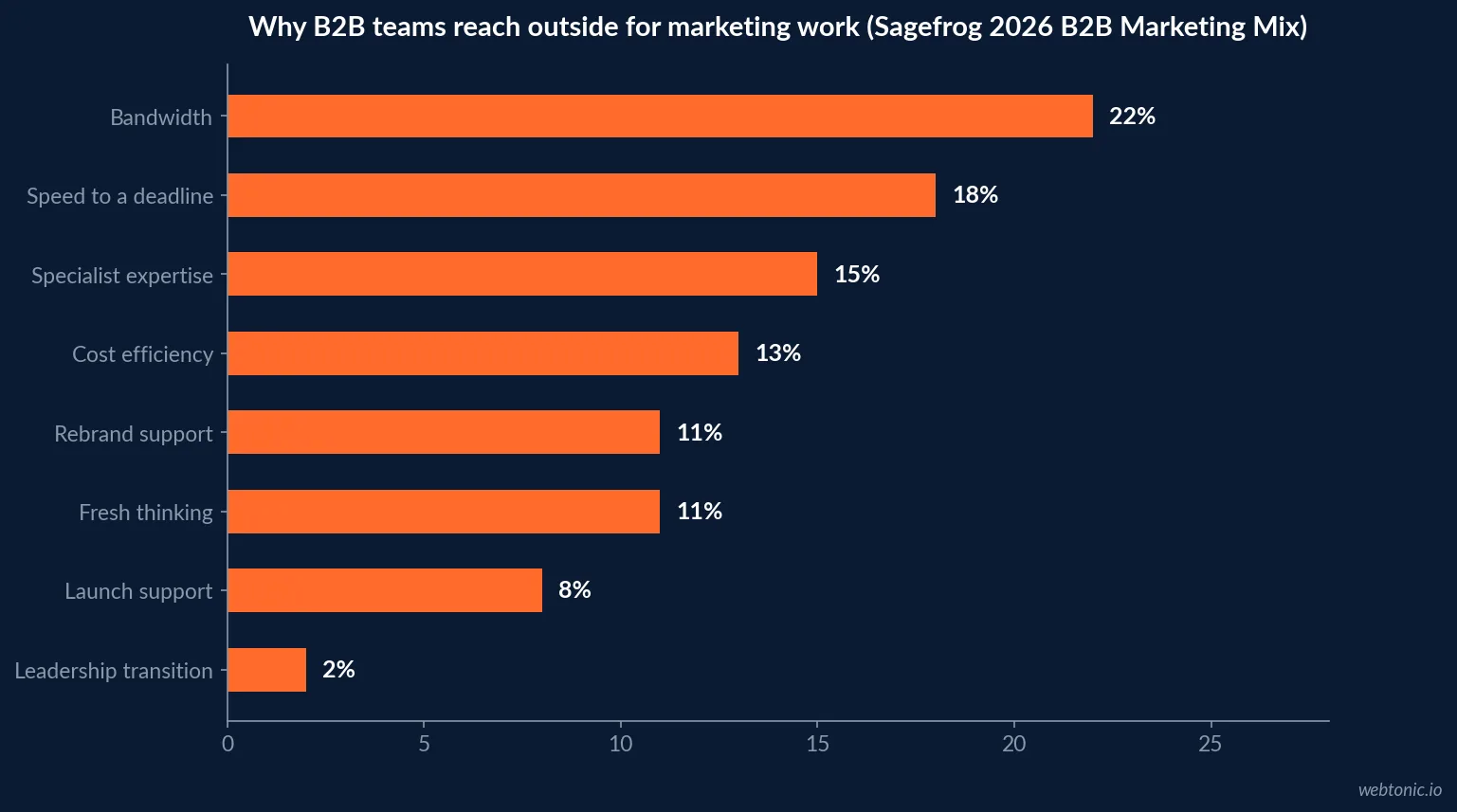
Sagefrog reports the reasons for outsourcing as bandwidth 22%, speed 18%, expertise 15%, cost efficiency 13%, rebrand 11%, fresh ideas 11%, launch support 8% and leadership transition 2%.
Cost is fourth. A plan sold on savings is being sold against the wrong motive; the buyer is nearly always buying a date they can hit.
How much of the digital work already leaves the building
The CMO Survey 2026 puts external delivery of digital marketing activity at 33.6% overall, with a wide sector spread: B2C product firms at 48%, B2C services at 44%, B2B product at 28% and B2B services at 25%. By industry, retail outsources 57% and consumer packaged goods 55%, while technology outsources 28%.
The sectors that build most are the ones selling expertise: education at 83.0%, consumer services at 73.3% and professional services at 70.0%, along with 64.1% of firms under USD 10 million in revenue. If you sit in one of those, an externally authored plan is the exception in your peer group and should come with an internal owner attached.
| Firm type | Digital activity delivered externally | Reading | What it means for plan work |
|---|---|---|---|
| B2C product | 48% | Highest outsourcing | External authorship is normal |
| B2C services | 44% | High | External authorship is normal |
| B2B product | 28% | Low | Expect internal drafting |
| B2B services | 25% | Lowest | Buy method, not hands |
| Firms under USD 10M revenue | 64.1% build in house | Capacity-constrained | Buy the modelling, own the defence |
The signature problem
Spencer Stuart reports median chief marketing officer tenure of 4.1 years against 5.0 across the C-suite, 31% of S&P 500 companies with no chief marketing officer, and 77% of vacancies filled within six months.
A plan written during a vacancy has no natural defender. The practical answer is a named interim or fractional owner for the board cycle - The Fractional Work Report puts demand growth at 149% year on year with about 150,000 US practitioners, marketing at 20% of demand and 87% carrying eleven or more years of experience.
| Situation | Author the plan | Defend the plan | Evidence behind the choice |
|---|---|---|---|
| Marketing leader in seat | External specialist | The leader | Bandwidth is the top reason at 22% |
| No marketing leader | External specialist | Fractional or interim owner | 31% have no CMO in seat |
| Leader newly hired | Jointly | The new leader | 77% of vacancies fill within six months |
| Expertise-selling firm | Internal team with review | The leader | Professional services build 70.0% |
| Raise inside eight weeks | External specialist | Founder or CFO | Speed is the second reason at 18% |
What the outside author has to bring that the team cannot
Benchmark access, mostly. Benchmarkit's CY-2025 benchmarks put median growth at 20%, median customer acquisition cost payback at 16 months, median lifetime value to acquisition cost at 4.1 times and gross revenue retention falling from 88% to 84%.
An internal team can produce its own numbers. Producing them beside the market's medians, without flattering the comparison, is where an outside author earns the fee. Our data and analytics practice exists for that step.
The capability audit before you decide
The CMO Survey's martech self-ratings, on a one to seven scale, are candid: vendor selection 4.9, tactical use of data 4.8, system integration 4.8, generating technology return 4.5, demonstrating that return 4.2, training 3.9 and hiring the skills 3.7. The barriers named are artificial intelligence skill gaps at 35.7%, resourcing at 22.3% and architecture at 19.1%.
Score your own team on the same seven lines before choosing. Anything at or below the survey's demonstrating-return figure of 4.2 is a candidate to buy in for the plan.
| Capability | Market self-rating, 1-7 | Reading | Plan implication |
|---|---|---|---|
| Selecting vendors | 4.9 | Strongest line | Keep in house |
| Tactical use of data | 4.8 | Adequate | Keep in house with review |
| Integrating systems | 4.8 | Adequate | Buy in for data room work |
| Demonstrating technology ROI | 4.2 | Weak | Buy in - this is the diligence question |
| Hiring the skills | 3.7 | Weakest line | Rent the capability for the cycle |
Strategy on paper is not the constraint
CMI's B2B research reports 97% of teams having a content strategy while only 13% call their approach significantly effective, with 48% saying somewhat and 30% reporting no change. The challenges prompting action are resources 39%, measurement 33%, quality 28% and differentiation 24%, and only 52% have governance in place.
Documents are abundant; execution and measurement are not. That is the argument for buying the plan and keeping the operating rhythm internal, rather than the other way round.
The cadence decides whether either choice works
Whoever writes it, the plan has to be re-benchmarked as the medians move - Benchmarkit records four consecutive years of growth deceleration and the largest single-year drop in gross retention in its series. Supporting evidence on rhythm is vendor research and should be read that way: EOS Worldwide reports firms running its system with a professional implementer growing 2.8 times faster in a TrueSpace and Gallup validated study of 305 companies.
The transferable part is the fixed review date, not the multiple.
One line in the plan neither side can skip
The CMO Survey 2026 reports artificial intelligence rising from 13.1% to 24.2% of marketing activities in a year, generative AI from 7.0% to 22.4% - a 220% increase - with 55.9% projected within three years and 41.5% of teams already working on visibility inside AI search answers. The barrier named most often is skill gaps, at 35.7%.
A growth plan written in 2026 without that line looks dated to a board, and it is the line an internal team is least likely to be able to evidence on its own.
| Adoption measure (2026) | Figure | Prior reading | Who usually has the evidence |
|---|---|---|---|
| AI share of marketing activities | 24.2% | 13.1% | External partners, per the survey |
| Generative AI share of activities | 22.4% | 7.0% | External partners |
| Projected AI share in three years | 55.9% | Not reported | Requires an internal roadmap |
| Teams working on AI search visibility | 41.5% | Not reported | Specialist support |
| Top barrier named | Skill gaps, 35.7% | Resourcing 22.3% | Argues for renting the skill |
How to decide in one sitting
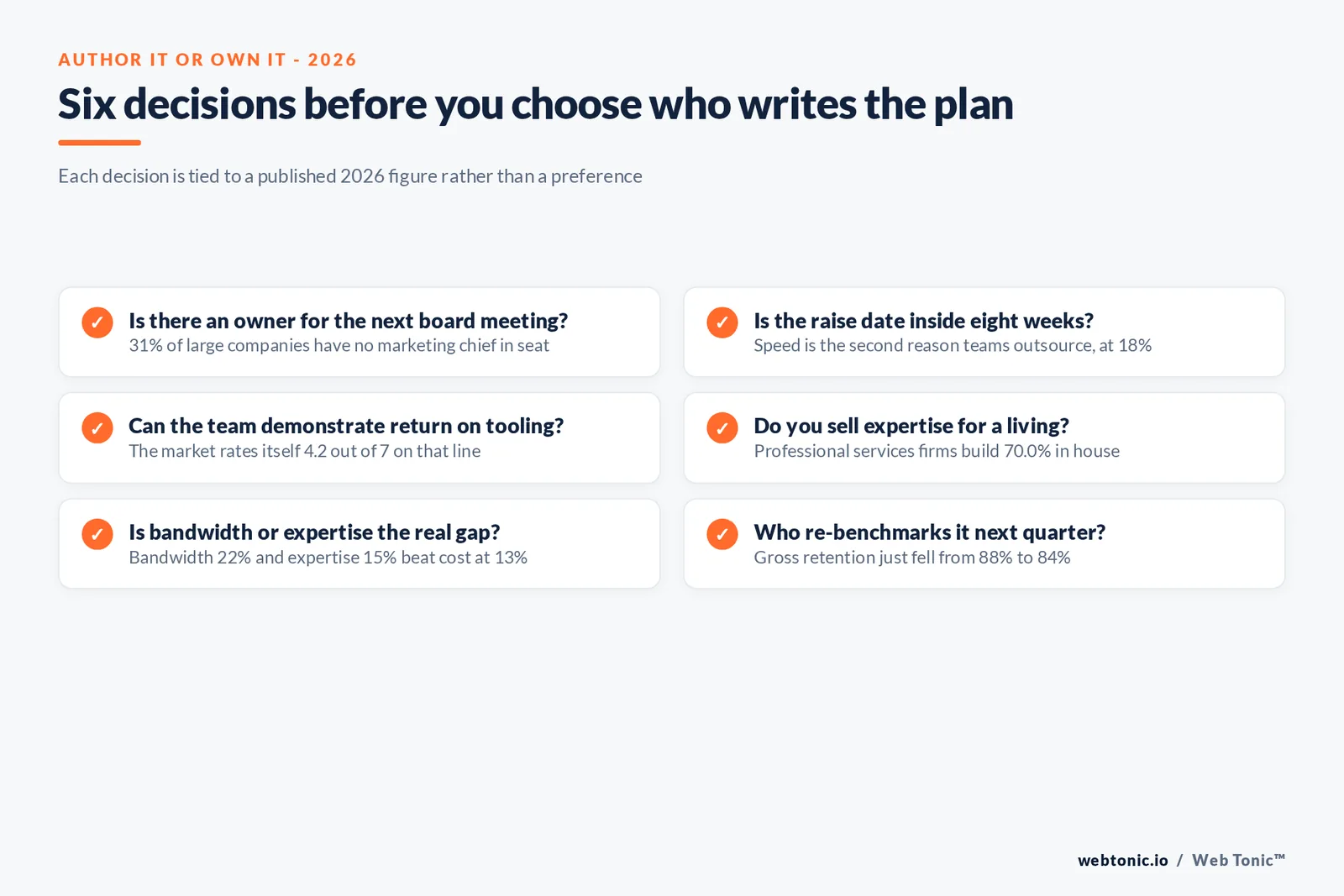
Ask three questions. Is there an internal owner who will still be here at the next board meeting? Does the team score above the market's 4.2 self-rating on demonstrating return? Is the raise date inside eight weeks? A no to the second or a yes to the third argues for an external author; a no to the first argues for a fractional owner before anything gets written.
If you want the marketing half of the pack authored and instrumented, talk to us, see how our growth marketing practice models channel scenarios, or read our view on when paid social is worth the investment before a channel line goes into the plan.
Frequently Asked Questions
Should we hire or outsource the growth plan?
Split the two jobs. Authorship - the modelling, benchmarking and document build - is a bounded piece of work that outside specialists deliver faster; defence in front of a board is an internal accountability that cannot be rented. The CMO Survey 2026 shows the market landing in the same place: 59.5% of marketing activity is built in house against 38.5% delivered by partners, which is a split, not a winner.
Who actually delivers outsourced marketing work in 2026?
Agencies take 15.5% of activity, consultancies 12.7% and other partners 10.4%, according to The CMO Survey 2026, adding to the 38.5% delivered externally. Only 1.9% of activity is bought as a finished product. For plan work specifically, the consultancy share matters most because it is the one priced by deliverable.
Does an outside author weaken the plan in diligence?
Only if nobody internal owns the numbers afterwards. Sagefrog's 2026 data shows B2B teams choosing hybrid arrangements most often at 35%, ahead of project work at 28% and retainers at 24%, precisely because the internal owner stays in place. A plan with an external author and an internal owner reads as resourced; one with neither reads as unowned.
What if there is no marketing leader to defend it?
That is common and it is the real gap. Spencer Stuart reports 31% of S&P 500 companies with no chief marketing officer and median tenure of 4.1 years, the shortest in the C-suite, with 77% of vacancies filled within six months. If a board cycle lands inside that gap, an interim or fractional owner defending the plan beats an unsigned document.
Why do teams outsource, if not to save money?
Cost efficiency is only the fourth reason. Sagefrog reports bandwidth at 22%, speed at 18% and expertise at 15% ahead of cost efficiency at 13%, with rebrands and fresh thinking at 11% each and leadership transition at just 2%. For plan work, speed usually decides it: the raise has a date and the internal team already has a quarter of committed work.
Sources
The CMO Survey - Highlights and Insights Report 2026
Sagefrog - 2026 B2B Marketing Mix Report
Spencer Stuart - CMO tenure 2026 snapshot
Fractional Jobs - The Fractional Work Report
Benchmarkit - CY-2025 B2B SaaS performance metrics benchmarks
Content Marketing Institute - B2B content marketing trends research
EOS Worldwide - Companies with an implementer grew 2.8x faster