Table of contents
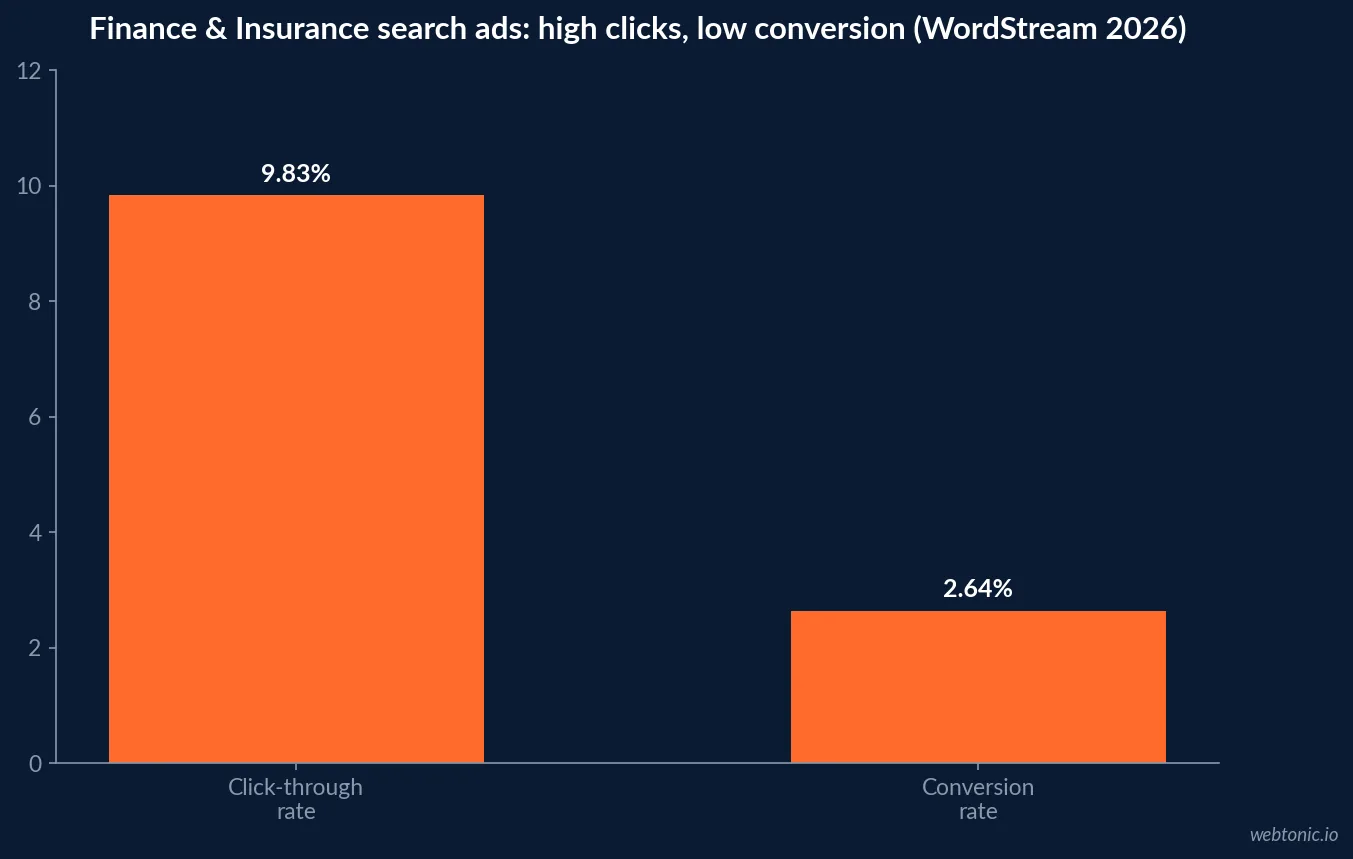
Insurance search ads post one of the highest click-through rates of any industry and one of the lowest conversion rates. That gap is not an ad problem - it is what happens after the click, on the landing page and inside the quote form, and 2026 benchmark data now sizes exactly how much is being left on the table.
Key Takeaways
- Finance and Insurance click-through rate is 9.83% in search, second only to Arts and Entertainment.
- Its conversion rate is only 2.64%, the third-lowest of any industry tracked.
- The cross-industry average cost per lead is USD 66.69 in 2026.
- Insurance landing pages convert at a median 18.2% on Unbounce's benchmark set of 41,000 pages.
- That is 119% above the 8.3% financial services median.
- The cross-industry landing page median is 6.6%.
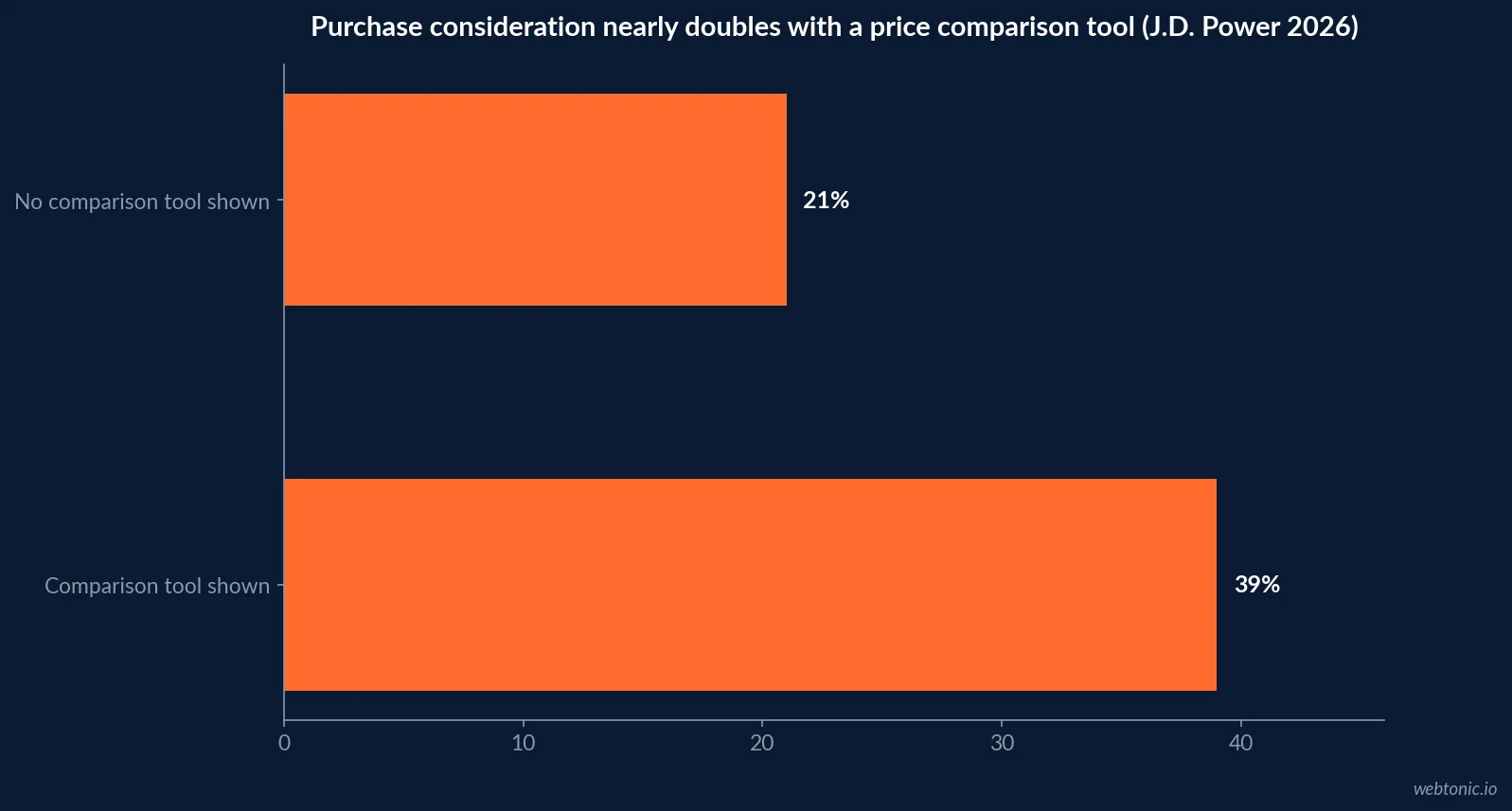
- Comparison tools nearly double purchase consideration: 39% versus 21%.
- Only a third of shoppers see a multi-carrier comparison tool.
- 28% see no price comparison tool at all.
- Shopping-segment satisfaction fell 12 points to 523 of 1,000 year over year.
- Service-segment satisfaction fell 4 points to 695 of 1,000.
- Shoppers now compare an average of 3.5 quotes, a study-record high.
- 48% of new auto policies are now bought digitally, up from 36% five years ago.
- 47% of insurance purchases now run through digital channels versus 35% through agents.
- Meta traffic-campaign CTR for Finance and Insurance is 1.46%, the lowest of any industry.
- Its Meta traffic-campaign CPC is USD 0.86, the highest of any industry.
- Insurance search CPC year over year moved only modestly against Real Estate's 27.27% jump.
The click-to-conversion gap, by the numbers
WordStream's LocaliQ-powered 2026 Search Advertising Benchmarks report puts Finance and Insurance click-through rate at 9.83%, trailing only Arts and Entertainment's 12.75% and just ahead of Travel's 9.82%. That is a strong signal: people who see an insurance search ad click it. The same report puts Finance and Insurance conversion rate at 2.64%, ahead only of Furniture at 2.99% and Career and Employment at 3.05%, and well below the cross-industry average of 8.18%.
The cross-industry average cost per lead sits at USD 66.69. Insurance does not appear among either the cheapest or the most expensive three industries for cost per lead in the same report, which is itself informative: the channel is not overpriced, the destination page is under-converting the traffic it is already winning cheaply.
| Search metric (2026) | Finance & Insurance | Where it ranks | Source |
|---|---|---|---|
| Click-through rate | 9.83% | 2nd highest of all industries | WordStream/LocaliQ |
| Conversion rate | 2.64% | 3rd lowest of all industries | WordStream/LocaliQ |
| Cross-industry avg. CTR | 6.64% | Insurance beats this by 3.19 pts | WordStream/LocaliQ |
| Cross-industry avg. CVR | 8.18% | Insurance trails this by 5.54 pts | WordStream/LocaliQ |
| Cross-industry avg. CPL | USD 66.69 | Reference point, not insurance-specific | WordStream/LocaliQ |
Landing pages actually built for insurance convert well - when they are simple
Unbounce's Conversion Benchmark Report, drawn from 41,000 landing pages and 57 million tracked conversions, found insurance pages converting at a median 18.2% - more than double the cross-industry median of 6.6% and 119% above the broader financial services median of 8.3%. That figure describes a single, simple ask: a callback, a quote-interest form, a rate-alert sign-up.
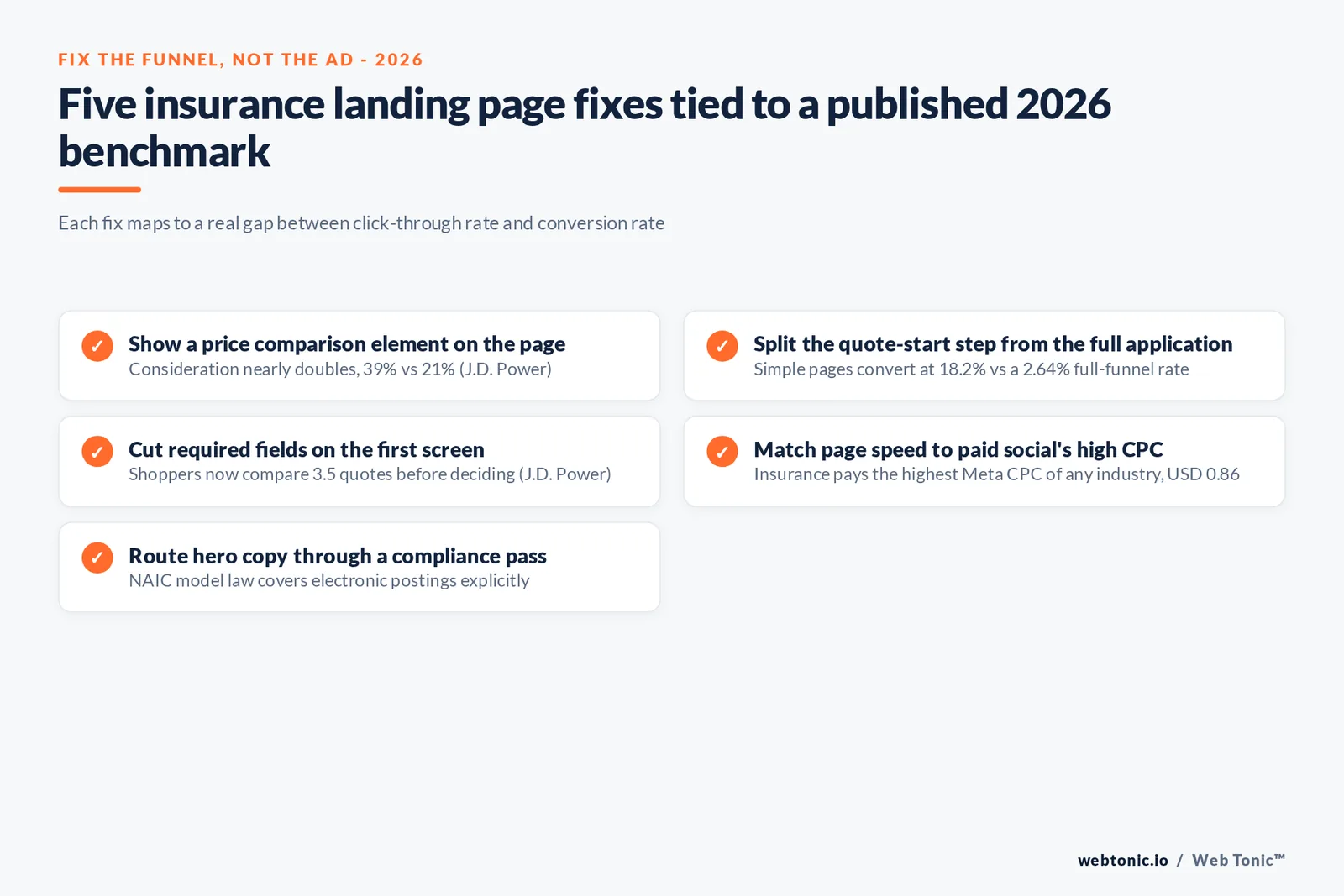
The gap with the search-ads conversion rate above is the tell. When the landing page's job is narrow, insurance converts better than almost any other category. When the page's job expands into a full underwriting-style application before it will show a number, conversion collapses toward the 2.64% figure. The fix most audits find is not a redesign - it is separating "get my quote started" from "finish my full application" into two different pages with two different jobs.
| Landing page benchmark | Conversion rate | Sample | Source |
|---|---|---|---|
| Insurance landing pages (median) | 18.2% | 41,000 pages / 57M conversions | Unbounce 2024 |
| Financial services (median, all subtypes) | 8.3% | Same dataset | Unbounce 2024 |
| Cross-industry median (all pages) | 6.6% | Same dataset | Unbounce 2024 |
| Insurance search-ads conversion rate | 2.64% | Google/Microsoft Ads accounts | WordStream 2026 |
Comparison tools are the single biggest lever the data can point to
J.D. Power's 2026 U.S. Insurance Digital Experience Study, covered by Insurance Business America, found that shoppers who see a digital price and coverage comparison tool are nearly twice as likely to consider buying: 39% consideration with a tool present against 21% without one. Despite that lift, only one-third of shoppers encounter a tool that compares competing carriers, 27% see a same-insurer-only version, and 28% see no comparison tool at all on the page they land on.
The same study recorded satisfaction sliding in both funnel stages it measures: the shopping segment fell 12 points year over year to 523 of 1,000, and the service segment fell 4 points to 695 of 1,000. A landing page audit that adds a real comparison element, even a simple side-by-side rate table, is working directly against the metric J.D. Power says moves consideration the most.
The competition a landing page is actually up against
J.D. Power's 2026 U.S. Insurance Shopping Study (12,437 consumers, fielded January 2025-January 2026) found shoppers now collect an average of 3.5 quotes before deciding - the highest level in the study's 20-year history - and that 48% of new auto policies are now purchased digitally, up from 36% just five years earlier. Separately, J.D. Power's Insurance Intelligence Report puts the digital-channel share of all insurance purchases at 47%, against 35% through agents and 17% through call centers.
A landing page is not competing with one insurer's ad; it is one of 3.5 open tabs. Load speed, a visible number, and a short number of required fields are the difference between staying one of those tabs and losing the shopper to whichever competitor gets to a price first.
| Digital shopping fact (2026) | Figure | Source |
|---|---|---|
| Average quotes compared per shopper | 3.5 (record high) | J.D. Power Insurance Shopping Study |
| New auto policies bought digitally | 48% (up from 36% in 5 yrs) | J.D. Power Insurance Shopping Study |
| Share of purchases via digital channel | 47% | J.D. Power Insurance Intelligence Report |
| Share of purchases via agent | 35% | J.D. Power Insurance Intelligence Report |
| Share of purchases via call center | 17% | J.D. Power Insurance Intelligence Report |
Paid social lands in the same trap as paid search
WordStream by LocaliQ's 2026 Facebook Ads Benchmarks, based on roughly 1,800 tracked campaigns, found Finance and Insurance sitting at the worst end of both traffic metrics measured: the lowest click-through rate of any industry at 1.46% and the highest cost per click at USD 0.86. That means every click an insurer buys on Meta is already the most expensive click in the report, which raises the cost of every landing-page conversion failure that follows it.
Read next to the search figures above, the pattern holds across two different auction mechanisms: insurance buyers are willing to click, platforms price that willingness accordingly, and the landing page is where the campaign's return is actually decided.
| Paid social metric (2026) | Finance & Insurance | Rank | Source |
|---|---|---|---|
| Traffic-campaign CTR | 1.46% | Lowest of any industry | WordStream/LocaliQ Facebook Benchmarks |
| Traffic-campaign CPC | USD 0.86 | Highest of any industry | WordStream/LocaliQ Facebook Benchmarks |
| Cross-industry median CTR | 1.93% | Insurance trails by 0.47 pts | WordStream/LocaliQ Facebook Benchmarks |
| Cross-industry median CPC | USD 0.60 | Insurance pays 43% more | WordStream/LocaliQ Facebook Benchmarks |
Where the compliance risk actually sits on the page
Every state applies some version of the NAIC's Unfair Trade Practices Act, which bars any advertisement - the model law's language covers electronic postings explicitly - that misrepresents the terms of a policy. For life and annuity products, the Advertisements of Life Insurance and Annuities Model Regulation adds per-violation fines and requires that any comparison, testimonial or headline benefit statement be substantiated. A landing page redesign that adds urgency copy or a savings percentage without a sourced basis for it is a compliance review item, not only a conversion one.
Building the funnel correctly the first time means separating the marketing claim on the hero from the underwriting detail lower on the page, and keeping both consistent with the filed policy language, which is exactly the kind of structural work our growth marketing practice does before touching the creative.
The mobile layer most audits still miss
J.D. Power's shopping data on 48% digital adoption for new auto policies is overwhelmingly an app- and mobile-web story: shoppers are downloading competing carrier apps specifically to compare rates, not sitting down at a desktop to fill out a long form. A landing page audit that tests only desktop load time and desktop form length is measuring the wrong device for roughly half the traffic this category now gets. State-level variation compounds the stakes: the same study found shopping and switching remain highest in Southern states like Oklahoma, Mississippi and Texas, which is a useful signal for where to prioritize a mobile-first redesign first if the rebuild has to be phased.
| Where digital adoption concentrates (2026) | Detail | Source |
|---|---|---|
| Primary shopping device | Mobile apps and mobile web, not desktop-first | J.D. Power Insurance Shopping Study |
| Highest shop-and-switch states | Oklahoma, Mississippi, Texas | J.D. Power Insurance Shopping Study |
| Lowest shop-and-switch region | New England (e.g. New Hampshire, Vermont) | J.D. Power Insurance Shopping Study |
What the funnel math argues for
Put the numbers in order and the fix is not more ad spend. Insurance already buys attention cheaply relative to its own high engagement; it loses the return after the click. A shorter first step, a visible comparison element, and a page that survives the load-speed and mobile checks that general conversion benchmarks already flag will move more of that 9.83% CTR into the 18.2% range Unbounce records for well-scoped insurance pages, instead of the 2.64% the full-funnel search data shows today.
If your quote funnel is closer to the 2.64% end than the 18.2% end, our data and analytics practice can map exactly where the drop happens before a redesign starts, or talk to us about auditing the funnel end to end.
Frequently Asked Questions
Why do insurance search ads get clicked so often but convert so poorly?
WordStream's 2026 Search Advertising Benchmarks put Finance and Insurance click-through rate at 9.83%, the second-highest of any industry tracked, while its conversion rate sits at 2.64%, the third-lowest. The click is cheap to earn because insurance intent is high; the conversion is hard to earn because the landing page then asks for a multi-field quote application before it shows a price, and most shoppers bounce before finishing that trade.
What is a good landing page conversion rate for insurance?
Unbounce's 2024 Conversion Benchmark Report, built from 41,000 landing pages and 57 million conversions, found insurance pages converting at a median 18.2%, more than double the six-industry median of 6.6% and 119% above the broader financial services median of 8.3%. That figure describes single-step interest or callback forms, not full multi-page quote applications, which is the gap worth benchmarking against your own funnel rather than the headline number alone.
Does showing a price comparison tool actually change conversion?
Yes, and by a wide margin. J.D. Power's 2026 U.S. Insurance Digital Experience Study found that shoppers who see a price and coverage comparison tool are nearly twice as likely to consider buying: 39% consideration with a tool versus 21% without one. Yet only a third of shoppers actually encounter a tool that compares competing carriers, 27% see a same-insurer-only version, and 28% see no comparison tool at all.
How many quotes does the average shopper compare before buying?
J.D. Power's 2026 U.S. Insurance Shopping Study, fielded from responses tied to 12,437 insurance consumers, found shoppers now collect an average of 3.5 quotes before deciding, the highest level in the study's 20-year history. A landing page that cannot get a shopper to a number quickly is competing against three or four other tabs open in the same browser session.
What compliance rule actually governs an insurance landing page?
State insurance departments enforce the NAIC's Unfair Trade Practices Act model and, for life and annuity products, the Advertisements of Life Insurance and Annuities Model Regulation. Both bar misleading or incomplete statements in any advertisement, a term the model law defines broadly enough to cover a landing page's headline claim, not only the fine print, and both carry per-violation fines that a redesign sprint should treat as a real cost of getting the copy wrong.
Sources
WordStream by LocaliQ - Search Advertising Benchmarks by Industry 2026
PPC Land - WordStream 2026 Facebook Ads Benchmarks coverage
Unbounce - Finance & Insurance Conversion Rate Benchmark Report
Insurance Business America - J.D. Power 2026 U.S. Insurance Digital Experience Study
Repairer Driven News - J.D. Power 2026 U.S. Insurance Shopping Study
NAIC - Unfair Trade Practices Act Model Law #880
NAIC - Advertisements of Life Insurance and Annuities Model Regulation #570