Table of contents
Just 30% of law firms produce marketing video, versus 89% of businesses generally, according to the ABA's TechReport and Wyzowl's 2025 survey respectively. For immigration firms serving a client base where 26.5 million people are limited-English-proficient, that gap is a bigger missed opportunity than in most practice areas. This report prices the budget question with 2025-2026 data.
Key Takeaways
- Only 30% of law firms produce marketing video, per ABA's 2023 Websites & Marketing TechReport - up from 24% in 2020.
- 89% of businesses overall use video as a marketing tool in 2025, per Wyzowl - down slightly from 91% in 2024.
- 84% of consumers want to see more brand video in 2026, a figure Wyzowl says has held within 8 points for 8 straight years.
- 89% of consumers say video quality affects their trust in a brand.
- 63% would rather watch a short video than read to learn about a product or service.
- 92% of marketers plan to spend the same or more on video in 2026.
- 46% of marketers allocate a third or less of their budget to video; 17% do not track video spend at all.
- A simple talking-head video runs USD 500-1,200 in 2025 production pricing guides.
- An animated explainer video runs USD 1,200-4,500.
- A fuller corporate story video runs USD 2,500-7,500.
- 80% of law firms maintain a social presence, led by LinkedIn at 78%, per ABA's 2025 Legal Technology Survey.
- 61% of U.S. residents speaking a non-English language at home speak Spanish, per Migration Policy Institute.
- 26.5 million U.S. residents are limited-English-proficient, 8.4% of the population.
- Attorneys & Legal Services average an $8.58 Google Ads CPC, raising the stakes on every click a video asset has to convert.
- The 2025 immigration court backlog held near 3.75 million pending cases, sustained demand a video-content program is marketing into.
Legal is a video-marketing laggard, not a video-marketing skeptic
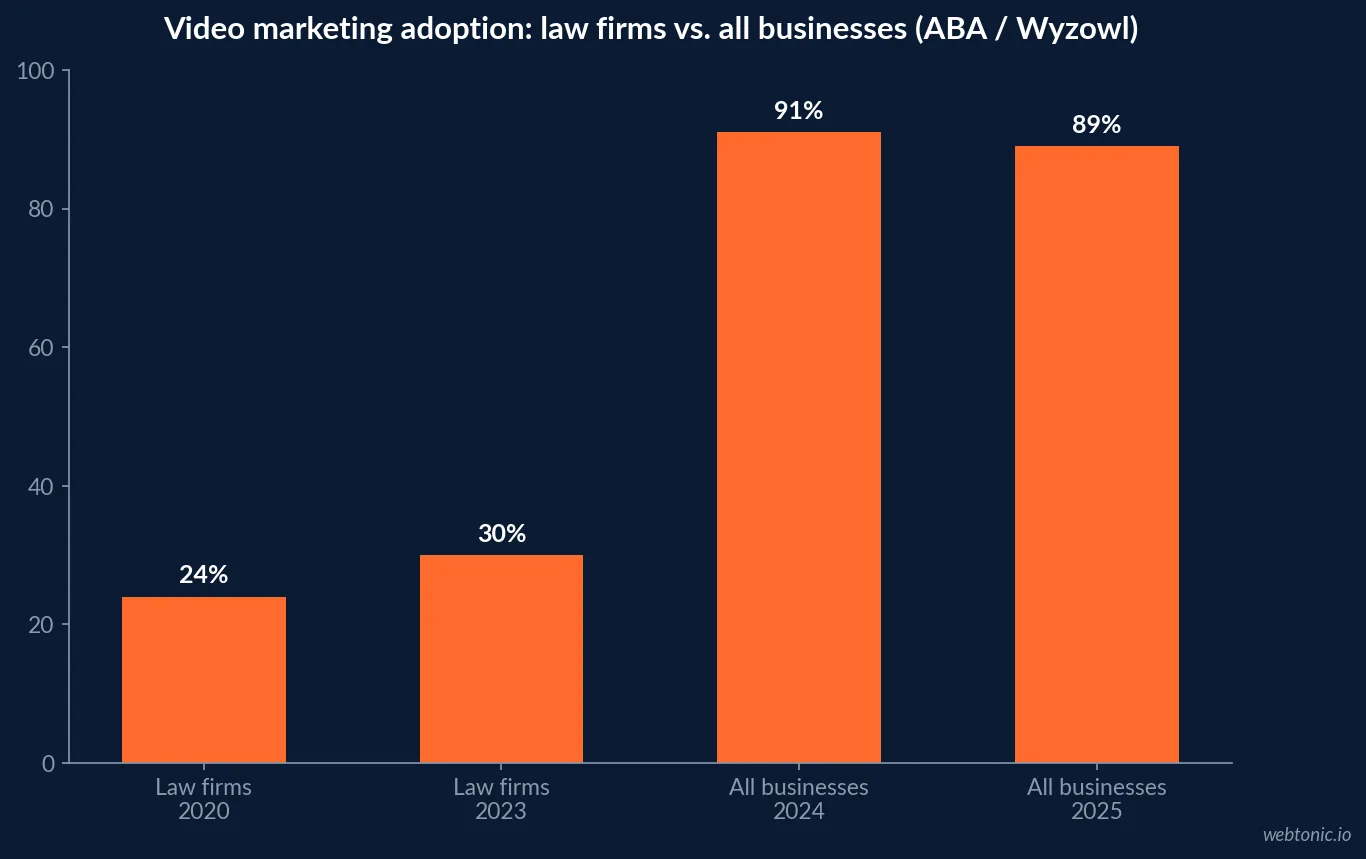
The gap between legal and the rest of business on video adoption is wide and has been slow to close. The ABA's 2023 Websites & Marketing TechReport found only 30% of law firms produce video to market their practice - up from 24% in 2020, a 6-point gain over three years. Compare that with Wyzowl's 2025 Video Marketing Statistics report, which found 89% of businesses across all sectors use video as a marketing tool. Legal is not behind because demand for video is low; it is behind because the industry's marketing adoption curve, from websites to social to video, has historically lagged consumer businesses by years.
| Metric | Figure | Source |
|---|---|---|
| Law firms producing marketing video (2023) | 30% | ABA TechReport |
| Law firms producing marketing video (2020) | 24% | ABA TechReport |
| All businesses using video marketing (2025) | 89% | Wyzowl |
| All businesses using video marketing (2024) | 91% | Wyzowl |
What consumers say video does to trust and comprehension
Wyzowl's 2025 data gives a clear reason to close that adoption gap: 89% of consumers say video quality affects their trust in a brand, and 63% say they would rather watch a short video than read text to understand a product or service. Separately, 84% of consumers want to see more video from brands in 2026, a figure Wyzowl says has stayed within 8 points for eight consecutive years of its survey. For an immigration case specifically, where the prospective client is often deciding whether a firm understands their exact visa category, employment authorization status, or removal-defense posture, a two-minute explainer can carry that trust signal faster than a page of legal copy.
| Consumer sentiment on video (Wyzowl 2025-2026) | Share |
|---|---|
| Say video quality affects trust in a brand | 89% |
| Would rather watch a short video than read | 63% |
| Want more brand video in 2026 | 84% |
| Consistent within 8 points for 8 years running | 84% |
Budget reality: what marketers actually spend, and what they don't track
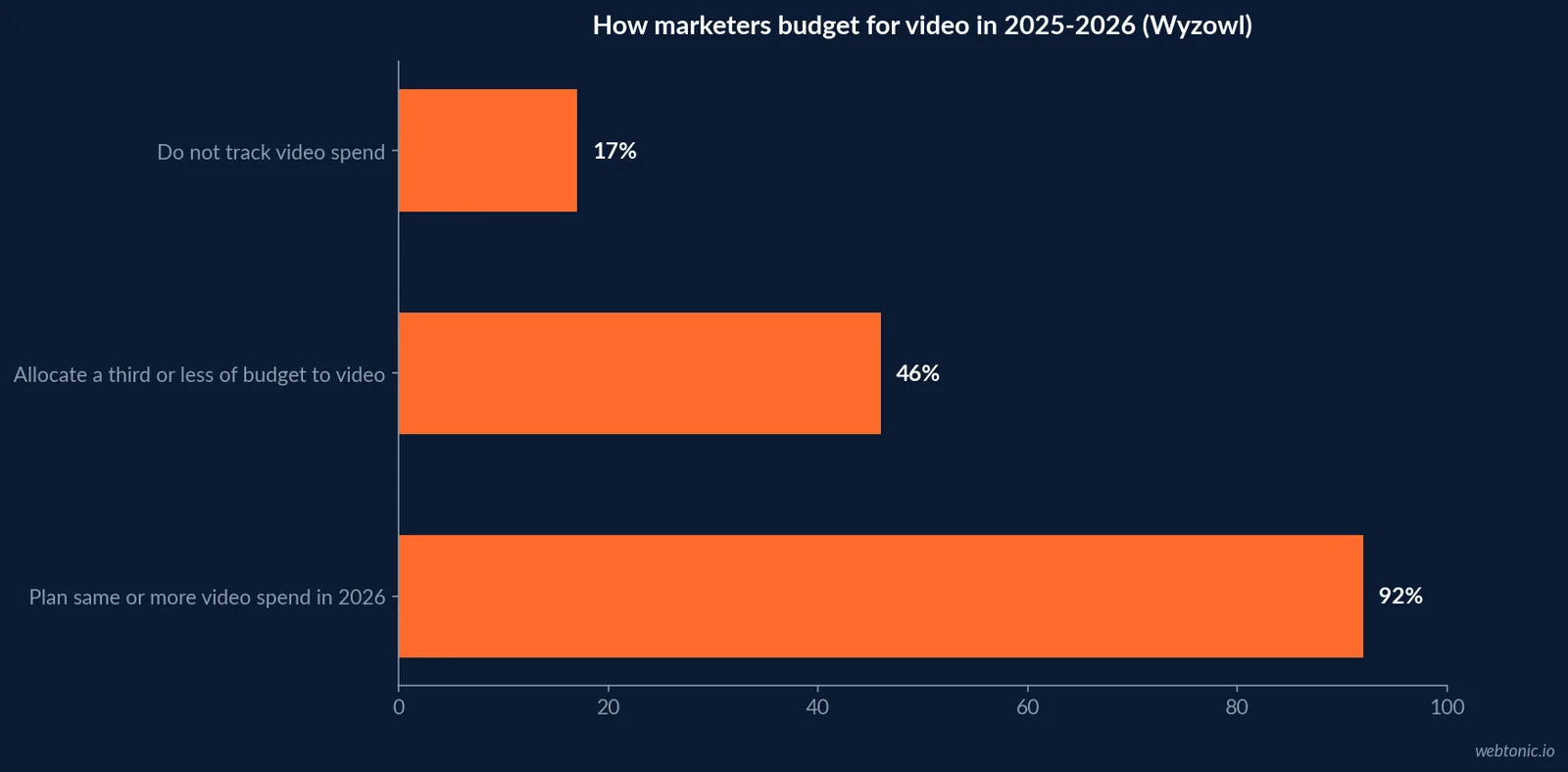
Wyzowl's financial data shows a split market: 92% of marketers plan to spend the same or more on video in 2026, but 46% allocate a third or less of their overall marketing budget to it, and a striking 17% are not tracking video spend at all. For an immigration practice building its first video budget, the honest starting point is: video intent is high, but most marketing teams - inside and outside legal - are not yet disciplined about measuring what they spend or what it returns.
Pricing an immigration law video program
2025 production-cost guides converge on a similar range for the video formats an immigration firm is most likely to need. A simple talking-head video runs USD 500-1,200, an animated explainer runs USD 1,200-4,500, and a fuller corporate story video runs USD 2,500-7,500, per cost breakdowns published by Synthesia and DailyMob Design. Immigration content that walks through a process - what happens at an EOIR hearing, how a green card interview works, what documents an H-1B petition needs - fits the explainer-video price band. A single flagship "About the firm" story video, produced once and reused across the site and consultation-booking flow, is the more typical corporate-story-tier spend.
| Video format | Typical 2025 production cost (USD) | Best immigration-law use case |
|---|---|---|
| Simple talking-head | 500 - 1,200 | Attorney intro, FAQ answer clips |
| Animated explainer | 1,200 - 4,500 | Visa process walkthroughs, EOIR hearing prep |
| Corporate story video | 2,500 - 7,500 | Firm-wide brand/trust video for the homepage |
| Full brand film | 5,000 - 15,000+ | Rarely needed below multi-office firm scale |
Why immigration video needs a language plan other practice areas don't
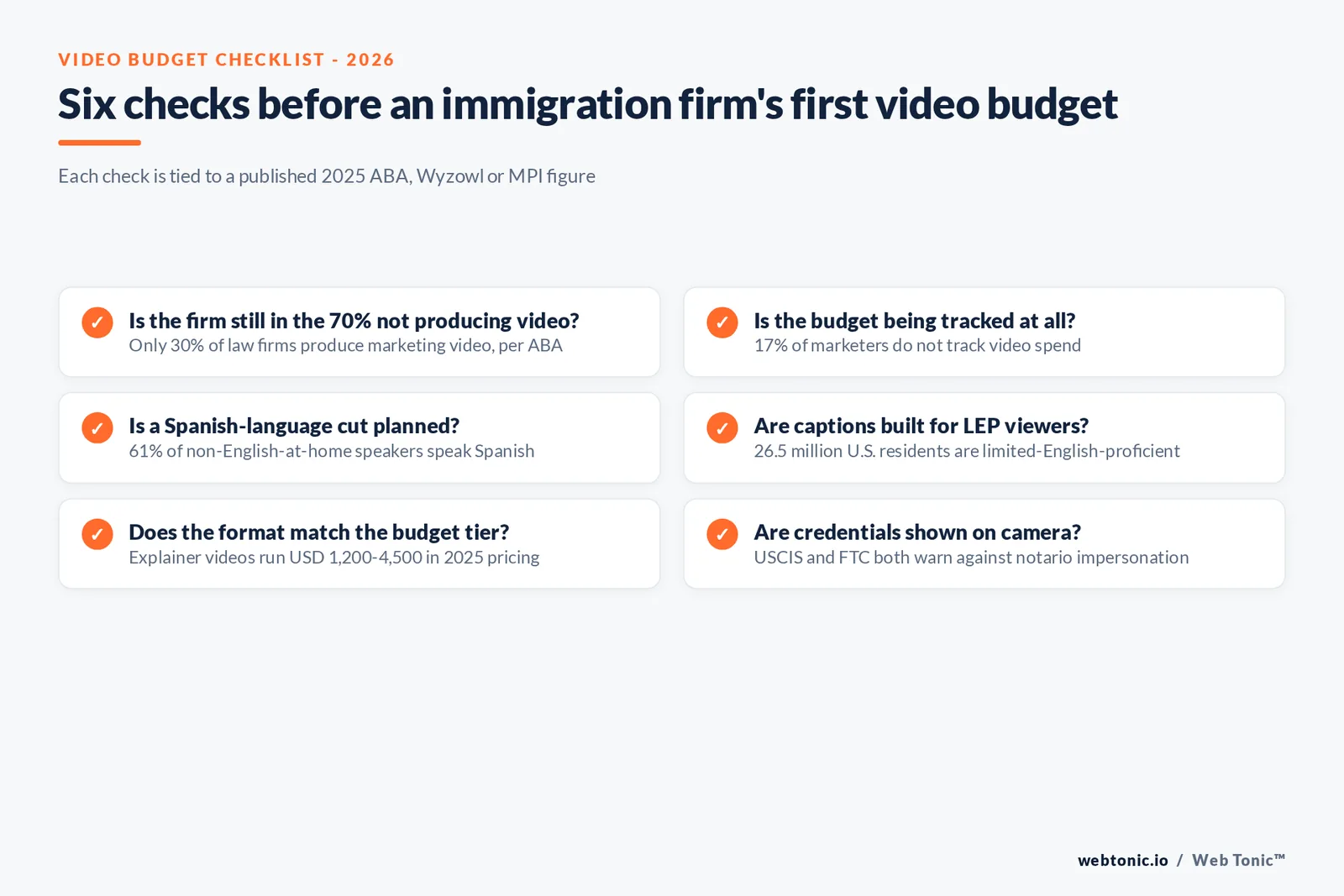
Migration Policy Institute's 2025 Frequently Requested Statistics report finds that among U.S. residents who speak a language other than English at home, 61% speak Spanish. Separate MPI research on language access counts 26.5 million limited-English-proficient (LEP) individuals in the U.S. as of 2022, 8.4% of the population. A video program built only in English, without captions or a Spanish-language cut of the highest-traffic explainer videos, is structurally inaccessible to a meaningful share of the audience an immigration practice is trying to reach - a constraint that does not apply the same way to most other legal verticals.
| Language access metric | Figure | Source |
|---|---|---|
| Share of non-English-at-home speakers who speak Spanish | 61% | Migration Policy Institute |
| Limited-English-proficient (LEP) U.S. residents | 26.5 million (8.4% of population) | Migration Policy Institute |
| Firms maintaining a social presence | 80% | ABA 2025 Legal Technology Survey |
| Firms on LinkedIn specifically | 78% | ABA 2025 Legal Technology Survey |
Where video fits against an immigration firm's paid media
Video budget decisions do not happen in a vacuum - they compete with the same paid media dollars driving traffic to the firm's landing pages. WordStream's 2025 data puts Attorneys & Legal Services at an average $8.58 Google Ads CPC, among the highest of any industry it tracks, which means every click a video asset earns organically (via YouTube search, or embedded on a high-traffic service page) is effectively a free impression the firm would otherwise be paying search-ad rates for. Firms already running Meta paid campaigns can also reuse the same video asset as both an organic YouTube upload and a Meta video ad creative, spreading one production cost across two channels instead of commissioning separate creative for each.
The immigration court backlog context matters here too: with EOIR tracking over 560,000 new case receipts in FY2025 and projecting roughly 600,000 for FY2026, the pool of people actively searching for guidance on their pending case is large and growing - a video answering "how long does my case take" or "what happens at my hearing" is speaking directly to that search intent, not a hypothetical audience.
Compliance: video testimonials carry the same rules as text
ABA Model Rule 7.1's bar on false or misleading communications applies equally to a video testimonial as it does to a landing page headline, and several state bars require an on-screen disclaimer when a video features a past client discussing case outcomes. Immigration firms carry the added notario-fraud dimension covered in USCIS and FTC consumer guidance: video content, especially in Spanish or other non-English languages distributed on YouTube or social platforms, is exactly the format scammers impersonating "notarios" also use, which makes clear on-camera attorney credentials a trust differentiator as much as a compliance requirement.
Building the first-year video plan
Three sequencing decisions follow from the data. First, start with the format gap that is cheapest to close: a handful of talking-head FAQ clips (USD 500-1,200 each) answering the highest-search-volume immigration questions gets a firm off the 30%-adoption sideline for a few thousand dollars total. Second, budget one Spanish-language (or top local-language) version of every explainer video from the start rather than as an afterthought, given that 61% of the non-English-speaking population speaks Spanish. Third, track spend and views from day one - the 17% of marketers who admit they don't track video spend are the same firms that will not be able to prove the channel's return next budget cycle. Firms building this out alongside a broader performance creative program should treat video as a paid-media asset with its own cost-per-lead math, not a one-off brand project; Web Tonic scopes video budgets against a firm's actual case-type mix rather than a generic legal-industry average.
Frequently Asked Questions
What share of law firms actually produce marketing video?
The American Bar Association's 2023 Websites & Marketing TechReport found that just 30% of responding firms produce video to market their practice, up only modestly from 24% in 2020. That is far below the 89% of all businesses that Wyzowl's 2025 survey found use video as a marketing tool - a gap that reflects legal's slower-moving marketing culture more than a lack of demand for video content.
How much should an immigration law firm budget for a single marketing video?
Published 2025 production pricing guides put a simple talking-head video at USD 500-1,200, an animated explainer at USD 1,200-4,500, and a fuller corporate story video at USD 2,500-7,500, according to industry cost breakdowns from Synthesia and DailyMob Design. Immigration firms producing process-explainer content (what to expect at a green card interview, how a case moves through EOIR) sit toward the explainer-video price band rather than the higher-cost brand-film tier most firms do not need.
Why does language matter more for immigration law video than other legal video?
Migration Policy Institute's 2025 data shows 61% of U.S. residents who speak a language other than English at home speak Spanish, and separate MPI research counts 26.5 million limited-English-proficient (LEP) individuals nationally as of 2022 - 8.4% of the population. Video content produced only in English, without captions or a translated version, is inaccessible to a meaningful share of the exact audience immigration firms are trying to reach, in a way that does not apply to most other practice areas.
Do consumers actually trust brands more because of video?
Yes, directionally. Wyzowl's 2025 survey found 89% of consumers say video quality affects their trust in a brand, and 63% said they would rather learn about a product or service by watching a short video than by reading. For an immigration case - where a prospective client is trying to judge whether a firm understands their specific visa category before ever speaking with someone - a short explainer video can do work that a page of text cannot.
What does ABA's social media data say about legal video distribution?
ABA's 2025 Legal Technology Survey found 80% of firms maintain a social media presence, led by LinkedIn at 78%, Facebook at 53%, Instagram at 22%, and X at 18% - none of which are natively video-first platforms at the volume YouTube, TikTok, or Instagram Reels are. That distribution pattern suggests most law firm video, where it exists, is being posted to platforms built around static or short-caption content rather than optimized for video discovery.
Sources
American Bar Association, 2023 Websites & Marketing TechReport
American Bar Association, 2025 Legal Technology Survey Report
Wyzowl, Video Marketing Statistics 2025-2026
Migration Policy Institute, Frequently Requested Statistics on Immigrants (2025)
Migration Policy Institute, Language Access for Individuals with Limited English Proficiency
WordStream/LocaliQ, 2025 Google Ads Benchmarks
DOJ Executive Office for Immigration Review, Sept. 2025 milestones release