Table of contents
No study prices Meta advertising for immigration law on its own, so the only honest way to budget it is to start from WordStream and LocaliQ's 2025 Attorneys and Legal Services benchmark and say plainly where that category-wide figure stops applying to a specific practice area. The gap between what is published and what is immigration-specific is the point of this page, not a footnote.
Key Takeaways
- USD 4.10 is the median CPC for legal-services Meta lead campaigns in 2025.
- USD 0.69 is the median CPC for legal-services Meta traffic campaigns.
- 10.53% conversion rate on legal leads campaigns, up 31% year over year.
- 77% is how far legal cost per lead fell year over year in the same report.
- 80% year-over-year increase in legal traffic-campaign click-through rate.
- 1.77% average click-through rate for legal traffic campaigns overall.
- 12.1 million USCIS cases were pending as of FY2026 Q2, up 7.2% year over year.
- 3,092,988 cases sat in the Immigration Court backlog as of August 2026.
- 2,278,978 of those court cases are immigrants awaiting asylum hearings.
- 24.1 months is the estimated USCIS backlog clearance time in FY2026 Q2, nearly double the prior year's 12.5 months.
- ~USD 39 is the implied cost per lead when the published CPC and CVR are combined.
- Meta's Discriminatory Practices policy bars targeting or excluding by national origin outright.
- No published study breaks Meta ad performance out by immigration practice area specifically.
The benchmark this budget has to start from
Immigration law does not get its own line in any Meta ads benchmark report available today. The closest verified figure is WordStream and LocaliQ's 2025 Facebook Ads Benchmarks report, built from over 1,000 campaigns running between April 2024 and June 2025 across the broader Attorneys and Legal Services category, which also covers personal injury, family, criminal defense and business law firms.
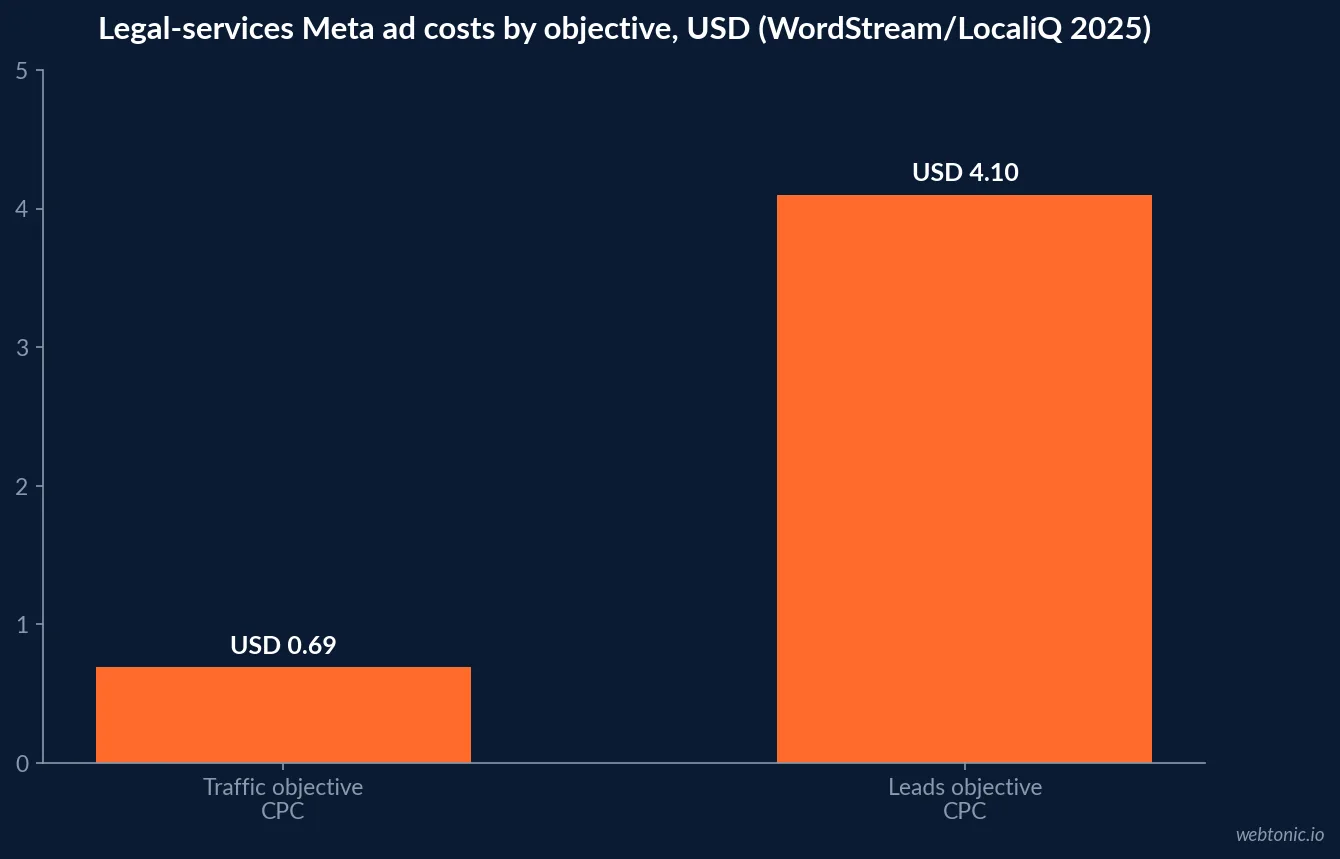
That category posted a lead-campaign CPC of USD 4.10 and a traffic-campaign CPC of USD 0.69, both reported as medians to reduce outlier skew. Any immigration firm quoting a number without naming this source, or without noting that immigration is one slice of a much broader category, is quoting a guess dressed up as data.
| Metric (legal services, 2025) | Published figure | Year-over-year change | Source |
|---|---|---|---|
| CPC, traffic objective | USD 0.69 | Down from USD 0.70 | WordStream/LocaliQ |
| CTR, traffic objective | 1.77% | Up 80% | WordStream/LocaliQ |
| CPC, leads objective | USD 4.10 | Down 44% | WordStream/LocaliQ |
| CVR, leads objective | 10.53% | Up 31% | WordStream/LocaliQ |
| CPL, leads objective | Not itemized | Down 77% | WordStream/LocaliQ |
Why the category got cheaper while converting better
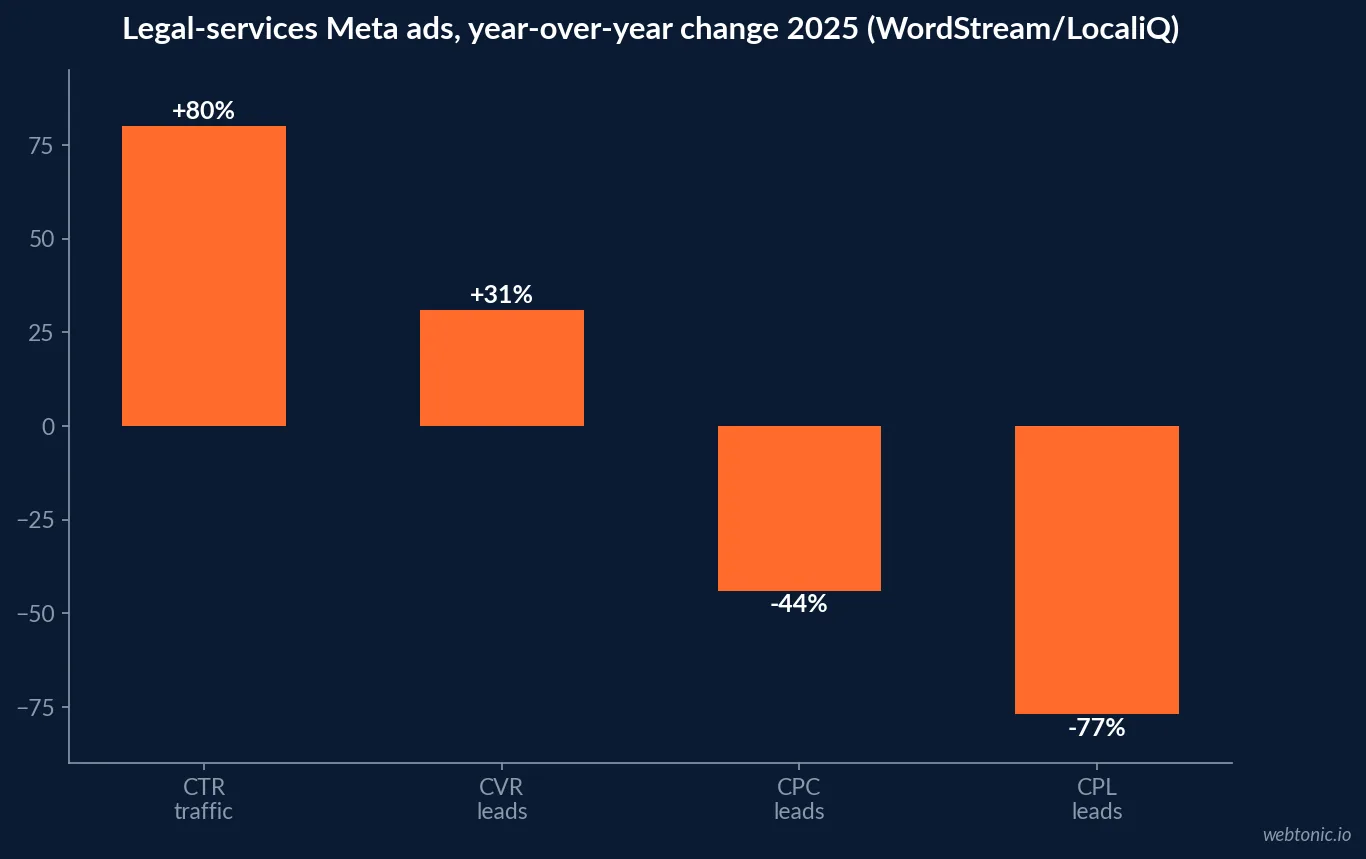
WordStream's own analysts attribute the swing to a crowded 2024 auction followed by a pullback: legal advertisers who stayed in market through 2025 competed against fewer bidders while running tighter creative, which explains the simultaneous 44% CPC drop and 31% CVR gain on leads campaigns. Nothing in the report isolates immigration from personal injury or family law inside that trend, so read it as a legal-category tailwind, not proof that immigration ads specifically got more efficient.
What is specific to immigration is the demand side. The American Immigration Council's analysis of USCIS's own data shows pending cases climbing to 12.1 million in FY2026 Q2, a 7.2% year-over-year increase, while completions fell to 1.5 million for an eighth straight quarterly decline and estimated backlog clearance time nearly doubled to 24.1 months. A backlog that size is exactly the kind of urgency that makes a paid Meta test worth running.
Turning the backlog into a demand signal
The TRAC immigration data project at Syracuse University puts the Immigration Court backlog at 3,092,988 active cases as of August 2026, with 2,278,978 of those already-filed asylum applicants waiting on hearings or decisions. Separately, the Executive Office for Immigration Review reports completing more than 722,000 cases in the first 11 months of FY2025, the highest single-year total in its history, and cutting pending caseload by over 447,000 cases since January 2025.
Both numbers point the same direction for a Meta budget: the system is processing faster in some channels while the raw caseload keeps growing, which means the population actively searching for representation is not shrinking even where individual courts are clearing dockets.
| Demand signal | Figure | Period | Source |
|---|---|---|---|
| USCIS pending cases | 12.1 million | FY2026 Q2 | American Immigration Council / USCIS |
| USCIS backlog clearance time | 24.1 months | FY2026 Q2 | American Immigration Council / USCIS |
| Immigration Court backlog | 3,092,988 cases | August 2026 | TRAC, Syracuse University |
| Asylum applicants awaiting hearings | 2,278,978 | August 2026 | TRAC, Syracuse University |
| EOIR case completions | 722,000+ | First 11 months FY2025 | Executive Office for Immigration Review |
Modeling a first test budget
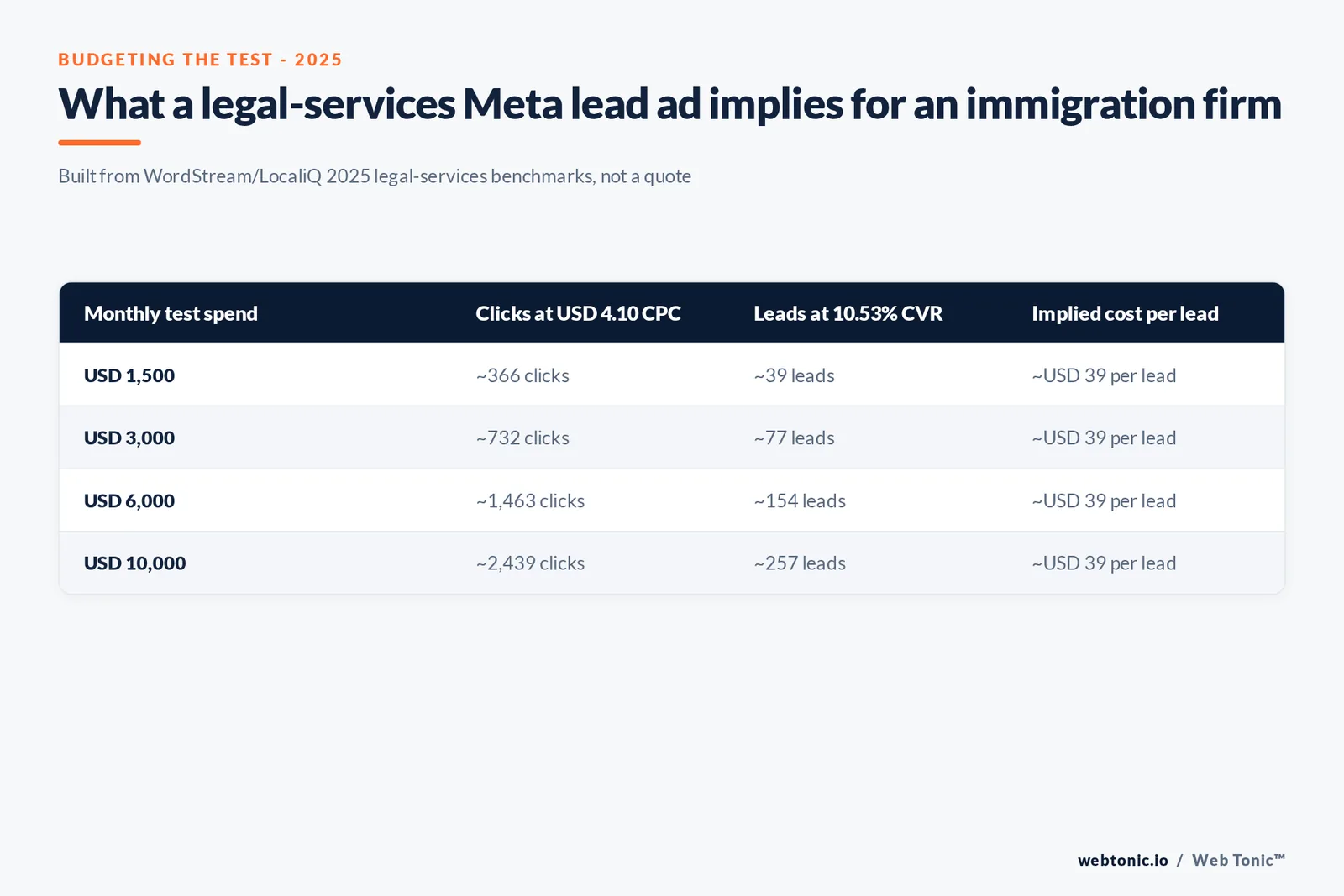
Applying the published rates arithmetically - not as a promise - a monthly budget of USD 3,000 at the USD 4.10 lead-campaign CPC buys roughly 732 clicks, and the category's 10.53% conversion rate implies about 77 leads, which works out to roughly USD 39 per lead before any landing-page or intake-form optimization. Larger or smaller budgets scale the same ratio, which is exactly why the number is only useful as a planning input, not a guarantee tied to any one immigration service line.
Two compliance layers that sit on top of the budget
Meta's own Discriminatory Practices advertising policy bars ads that discriminate or encourage discrimination based on personal attributes, and lists national origin explicitly among the protected characteristics - so building a Meta audience around a specific country of origin is a platform-level violation before it is ever a bar-rule question.
On the bar-rule side, the ABA Model Rules 7.1 through 7.3 govern truthfulness, advertising mechanics and direct solicitation respectively, and most state bars layer their own restrictions for immigration advertising specifically because of how often the practice area attracts fraud. Both USCIS and the FTC publish standing warnings against notarios and unaccredited consultants who imply they can give legal advice - language and framing a licensed firm's own Meta creative should never echo, even in a softened form aimed at building trust with a specific community.
| Compliance layer | Governing body | What it restricts | Risk if ignored |
|---|---|---|---|
| Platform policy | Meta Transparency Center | Targeting or excluding by national origin | Ad rejection, account-level enforcement |
| Attorney advertising | ABA Model Rule 7.1 | False or misleading statements about services | Bar discipline |
| Attorney advertising | ABA Model Rule 7.2 | Advertising mechanics and required disclaimers | Bar discipline |
| Solicitation | ABA Model Rule 7.3 | Direct, targeted outreach to a known prospect | Bar discipline |
| Consumer protection | USCIS / FTC | Implying non-attorney staff can give legal advice | Federal referral, reputational harm |
How Meta compares with the other paid channel legal buyers use
Immigration firms rarely run Meta in isolation. Our own analysis of whether Facebook ads are worth it and of what Facebook ads cost both frame Meta as a demand-capture channel that performs best alongside a search program built to catch people who are already typing "immigration lawyer" rather than scrolling past an ad. A firm weighing where the next dollar goes should read how to build a Google Ads strategy before assuming Meta alone can carry a launch budget.
The practical split most legal advertisers land on is Meta for awareness and retargeting around a backlog-driven news moment, and search for the harder-intent, already-searching prospect - which is also why the 10.53% lead conversion rate on Meta looks strong only once it is compared against a channel with a much higher cost floor per click.
| Channel role | What legal-services Meta data supports | What it does not support | Better fit |
|---|---|---|---|
| Top-of-funnel awareness | 80% YoY CTR growth on traffic objective | Proof of case-signing volume | Meta |
| Retargeting around a policy news cycle | Category-wide engagement lift documented elsewhere | An immigration-specific lift figure | Meta |
| Already-searching, high-intent prospect | Not measured by this benchmark | N/A | Search |
| Community-specific outreach | CVR of 10.53% at the category level | A targeting method by national origin | Meta, within policy limits |
What to test first, given what is and is not known
Because no report isolates immigration from the rest of the legal category, the responsible move is to treat the WordStream figures as a starting cap on cost per click and cost per lead, then measure the firm's own leads objective conversion rate against the 10.53% category average once real data exists. A rate meaningfully below that after a few weeks points to creative or landing-page friction rather than a bad platform choice, since the category-wide number already accounts for the broader competitive auction.
Our performance creative practice builds the ad variants and landing pages that this kind of test needs before the budget is defended internally, and our Meta Ads services page has the fuller build-out for firms ready to move past a first test.
Reading the numbers a quarter or a year from now
Because WordStream refreshes this report roughly once a year, an immigration firm testing Meta today is working from data that already lags the live auction by months. The safer habit is to treat every figure on this page as a directional cap that should be re-checked against the next published edition, not as a number frozen in place. The category swung 44% on cost per click and 77% on cost per lead in a single year; a firm that keeps running the same creative without revisiting the benchmark risks either overpaying against a cheaper market or underbidding against a tighter one.
The same caution applies to the demand side. USCIS's own backlog dashboard and TRAC's court data both update quarterly, and a 7.2% year-over-year swing in pending cases is exactly the kind of shift that should move a budget conversation, even before the next Meta benchmark is published.
| What changed this year | Direction | Why it matters for next quarter's budget |
|---|---|---|
| Legal Meta lead CPC | Down 44% | Re-test the budget cap before assuming last year's number still holds |
| Legal Meta lead CVR | Up 31% | A flat conversion rate now may signal a creative or landing-page problem |
| USCIS pending cases | Up 7.2% | Rising demand can justify a bigger test even at a flat CPC |
| EOIR case completions | Record high | Faster court throughput can shift which service lines to advertise first |
Frequently Asked Questions
What does Meta advertising cost an immigration law firm in 2025?
No publisher segments Meta ad data down to immigration law specifically, so the honest starting point is WordStream and LocaliQ's 2025 Facebook Ads Benchmarks report for the broader Attorneys and Legal Services category: a median cost per click of USD 4.10 on lead-generation campaigns and USD 0.69 on traffic campaigns, both drawn from over 1,000 campaigns run between April 2024 and June 2025. Treat that as the legal-industry floor, not an immigration-specific quote.
Is Meta a good lead source for immigration cases specifically?
The published conversion rate is favorable relative to most other verticals: Attorneys and Legal Services leads campaigns converted at 10.53% in WordStream's 2025 data, up 31% year over year and well above the 7.72% all-industry average. Immigration is one slice of that legal category alongside personal injury, family and criminal defense, so a firm's actual rate will move with practice area, ad creative and how specific the intake form is.
Why did legal Meta ad costs fall while conversion rose?
WordStream's report shows lead-campaign CPC for Attorneys and Legal Services down 44% year over year and cost per lead down 77%, even as click-through rate on traffic campaigns rose 80%. The report's own read is that more legal advertisers competed for the same inventory in 2024, then a share pulled back in 2025, which combined with better-targeted creative to push efficiency up across the category. No source ties this specifically to immigration case volume.
What must an immigration Meta ad avoid saying?
Two separate compliance layers apply. Meta's own Discriminatory Practices policy bars ads that target or exclude by national origin, so audience-building by country of origin is a platform violation, not just a legal risk. Separately, the ABA Model Rules (7.1 on truthful communication, 7.2 on advertising mechanics, 7.3 on solicitation) govern what the ad copy itself can promise, and the USCIS and FTC both warn consumers by name against notarios and immigration consultants who imply they can give legal advice - language a firm's own ads should never echo, even loosely.
How much should a first Meta test cost?
Applying WordStream's published rate base, a USD 3,000 monthly test at a USD 4.10 lead-campaign CPC buys roughly 732 clicks, and at the category's 10.53% conversion rate that implies about 77 leads, or close to USD 39 per lead. That is an arithmetic projection built from published averages, not a guarantee - actual cost per lead depends heavily on the specific visa or removal-defense service being advertised.
Sources
WordStream 2025 Facebook Ads Benchmarks report (PDF)
LocaliQ 2025 Facebook Advertising Benchmarks
American Immigration Council, USCIS backlog analysis
TRAC Immigration, Syracuse University
Executive Office for Immigration Review
Meta Transparency Center, Discriminatory Practices policy
ABA Model Rule 7.1
USCIS, avoiding immigration legal-services scams
Federal Trade Commission, notario fraud alert