Table of contents

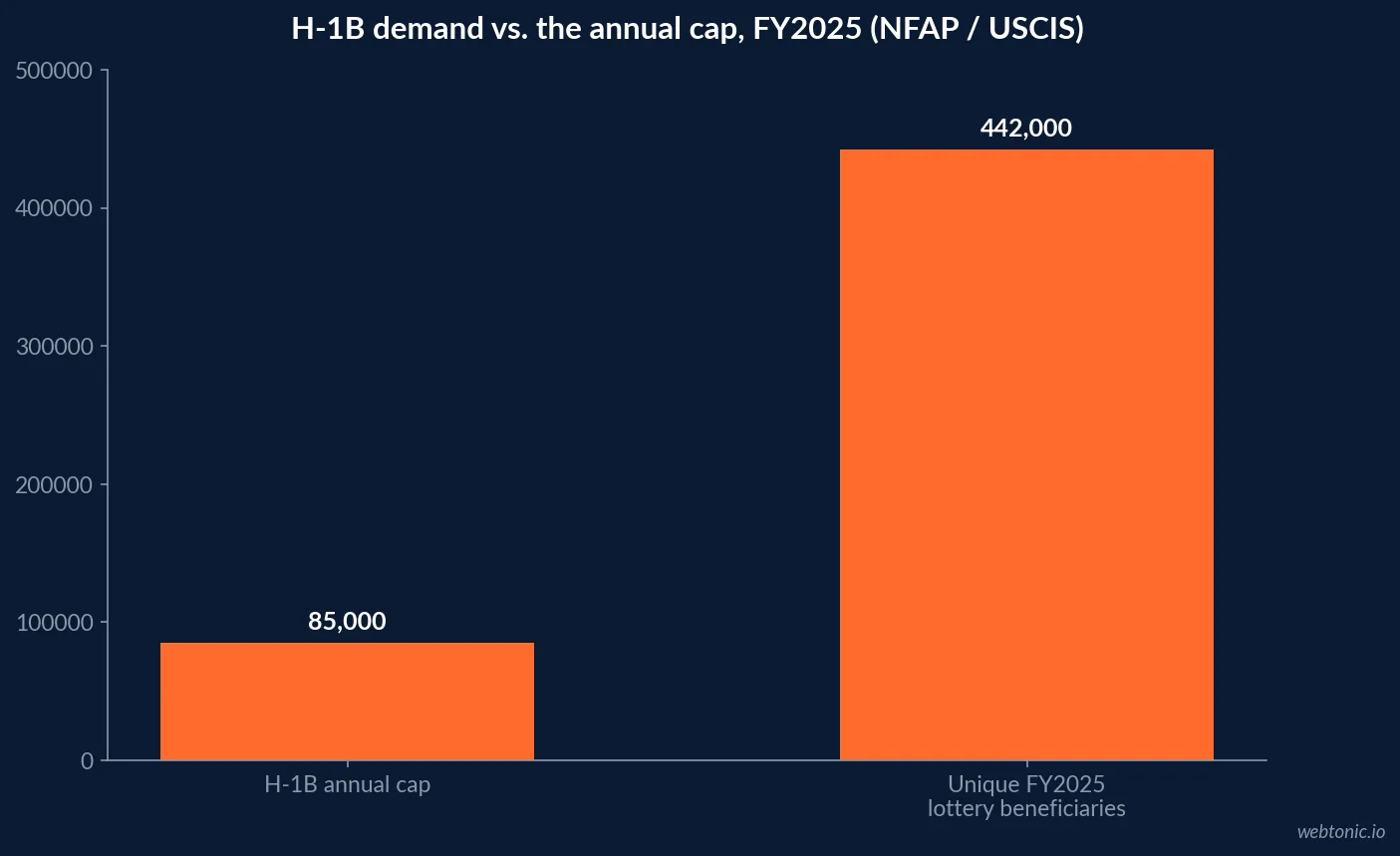
442,000 unique beneficiaries competed for an 85,000-visa H-1B cap in FY2025 - and every one of those cases sits behind an employer, not an individual applicant, making the employer the real LinkedIn buyer for immigration law. This report separates that B2B sponsorship reality from the cross-industry LinkedIn cost data available for 2025-2026.
Key Takeaways
- 442,000 unique beneficiaries entered the FY2025 H-1B lottery competing for an 85,000-visa annual cap, per National Foundation for American Policy analysis of USCIS data.
- More than 300,000 H-1B registrations were rejected on the lottery alone in FY2025.
- USCIS averaged roughly 480,000 initial high-skilled petitions a year (H-1B, L-1A, L-1B, O visas) from FY2016 through FY2025.
- Approximately 700,000 people live and work in the U.S. in H-1B status at any time.
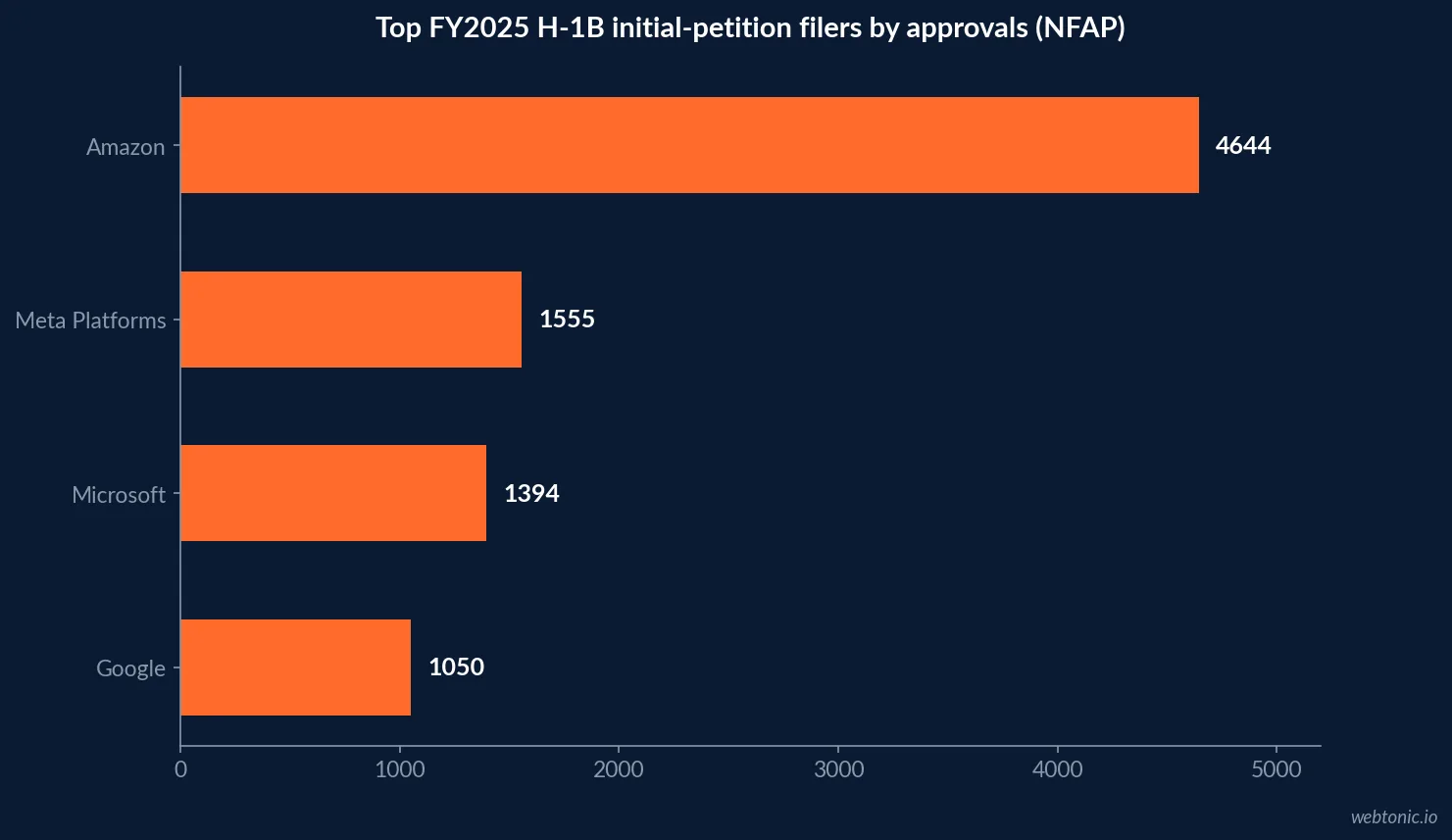
- Amazon filed the most approved H-1B petitions in FY2025, with 4,644, followed by Meta (1,555), Microsoft (1,394) and Google (1,050).
- 78% of law firms maintain a LinkedIn presence - the highest of any platform - per ABA's 2025 Legal Technology Survey.
- Cross-industry B2B LinkedIn CPCs run $10.48-$15.72 depending on funnel stage, per HockeyStack's 2025 report on 70+ B2B SaaS companies.
- The same dataset shows CTRs of 0.82%-0.96% across funnel stages.
- The H-1B annual cap equals just 0.05% of the U.S. labor force and has been exhausted every year since FY2004.
- Nearly two-thirds of H-1B holders hold a master's degree or higher.
The buyer is the employer, not the applicant
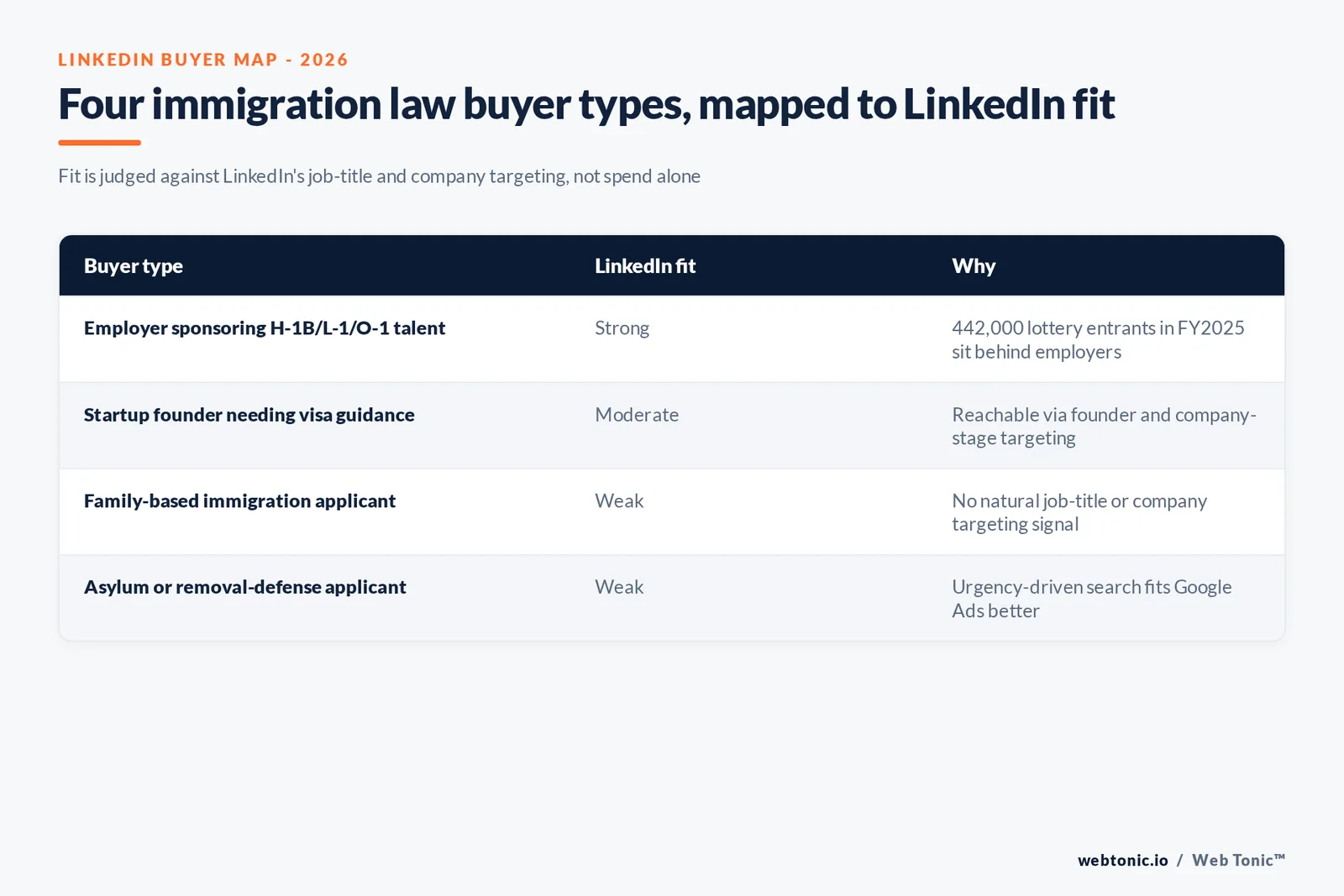
LinkedIn is organized around job titles, employers, and professional identity - which makes it a structurally different channel for immigration law than Google Search or Meta. The natural LinkedIn buyer for an immigration practice is not a person searching "immigration lawyer near me," it is an HR leader, talent acquisition manager, or general counsel evaluating outside counsel to handle H-1B, L-1, or O-1 sponsorship for employees the company has already decided to hire. A firm that treats LinkedIn as a consumer-style lead-gen channel for individual applicants is fighting the platform's targeting model; a firm that builds campaigns around employer titles and company attributes is working with it.
| Immigration law buyer type | LinkedIn fit |
|---|---|
| Employer sponsoring H-1B/L-1/O-1 talent | Strong - matches LinkedIn's job-title and company targeting |
| Individual family-based immigration applicant | Weak - little natural LinkedIn targeting signal |
| Asylum or removal-defense applicant | Weak - urgency-driven search fits Google better |
| Startup founder needing visa sponsorship guidance | Moderate - reachable via founder/company-stage targeting |
How large is the employer-sponsorship market
The scale of the employer-side opportunity is documented directly in USCIS and NFAP data. An NFAP analysis of USCIS data found approximately 442,000 unique beneficiaries entered the FY2025 H-1B registration lottery against an 85,000 annual cap (65,000 regular plus a 20,000 exemption for U.S. master's-degree holders), meaning more than 300,000 registrations were rejected purely on the numbers. Separately, USCIS data compiled by the American Immigration Council shows an average of roughly 480,000 initial high-skilled petitions filed per year (H-1B, L-1A, L-1B, and O visas combined) from FY2016 through FY2025. Each filing requires an employer with a legal team or outside counsel behind it - the exact professional audience LinkedIn's targeting is built to reach.
| H-1B / high-skilled visa metric (FY2025 unless noted) | Figure |
|---|---|
| H-1B annual cap | 85,000 (65,000 regular + 20,000 master's exemption) |
| Unique beneficiaries in the FY2025 lottery | ~442,000 |
| Registrations rejected on the cap | 300,000+ |
| Average initial high-skilled petitions/year, FY2016-FY2025 | ~480,000 |
| People living/working in the U.S. in H-1B status | ~700,000 |
| Share of H-1B holders with a master's degree or higher | ~2/3 |
Who is actually filing: the employer side by the numbers
The NFAP brief also names the largest FY2025 filers by approved initial H-1B petitions: Amazon led with 4,644, followed by Meta Platforms (1,555), Microsoft (1,394), and Google (1,050) - the first year these four U.S. technology companies held all top four spots. That concentration illustrates the LinkedIn targeting logic directly: companies of this size and hiring pattern have identifiable job titles (technical recruiting, global mobility, immigration program manager) that a corporate-immigration practice can target with LinkedIn's company-size and job-function filters, well beyond just the largest filers.
| FY2025 top H-1B filers (initial approvals) | Approved petitions |
|---|---|
| Amazon | 4,644 |
| Meta Platforms | 1,555 |
| Microsoft | 1,394 |
| 1,050 |
What LinkedIn ads cost for a comparable B2B audience
No primary source publishes legal-specific LinkedIn ad benchmarks. The most credible disclosed dataset available is HockeyStack's 2025 LinkedIn Ads Benchmark Report, built from more than USD 28 million in LinkedIn ad spend across over 70 B2B SaaS companies with $5M-$1B in annual revenue. That report found CTRs of 0.82%-0.96% and CPCs of $10.48-$15.72 depending on funnel stage. These figures describe B2B SaaS buying behavior, not legal services - immigration firms should treat them as a directional cross-industry reference for what professional, job-title-targeted LinkedIn campaigns typically cost, not a legal-specific benchmark.
| LinkedIn Ads metric (B2B SaaS cross-industry, HockeyStack 2025) | Range |
|---|---|
| CTR | 0.82% - 0.96% |
| CPC | $10.48 - $15.72 |
| Sample | 70+ B2B SaaS companies, $28M+ ad spend analyzed |
What the DOL's own labor certification data adds
Every H-1B, H-1B1, and E-3 filing also runs through the Department of Labor's Labor Condition Application (LCA) process before it ever reaches USCIS - a second, independent data trail confirming the volume of employer-side filings that keeps a corporate immigration practice in business year-round, not just during the annual registration window. The DOL's FY2025 Selected Statistics report tracks these filings by quarter, giving firms building a LinkedIn content calendar a predictable filing-season rhythm to publish against - content timed to the LCA and H-1B registration windows reaches employer audiences when they are actively evaluating counsel, rather than competing for attention outside the filing cycle.
That filing cadence also explains why 72% of new H-1B petitions in FY2025 went to employers with 100 or fewer approvals, per the NFAP brief cited above - the addressable LinkedIn audience is not limited to the household-name tech employers named earlier. Mid-market companies filing a handful of petitions a year are a larger, more reachable audience on LinkedIn's job-title targeting than the small number of mega-filers, and are less likely to already have in-house immigration counsel on retainer.
That distinction matters for how a firm structures LinkedIn campaigns. A single ad set targeting "HR Director" or "Global Mobility Manager" job titles at companies with 50-500 employees will reach a meaningfully different, and generally less-defended, buyer than the same titles filtered to companies with 10,000-plus employees, where an in-house immigration team or a retained AmLaw 100 firm is the default competitor. Firms without the budget to compete for Amazon- or Microsoft-scale accounts should build their targeting around the 72% of employers filing 100 or fewer petitions a year, where a smaller firm's responsiveness and specialization can outweigh the brand recognition of a large incumbent.
The timing angle also deserves its own line item. LinkedIn ad performance on hiring-adjacent content tends to track the same seasonal pattern as the H-1B registration window itself - employer interest in immigration counsel spikes in the weeks around the March registration period and again as new fiscal year cap-subject petitions come due each April 1. Firms that hold back LinkedIn spend until a company has already retained counsel elsewhere are competing for scraps; firms that run always-on, lower-budget LinkedIn content through the off-season and increase spend specifically around the registration and petition-filing windows are targeting the buyer at the exact moment the decision is being made.
Why legal already leans on LinkedIn organically
The ABA's 2025 Legal Technology Survey found 78% of law firms maintain a LinkedIn presence - the highest adoption of any social platform it measured, ahead of Facebook (53%), Instagram (22%), and X (18%). That organic footprint is a useful precondition for paid LinkedIn work: a firm already has some brand presence and content history on the platform before it turns on ad spend, unlike TikTok, where legal's presence is thin enough that ABA's survey does not report a figure for it at all.
Building a LinkedIn plan around the real buyer
Three sequencing decisions follow from the data. First, segment campaigns by buyer type before writing a single ad: employer-sponsorship campaigns should target HR, global mobility, and general counsel job functions at companies with visible international hiring, while individual-applicant immigration matters should be routed to Google Search and community channels where LinkedIn's targeting adds little. Second, size the CPC expectation against the HockeyStack B2B range ($10.48-$15.72) rather than against Google or Meta legal-industry CPCs, since LinkedIn's cost structure and buyer intent are fundamentally different. Third, treat the roughly 480,000-per-year high-skilled petition volume as the addressable employer market and build content (LinkedIn articles, thought leadership on visa policy changes) that positions the firm ahead of a company's next filing cycle, not just at the moment of an ad click. Firms weighing LinkedIn against other paid channels should benchmark it alongside a full paid-media program and the published cost-per-lead data for the industry overall, since employer-side immigration law is a small, high-value slice of a much larger practice. Firms unsure whether corporate immigration is worth building into a dedicated LinkedIn program can size the addressable market against their existing employer-client base before committing budget.
Frequently Asked Questions
Who is actually the buyer for immigration law LinkedIn ads?
Overwhelmingly, the employer - not the visa applicant. LinkedIn is a B2B, professional-identity platform, and the immigration law transactions that map naturally to it are employer-side: a company's HR or legal team sourcing outside counsel to sponsor H-1B, L-1, or O-1 employees. Individual family-based or asylum immigration matters, by contrast, have little natural fit on a platform organized around job titles and employers, and should be marketed on other channels.
How big is the H-1B employer-sponsorship market immigration firms can target on LinkedIn?
Roughly 442,000 unique beneficiaries were entered into the FY2025 H-1B registration lottery, competing for an annual cap of 85,000 (65,000 regular plus 20,000 for U.S. master's degree holders or higher), according to National Foundation for American Policy analysis of USCIS data. That means more than 300,000 registrations were rejected purely on the lottery, and USCIS's H-1B Employer Data Hub shows an average of roughly 480,000 initial high-skilled petitions filed per year from FY2016 through FY2025 - a recurring, identifiable population of corporate LinkedIn users whose companies need immigration counsel every filing cycle.
What does LinkedIn advertising cost for a B2B audience like corporate immigration buyers?
No primary source reports legal-specific LinkedIn ad costs. The closest disclosed benchmark is HockeyStack's 2025 LinkedIn Ads report, built from more than USD 28 million in ad spend across over 70 B2B SaaS companies, which found CTRs of 0.82-0.96% and CPCs of USD 10.48-15.72 depending on funnel stage. Those numbers describe B2B SaaS, not legal services, and should be used only as a directional cross-industry reference until a legal-specific benchmark exists.
Do law firms actually use LinkedIn for marketing?
Yes, more than any other platform. The ABA's 2025 Legal Technology Survey found 78% of firms maintain a LinkedIn presence, the highest of any social platform measured, ahead of Facebook (53%), Instagram (22%), and X (18%). That organic presence is a reasonable precondition for LinkedIn paid campaigns - firms already treat the platform as their primary professional channel before any ad spend enters the picture.
Should an immigration firm run LinkedIn ads targeting individual visa applicants?
Generally, no. LinkedIn's targeting strengths - job title, company size, seniority, industry - map to employer decision-makers, not individual applicants searching for personal immigration help. A firm building a corporate immigration or employer-sponsorship practice line should run LinkedIn campaigns targeting HR, talent acquisition, and general counsel titles at companies with visible international hiring activity; a firm focused on family-based or asylum work will get more efficient volume from Google Search and community-specific channels than from LinkedIn.
Sources
National Foundation for American Policy, H-1B Petitions and Denial Rates in FY 2025
American Immigration Council / USCIS, High-Skilled Nonimmigrant Petitions data
USCIS, H-1B Electronic Registration Process
HockeyStack Labs, 2025 LinkedIn Ads Benchmark Report for B2B Marketers
U.S. Department of Labor, LCA Selected Statistics FY2025 Q4
American Bar Association, 2025 Legal Technology Survey Report