



Table of contents
Key Takeaways
HVAC ecommerce is no longer a fringe experiment — it is a structural shift reshaping how contractors source parts and how consumers buy equipment. 7,700 live Shopify stores operate in the HVAC and Climate Control category according to StoreLeads (2026), while 44% of HVAC distributors still generate zero ecommerce revenue (Flxpoint, 2026). Shopify's B2B gross merchandise volume surged 140% year-over-year to $9.4 billion in H1 2026, with an average B2B order value of $1,840 — 14× higher than DTC orders (Ecommerce Times, 2026). 67% of B2B buyers have already switched suppliers because of a poor digital buying experience, signaling that HVAC businesses without an online storefront are actively losing customers.
HVAC Ecommerce Benchmarks at a Glance
Table 1. Key ecommerce benchmarks for HVAC and home improvement on Shopify in 2026.
| Metric | HVAC / Home Improvement | Ecommerce Average |
|---|---|---|
| Live Shopify stores (HVAC) | 7,700 | — |
| Shopify Home Improvement stores | 12,752 | — |
| Conversion rate | 2.1% | 2.3% |
| Mobile conversion rate | 1.8% | 2.85% |
| Average order value | $135 | $143 |
| Shopify B2B avg order value | $1,840 | $130 (DTC) |
| Cart abandonment rate | 71.5% | 70.19% |
| Return rate | 11.5% | 17.5% |
| Repeat purchase rate | 48% | 28.5% |
The HVAC Ecommerce Landscape in 2026
The HVAC industry's digital transformation is accelerating, driven by the same forces that reshaped retail: buyer expectations, mobile-first purchasing, and platform accessibility. The U.S. HVAC contractor industry generated $156.2 billion in revenue in 2025 across 117,449 businesses (Frontburner Marketing, 2025), and the ecommerce share of that market is growing rapidly.
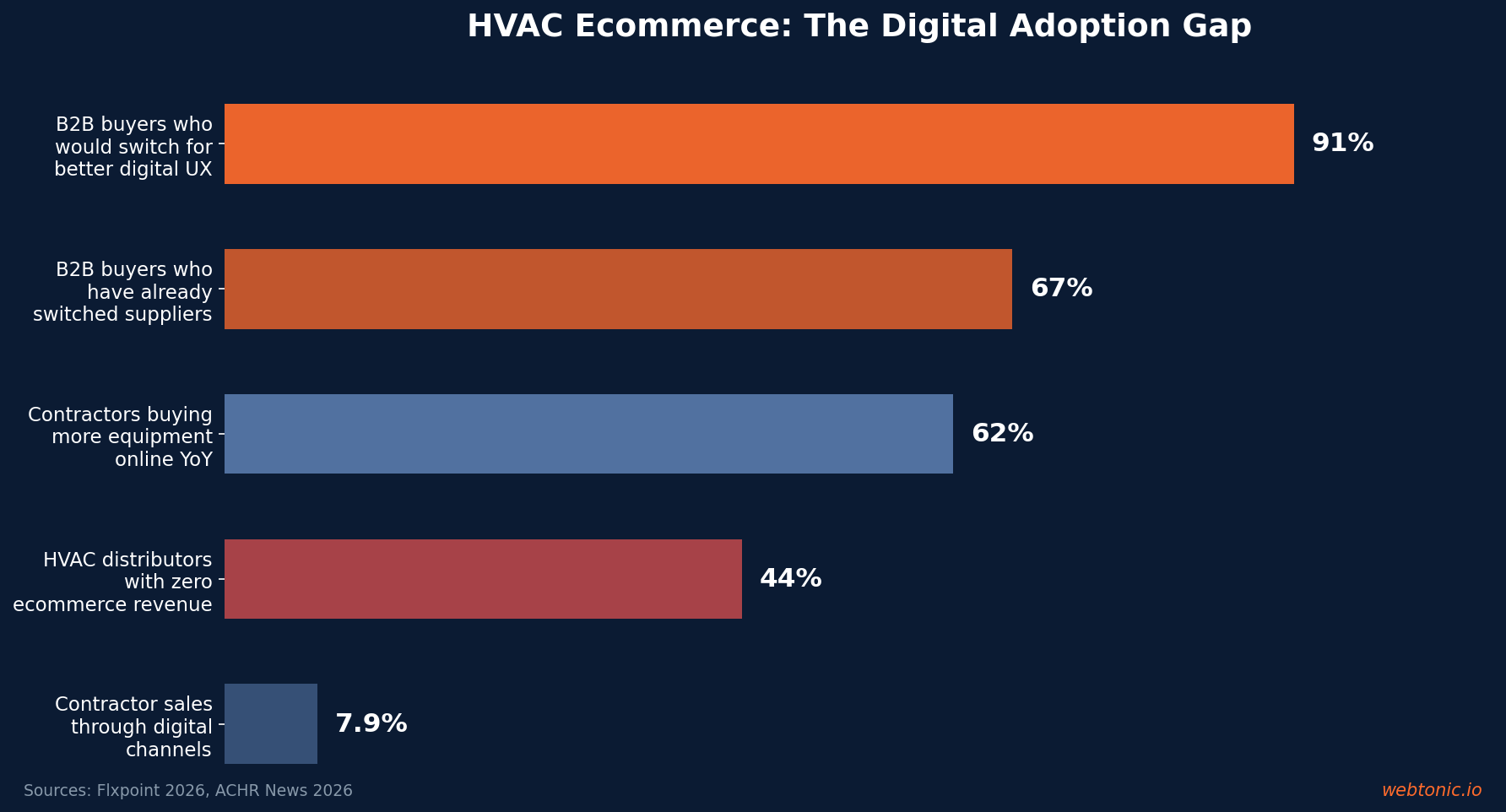
The online distribution channel held approximately 28.7% of global HVAC parts market share (Dataintelo, 2026), with major platforms like Amazon, SupplyHouse.com, and RepairClinic capturing significant volume. Yet the gap between digital leaders and laggards is enormous: only 7.9% of contractor sales flow through digital channels, and 44% of HVAC distributors have zero ecommerce revenue.
Contractors themselves are increasingly buying online. 62% of HVAC contractors reported buying "a lot more" or "somewhat more" equipment online in the past 12 months, up from 58% the year prior (ACHR News, 2026). Contractors made 10% of their purchases from online-only retailers and expect traditional wholesaler share to decline from 58% to 53% by 2030. For HVAC businesses exploring how digital advertising drives ecommerce traffic, our HVAC Google Ads statistics guide covers paid channel benchmarks.
Shopify's B2B Surge and What It Means for HVAC
Shopify's wholesale infrastructure reached a tipping point in 2026. The platform's B2B commerce segment hit $9.4 billion in GMV in H1 2026, up 140% year-over-year. This growth is partly structural: Shopify rolled out its overhauled B2B storefront framework in Q4 2025, giving merchants the ability to run separate buyer-facing portals with custom catalogs, net payment terms (30/60/90-day options), draft order automation, and purchase order workflows.
Key Shopify B2B metrics that matter for HVAC businesses:
- Average B2B order value: $1,840 — roughly 14× higher than the average DTC order at ~$130
- B2B project requests now account for 35% of Shopify Plus agency pipelines, up from less than 10% eighteen months ago (Elkfox, Toronto-based Shopify Plus partner)
- 91% of B2B buyers would switch suppliers for a better online buying experience
- 67% of B2B buyers have already switched suppliers because of a poor digital experience
For HVAC distributors and parts sellers, the shift is clear: Parts Town saw 55% HVAC revenue growth after integrating 89 supplier connections on Flxpoint — no new headcount needed. The operational improvement came first (accurate catalogs, automated order routing, near-zero peak-season oversells), and the revenue growth followed.
HVAC Shopify Store Performance Metrics
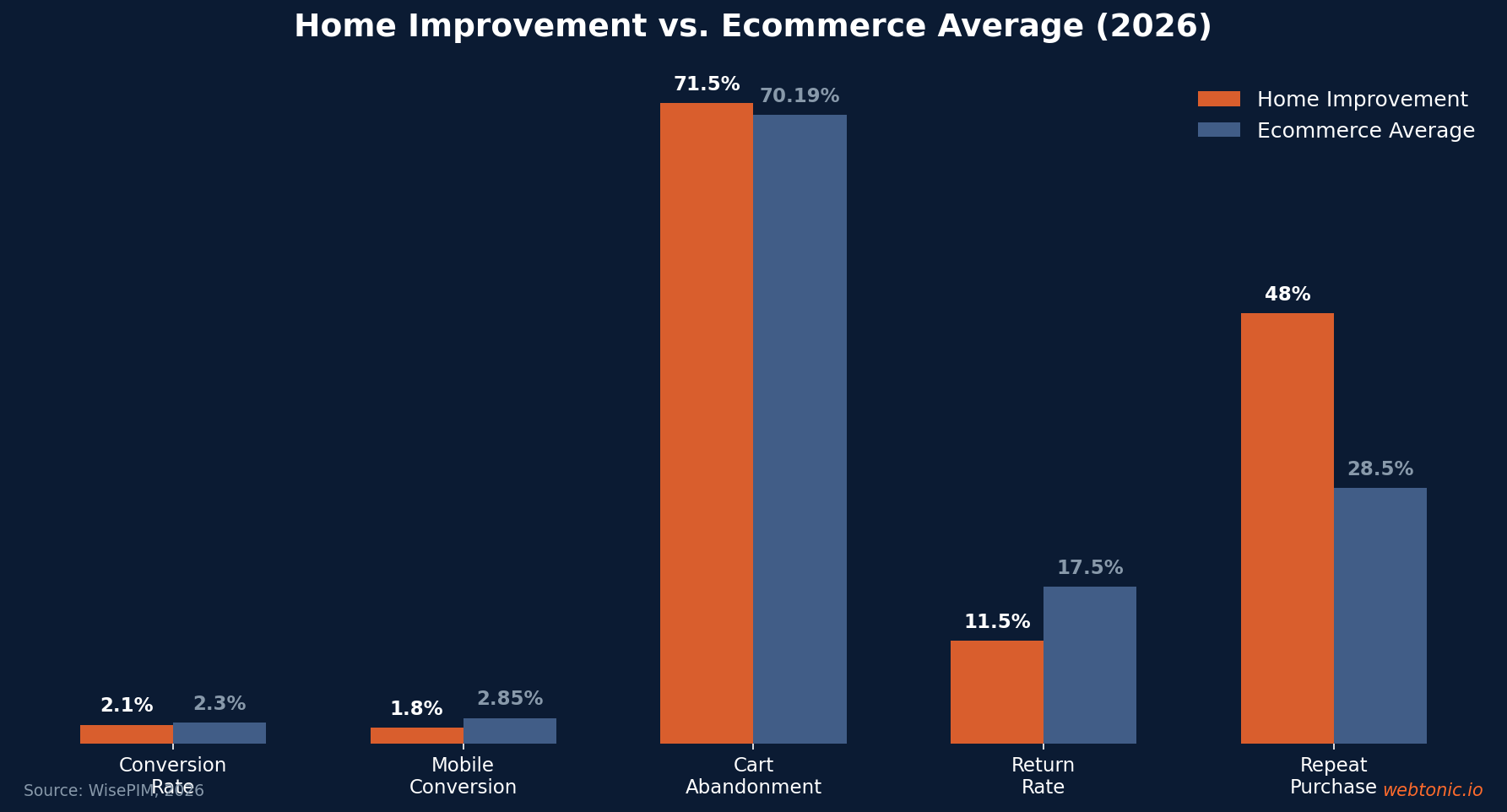
The home improvement vertical — the closest Shopify benchmark category to HVAC — shows distinct performance patterns compared to the broader ecommerce average (WisePIM, 2026):
Table 2. Home improvement ecommerce performance vs. industry average.
| Metric | Home Improvement | Ecommerce Avg | Gap |
|---|---|---|---|
| Conversion rate | 2.1% | 2.3% | 9% lower |
| Mobile conversion | 1.8% | 2.85% | 37% lower |
| Average order value | $135 | $143 | 5% lower |
| Cart abandonment | 71.5% | 70.19% | On par |
| Return rate | 11.5% | 17.5% | 34% lower |
| Repeat purchase rate | 48% | 28.5% | 68% higher |
The 48% repeat purchase rate is the standout metric. HVAC parts are consumable: filters need replacing, refrigerant needs restocking, and seasonal maintenance creates predictable reorder cycles. This creates strong lifetime value for stores that capture first orders. The 11.5% return rate — 34% lower than the ecommerce average — reflects the fact that HVAC buyers typically know exactly what part they need. Improving conversion rates is critical for all HVAC digital channels, and our HVAC landing page statistics guide covers the optimization tactics that move the needle.
The Amazon Effect on HVAC Equipment Buying
Consumer purchasing patterns are reshaping the HVAC supply chain. According to a five-year tracking study by myCLEARopinion Insights Hub (published in ACHR News, 2026):
- 70% of contractors reported customers buying "a lot more" or "somewhat more" HVAC equipment online compared to the previous year
- 14% of contractors said customers "always" request installation of products they already purchased, with 61% saying customers "sometimes" ask for such services
- Customers saved an average of 15% below the contractor's retail price when buying online themselves
- 62% of contractors are buying more equipment online themselves, with 10% of purchases from online-only retailers
- Contractors expect traditional wholesaler share to decline from 58% to 53% by 2030
This "Amazon Effect" creates a dual opportunity for HVAC businesses on Shopify: selling directly to homeowners doing their own research, and building B2B storefronts for contractor procurement. Understanding how customers discover HVAC businesses online is foundational — our HVAC SEO statistics guide covers the organic search patterns that drive both consumer and contractor traffic.
The shift extends beyond just parts. 82% of HVAC companies now consider digital marketing crucial to their growth, and the companies that combine strong ecommerce with digital advertising are seeing compounding returns. Seasonal campaign timing is particularly important: retrofit and replacement projects drive 62.5% of the U.S. HVAC equipment market and are growing faster than new construction at a 7.1% annual rate. Homeowners with 10–15 year old systems represent the primary ecommerce opportunity, as they research replacement parts and full-system options online before contacting a contractor.
The professional buyer demographic for home improvement ecommerce skews 25–60 years old, predominantly male (82%), managing teams of 2–15 technicians with average annual material purchases of $125,000–$350,000. These buyers prioritize efficient project completion with target margins of 28–32%, and project delays due to stock issues or inaccurate specifications cost them an average of $275 per day in lost productivity. For contractors evaluating their creative advertising strategy to drive ecommerce traffic, our HVAC ad creative statistics guide covers the visual assets that convert.
Shopify Home Improvement Market Growth
The broader Shopify home improvement ecosystem provides context for HVAC ecommerce growth (Bootleads, 2026):
- 12,752 active Shopify stores operate in the Home Improvement segment
- 404 new stores were added in the last 30 days, representing 3% monthly growth
- Growth has slowed below the Shopify platform average of 12% monthly, suggesting the market is maturing rather than emerging
- The most common product count range is 50–199 products, with prices typically under $25
- 65.8% of Shopify HVAC stores are based in the United States
For HVAC specifically, the 7,700 live Shopify stores range from small filter subscription services to full-catalog distributors. The $135 average order value sits below the broader ecommerce average, but this is offset by the repeat purchase rate nearly doubling the industry norm.
HVAC Digital Transformation Benchmarks
The gap between digital leaders and laggards in HVAC distribution is widening. Key transformation benchmarks from the Flxpoint 2026 HVAC Industry Report:
Table 3. HVAC distributor digital maturity benchmarks.
| Metric | Digital Leaders | Industry Average |
|---|---|---|
| Ecommerce revenue share | 20–35% | 7.9% |
| Distributors with zero ecommerce | — | 44% |
| B2B buyer switch rate (poor UX) | — | 67% |
| Revenue growth (with integrations) | 55% (Parts Town) | Flat to declining |
| Online parts market share | — | 28.7% (global) |
| Supplier integrations impact | 89 suppliers → near-zero oversells | Manual PO processing |
The core message from the data: ecommerce revenue grows up to 20% when product visibility and customer experience improve. For HVAC businesses building their online presence, our web development services page covers the technical infrastructure that supports high-performing ecommerce stores.
Best Practices for HVAC Shopify Stores in 2026
- Prioritize mobile conversion. The 37% mobile conversion gap versus the ecommerce average is the biggest growth opportunity. Optimize product pages for mobile with clear specs, compatibility info, and one-tap ordering.
- Build for repeat purchases. With a 48% repeat rate, subscription models for filters, maintenance kits, and seasonal supplies can dramatically increase lifetime value.
- Invest in product data quality. HVAC buyers need exact specifications — voltage, BTU capacity, compatibility models, certifications. Incomplete product data was cited as a purchase barrier by 76% of home improvement shoppers.
- Consider Shopify B2B for wholesale. With average B2B orders at $1,840, even a small contractor customer base generates significant revenue. Use net terms and custom catalogs to compete with traditional distribution.
- Reduce cart abandonment with specifications clarity. Complex installation requirements not disclosed upfront cause 76% of shoppers to abandon. Surface compatibility and installation info before the cart stage.
- Add Facebook Ads and Google Shopping. Drive traffic to your Shopify store with targeted campaigns. HVAC parts shoppers are high-intent buyers with strong purchase signals.
Frequently Asked Questions
How many HVAC stores are on Shopify in 2026?
There are 7,700 live Shopify stores in the HVAC & Climate Control category as of 2026, according to StoreLeads. The broader Home Improvement segment includes 12,752 active Shopify stores. About 65.8% of HVAC Shopify stores are based in the United States.
What is the conversion rate for HVAC ecommerce stores?
Home improvement ecommerce stores average a 2.1% conversion rate, slightly below the 2.3% ecommerce average. Mobile conversion is significantly lower at 1.8% versus 2.85% for the broader market — a 37% gap that represents the biggest optimization opportunity for HVAC Shopify stores.
How big is the HVAC parts ecommerce market?
The online distribution channel holds approximately 28.7% of the global HVAC parts market. Total U.S. HVAC contractor industry revenue reached $156.2 billion in 2025. However, only 7.9% of contractor sales flow through digital channels, and 44% of HVAC distributors have zero ecommerce revenue, indicating massive untapped potential.
What is Shopify's B2B performance for wholesale HVAC?
Shopify's B2B commerce segment hit $9.4 billion in GMV in H1 2026, up 140% year-over-year. The average B2B order value is $1,840 — 14× higher than DTC orders. Shopify Plus now supports custom catalogs, net payment terms (30/60/90-day), draft order automation, and purchase order workflows tailored to wholesale operations.
Are HVAC contractors buying more equipment online?
Yes. 62% of contractors reported buying "a lot more" or "somewhat more" equipment online in the past 12 months, up from 58% the year prior. Contractors now make 10% of purchases from online-only retailers and expect traditional wholesaler share to decline from 58% to 53% by 2030.
Sources
Flxpoint — 2026 HVAC Industry Report: Ecommerce & Supply Chain Trends
Ecommerce Times — Shopify's B2B GMV Surges 140% (July 2026)
ACHR News — Surveys Show Amazon Effect in HVAC Equipment Buying (2026)
WisePIM — Home Improvement & Hardware E-commerce Benchmarks 2026
Bootleads — 12.8K Shopify Home Improvement Stores: Stats & Market Data (2026)
Dataintelo — HVAC Parts Market Research Report 2034
Frontburner Marketing — 30+ HVAC Marketing Statistics (2025)
StoreLeads — HVAC & Climate Control Shopify Store Report (2026)


