Table of contents
For HVAC installation and repair, Google Shopping is not an option to weigh: Google's policy excludes services, so the cost question only applies to businesses that sell equipment and parts. On that side the 2025 numbers show a shrinking cooling market and a fast-digitising distribution channel.
Key Takeaways
- 7.75 million central AC and heat pump units shipped in 2025, down 20% from 9.68 million (AHRI via ACHR News).
- Air conditioner shipments fell 26.2% to 4.10 million in 2025.
- Heat pump shipments fell 11.6% to 3.64 million, still above gas furnaces.
- Gas warm-air furnace shipments rose 4.1% to 3.25 million in 2025.
- Watsco booked about USD 2.5 billion in e-commerce sales, 35% of its 2025 total.
- Some Watsco regions exceed 60% e-commerce penetration.
- About 73,000 users are on Watsco's HVAC Pro+ apps, up 15%.
- More than 10,000 new SKUs came with the A2L refrigerant launch, per Watsco.
- Google Shopping investment rose 18% year over year in Q2 2026 (Tinuiti, cross-retail).
The eligibility answer comes before the cost answer
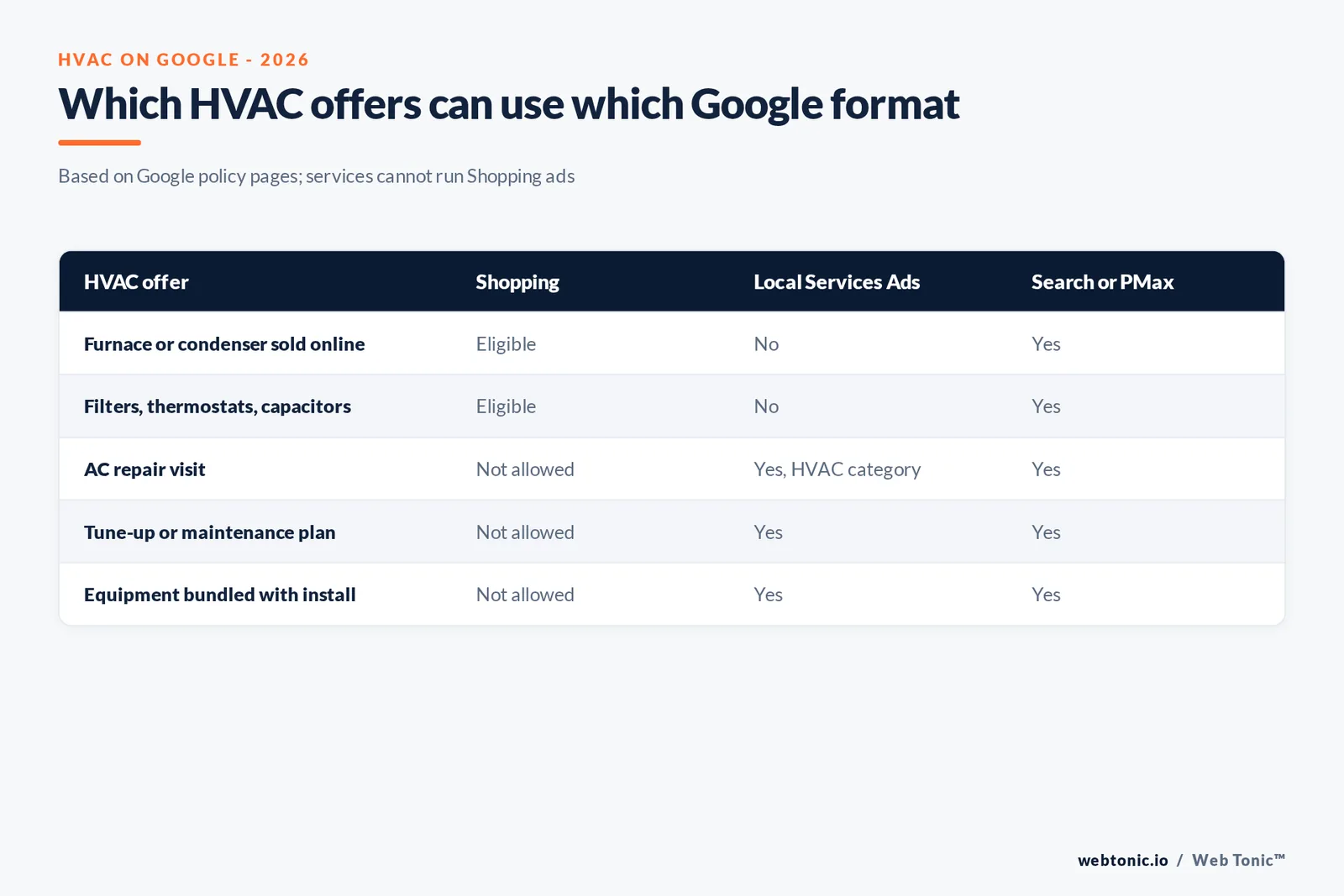
Google's Unsupported Shopping content policy lists Services as not allowed: "labor, time, effort, expertise, or actions, which do not result in ownership of a tangible product", including "any services sold bundled with physical goods." Its own example list opens with maintenance or repair services. A tune-up, a same-day AC repair, a duct cleaning or an installed-system price is therefore not a Shopping product, whatever the budget.
What remains eligible is the hardware: condensers, furnaces, thermostats, filters, capacitors, motors and refrigerant-line accessories, sold with a price and checkout. For most residential contractors, that means Shopping is a channel for their supplier, not for them.
| HVAC offer | Shopping eligible? | Reason given by Google | Better Google format |
|---|---|---|---|
| Furnace sold for delivery or pickup | Yes | Tangible product | Shopping, Performance Max |
| Replacement filters and thermostats | Yes | Tangible product | Shopping, free listings |
| AC repair visit | No | Maintenance or repair service | Local Services Ads |
| Seasonal tune-up plan | No | Service, no tangible ownership | Search |
| Heat pump with installation included | No | Service bundled with goods | Search, Local Services Ads |
The equipment market in 2025 shipments
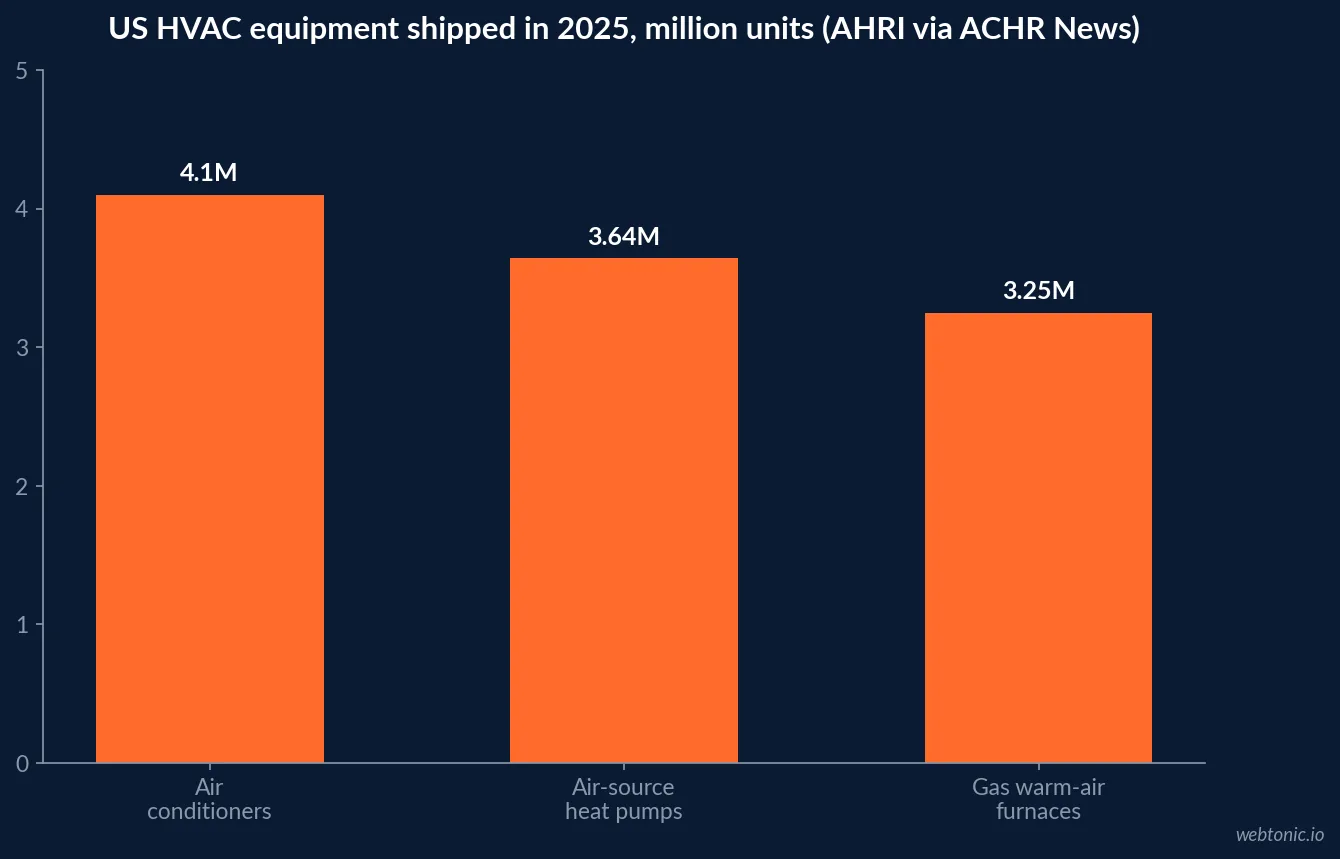
AHRI publishes monthly manufacturer shipments on its historical data pages; the 2025 year-end totals were summarised by ACHR News. Combined central air conditioner and air-source heat pump shipments fell to 7.75 million units from 9.68 million, a 20% drop. Air conditioners alone fell 26.2% to 4.10 million; heat pumps fell 11.6% to 3.64 million. Gas warm-air furnaces moved the other way, up 4.1% to 3.25 million, which kept heat pumps ahead of furnaces for the year.
For anyone weighing Shopping spend, that is the demand backdrop: fewer cooling units moving through the channel, and a refrigerant transition that reshuffled what is in stock.
| Product (AHRI, 2025) | Units shipped | Change vs 2024 | Feed implication |
|---|---|---|---|
| Central AC + air-source heat pumps | 7.75 million | -20% | Smaller pool of equipment searches |
| Air conditioners only | 4.10 million | -26.2% | Legacy SKUs need clear availability |
| Heat pumps only | 3.64 million | -11.6% | Still outsold gas furnaces |
| Gas warm-air furnaces | 3.25 million | +4.1% | Growing heating catalog |
| Oil warm-air furnaces | 32,799 | +9.2% | Niche but rising |
The refrigerant transition behind the 2025 slump
ACHR News ties the 2025 decline to the move away from R-410A, tariffs, high interest rates, the end of federal tax credits and inventory destocking. December was the sharpest month: combined AC and heat pump shipments fell 21.4% against December 2024, with air conditioners down 35.9% and heat pumps down only 2.4%, while gas furnaces were flat at 267,065 units.
Manufacturer commentary in the same report explains the overhang. Carrier's chief executive said the industry averaged 9.7 million units a year between 2020 and 2024, about 3.5 million above normal, and delivered about 7.5 million in 2025. Lennox said roughly 40% of its residential mix still involved R-410A equipment in 2025, all shifting to R-454B. For a feed manager, that is a once-a-decade catalog rewrite: old model numbers retire, new ones need identifiers and specs, and search queries change with them.
| Transition signal (ACHR News, 2025) | Figure | Who reported it | Catalog consequence |
|---|---|---|---|
| December AC + heat pump shipments | -21.4% vs Dec 2024 | AHRI data | Cooling SKUs slow in winter |
| December AC shipments | -35.9% | AHRI data | Retire or mark out-of-stock R-410A units |
| Industry average 2020-2024 | 9.7 million units a year | Carrier CEO | Inventory overhang to clear |
| Industry delivery 2025 | About 7.5 million units | Carrier CEO estimate | Lower volume, same catalog size |
| Lennox residential mix on R-410A | About 40% in 2025 | Lennox CEO | Large share of models replaced |
What an HVAC parts feed has to carry
HVAC parts are matched by exact model and capacity, so the fields that roofing or apparel feeds can treat loosely are critical here. Put brand, model number and capacity (tonnage or BTU) at the start of the title, where Google's optimisation guidance says key details belong because titles are truncated in most ad formats. Load the manufacturer part number as MPN, and the barcode as GTIN where the box has one. Mark compatibility and refrigerant type in the description, since a buyer replacing an R-410A condenser and one buying an R-454B system are searching for different things. Finally, keep regulated items such as refrigerant cylinders out of the feed unless you have confirmed the relevant Merchant Center policy for your country, and exclude any listing whose landing page only offers a quote, because Shopping requires the product to be purchasable.
What distributor e-commerce data shows
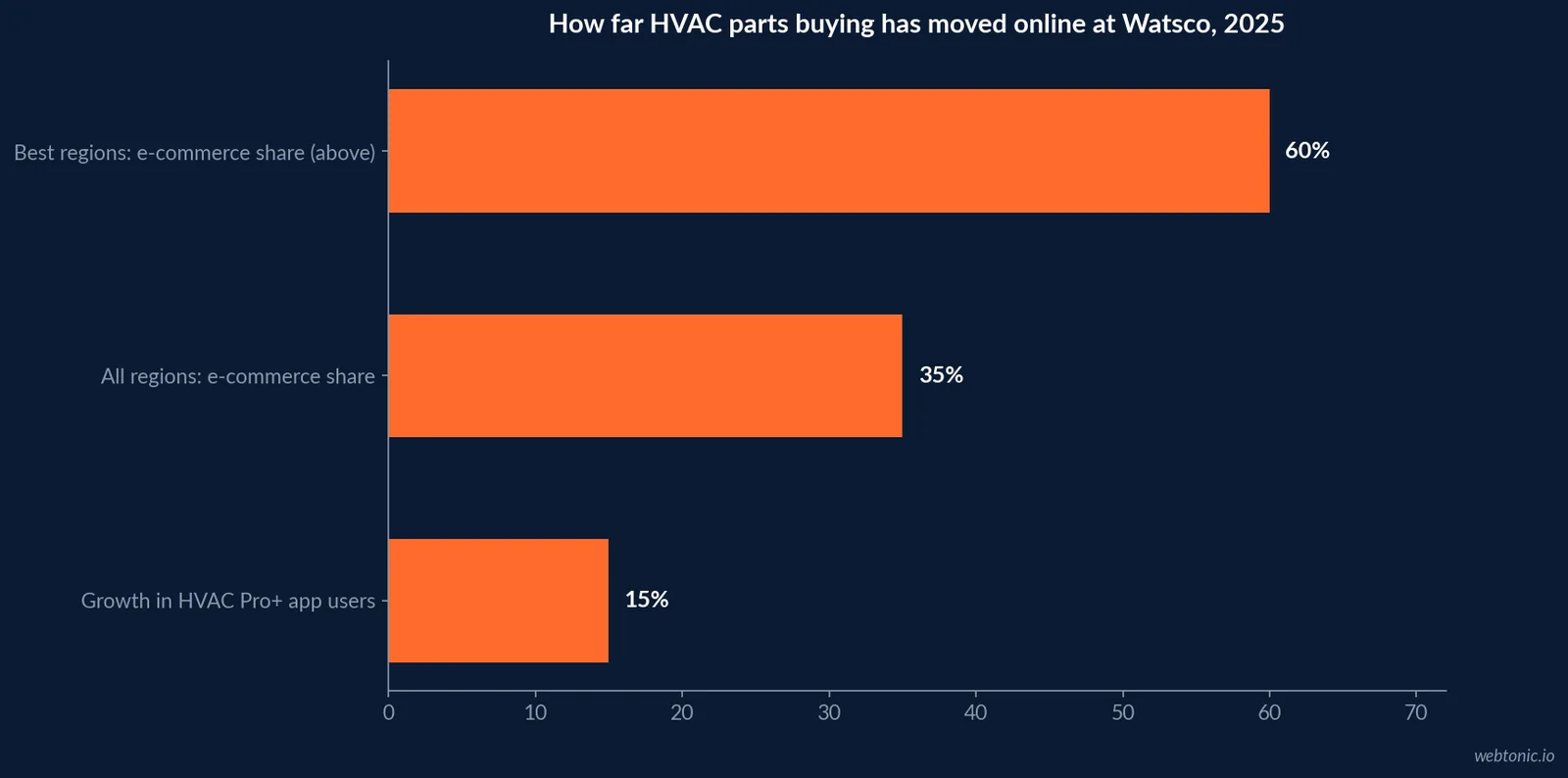
The strongest public evidence that HVAC buyers shop parts digitally comes from Watsco, the largest US HVAC/R distributor to publish these figures. It reported e-commerce sales of about USD 2.5 billion in 2025, 35% of overall sales, with outperforming regions above 60% e-commerce penetration. The authenticated community on its HVAC Pro+ mobile apps grew 15% to about 73,000 users, and HVAC equipment was 67% of its sales.
Those are contractor-to-distributor purchases, largely inside logged-in portals rather than Google Shopping. They show buyers are comfortable ordering parts online; they do not show that Shopping ads are the way they find them.
| Watsco 2025 digital metric | Value | What it indicates |
|---|---|---|
| E-commerce sales | About USD 2.5 billion | Scale of online parts buying |
| E-commerce share of sales | 35% | Portion of distributor revenue ordered online |
| Best-region penetration | Above 60% | Ceiling where adoption is highest |
| HVAC Pro+ app users | About 73,000, up 15% | Contractors using mobile ordering |
| New SKUs for A2L launch | More than 10,000 | Catalog churn a feed must absorb |
The catalog problem: SKU churn and refrigerant transitions
Watsco says it added more than 10,000 new SKUs for the A2L refrigerant launch, each with features, dimensions, capacities, literature, warranty and regulatory match-ups. That is the feed-management burden in one line: every new model needs a correct title, identifier, image, price and availability, and every discontinued model needs to leave the feed.
Cross-industry data shows why that matters. The DataFeedWatch Feed Marketing Report 2022 (more than 15,000 stores) found 7% of Google Shopping feed items rejected for data errors and 16.66% of advertised products out of stock. Google's product data optimisation tips recommend complete product data and GTINs so listings can appear "in more places on Google".
What Shopping costs across retail in 2026
No public source reports an HVAC Shopping CPC, conversion rate or ROAS. The cross-retail reference is Tinuiti's Q2 2026 Digital Ads Benchmark Report (vendor, client data). As summarised by Search Engine Journal, Google Shopping investment grew 18% year over year, Google search spend nearly 14%, and average search CPC just 1%. Tinuiti also reports Amazon at 0% US Shopping impression share against the median retailer after leaving most auctions in July 2025.
For a parts seller that means less competition from the biggest marketplace; it does not give you a target cost per sale. Build that from your own margin per SKU.
| Cost question | Public answer | Source | What to use instead |
|---|---|---|---|
| HVAC Shopping CPC | Not published | None found | Your own Merchant Center data |
| Cross-retail Shopping spend growth | +18% YoY, Q2 2026 | Tinuiti via SEJ | Directional only |
| Search CPC change | About +1%, Q2 2026 | Tinuiti via SEJ | Directional only |
| Amazon Shopping impression share | 0% vs median retailer | Tinuiti Q2 2026 | Less marketplace pressure |
| Feed items rejected | 7% (2022 study) | DataFeedWatch | Audit your disapproval rate |
Where HVAC contractors should spend instead
Google lists HVAC as a US category in Local Services Ads, billed per lead, and describes Performance Max as a single campaign reaching YouTube, Display, Search, Discover, Gmail and Maps, recommended when a business has goals such as generating leads. Our HVAC Google Ads statistics and the Google Ads cost guide cover those costs.
Online retail context
The Census Bureau put US retail e-commerce at USD 340.2 billion in Q2 2026, 17.1% of retail sales and up 12.2% year over year. HVAC equipment is mostly sold through trade channels, so this share is a ceiling on expectations rather than an HVAC figure.
The more useful comparison is inside the trade. Watsco's 35% e-commerce share is roughly double the Census retail share, which suggests professional buyers already order HVAC parts online more readily than the average consumer buys anything online. The catch is where that ordering happens: in distributor portals and apps that require an account, not on an open Google results page. A retailer selling to homeowners and DIY buyers is the natural Shopping advertiser; a distributor selling to licensed contractors may find its best digital channel is its own app.
When Shopping is worth testing for an HVAC business
- You sell parts or equipment with an online checkout, not just quotes.
- Your catalog has manufacturer identifiers you can load as GTIN and MPN.
- Your stock data syncs automatically, given 16.66% out-of-stock rates in the 2022 study.
- You can absorb SKU churn like the 10,000+ A2L additions without stale listings.
- You measure margin per SKU, since no HVAC ROAS benchmark exists.
Other HVAC channels on this site
Demand-side channels are covered in our HVAC CTV statistics and HVAC influencer and UGC statistics. Together they show the pattern: contractors buy attention and leads; distributors buy product clicks.
Frequently Asked Questions
Are HVAC Google Shopping ads worth the cost for a contractor?
For installation and repair, the question does not arise: Google's Unsupported Shopping content policy bans maintenance and repair services and any service sold bundled with physical goods. A contractor's budget belongs in Local Services Ads, where HVAC is a listed US category, Search or Performance Max. Shopping is only worth testing if you also sell parts or equipment online with a checkout.
Can I list a furnace with installation included?
Not as a Shopping product. The policy explicitly disallows services sold bundled with physical goods. You can list the furnace alone if customers can buy it on your site, and promote the installed package through Search.
How big is the HVAC equipment market sellers compete in?
AHRI data reported by ACHR News put 2025 US shipments of central air conditioners and air-source heat pumps at 7.75 million units, down 20% from 9.68 million, while gas warm-air furnaces rose 4.1% to 3.25 million.
Do HVAC contractors actually buy parts online?
The best public signal comes from distributor Watsco, which reported about USD 2.5 billion of e-commerce sales in 2025, 35% of its total, with some regions above 60%, and about 73,000 users on its HVAC Pro+ apps.
What does a Shopping click cost for HVAC parts?
No public benchmark reports an HVAC-specific Shopping CPC or ROAS, so any figure quoted as one is a guess. The cross-retail signal is Tinuiti's Q2 2026 benchmark: Shopping investment up 18% year over year and search CPCs up about 1%, as reported by Search Engine Journal.
Sources
Google Merchant Center - Unsupported Shopping content
ACHR News - AHRI 2025 shipments
AHRI - Central AC and heat pump historical data
Watsco - 2025 results
DataFeedWatch - Feed Marketing Report 2022
Tinuiti - Digital Ads Benchmark Q2 2026
Search Engine Journal - Q2 2026 paid search
Google - Local Services Ads
Google Ads - About Performance Max
US Census - Quarterly e-commerce