



Table of contents
Most HVAC contractors spend thousands on ads every month but 79% run no tracking pixel on their landing pages, according to a PipelineOn audit of 175 HVAC advertisers. The data below covers analytics adoption rates, call tracking benchmarks, attribution gaps, and the ROI companies unlock when they finally measure what matters.
Key Takeaways
- 79% of HVAC Facebook advertisers have no Meta Pixel installed, and 96% have no Conversions API — leaving the vast majority of ad spend unmeasured (PipelineOn, Q2 2026).
- Top-quartile HVAC firms track close rates by channel at a 79% adoption rate versus just 11% for the average operator (Built on Tenth, 2026).
- Phone leads convert at 46% while website form fills average 7.8%, making call tracking the single highest-leverage analytics investment for HVAC (BaaDigi, 2026).
- 67% of HVAC marketing spend suffers from an attribution gap where the company cannot connect a lead to the channel that produced it (Click-Vision).
- 91.8% of UK HVAC firms with detectable analytics use Google Analytics, covering 1,170 of 1,274 tracked companies (Firmbase, 2026).
- HVAC companies that standardize 100+ KPIs save an estimated $120,000 per year in reporting overhead alone (Valiotti Data, 2025).
HVAC Analytics Adoption at a Glance
| Metric | Value | Source |
|---|---|---|
| HVAC advertisers with no Meta Pixel | 79% | PipelineOn Q2 2026 |
| HVAC advertisers with no CAPI | 96% | PipelineOn Q2 2026 |
| HVAC advertisers with no visitor ID | 100% | PipelineOn Q2 2026 |
| UK HVAC firms using Google Analytics | 91.8% (1,170 firms) | Firmbase 2026 |
| Top firms tracking close rate by channel | 79% | Built on Tenth 2026 |
| Average firms tracking close rate by channel | 11% | Built on Tenth 2026 |
| Marketing spend with attribution gap | 67% | Click-Vision |
| KPIs standardized in best-practice system | 100+ | Valiotti Data |
The HVAC Tracking Gap: How Much Goes Unmeasured
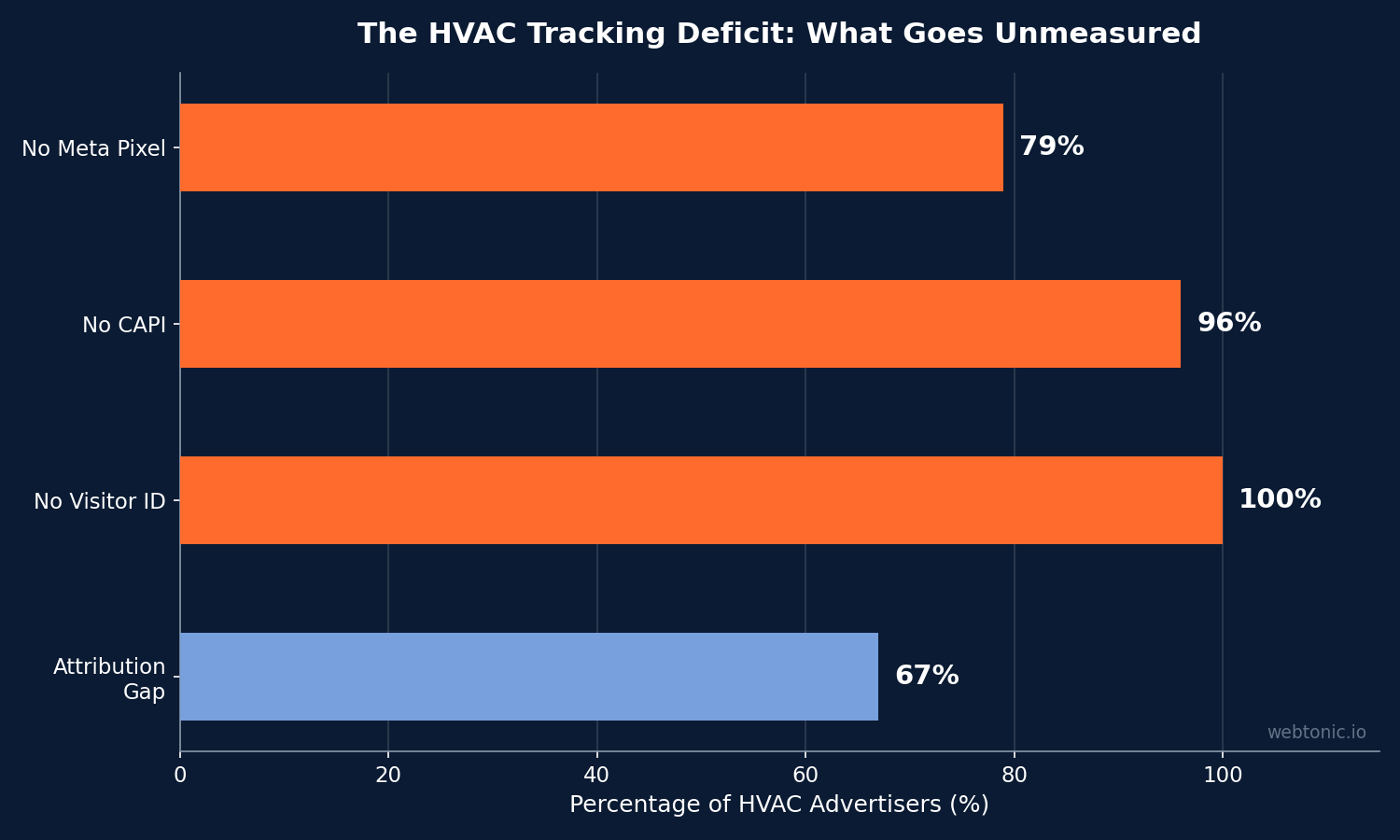
The scale of the tracking deficit in HVAC advertising is striking. PipelineOn's Q2 2026 audit of 175 HVAC advertisers running 720 live Facebook ads found that virtually none have modern measurement infrastructure in place:
- 79% have no Meta Pixel firing on their landing page — meaning Facebook cannot report which clicks become leads.
- 96% have no Conversions API (CAPI) integration — so server-side event matching, the backbone of Meta's attribution system, is absent.
- 100% lack any form of visitor identification — no hashed email matching, no enhanced conversions, nothing that ties an anonymous click to a downstream booked job.
These numbers become even more alarming when you consider the ad volume involved. Across those 175 advertisers, 720 live ads are running simultaneously, each driving paid traffic to pages that cannot measure whether that traffic converts. The contractors are paying for clicks they can never optimize against, and Facebook's algorithm cannot learn from conversions it never sees.
Meanwhile, Click-Vision estimates a 67% attribution gap across HVAC marketing budgets: two-thirds of every dollar spent cannot be traced to the channel that produced the lead. That gap does not mean the ads failed — it means the contractor literally cannot tell whether they worked. Budget decisions default to gut feeling, and working channels get cut while underperforming ones persist because no data exists to differentiate them.
Call Tracking and Phone Lead Conversion Benchmarks
Phone calls remain the dominant lead type in HVAC, and the data makes the case for call tracking overwhelming. BaaDigi's 2026 HVAC benchmark report shows that phone leads convert at roughly 46%, while website visitor-to-lead conversion sits at 7.8%. That nearly 6× gap means a single missed or mishandled call destroys more revenue than a dozen unoptimized landing page headlines.
Call tracking with dynamic number insertion (DNI) assigns unique phone numbers to each marketing channel, so contractors know whether a call came from Google Ads, a Facebook campaign, organic search, or a yard sign. Without DNI, the 46% phone conversion rate is invisible — the contractor sees booked jobs but has no idea which channel produced the phone call that led to the booking.
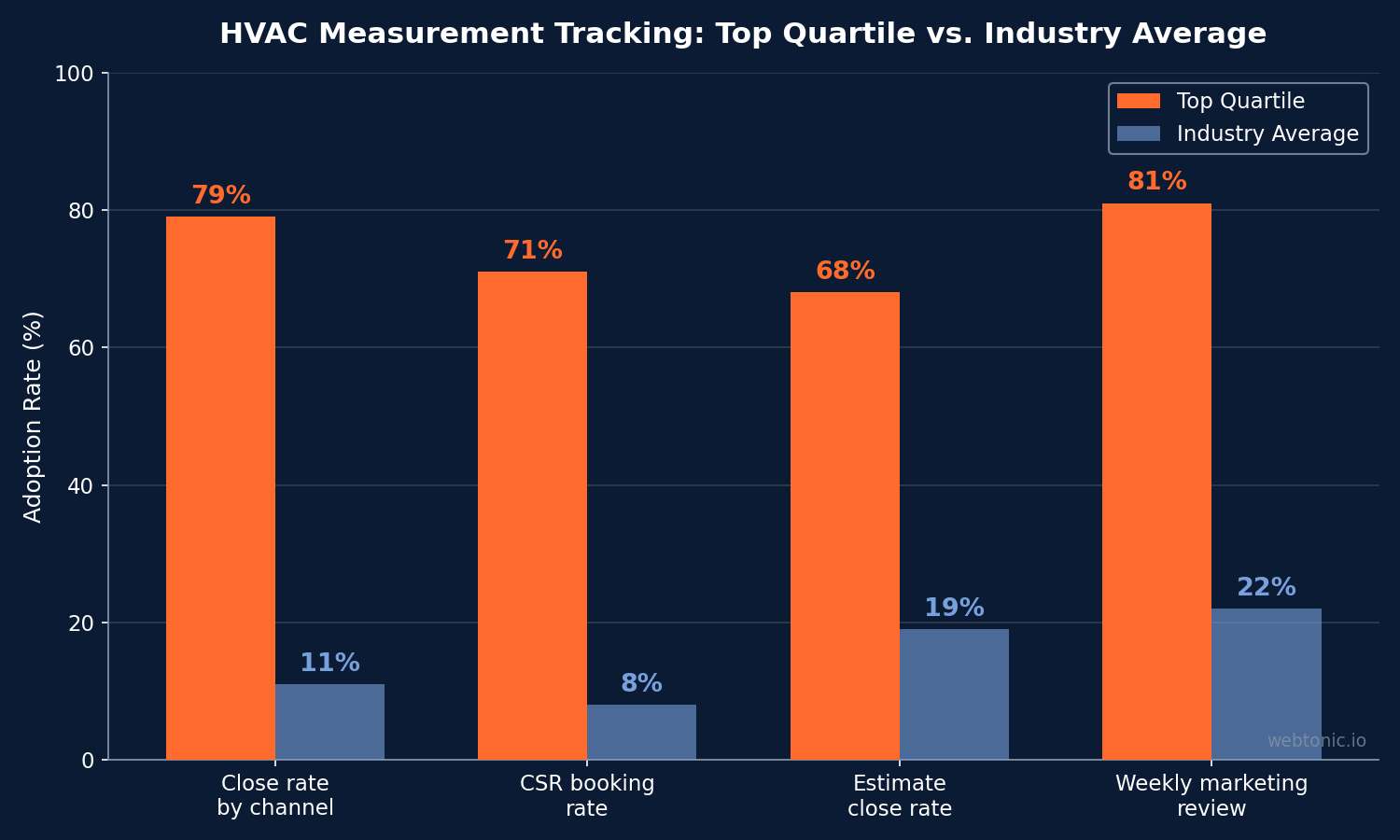
Built on Tenth's top-quartile analysis reveals the measurement habits that separate leading HVAC companies from the rest:
| Tracking Practice | Top Quartile | Industry Average |
|---|---|---|
| Close rate tracked by channel | 79% | 11% |
| CSR booking rate tracked individually | 71% | 8% |
| Estimate close rate tracked | 68% | 19% |
| Weekly marketing review meeting | 81% | 22% |
| Marketing spend as % of revenue | 8–12% | <5% |
| Customer acquisition cost (CAC) | <$350 | Untracked |
The pattern is clear: top-performing HVAC operators are 7× more likely to track close rates by channel and nearly 9× more likely to track individual CSR booking performance than the industry average. The measurement gap is not about technology — call tracking costs $50–$200 per month — it is about operational discipline.
Google Analytics and Platform Adoption in HVAC
Firmbase's 2026 technology census of UK HVAC companies found 1,170 active Google Analytics installations across 1,274 HVAC firms with any detectable analytics — a 91.8% share. Google Analytics dominates the market, but the raw installation number masks a deeper problem: having the tag on the site and actually using the data are fundamentally different things.
Fervor Studio's "Digital State of the HVAC Industry" report, which scored 104 HVAC websites, found only 7% use HubSpot Marketing for analytics, 3% use VWO for A/B testing, and just 1% run Optimizely. The overwhelming majority install a basic analytics tag but never layer on the conversion rate optimization or testing tools that turn raw traffic data into actionable revenue insights.
This "install and forget" pattern means most HVAC companies can tell you how many people visited their website last month but cannot answer the questions that actually drive growth: which pages produce phone calls, which traffic sources generate booked jobs, and where visitors drop off in the conversion funnel. The analytics infrastructure exists — the analytical capability does not.
ROI of Proper Marketing Measurement
When HVAC companies do invest in analytics infrastructure, the returns are measurable and often surprising. Valiotti Data's case study documented a full analytics transformation for an HVAC operation that replaced fragmented Excel files with 7+ real-time Power BI dashboards and 100+ standardized KPIs. The results:
- $120,000 per year in estimated reporting savings from eliminating manual data assembly across departments.
- 3–5× infrastructure cost reduction versus the client's previous Fivetran-based data pipeline.
- Data now flows automatically from ServiceTitan API and Google Sheets into BigQuery, transformed through a three-layer warehouse: Raw → Staging → Analytics.
- Every KPI now has one calculation logic, one interpretation, and one home — ending the version-control chaos of spreadsheet reporting that plagued weekly meetings.
SureShotSystems' 2026 ROI benchmarks emphasize that without closed-loop attribution, HVAC advertisers undervalue their campaigns by 0.5×–1.2× incremental ROAS — meaning they attribute roughly half or less of the actual revenue their ads generate. Contractors who implement server-side tracking and call recording integration consistently discover their true ROAS is significantly higher than what platform dashboards report, because multi-touch journeys and phone conversions are finally captured.
The Seven KPIs Every HVAC Dashboard Should Track
PipelineOn's contractor dashboard guide identifies the seven KPIs that separate data-driven HVAC operators from the rest:
- Cost per lead (CPL) by channel — not blended, but broken out by Google Ads, LSA, Meta, and organic separately.
- Customer acquisition cost (CAC) by channel — including call handling and dispatch costs, not just ad spend.
- Customer lifetime value (CLV) by customer type — new install versus maintenance agreement versus emergency repair.
- Conversion rate by funnel stage — click-to-lead, lead-to-booked, booked-to-completed job.
- Ad spend pacing — daily and weekly spend versus budget, with seasonal adjustment for summer and winter peaks.
- Revenue attribution by source — closed-loop tracking from first touch to completed job revenue.
- Booked jobs by day-of-week — for dispatch planning and bid scheduling optimization.
The report notes that the attribution-ready contractor dashboard requires at minimum call tracking, CRM integration, and offline conversion imports — a full measurement stack that fewer than 20% of HVAC companies currently have in place. Most contractors are making budget decisions based on incomplete data from a single platform rather than a unified view across channels.
Multi-Touch Attribution in HVAC Marketing
HVAC purchase journeys are rarely single-touch. A homeowner might see a truck wrap, search on Google, click a paid ad, visit the website, then call three days later after reading reviews on Yelp. Full Stack HVAC's marketing ROI guide outlines a 4-step closed-loop attribution chain that makes every dollar of spend measurable:
- Step 1: Tag every inbound channel with unique tracking numbers and UTM parameters.
- Step 2: Record every call and form fill in a CRM with source data attached automatically.
- Step 3: Match booked jobs to the originating lead source through dispatch software like ServiceTitan or Housecall Pro.
- Step 4: Calculate revenue per source and compare to spend for true ROI by channel.
Without this chain, the 67% attribution gap persists, and marketing budgets get cut based on incomplete data rather than actual performance. HVAC companies spending $25,000+ per month on ads are the most likely to invest in multi-touch attribution — and the most likely to discover that their true ROI exceeds dashboard reports by 50% or more.
The challenge is operational, not technical. The tools exist — CallRail, WhatConverts, and ServiceTitan all support attribution workflows. The bottleneck is getting dispatchers to tag lead sources in the CRM consistently, getting CSRs to ask "how did you hear about us?" on every call, and getting owners to review attribution reports weekly rather than monthly. The 81% of top-quartile firms holding weekly marketing review meetings (Built on Tenth) are closing this loop by habit, not by technology investment alone.
HVAC Analytics vs. Other Home Services
| Industry | GA Install Rate | Call Tracking Use | Attribution Gap |
|---|---|---|---|
| HVAC | 91.8% | ~25% | 67% |
| Plumbing | ~85% | ~20% | 70–75% |
| Electrical | ~80% | ~18% | 72–78% |
| Roofing | ~78% | ~22% | 65–72% |
HVAC leads the home services sector in raw analytics tag installation but trails in converting installed tracking into actionable measurement. The gap between "Google Analytics is on the site" and "we can tell you which ad produced which booked job" remains the industry's biggest data problem. Companies that close this gap gain a structural advantage in ad efficiency because they can reallocate spend toward channels with proven ROI rather than guessing.
Best Practices for HVAC Marketing Analytics
- Install Meta Pixel and Conversions API before spending on Facebook Ads. The 79% of HVAC advertisers without a Pixel are bidding blind — they pay for clicks they can never optimize against.
- Implement call tracking with dynamic number insertion (DNI). Phone leads at 46% conversion versus 7.8% for web forms means call data is your highest-ROI analytics investment by a wide margin.
- Track CSR booking rates individually. Top-quartile HVAC firms do this at 71% adoption — knowing which receptionist books the most appointments lets you coach the rest and identify training gaps.
- Hold a weekly marketing review meeting. At 81% adoption among top performers versus 22% industry-wide, this single habit correlates most strongly with efficient ad spend and lower customer acquisition costs.
- Build closed-loop attribution from ad click to completed job. Without it, budget decisions default to gut feeling rather than data, and the 67% attribution gap remains unresolved.
- Standardize KPIs across all reporting. Companies that formalize 100+ metrics with one calculation logic eliminate the "my numbers don't match your numbers" problem that derails marketing meetings and delays decisions.
FAQ
What percentage of HVAC companies use marketing analytics?
91.8% of UK HVAC firms with detectable analytics use Google Analytics (Firmbase, 2026), but actual utilization is far lower. Only about 25% use call tracking, and PipelineOn found 79% of HVAC Facebook advertisers have no tracking pixel at all. Having analytics installed and using analytics to make decisions are two very different things in this industry.
Why is call tracking important for HVAC businesses?
Phone leads convert at 46% compared to 7.8% for website form fills (BaaDigi, 2026). Since HVAC is a phone-first industry — most customers call when their AC breaks rather than filling out a form — call tracking captures the majority of conversion data that web-only analytics miss entirely. Without it, the highest-converting channel is invisible to measurement.
What is the attribution gap in HVAC marketing?
The attribution gap is the percentage of marketing spend that cannot be traced to the channel that produced the lead. In HVAC, Click-Vision estimates this gap at 67%, meaning two-thirds of ad budgets cannot be connected to downstream revenue. Closing it requires multi-touch attribution, CRM integration, and consistent lead source tagging at every customer touchpoint.
How much can HVAC companies save with better analytics?
Valiotti Data documented $120,000 per year in reporting savings from replacing manual Excel workflows with automated dashboards and standardized KPIs. Beyond direct savings, proper attribution typically reveals 0.5×–1.2× additional ROAS that was previously invisible, meaning companies often discover their ads are working better than they thought and can reinvest accordingly.
What KPIs should an HVAC marketing dashboard track?
PipelineOn recommends seven core metrics: CPL by channel, CAC by channel, CLV by customer type, conversion rate by funnel stage, ad spend pacing, revenue attribution by source, and booked jobs by day-of-week. The key is tracking these per-channel rather than as blended averages, which hide underperforming spend behind strong channels.
Sources
pipelineon.com/blog/home-service-meta-ad-research
builtontenth.com/insights/hvac-marketing-benchmarks-2026
baadigi.com/tools/benchmarks/hvac
firmbase.co — HVAC Google Analytics UK
fervorstudio.ca — Digital State of HVAC Industry
valiotti.com — HVAC Analytics Case Study
sureshotsystems.com — HVAC Advertising ROI Benchmarks
fullstackhvac.com — HVAC Marketing ROI Measurement
pipelineon.com/blog/contractor-marketing-dashboard
click-vision.com


