



Table of contents

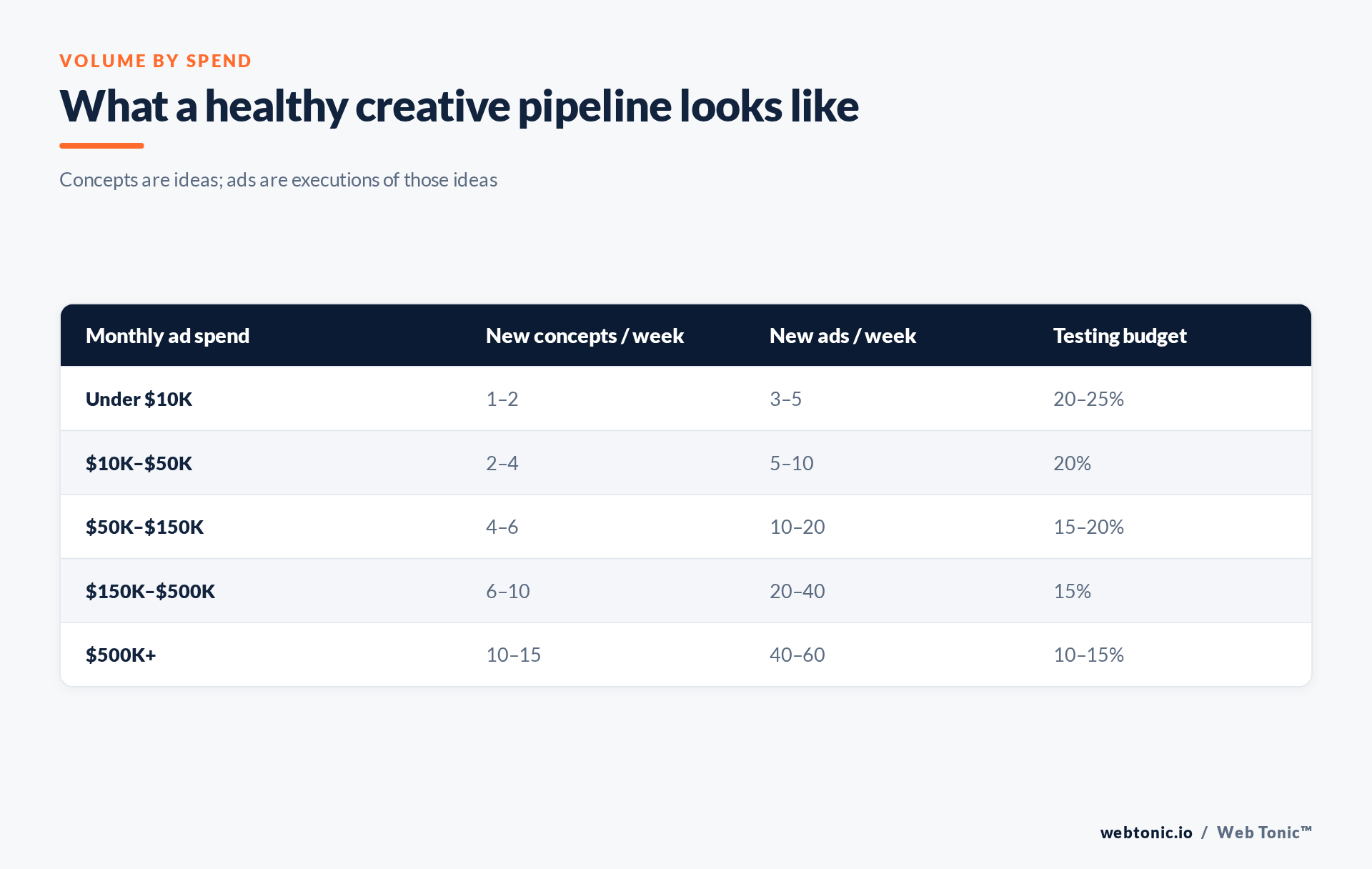
Quick answer: Creative volume scales with spend. Under $10K a month you need 1–2 new concepts and 3–5 new ads a week; at $50K–$150K it is 4–6 concepts and 10–20 ads; above $500K, 10–15 concepts and 40–60 ads.
Last verified: 2026-08-21
Why the number scales with budget
Spending more money does not mean showing the same ad to more people. It means showing it to the same people more often, then reaching further into audiences with weaker intent. Frequency climbs, response falls, and the account needs fresh material simply to hold its position. That is why creative volume is a function of spend rather than of taste, ambition or how good last month's winner was.
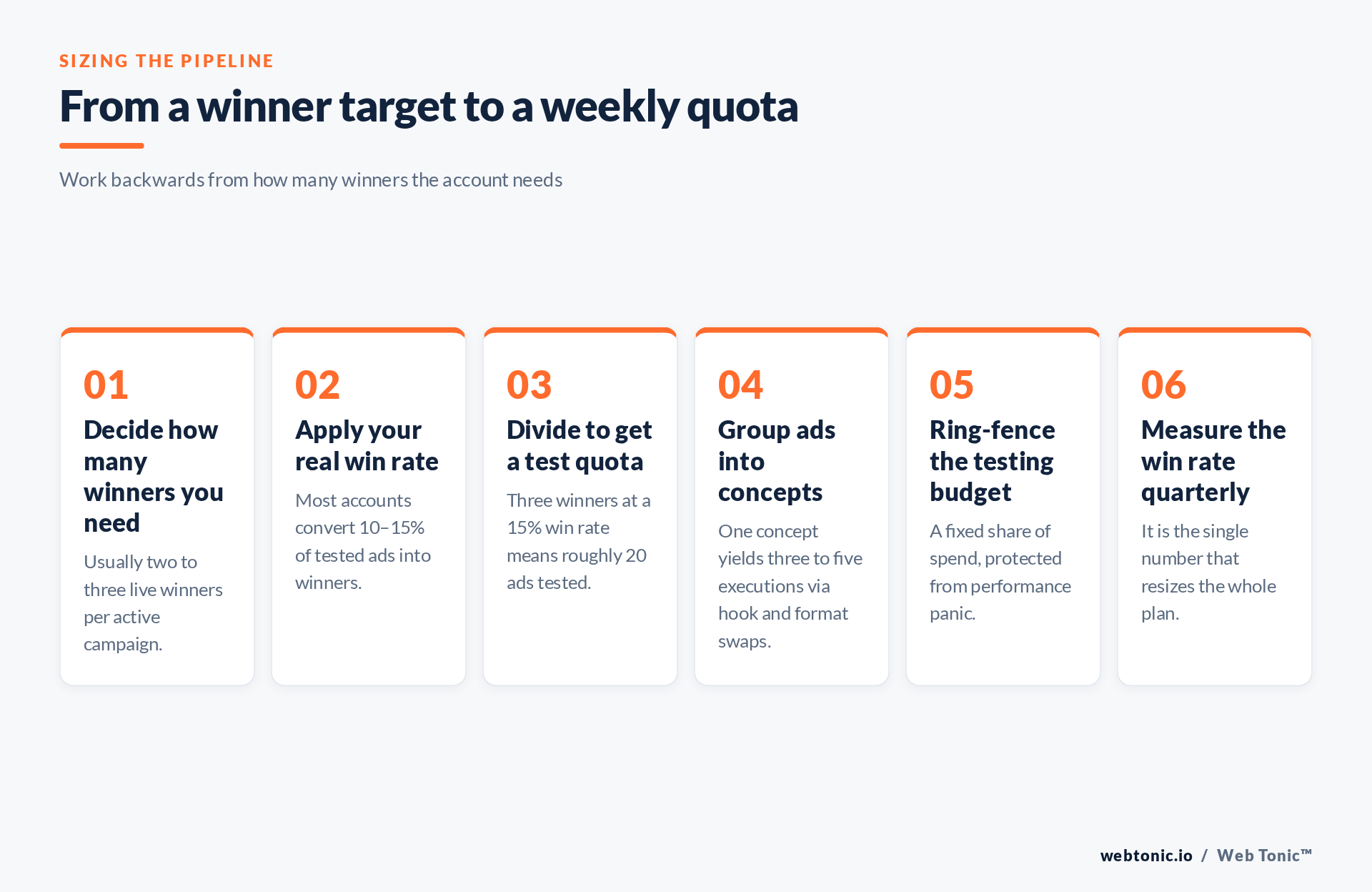
The second reason is statistical. Finding a winner is a search problem, and search problems need samples. Most accounts turn 10–15% of tested ads into genuine winners; strong accounts reach 20–25%. At a 15% win rate, three winners require roughly twenty tested ads. If you only ship four ads a month, you are not running a creative programme — you are buying lottery tickets and calling the outcome strategy.
Ad delivery behaves like a multi-armed bandit: the system explores options and then exploits the best one it has found. It can only exploit what you gave it. A thin pipeline caps performance at the quality of your least-bad idea, no matter how sophisticated the bidding is.
Concepts versus ads — the distinction that saves money
A concept is a distinct idea: an angle, a story, a proof mechanism, a format. An ad is one execution of it. One concept reliably produces three to five ads through hook swaps, opening-frame changes, aspect-ratio adaptations and copy variants.
Teams that confuse the two either burn a production budget shooting five unrelated ideas a week, or ship fifty near-identical variants and conclude that creative testing does not work. Neither result is about creative; both are about counting. Plan concepts first, then multiply into ads.
Building the weekly quota
- State how many live winners the account needs. Two to three per active prospecting campaign is a workable floor. Retargeting can run on fewer.
- Use your own win rate, not a benchmark. Count the ads launched last quarter and how many earned sustained spend. That ratio is the input everything else depends on.
- Divide to get the test count. Winners needed divided by win rate equals ads to test. Round up, because some tests will not gather enough data to judge.
- Convert ads into concepts. Divide by three to five depending on how much variation each idea supports.
- Ring-fence the testing budget. Smaller accounts need a larger percentage because their absolute spend is small; large accounts need a smaller percentage of a much bigger number.
- Give every test enough budget to resolve. An ad that never accumulates enough conversions produces no verdict, which is worse than not testing it — you paid for the impressions and learned nothing.
| Monthly spend | Concepts / week | Ads / week | Testing budget |
|---|---|---|---|
| Under $10K | 1–2 | 3–5 | 20–25% |
| $10K–$50K | 2–4 | 5–10 | 20% |
| $50K–$150K | 4–6 | 10–20 | 15–20% |
| $150K–$500K | 6–10 | 20–40 | 15% |
| $500K+ | 10–15 | 40–60 | 10–15% |
| Any level | Format mix matters | Static, UGC, founder, carousel | Protected, not raided |
Reading the results honestly
Volume only pays off if the verdicts are sound. Two failure modes recur. The first is calling winners early on tiny samples — the reason statistical significance and sample size are worth a moment's thought before a launch, not after a disappointing month. The second is survivorship bias: studying only ads that scaled tells you what the algorithm liked, not what your audience responded to.
A verdict is also only as good as the measurement underneath it. If conversions are miscounted or double-counted, the ranking of your creative is fiction. Confirm the plumbing first — our page on pixel and CAPI deduplication covers the most common distortion, and Google's conversion measurement documentation plus the reporting API overview describe the same discipline on the search side.
Finally, do not let a quota override judgment. Twelve variations of a tired concept is not twelve tests. If the account is producing volume but the win rate is falling, the problem is upstream in research and angles, not in the number of exports. That is the work we run as performance creative alongside Meta Ads management, and it depends on reliable conversion tracking. More on the blog.
Frequently Asked Questions
How many ads should be live in one ad set?
Enough for the system to choose between, but not so many that each is starved of data. Three to six live ads per ad set is a practical range for most budgets; consolidate rather than fragment.
What if we cannot produce that much creative?
Then reduce the number of concepts and increase the executions per concept, and expect performance to plateau earlier. Under-producing is a valid constraint, but it should be a stated trade-off rather than a surprise.
How long should a creative test run?
Until it accumulates enough conversions to judge, typically several days to two weeks. Judging on a single day of data mostly measures noise and time-of-week effects.
Does the testing budget come out of the winners' budget?
Yes, and that is the point. A protected testing allocation is the cost of having winners in three months' time; raiding it during a soft week is how accounts run out of creative.
Do these numbers apply to lead generation as well as ecommerce?
The volume bands hold, but lead gen accounts usually have fewer conversions per dollar, so tests take longer to resolve. Lean toward fewer, better-funded tests.
Sources: multi-armed bandit; statistical significance; sample size determination; survivorship bias; Google Ads — conversion measurement; Google Ads API reporting. Meta's own delivery and creative documentation was consulted directly. Last verified 2026-08-21.


