Table of contents
Every business asks this before signing off on an SEO strategy: how long does SEO take before it actually shows up as organic traffic? The honest answer disappoints most people at first, because there's no single number. But there is a well-documented range, backed by Google itself, that separates realistic expectations from an agency overselling speed it can't deliver.
SEO takes time because search engines have to crawl a site, index its content, and compare it against every competitor already ranking before anything moves. Search engine optimization is often described as a marathon, not a sprint, and that framing exists for a reason: small technical fixes can show up within weeks, but building the authority to compete for real rankings takes months. This guide breaks down the actual timeline, what factors influence it, and what to track while waiting.
Key Takeaways
- Maile Ohye, a former Google Developer Programs Tech Lead, stated in Google's own guide for hiring an SEO that SEOs typically need four months to a year to implement improvements and see potential benefit.
- Google's John Mueller has said simple text or title changes get reprocessed quickly, but larger strategic site changes can take significantly longer to fully show up in rankings.
- The typical SEO timeline runs in four phases: months 1-3 for technical foundation, months 3-6 for early long-tail keyword rankings, months 6-12 for real traffic growth, and 12+ months for compounding authority.
- Low-competition, long-tail keywords can rank in as little as 1 to 3 months, while short, highly competitive terms can take 7 to 18 months or longer.
- Domain age itself is not a direct Google ranking factor, according to Mueller, but older domains tend to have accumulated more backlinks and trust signals, which indirectly helps them rank faster than brand-new sites.
- Tracking progress with Google Search Console (GSC) and Google Analytics matters more than watching daily rankings; early KPIs like impressions and indexed pages move before traffic and conversions do.
What determines how long SEO takes?
How long SEO takes depends primarily on four factors: keyword competition, site authority and age, technical health, and the resources put into content and link building. There's no fixed number Google or any tool can promise, which is why John Mueller's classic answer to "how long does SEO take" is famously "it depends," and in this case, it genuinely does.
Keyword competition is often the biggest lever. A long-tail keyword with low competition can rank in the SERP within weeks of publishing genuinely useful content. A short, highly competitive head term, the kind an established brand in California or Boston has been targeting for years, can take well over a year even with strong execution. Site authority works similarly: an established site with a clean backlink profile processes changes faster than a domain still building its first signals.
The SEO timeline: month by month
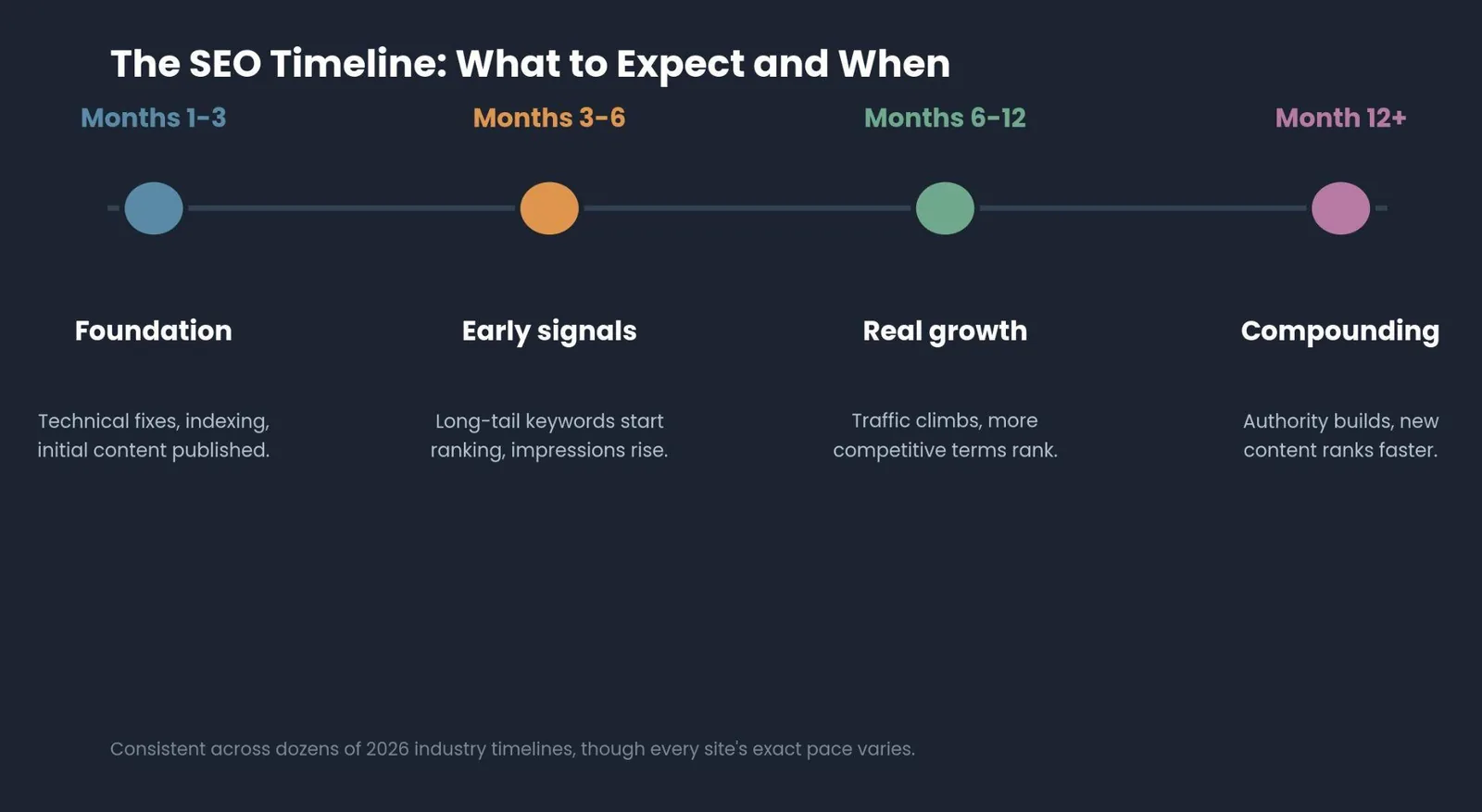
According to a 2026 SEO timeline breakdown from MH Tech Solutions, the same four-phase pattern shows up consistently across dozens of independently published sources. Months 1 to 3 focus on technical fixes, initial quality content publishing, and getting pages properly indexed, foundational work that rarely produces visible traffic on its own. Months 3 to 6 typically bring the first visible movement: long tail keywords start appearing in the SERP, impressions climb in Google Search Console, and early signals suggest the foundation is working. Months 6 to 12 is when organic search traffic usually becomes measurable, with more competitive terms beginning to rank and real business outcomes, leads and conversions, starting to appear. Beyond 12 months, results compound: older content accumulates more high quality backlinks and engagement, making it easier for newer content to rank faster than it would have on its own.
What Google itself says about SEO timelines
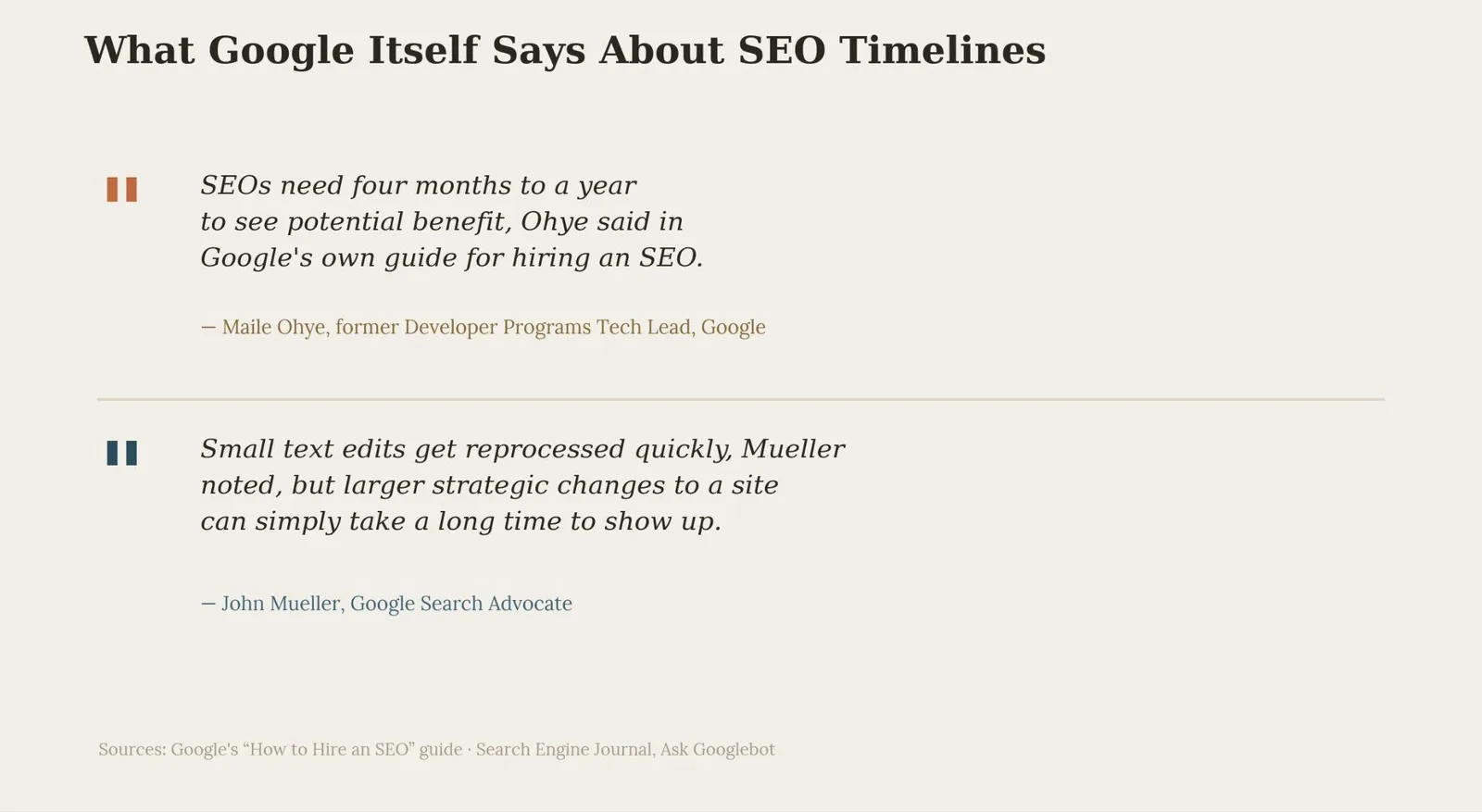
The most-cited SEO timeline benchmark traces back to Google's own "How to Hire an SEO" guide, as documented by Mangools, where Maile Ohye stated that SEOs typically need four months to a year to first implement improvements and then see potential benefit. According to Search Engine Journal's reporting on Google's own statements, John Mueller has added nuance to that over the years: simple changes, like updating a title tag, get recrawled and reprocessed quickly, while larger, more strategic site changes need much more time before Google fully reevaluates them.
Mueller has also pushed back directly on the idea that domain age itself is a ranking factor, according to Safari Digital's analysis of Mueller's public statements, stating plainly that it offers no direct SEO benefit. What actually matters is what tends to accumulate alongside age: backlinks, content depth, and a track record of trust signals. That's why brand-new domains often experience what practitioners informally call a "sandbox" period, not because Google penalizes new sites deliberately, but because it simply hasn't gathered enough signal yet to know where a new site belongs.
SEO vs. PPC: how their timelines compare
| Factor | SEO (organic) | PPC (paid ads) |
|---|---|---|
| Time to first results | Weeks for technical fixes, months for rankings | Immediate, live the day a campaign launches |
| Time to meaningful ROI | Typically 6-12 months | Immediate, but only while spend continues |
| Cost model | Time and investment in content, technical work, links | Ongoing cost per click |
| Long-term value | Compounds; older content ranks new content faster | Resets to zero the moment spend stops |
| Best for | Durable, long term organic visibility | Immediate visibility while SEO builds |
| Measurement tools | Google Search Console, Google Analytics | Ad platform dashboards, conversion tracking |
Most competitive businesses run both. PPC fills the gap while SEO compounds in the background, and teams with a mature organic foundation often scale back paid spend over time as organic traffic takes on more of the load for free.
Factors that speed up or slow down your SEO timeline
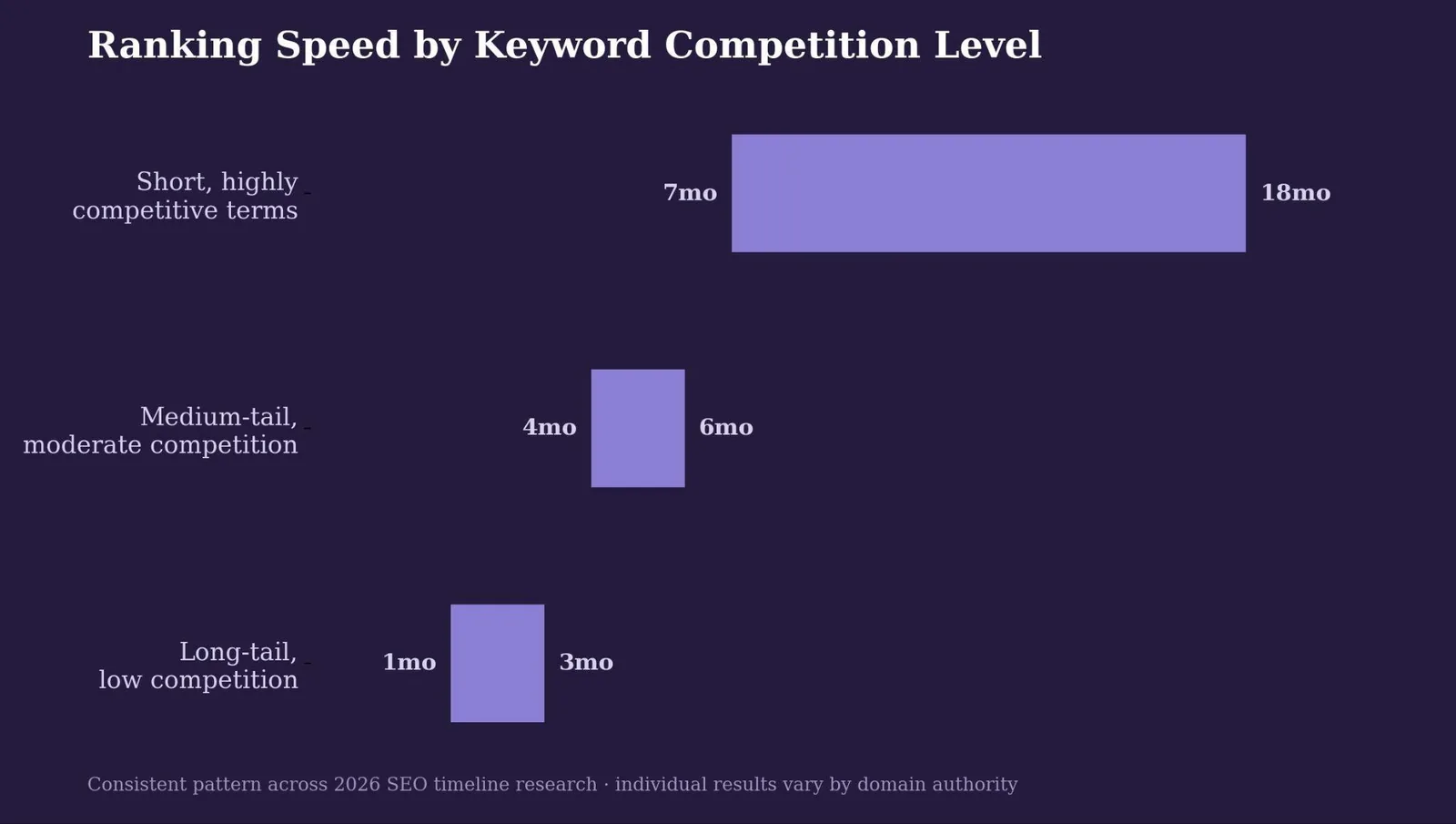
Keyword difficulty is the clearest predictor, per Analyze AI's breakdown of SEO ranking timelines. Low competition keywords in a narrow niche can realistically rank within 1 to 3 months. Medium-tail terms with moderate competition typically take 4 to 6 months. Short, highly competitive terms, the ones an established brand with the marketing budget of an Amazon or a major national retailer has been targeting for years, can take anywhere from 7 months to a year and a half.
Resources matter almost as much. A team publishing 4 to 6 pieces of high quality content per month while actively pursuing link building builds topical authority faster than a business squeezing in one post every few weeks. Technical health matters too: a site with technical SEO problems, slow load times, broken internal links, poor mobile usability, delays every other phase of the timeline, since a search engine has to trust the foundation before it rewards anything built on top of it.
Curious where you'd fall on this timeline? Answer three quick questions below for a realistic estimate based on your own situation.
SEO timeline tool
Estimate your SEO timeline
Answer three questions for a realistic range based on your starting point.
1. How old is your domain?
2. How competitive are your target keywords?
3. How much are you publishing and building each month?
Answer all three to see your estimate
Your estimate will appear here based on your selections.
How to track progress while you wait
Key performance indicators shift in a specific order, and knowing that order prevents premature panic. Google Search Console typically shows rising impressions and newly indexed pages before rankings visibly improve. Google Analytics picks up small increases in organic sessions next, often for long tail keywords rather than the primary target term. Only after both of those move does Google Business Profile and Google Maps visibility, for local businesses, and conversion data typically follow. Watching only the final metric, rankings or revenue, while ignoring the earlier leading indicators is one of the most common reasons businesses conclude SEO "isn't working" around month three, right before it usually starts.
Beyond Google's own tools, unlinked brand mentions on forums like Reddit or industry sites are worth tracking too; they don't move rankings directly, but they're often an early sign that content is getting genuine traction before backlinks catch up.
Common SEO timeline mistakes
Expecting Google search rankings to move within days of a single content push is the most common mistake. A basic recrawl happens fast; a genuine reevaluation of the whole site doesn't.
Judging SEO efforts by day-to-day ranking fluctuations is a close second. Rankings move up and down constantly for reasons that have nothing to do with the work being done; the trend over months is what matters, not any single day's snapshot.
Targeting only highly competitive, short keywords from day one is a quieter mistake. Building early wins on low competition keywords creates momentum, traffic, and internal linking opportunities that make the harder, more competitive terms easier to reach later.
And abandoning a campaign at month three or four, right as Google Search Console data typically starts showing early movement, wastes the exact foundation-building phase that makes months six through twelve possible. Businesses across the USA, whether targeting a single city or a national audience, run into this same timing mistake regardless of market size.
Frequently asked questions
How long does SEO take to show results?
Most sites see early signals, rising impressions and long-tail keyword movement, within 3 to 6 months. Meaningful traffic and lead growth typically follows in the 6 to 12 month range, with results continuing to compound after that.
Can SEO ever work faster than a few months?
For very low-competition, narrow long tail keywords on a site with some existing authority, yes, rankings can appear within weeks. But broad, competitive terms almost never move that fast regardless of budget.
Does domain age affect how long SEO takes?
Not directly. John Mueller has stated domain age itself provides no ranking benefit. Older domains simply tend to have more accumulated backlinks, content, and trust signals, which is what actually speeds things up.
Is it worth paying for PPC while waiting for SEO to work?
Many businesses do exactly that. PPC delivers immediate visibility while SEO builds toward a long-term, compounding result. Once the organic foundation matures, many teams reduce paid spend since organic traffic increasingly covers the same searches for free.
What should I track if rankings haven't moved yet?
Check Google Search Console for rising impressions and newly indexed pages, and Google Analytics for small upticks in organic sessions. Both typically move before rankings and revenue do, and both are useful KPIs for knowing whether the work is on track.
The bottom line on how long SEO takes
How long SEO takes comes down to a genuinely honest range: 3 to 6 months for early signals, 6 to 12 months for meaningful growth, and 12 months or more for the kind of compounding authority that makes everything afterward easier. Anyone promising page-one rankings in weeks is either targeting keywords nobody searches for or using tactics that risk the site's long-term standing.
Check Google Search Console this week for a simple gut check: if impressions are climbing even without a matching jump in clicks, the foundation is working exactly as it should at this stage.
Ready to build a realistic SEO strategy for your brand?
Setting the right expectations from day one, and knowing exactly what to measure at each stage, is where most in-house teams get stuck. Web Tonic's SEO and growth marketing team builds timelines and reporting around real leading indicators, not vanity metrics, so progress is visible long before month six.
More from Web Tonic: growth marketing services, data & analytics.
Sources: mhtechsol.com · mangools.com · searchenginejournal.com · safaridigital.com.au · tryanalyze.ai