Table of contents

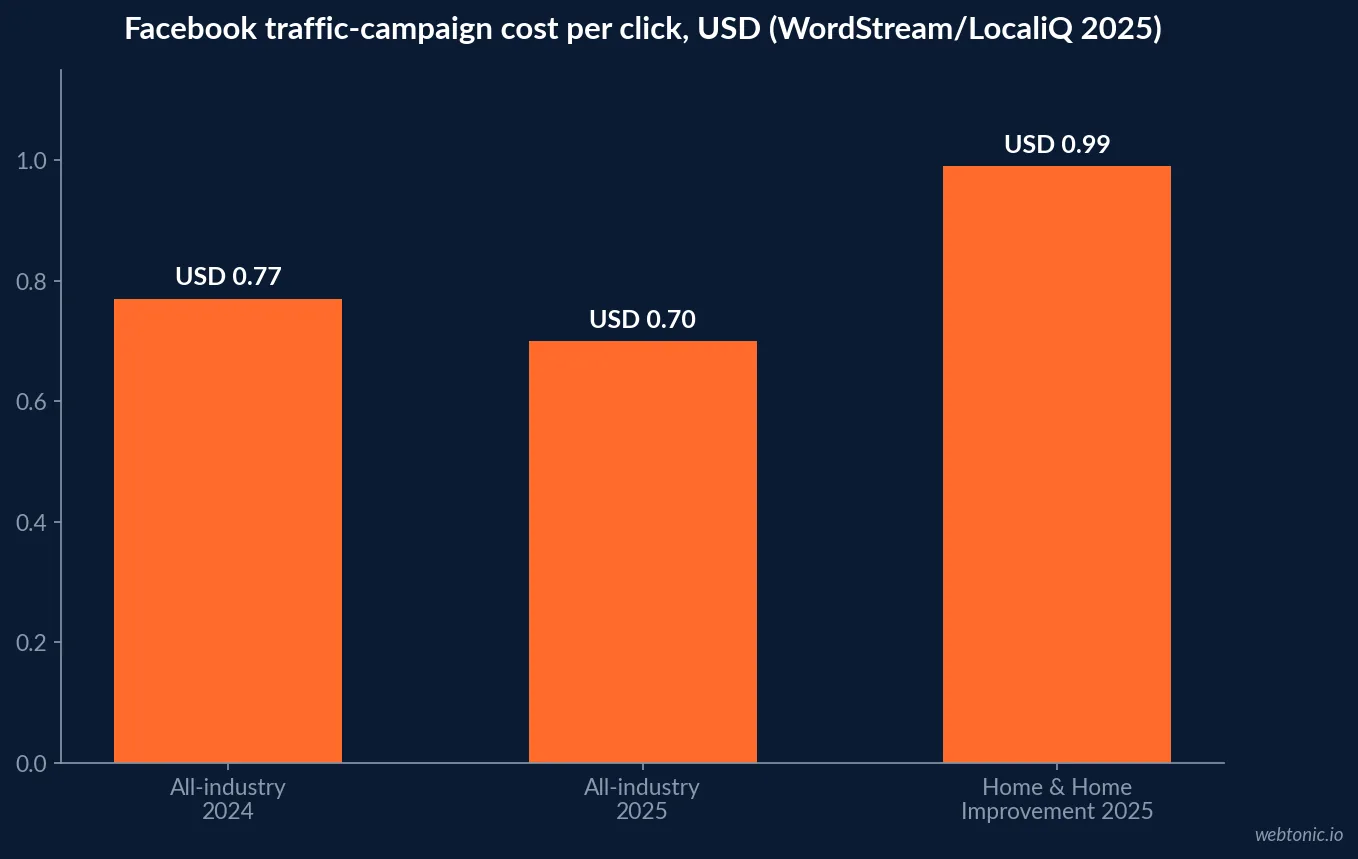
Home & Home Improvement Facebook traffic ads averaged a USD 0.99 cost per click in 2025, 41% above the USD 0.70 all-industry mark - and the leads objective converted at just 5.22%, one of the three steepest year-over-year declines WordStream tracked. This page reads that data for a retail audience of DIY homeowners and Pro buyers browsing a catalog, not the local-service leads model most home-improvement Meta benchmarks are written for.
Key Takeaways
- Home & Home Improvement traffic CPC is USD 0.99, the third-highest tracked category.
- That is 41% above the USD 0.70 all-industry average for 2025.
- All-industry CPC fell from USD 0.77 to USD 0.70 year over year.
- Leads-objective conversion rate for the category is 5.22%, against 7.72% overall.
- That conversion rate is down 36% year over year, a top-three decline.
- All-industry leads CTR is 2.59% and CPL is USD 27.66 - WordStream does not break either out by category, so treat both as the cross-industry floor, not a category number.
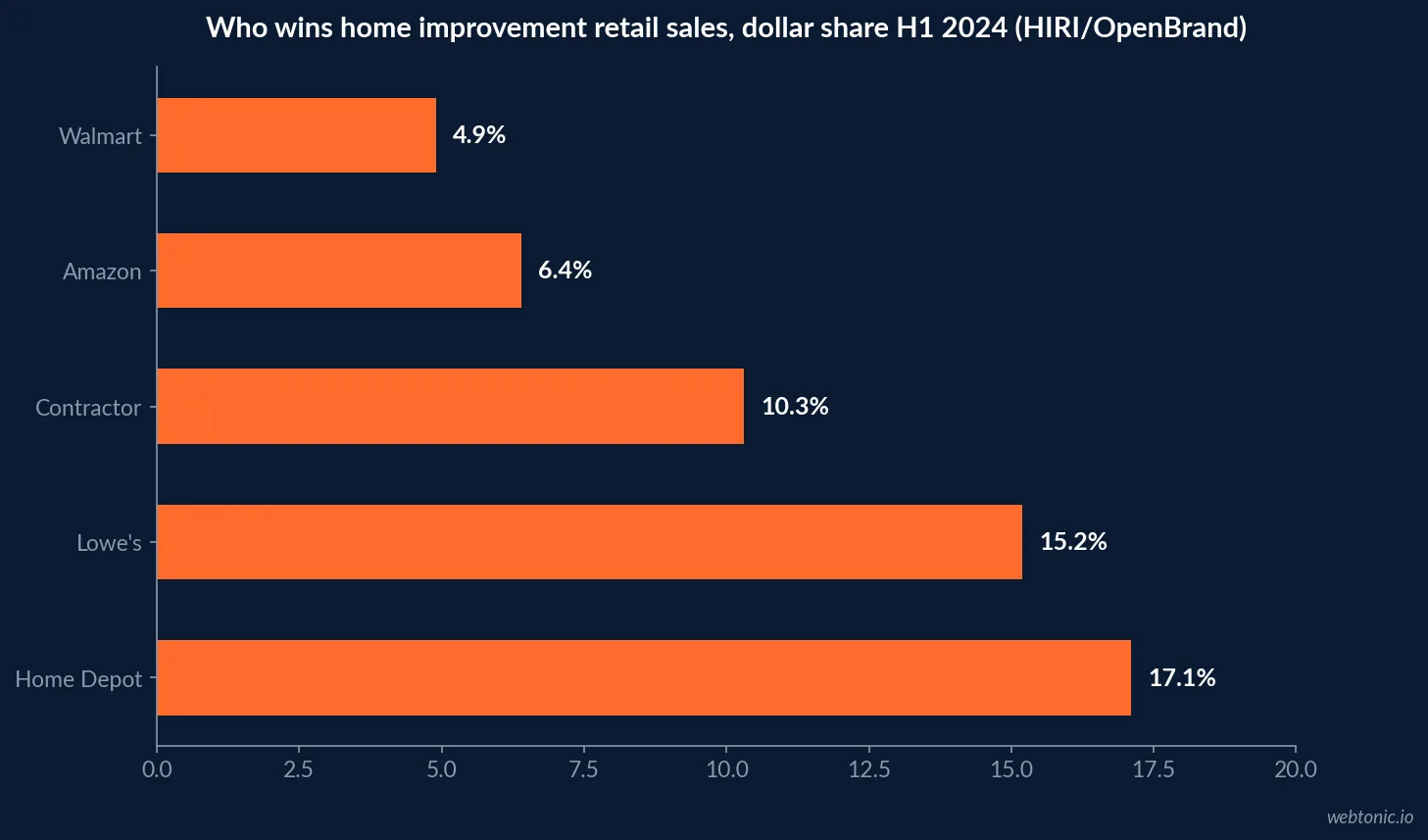
- Home Depot holds 17.1% of category dollars, Lowe's 15.2% (HIRI/OpenBrand, H1 2024).
- Home Depot's fiscal 2025 sales were USD 164.7 billion, with online at 15.9% of net sales.
- Lowe's online sales grew 8.8% and now sit at 13% of retail sales.
- Paint is bought by 62% of renovating homeowners, the single most common purchase (Houzz 2026).
- FTC's Made in USA Rule, 16 CFR 323, and Green Guides both apply to catalog ad claims.
What a click costs on Meta versus Google for this category
WordStream/LocaliQ's 2025 Facebook Ads Benchmarks report, built from 1,180 campaigns running April 2024 through June 2025, lists Home & Home Improvement among the three highest-CPC traffic categories at USD 0.99, behind only Finance and Insurance (USD 1.22) and Personal Services (USD 1.00). The all-industry average fell from USD 0.77 to USD 0.70 over the same period, so the category is not just expensive in absolute terms - the gap to the average widened.
| Metric (Traffic objective, 2025) | All-industry | Home & Home Improvement | Source |
|---|---|---|---|
| Average CPC | USD 0.70 | USD 0.99 | WordStream/LocaliQ FB Benchmarks 2025 |
| Prior-year CPC | USD 0.77 | n/d by category | WordStream/LocaliQ FB Benchmarks 2025 |
| Average CTR (all industries) | 1.71% | n/d by category | WordStream/LocaliQ FB Benchmarks 2025 |
| Google search CPC, same category | USD 5.16 median | USD 7.85 | WordStream Google Ads Benchmarks 2025 |
The leads objective is where the category is actually struggling
Traffic-objective CPC is only half the picture. On the leads objective, the same WordStream report puts the all-industry click-through rate at 2.59% and cost per lead at USD 27.66, both roughly flat year over year. Home & Home Improvement is not named among the highest or lowest for either metric, which is itself worth stating plainly rather than guessing a number: the category's leads CTR and CPL are simply not broken out in the published data, so any page that quotes a precise figure for either is inventing one.
What is disclosed is the conversion rate, and it is the more important number for a retailer running design-consultation or financing lead forms. Home & Home Improvement's leads CVR sits at 5.22% against a 7.72% all-industry average, and the category posted one of the three largest year-over-year declines at down 36%, trailing only Career and Employment (down 37%).
| Leads objective, 2025 | Figure | YoY change | Source |
|---|---|---|---|
| All-industry CTR | 2.59% | +0.4% (from 2.58%) | WordStream/LocaliQ FB Benchmarks 2025 |
| All-industry CPL | USD 27.66 | up from USD 22.87 | WordStream/LocaliQ FB Benchmarks 2025 |
| All-industry CVR | 7.72% | down from 8.67% | WordStream/LocaliQ FB Benchmarks 2025 |
| Home & Home Improvement CVR | 5.22% | down 36% | WordStream/LocaliQ FB Benchmarks 2025 |
| Home & Home Improvement CTR / CPL | Not disclosed by category | n/a | WordStream/LocaliQ FB Benchmarks 2025 |
Who a retailer's Meta ads are actually competing against
HIRI's OpenBrand-sourced 2024 trends data puts Home Depot at 17.1% and Lowe's at 15.2% of home improvement category dollars in the first half of 2024, with Contractor purchases at 10.3% (homeowners buying materials through the pro they hired rather than a store), Amazon at 6.4% and Walmart at 4.9%. Together the top two home centers hold roughly a third of the category - a specialty or regional retailer bidding against that concentration needs a Meta strategy built on assortment or service, not on outbidding a national chain's catalog budget.
What the two biggest retailers are doing with their own digital budgets
Home Depot's own fiscal 2025 earnings release reports total sales of USD 164.7 billion, and its 10-K filing (Home Depot investor relations) states online sales were 15.9% of net sales. Lowe's 2025 annual report puts its online sales growth at 8.8%, now 13% of retail sales. Both companies are still overwhelmingly store-driven businesses running digital as a discovery and fulfillment layer, not a replacement channel - which is the same posture a Meta catalog strategy should take for a smaller retailer.
| Retailer (fiscal 2025) | Total sales | Online share of sales | Online growth |
|---|---|---|---|
| The Home Depot | USD 164.7 billion | 15.9% | n/d in this release |
| Lowe's | n/d in this excerpt | 13% | 8.8% |
What the catalog should actually be selling
The 2026 U.S. Houzz and Home Renovation Trends Study (n=20,358, including 10,176 renovating homeowners) found paint bought by 62% of renovating homeowners in 2025, the single most common purchase, ahead of light fixtures (48%) and faucets and shower heads (46%). These are exactly the low-consideration, visually driven SKUs that perform on Meta's traffic objective - a catalog weighted toward big-ticket appliances or cabinetry is fighting the CPC and CVR headwinds above without the volume to offset them.
| Most-purchased renovation products, 2025 | Share of renovating homeowners | YoY change |
|---|---|---|
| Paint | 62% | -3pp |
| Light fixtures | 48% | -3pp |
| Faucets and shower heads | 46% | flat |
| Lawn and garden supplies | 44% | flat |
| Building materials | 41% | flat |
The compliance layer retail ad creative can't skip
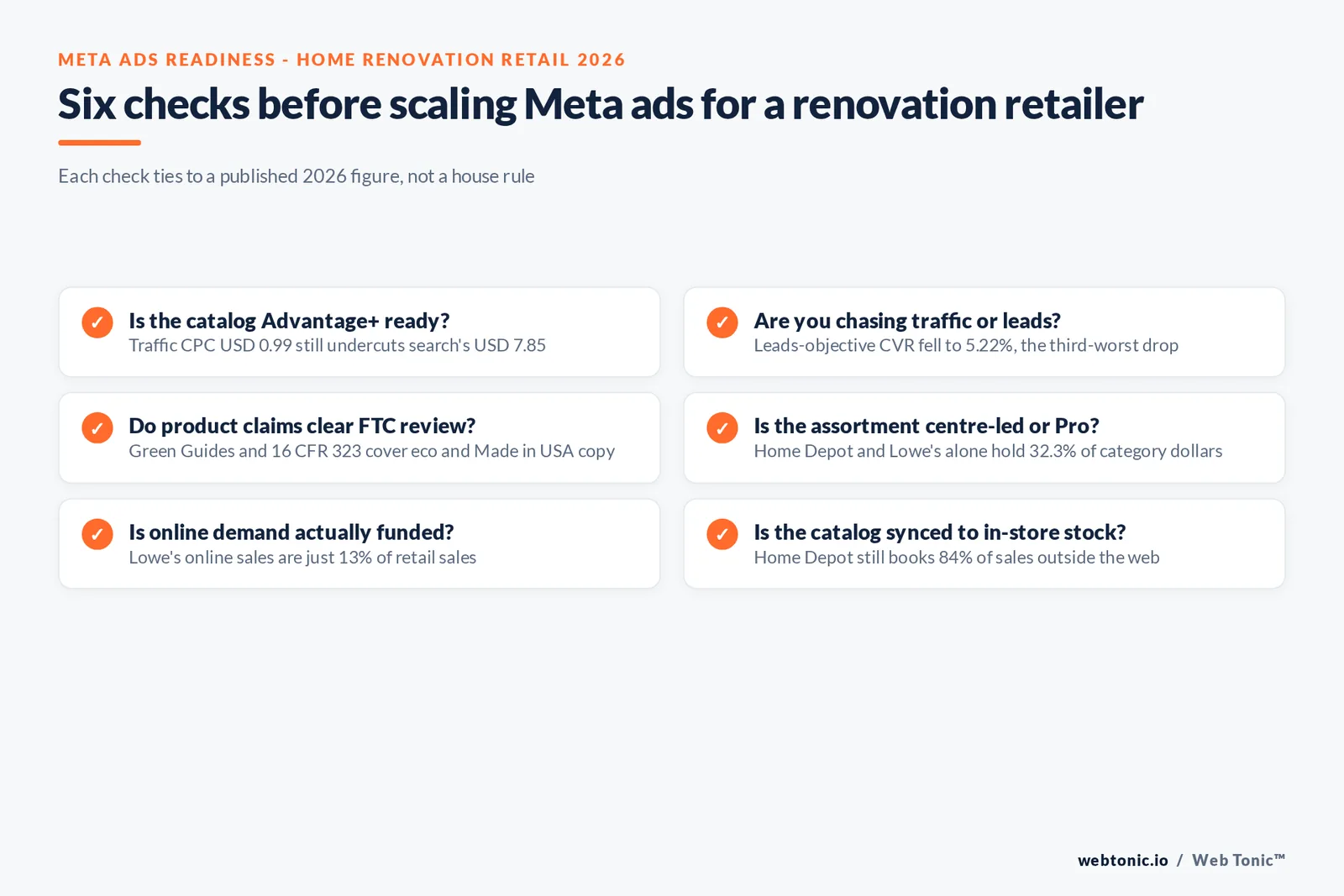
Two FTC rules bite specifically on retail product creative. The Made in USA Labeling Rule, 16 CFR Part 323, requires that any unqualified "Made in USA" claim mean the product is all or virtually all made domestically - a claim that applies equally to a Meta catalog ad as to packaging. The FTC's Green Guides govern environmental claims like "eco-friendly" or "sustainable" paint and building materials, requiring substantiation behind the exact language used in the ad, not just the product page it links to. Neither is unique to this industry, but both are unusually common in home improvement retail creative.
Our performance creative practice reviews catalog ad copy against both rules before a feed goes live.
How to read the CPC gap without over-reacting
Meta's traffic CPC (USD 0.99) looks far cheaper than Google search's CPC for the same category (USD 7.85), but the two are not interchangeable. Google search captures a buyer actively typing "interior paint colors" or "best cordless drill" - active intent that converts at a different rate than a scroll-stopping catalog ad. The workable split most retailers land on: Meta traffic and retargeting for catalog reach and cart recovery, Google search for the moment of purchase intent, and Meta leads only where the 5.22% conversion rate and its 36% decline are already priced into the budget. For the paid-search side of that comparison, see our breakdown of what Google Ads actually costs.
Where Advantage+ Shopping campaigns fit the catalog picture
A retailer with the SKU depth Houzz's data implies - paint, fixtures, lawn and garden, building materials - is a natural fit for Meta's Advantage+ Shopping campaign type, which automates placement and audience decisions across a full catalog feed rather than requiring a manual ad set per product line. The traffic-objective CPC of USD 0.99 above is the closest published proxy for what an Advantage+ campaign's top-of-funnel reach will cost per click, since WordStream does not break out a separate Advantage+ benchmark; budget against the traffic figure, not the leads figure, when modelling a catalog-wide campaign.
Our Meta Ads service page covers how we structure catalog feeds for multi-SKU retailers before a campaign goes live.
| Campaign type | Best-fit product mix | Benchmark to budget against |
|---|---|---|
| Advantage+ Shopping (catalog-wide) | Full SKU range, especially high-frequency items | Traffic CPC, USD 0.99 |
| Traffic objective (manual) | Seasonal or promotional single-category pushes | Traffic CPC, USD 0.99 |
| Leads objective | Design consultations, financing, credit applications | Leads CVR, 5.22% |
| Retargeting / dynamic product ads | Cart abandoners, catalog browsers | Leads CPL, USD 27.66 (all-industry floor) |
Reading the assortment gap against Meta's own audience
The retailer market-share picture above is a dollar-share measure across all channels, not a Meta-specific audience breakdown - Meta does not publish purchase-attribution data broken out by retailer. What it does confirm is the competitive reality any campaign plan has to account for: two companies hold roughly a third of category dollars, and a regional or specialty retailer's Meta budget has to compete for the same DIY-homeowner audience those two chains are also targeting at scale. This is the same reasoning our Facebook ads ROI breakdown applies to smaller advertisers in crowded categories generally.
What this means for a mid-market retailer's Meta plan
Lead with the visually driven, frequently repurchased SKUs (paint, fixtures, seasonal lawn and garden) on the traffic objective where CPC is manageable, keep lead-generation objectives for higher-intent moments like a kitchen consultation booking rather than a general newsletter signup, and budget the leads CVR at 5.22% rather than the 7.72% all-industry figure so a campaign plan does not overestimate volume. If you want a structured build of that plan, talk to our team, or read how our growth marketing practice sequences catalog and lead campaigns across a season.
Frequently Asked Questions
What does a home renovation retailer pay for a Facebook click in 2025?
WordStream/LocaliQ's 2025 Facebook Ads Benchmarks report, built from 1,180 campaigns running April 2024 to June 2025, puts the average traffic-objective CPC for Home & Home Improvement at USD 0.99 - the third highest of the industries it tracks, behind Finance and Insurance and Personal Services, and well above the USD 0.70 all-industry average. It is still cheaper than the USD 7.85 average CPC WordStream reports for the same category on Google search.
Is Meta a good lead-generation channel for a renovation retailer?
The honest answer is that it has gotten harder. WordStream's data shows the Home & Home Improvement leads-objective conversion rate at 5.22% against a 7.72% all-industry average, and it was one of the three biggest year-over-year CVR decliners at down 36%. Retailers running lead forms for design consultations or credit offers should expect a below-average conversion rate and budget accordingly.
Who actually captures home improvement retail dollars, and why does that matter for targeting?
HIRI's OpenBrand-sourced data for the first half of 2024 puts Home Depot at 17.1% of category dollars and Lowe's at 15.2%, with 'Contractor' (homeowners buying through the pro they hired) at 10.3%, Amazon at 6.4% and Walmart at 4.9%. A retailer outside that top five is fighting for share against two companies that alone hold roughly a third of the category, which should shape both bid strategy and how a smaller retailer's ads differentiate on assortment or service rather than price.
Are there compliance rules specific to Meta ad creative for this industry?
Yes. Product ad creative that claims a paint, tool or building material is eco-friendly, recyclable or sustainable falls under the FTC's Green Guides, and any 'Made in USA' claim in an ad or catalog feed is covered by the FTC's Made in USA Labeling Rule, 16 CFR Part 323, which requires the product be 'all or virtually all' made in the US. Neither applies only to search ads - a Meta catalog ad making either claim is a live enforcement target.
Does the CPC gap between Meta and Google search justify shifting budget?
Not on cost alone. Meta's traffic CPC of USD 0.99 is roughly an eighth of Google's USD 7.85, but that comparison is objective-mismatched: Meta traffic clicks are optimized for clicks, not conversions, while Google search captures active buying intent. The workable split most retailers land on is Meta for top-of-funnel catalog reach and retargeting, Google search for the moment someone is ready to buy, with the leads-objective CVR gap above as the reason not to run cold lead forms on Meta at scale.
Sources
WordStream/LocaliQ - Facebook Ads Benchmarks 2025
WordStream - Google Ads Benchmarks 2025 by industry
HIRI - 5 Key 2024 Home Improvement Trends (OpenBrand data)
The Home Depot - Fourth Quarter and Fiscal 2025 Results
The Home Depot - Investor Relations, FY25 10-K
Lowe's Companies - 2025 Annual Report
Houzz - 2026 U.S. Houzz and Home Renovation Trends Study
eCFR - 16 CFR Part 323, Made in USA Labeling Rule
Federal Trade Commission - Green Guides