Table of contents
Home renovation retail's LinkedIn audience is Pro contractors, distribution and supplier partners, and recruiting candidates — never the DIY homeowner buying paint on a Saturday. No study benchmarks LinkedIn ad performance for this category specifically, so this page uses the closest verified B2B data and the category's own Pro-market growth figures to state what is actually knowable.
Key Takeaways
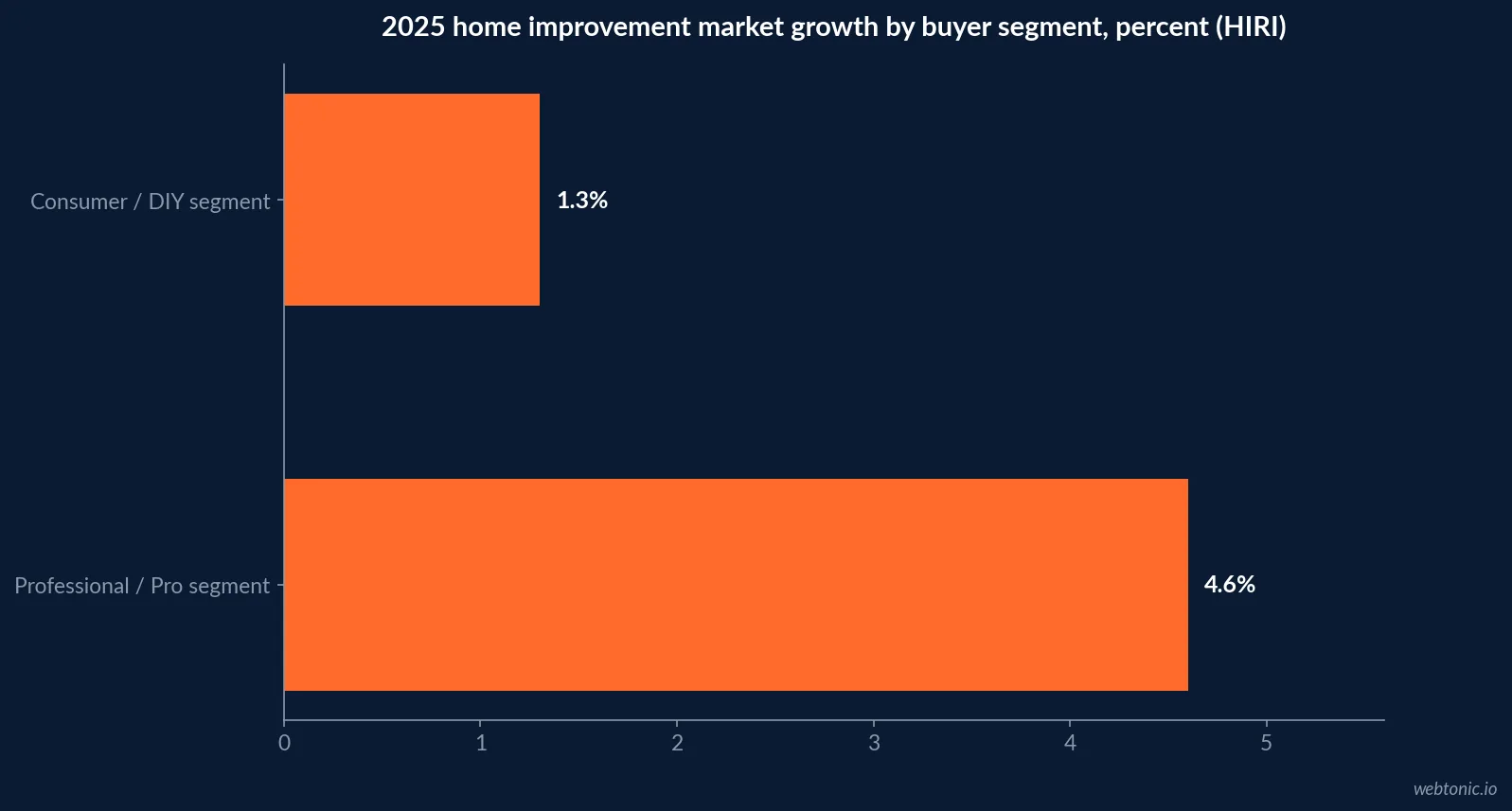
- LinkedIn Ads deliver a 113% ROAS in Dreamdata's cross-industry 2025 B2B benchmark, ahead of Google Search (78%) and Meta Ads (29%).
- LinkedIn's share of B2B ad budgets grew from 31% to 39% across 2024, per the same report.
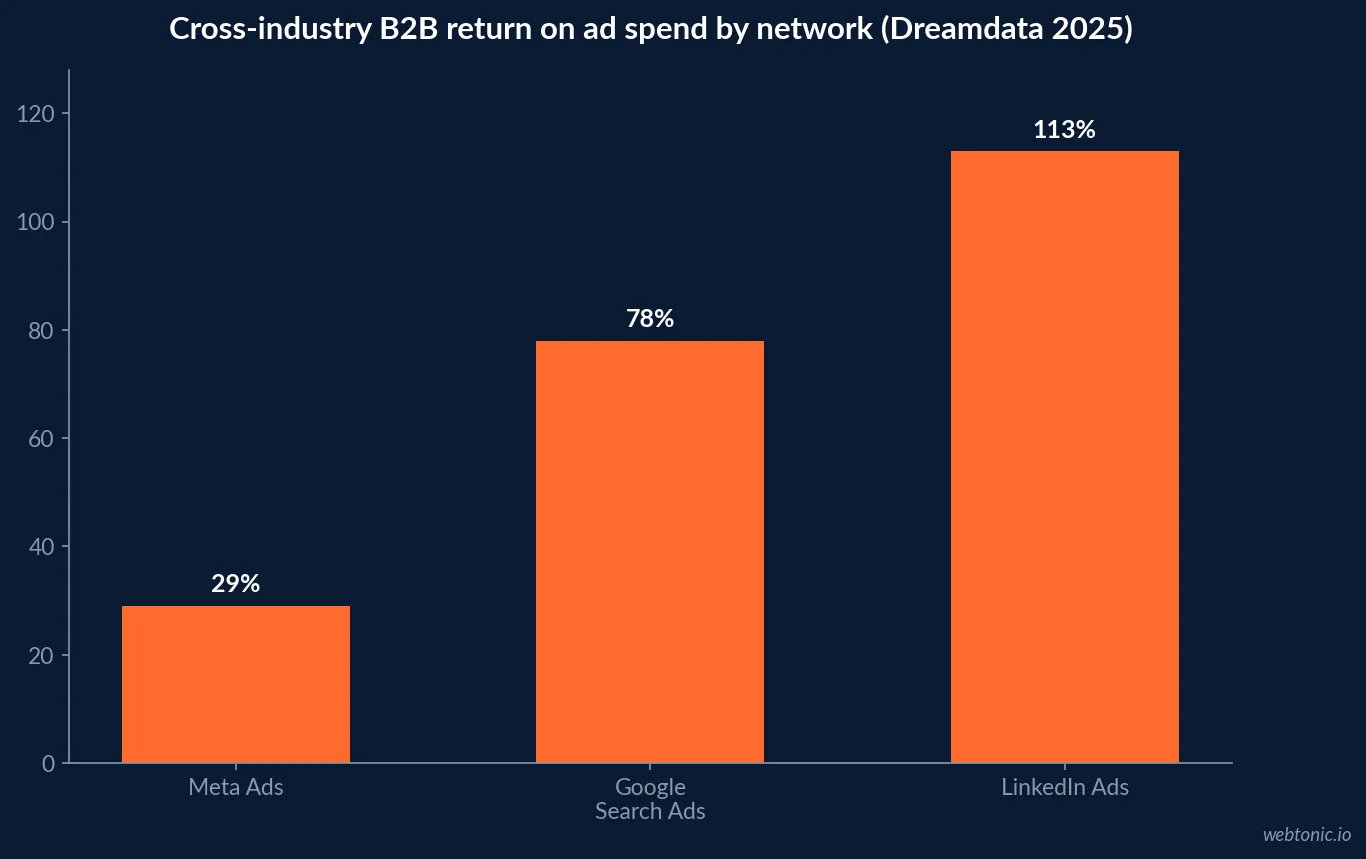
- The professional side of the home improvement market grew 4.6% in 2025, against 1.3% for the consumer side (HIRI).
- Home Depot's Pro-market push includes an USD 18.25 billion SRS Distribution acquisition and a subsequent GMS Inc. acquisition, both aimed squarely at trade contractors.
- The average B2B buying journey runs 211 days, extending to 320 days from first LinkedIn ad impression to revenue.
- No published study benchmarks LinkedIn ad performance for home renovation retail specifically — every figure above is a cross-industry or adjacent-category marker, stated as such.
- Lowe's Q4 fiscal 2025 results cite continued growth in Pro sales alongside online and home-services sales.
- The total home improvement products market reached USD 526.5 billion in 2025, with the Pro segment the faster-growing half.
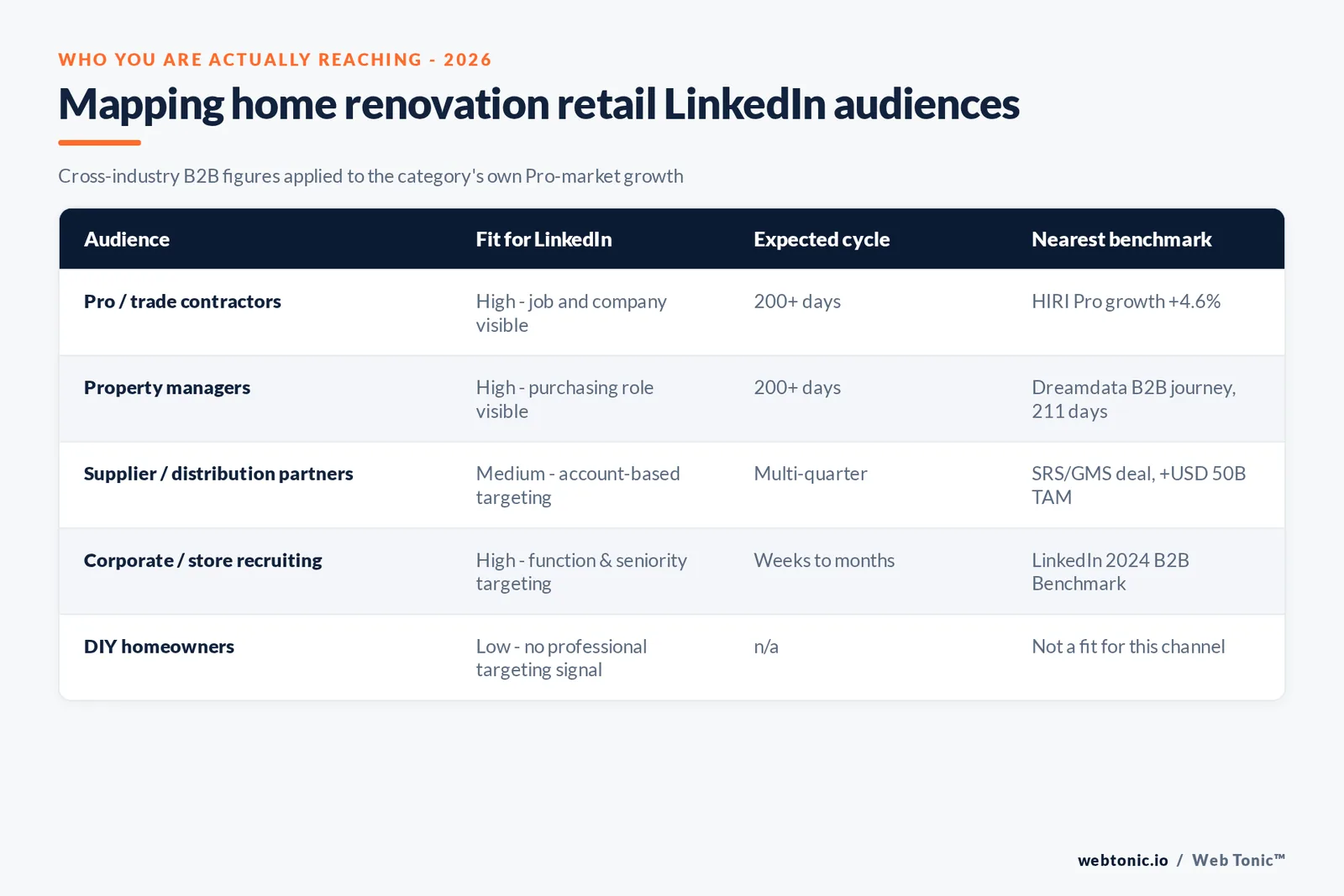
| Audience segment | Why LinkedIn fits | What NOT to expect |
|---|---|---|
| Pro / trade contractors | Job title, company and trade are on their profile | High volume; this is an account-based, not mass-reach, channel |
| Property managers / facilities buyers | B2B purchasing role is identifiable | Impulse conversion; expect a 200+ day cycle |
| Supplier / distribution partners | Company-page and account targeting reaches procurement roles | Consumer-style creative performance metrics |
| Corporate / store recruiting | Function and seniority targeting fits open-role campaigns | A home-improvement-specific LinkedIn benchmark (none published) |
| DIY homeowners | Not a fit — this is the one segment LinkedIn should not target | Any meaningful reach at consumer-retail cost levels |
The cross-industry benchmark, used honestly
No public study reports LinkedIn ad ROAS, CPC or CTR broken out for home renovation or home improvement retail. The most defensible reference point is Dreamdata's 2025 LinkedIn Ads Benchmarks Report, built from aggregated ad-cost and revenue data across hundreds of its B2B customers. It found LinkedIn Ads generating the highest ROAS of the major ad networks at 113%, ahead of Google Search Ads at 78% and Meta Ads at 29%, even though LinkedIn runs a higher cost per click and impression than either. The same report found LinkedIn's share of B2B ad budgets grew from 31% in H1 2024 to 39% by year-end, overtaking Google Search's non-branded spend share of 37%. None of this is home-renovation-specific, and that gap is the honest starting point for any campaign plan in this category.
Why the Pro segment, specifically, is the LinkedIn opportunity
HIRI's own Q3 2025 market forecast shows the professional side of the home improvement products market growing 4.6% in 2025, more than three times the 1.3% growth on the consumer side. Home Depot has backed that shift with real capital: its USD 18.25 billion acquisition of SRS Distribution in 2024, followed by SRS's own acquisition of GMS Inc. in September 2025, both explicitly aimed at "roofers, landscapers, and pool contractors" and other specialty trade buyers — SRS Distribution's own announcement of the GMS deal repeats that same Pro-focused language. The Home Depot release states the SRS deal alone increased its addressable Pro market by roughly USD 50 billion. Lowe's Q4 fiscal 2025 results likewise cite "continued growth in Pro, online, and home services sales." That is precisely the audience LinkedIn's job-title and company targeting reaches and Meta or Google's consumer surfaces do not.
| Signal | Pro / trade side | Consumer / DIY side |
|---|---|---|
| 2025 market growth (HIRI) | 4.6% | 1.3% |
| Home Depot capital committed to the segment | USD 18.25B (SRS) + GMS deal | n/a |
| Addressable market expansion (Home Depot, SRS deal) | +USD 50B | n/a |
| LinkedIn targeting fit | Job title, company, seniority all identifiable | Largely untargetable |
| Lowe's Q4 FY25 commentary | Pro sales cited as a growth driver | Not singled out |
LinkedIn's own segment data: the closest available proxy
LinkedIn's 2025 B2B Marketing Benchmark, based on Ipsos research surveying 1,500 B2B marketing leaders across six countries in March 2025, segments respondents by industry: financial services (n=274), technology (n=310), agencies (n=315), professional services (n=288), health (n=60) and manufacturing (n=73). Home renovation retail is not its own segment, and manufacturing — the closest available proxy, given the overlap with building-materials suppliers and distributors — is a small 73-respondent slice of the total sample. Any manufacturing-labeled figure from that report should be read as directional, not as a home-renovation-specific number.
| Industry segment in LinkedIn's 2025 B2B Benchmark | Respondents (n) |
|---|---|
| Agency | 315 |
| Technology | 310 |
| Professional services | 288 |
| Financial services | 274 |
| Other | 180 |
| Manufacturing (closest proxy for this category) | 73 |
| Health | 60 |
The scale of the Pro opportunity, in retailer-reported numbers
Both national retailers size the Pro segment in numbers large enough to justify a dedicated B2B channel budget. Home Depot's fiscal 2025 total sales reached USD 164.7 billion, and Lowe's Q4 2025 quarter alone posted USD 20.6 billion in sales, up from USD 18.6 billion the prior-year quarter, with Lowe's own release crediting part of that gain to "continued growth in Pro, online, and home services sales." Even a small percentage of either retailer's Pro-side revenue re-allocated toward LinkedIn's account-based targeting represents a meaningfully larger test budget than most B2B marketers manage, which argues for treating this as a real channel line, not a rounding-error experiment.
Budgeting for a 211-day, not a 30-day, buying journey
Dreamdata's aggregated data puts the average B2B customer journey at 211 days, extending to 49% longer for larger companies, with the biggest bottleneck between marketing-qualified and sales-qualified stages. Its LinkedIn-specific data shows an average of 320 days from a LinkedIn ad's first impression to revenue, 235 days from first engagement to revenue, and 219 days from first conversion to revenue. A home renovation retailer running LinkedIn campaigns toward Pro accounts, supplier partnerships or corporate recruiting should report against a multi-quarter pipeline view, not the 7- or 30-day attribution windows built for its consumer paid-social channels.
The measurement fix that changes the ROAS number
Dreamdata's data also isolates a specific lever that improves the 113% ROAS figure further: LinkedIn's Conversions API (CAPI). Advertisers who integrate CAPI — 75% of Dreamdata's own LinkedIn Ads customers have done so — see a 20% lower cost per acquisition and a 31% increase in attributed conversions compared with non-integrated advertisers, because revenue and pipeline data feeds back to LinkedIn's optimization engine instead of stopping at the first-conversion event. For a home renovation retailer running a 200-plus day Pro or recruiting cycle, CAPI is not optional infrastructure; it is the difference between LinkedIn's algorithm optimizing toward a form-fill and optimizing toward an actual closed Pro account or hired candidate.
| CAPI integration status | Cost per acquisition | Attributed conversions |
|---|---|---|
| Not integrated (baseline) | Baseline | Baseline |
| CAPI integrated | 20% lower | 31% higher |
| Share of Dreamdata's own LinkedIn Ads customers using CAPI | 75% | n/a |
What LinkedIn's own benchmark report does and does not cover
LinkedIn's own 2024 B2B Marketing Benchmark segments its survey respondents into financial services, technology, agencies, professional services, health and manufacturing, with manufacturing the closest proxy to home renovation retail's Pro and supplier side. No newer LinkedIn-published benchmark corrects that gap for home improvement specifically. Until it does, manufacturing-segment figures from LinkedIn's own report are the nearest first-party reference point, clearly labeled as an adjacent industry rather than an exact match.
Recruiting: the other legitimate LinkedIn use case
Beyond Pro-side sales, both retailers run large enough store, distribution-center and corporate operations that talent acquisition is a defensible LinkedIn budget line on its own, separate from any product-sales objective. Home Depot's SRS and GMS acquisitions alone added specialty-trade-distribution headcount across roofing, landscaping and pool-contractor supply lines, and a company integrating that many new specialty-trade employees has an ongoing corporate and regional-management recruiting need that maps directly onto LinkedIn's job-title and seniority targeting — a use case entirely separate from, and easier to measure than, Pro-side sales influence.
| Recruiting objective | LinkedIn targeting fit | Typical cycle |
|---|---|---|
| Corporate / regional management roles | High - function & seniority | Weeks to months |
| Specialty-trade distribution roles (post-SRS/GMS) | Medium - skill & location targeting | Weeks to months |
| Store-level hourly roles | Low - LinkedIn is not the primary channel | Days to weeks |
Five rules for spending LinkedIn budget honestly in this category
- Never target DIY intent on LinkedIn. The platform's targeting strength is professional identity, which a weekend homeowner project does not carry.
- Segment by Pro, supplier and recruiting objective — each has a different creative, landing page and success metric.
- Report against a 200-plus day window. A 30-day attribution model will show near-zero return on a channel whose own data shows a 211-to-320-day cycle.
- Use the 113% ROAS figure as a floor to test against, not a promise. It is a cross-industry B2B number, not a home-renovation-specific one.
- Track HIRI's Pro-versus-consumer growth split quarterly. The 4.6%-versus-1.3% gap is the clearest evidence the Pro audience, not the DIY one, is where this channel's budget belongs.
Where this fits Web Tonic's own B2B work
Web Tonic's growth marketing team builds this same Pro-versus-DIY segmentation into paid social plans for retail and home-services clients; see how the adjacent Google Ads channel is priced for comparison in the Google Ads strategy guide, how email, the other B2B nurture channel for a 211-day cycle, benchmarks on the email marketing statistics page, and how a paid-social partner should be vetted on the best Google Ads agencies page.
Frequently Asked Questions
Who is the actual buyer for home renovation retail LinkedIn ads?
Almost never the DIY homeowner. LinkedIn's audience and ad formats are built around professional identity, which maps to three real use cases for this category: recruiting store, distribution-center and corporate staff; reaching Pro-side trade contractors and property managers who buy on account terms; and courting supplier or franchise partners. Home Depot's own Pro-market strategy, including its USD 18.25 billion acquisition of SRS Distribution and the subsequent GMS acquisition, describes exactly this audience: roofers, landscapers, pool contractors and specialty trade buyers, the professional segment that LinkedIn's targeting actually reaches.
What is a realistic ROAS benchmark for LinkedIn ads in this category?
No study benchmarks LinkedIn ROAS for home renovation retail specifically, so the honest reference point is the cross-industry B2B figure. Dreamdata's 2025 LinkedIn Ads Benchmarks Report, built from aggregated data across hundreds of its B2B customers, found LinkedIn Ads delivering a 113% ROAS, ahead of Google Search Ads at 78% and Meta Ads at 29%, even though LinkedIn's cost per click and impression run higher than either. Any home-renovation-retail LinkedIn campaign should be judged against that 113% cross-industry marker until an in-category figure exists.
Why would a home renovation retailer advertise on LinkedIn instead of just Meta or Google?
Because the Pro segment is growing faster than the DIY segment, and Pro buyers are professionally identifiable in a way DIY shoppers are not. HIRI's 2025 market data shows the professional side of the home improvement market growing 4.6% against 1.3% for the consumer side. A contractor, property manager or trade buyer has a LinkedIn profile that states their job function and company; a homeowner doing a weekend project typically does not, which is exactly the targeting gap LinkedIn is built to close and Meta or Google search are not.
How long is the buying cycle for a LinkedIn-sourced Pro or recruiting lead?
Long, by design. Dreamdata's aggregated B2B data puts the average customer journey at 211 days, extending to 320 days from a LinkedIn ad's first impression to revenue. A retailer running LinkedIn campaigns aimed at Pro accounts or corporate recruiting should budget and report against a multi-quarter window, not a last-click, 30-day attribution model built for consumer retail media.
Does LinkedIn's own official data say anything about this category directly?
Not at the category level. LinkedIn's own 2024 B2B Marketing Benchmark report covers financial services, tech, agencies, professional services and manufacturing, with no home-improvement-retail breakout, and no newer LinkedIn-published benchmark corrects that gap as of this writing. Manufacturing is the closest proxy in LinkedIn's own segmentation, which is one more reason to treat every figure on this page as a cross-industry marker, not a category-specific promise.
Sources
Dreamdata — 2025 LinkedIn Ads Benchmarks Report highlights
LinkedIn — 2024 B2B Marketing Benchmark
HIRI — U.S. Size of the Home Improvement Products Market, 2025 Q3
The Home Depot — Agreement to acquire SRS Distribution
The Home Depot — SRS Distribution completes acquisition of GMS
SRS Distribution — Announcement of the GMS acquisition agreement
Lowe's — Q4 2025 press release
The Home Depot — Q4 and fiscal 2025 results release
WordStream by LocaliQ — 2025 Home Services Benchmarks (PDF)