Table of contents

Home renovation retail creative is not media-cost constrained - it is context constrained. Published platform guidance and category benchmark modeling agree on the same finding from different angles: staged, in-context creative with more assets and faster opening pacing outperforms flat product-only imagery, and the gap is large enough to change how a retailer should brief its next asset batch.
Key Takeaways
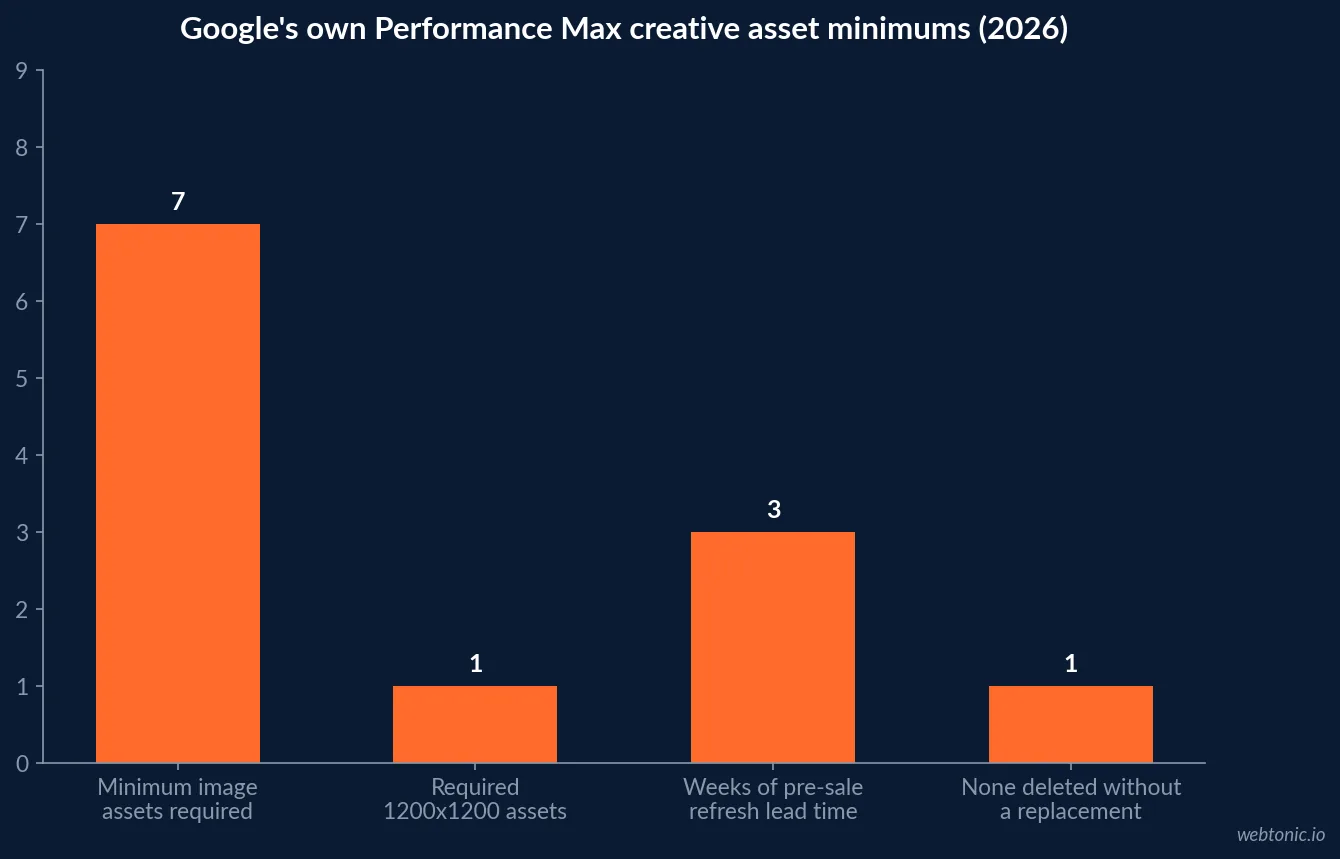
- Google recommends at least 7 image assets per Performance Max asset group.
- One asset should be a 1200x1200 image, per Google's own spec.
- Google explicitly says "the more assets, the better" for delivery combinations.
- Sale campaigns should start creative refresh 2-3 weeks in advance.
- Low-rated assets should never be deleted without a replacement.
- Two or more shots in the first five seconds lift ad recall and consideration.
- Tight framing on the subject is one of Google's four core creative rules.
- Store ratings above 3.5 stars are required before they can show next to text ads.
- Store ratings lift Search-network CTR by roughly 2%.
- Home renovation is a research-first category: 69% of consumers research online first.
- HIRI forecasts the category at USD 540.1 billion in 2026.
- Lowe's grew online sales 8.8% in fiscal 2025 with better conversion, not just more traffic.
- Home Depot reports its highest online conversion rates in company history in FY2025.
- Call to action, brand and price assets are all native Performance Max asset types.
What Google itself tells advertisers to build
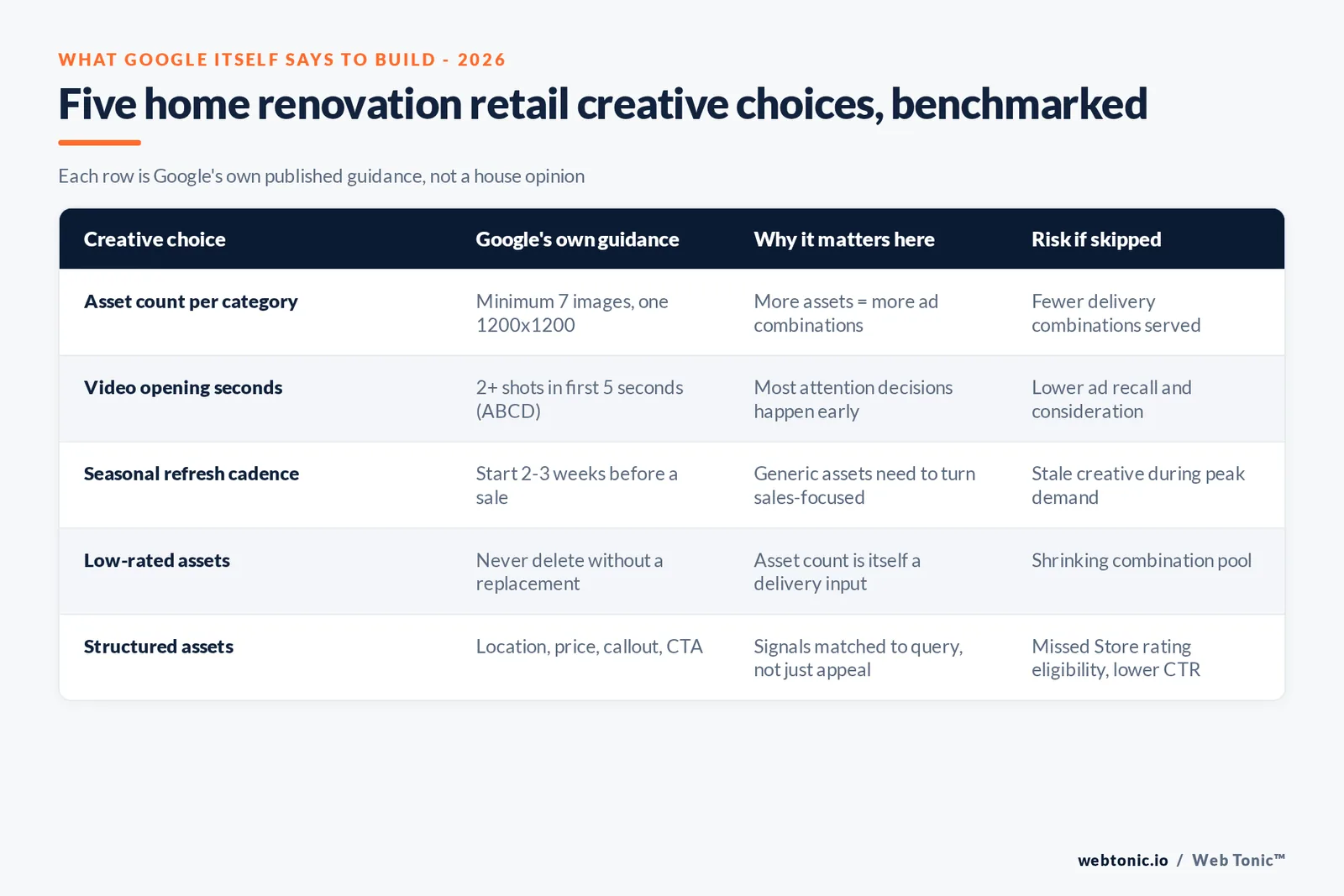
Google's own Performance Max creative best-practices documentation is unusually specific: add at least 7 image assets including one in the 1200x1200 format, never delete a "low"-rated asset without a replacement, and add more assets as the marketing message evolves because "more assets means more ad combinations we can serve across networks to maximize performance." For seasonal pushes, Google recommends starting the campaign 2 to 3 weeks in advance and then refreshing assets frequently to move from generic store assets to sales-focused ones.
None of that guidance is home-renovation-specific - it applies to every Performance Max advertiser - but a multi-category retailer selling lumber, appliances, paint and outdoor living in one account has more asset groups to keep current than almost any other vertical, which makes the refresh discipline harder to skip without a real production process behind it.
| Performance Max asset guidance (Google, verbatim) | What it means for home renovation retail |
|---|---|
| Minimum 7 image assets, one at 1200x1200 | A single hero shot per SKU category is under-spec'd |
| "The more assets, the better" | Seasonal and project-based categories need parallel asset sets |
| Refresh 2-3 weeks before a sale, then frequently | Holiday and spring-project pushes need a production calendar |
| Never delete a low-rated asset without a replacement | Asset count itself is a delivery input, not just quality |
| Add location, price, call-to-action assets | Store-locator and price signals matter as much as imagery |
The first-five-seconds rule that governs video creative
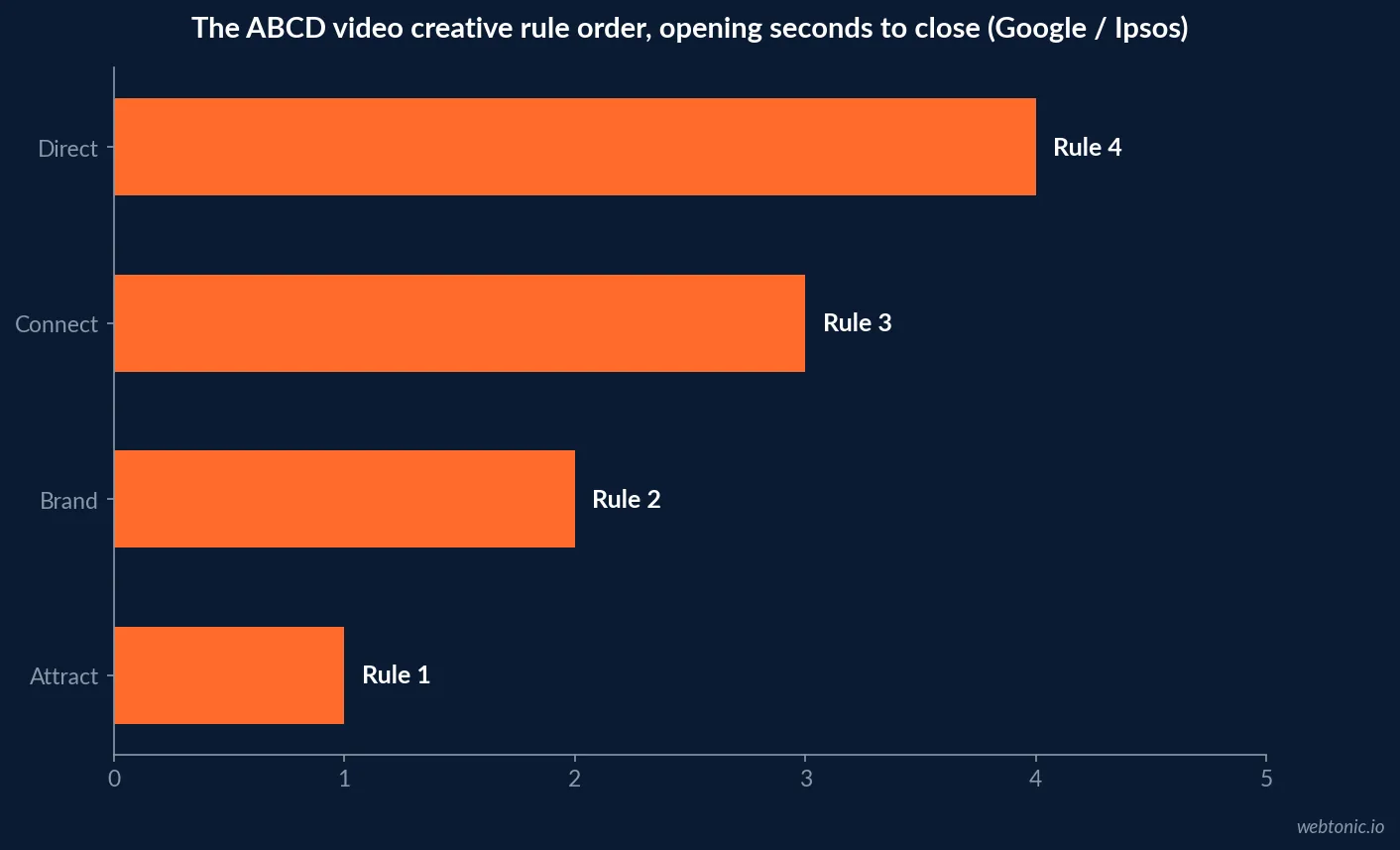
Google's ABCD video creative playbook - built with research partner Ipsos and reviewed by Nielsen Neuro and Kantar - names four rules for effective video: Attract, Brand, Connect, Direct. The Attract rule is explicit: use tight framing on the subject and aim for two or more shots in the first five seconds, because "having multiple shots in the first five seconds is a positive factor for Ad Recall and Consideration." The playbook also recommends an emerging story arc - a strong opening cue followed by multiple peaks - over a slow build, specifically because most of the skip or attention decision happens before that five-second mark.
For a category selling high-consideration, big-ticket projects, that means the temptation to open on a slow establishing shot of a finished room is working against the platform's own published creative research. The room reveal belongs later in the story arc, not as the opening frame.
| ABCD rule (Google / Ipsos / Nielsen Neuro / Kantar) | What it says to do |
|---|---|
| Attract | Tight framing, 2+ shots in the first 5 seconds |
| Brand | Make the brand visible or audible early, not just at the end |
| Connect | Make the consumer think or feel something about the brand |
| Direct | Give an explicit call to action rather than an implied one |
Staging versus product-on-white: the honest caveat
Independent, transparently-labeled benchmark modeling for the Home & Decor Meta ads vertical shows a consistent pattern: room-staged and before/after creative post modeled click-through rates in the 1.15% to 1.35% range, while a flat product-on-white shot models at roughly 0.62% - about half. That modeling is a planning baseline built from aggregated estimates, not observed customer medians or a performance guarantee, and it should be read as directional context alongside the platform-level creative research above, not as a standalone benchmark to plan spend against.
What is not modeled, and comes straight from Google's own published research instead, is the mechanism: tight framing and early engagement cues are measurable ad-recall drivers, and a staged room scene makes both easier to deliver in the opening seconds than an isolated product image.
Why context matters more here than in most retail categories
Home renovation is a research-first, high-consideration purchase: the Google/OTX home improvement funnel study found 69% of consumers and 64% of professionals research products online before buying. A shopper spending weeks comparing flooring or cabinetry options is evaluating fit, finish and scale in a real room far more than an isolated SKU photo can communicate - which is exactly the gap staged and before/after creative closes, and exactly why Google's own guidance leans so hard on volume and framing rather than a single hero asset.
| Category context (2025-2026) | Figure | Source |
|---|---|---|
| Consumers who research home improvement online first | 69% | Google / OTX funnel study |
| Professionals who research online first | 64% | Google / OTX funnel study |
| U.S. home improvement products market, 2026 | USD 540.1 billion | HIRI, August 2026 |
| Lowe's online sales growth, FY2025 | 8.8% | Lowe's 2025 Annual Report |
| Home Depot online conversion rate, FY2025 | Highest in company history | Home Depot 2025 Annual Report |
Structured assets are creative decisions too
Performance Max and standard Search campaigns both let advertisers attach Location, Affiliate location, Callout, Call, Sitelink, Structured snippet, Lead form and Price assets - Google frames every one of them as part of "your ad creative," not a separate technical setting. For a retailer with dozens of physical locations and project-based pricing, skipping these structured assets is a creative gap as real as an outdated hero image, and it is also the one most directly tied to Google's Store ratings feature: a 3.5-star or higher rating is required before a store rating badge can display next to a text ad, and Google's own documentation reports that badge lifts Search-network click-through by roughly 2% on average.
That links creative performance directly back to review volume and rating quality - a retailer that neglects the reputation side of its operation is also quietly capping its own ad creative's ceiling.
| Structured asset type | What it adds to the ad | Why it matters for this category |
|---|---|---|
| Location / affiliate location | Nearest store address and hours | Sends local intent to a physical Pro desk |
| Price | Category or SKU-level pricing shown in-ad | Sets expectation before the click for big-ticket items |
| Callout | Short value props (e.g. free delivery, Pro pricing) | Cheap to add, easy to A/B by season |
| Call | Click-to-call button on mobile | Feeds directly into the call-tracking layer |
| Lead form | In-ad consultation request | Captures project-based leads before a site visit |
A practical creative checklist
Build at least seven image assets per active category, including one 1200x1200 format; brief video openings around two-plus shots in the first five seconds rather than a slow room reveal; refresh seasonal-sale assets on a 2-3 week lead time and keep low performers live until a replacement exists; attach every eligible structured asset (location, price, callout); and treat the store-rating badge as a creative asset that depends on the reputation-management program, not a separate workstream. Our performance creative practice builds and rotates exactly this kind of asset set for retail accounts running Performance Max at scale. Read our Google Ads strategy guide for how asset-group structure feeds into the wider account, or talk to us about auditing your current asset groups against these minimums.
What the attribution side of the business changes about the creative brief
Creative and measurement are not separate workstreams for this category. A retailer that has enabled Google's store-visit and call-tracking layers can actually test whether a staged room scene drives more store visits than a product-on-white shot, not just more clicks - closing a loop that a click-through-only measurement plan cannot see. Without that instrumentation, a creative test can only be judged on the online-close minority of the funnel, which the Google/OTX data above shows is a small share of how this category actually buys.
| Creative decision | Metric it should be judged on | Why click-through alone misleads |
|---|---|---|
| Room-staged vs. product-on-white | Store visits + on-call leads | 69% of research happens online, most closing does not |
| Video opening (slow build vs. ABCD) | View-through rate, ad recall | Recall drives store visits weeks later, not same-session clicks |
| Seasonal refresh timing | Search-network CTR + store visits | A stale asset can still get clicks from branded search |
| Structured price/location assets | Store rating eligibility, in-store foot traffic | These assets serve local intent, not just online checkout |
Production cost is the real trade-off, not media cost
The modeled Home & Decor benchmark data frames the trade-off honestly: a room-scene lifestyle shot or a before/after image costs more to produce than a product-on-white shot, but both draw from the same media budget once live. Google's own creative guidance does not address production cost at all - it only says more and better-framed assets perform better - which means the real budgeting decision a home renovation retailer faces is a production-calendar one, not a bidding one. A retailer running Performance Max across dozens of categories should budget photography and video production against the 2-3 week seasonal refresh window Google recommends, not against a campaign launch date after the fact.
Where creative and reputation intersect
The 3.5-star minimum for a store rating badge is a creative constraint as much as an operational one: a retailer with a below-threshold rating cannot display the badge no matter how strong its imagery is, and the badge itself is worth roughly a 2% CTR lift per Google's own figures. Reputation and review management is a prerequisite for one specific creative asset type - the store rating badge - not a separate discipline entirely, and it deserves its own budget line rather than an assumption that good creative alone can compensate for a weak rating.
Frequently Asked Questions
Does home renovation retail creative need more assets than other categories?
Google's own Performance Max creative guidance says more assets generally means more ad combinations and better delivery, and specifically recommends at least 7 image assets including one at 1200x1200. For a multi-category retailer running Performance Max across dozens of product lines, that recommendation compounds quickly - asset groups need refreshing per category, not once for the whole account.
Is staged, in-room creative actually proven to outperform product-only shots?
Directionally, yes, and the mechanism matches YouTube's published creative research. Google's ABCD playbook, built with Ipsos and reviewed by Nielsen Neuro and Kantar, finds two or more shots in the first five seconds and tight framing on the subject improve ad recall and consideration - both are easier to deliver with a staged room scene than a flat product-on-white image, which is why category-level creative guidance consistently favors context over isolation for high-consideration home categories.
How often should Performance Max creative be refreshed for a home renovation retailer?
Google's own guidance ties refresh timing to promotional cadence, not a fixed calendar: start weekend or sale campaigns 2-3 weeks in advance, then refresh assets frequently to move from generic store assets toward sales-focused ones. Google also explicitly warns not to delete 'low'-rated assets without replacing them, since asset volume itself is a ranking input in Performance Max.
What creative levers do platforms recommend regardless of media budget?
Adding a business name, logo and consistent branding to every asset; supplying explicit call-to-action assets such as 'Sign up' or 'Subscribe'-style prompts matched to the campaign goal; and supplying location, affiliate-location and price assets where eligible so Google's systems have first-party structured signal to match to the query, not just the creative to judge on appeal alone.
Does video length matter for home renovation retail's YouTube and Meta creative?
Google's ABCD framework is built around the first five seconds regardless of total length: an emerging story arc with a strong early cue and multiple peaks outperforms a slow build, because most of the attention or skip decision happens before the five-second mark. That finding transfers directly to bumper and in-feed formats a home renovation retailer would run alongside longer project-inspiration video.
Sources
Google Ads Help - Best practices for Performance Max creative assets
Think with Google - A playbook for building effective creative on YouTube (ABCD)
Google Ads Help - About store ratings
Google / OTX - The Home Improvement Purchase Funnel
HIRI - Economic Industry Update, August 2026
Lowe's - 2025 Annual Report
Home Depot - Fourth Quarter and Fiscal 2025 Earnings Release
AdRiseLab - Home & Decor Meta Ads modeled benchmarks 2026 (modeled estimates, not observed data)