



Table of contents
Key Takeaways
- 22% of HVAC leads come from social media, and social media mentions of HVAC brands increased by 45% in 2022, signaling growing platform importance for the industry (Zipdo).
- Facebook home services CPLs spiked 80%+ in 2025, while organic engagement on Retail/Home Decor brands dropped nearly 30% — making strategic targeting essential (PipelineOn).
- Top-quartile contractor Meta Ads ROAS is 5–8×, with the strongest performers running video creative, sub-5-minute lead response, and Conversion API tracking (Elev8 Operations).
- 80% of home services companies use Facebook and Instagram to promote their business, but only 44% of marketing leaders rate their team as expert at measuring social media ROI (Click-Vision, PipelineOn).
- HVAC video posts generate 80% more engagement than static posts, and YouTube ads for HVAC have a 3.1% conversion rate (Zipdo).
- One HVAC social media campaign generated $61,076 in revenue from $9,800 in ad spend — a 6.2× ROAS during a traditionally slow shoulder month (Rooks Agency).
HVAC Social Media Benchmarks at a Glance
| Metric | HVAC / Home Services | All-Industry Average |
|---|---|---|
| Lead share from social | 22% | Varies by vertical |
| Facebook engagement rate | 0.21% (home services) | 1.3% |
| Instagram engagement rate | 0.43% (home services) | 3.5% |
| Facebook CPC | $0.88 | $0.50–$2.00 |
| Instagram CPC | $0.84 | $0.50–$3.00 |
| Top-quartile Meta ROAS | 5–8× | 3–5× |
| Video vs. static engagement lift | +80% | +40–60% |
| YouTube ad conversion rate | 3.1% | 1.5–2.5% |
How Social Media Drives HVAC Leads
22% of all HVAC leads originate from social media platforms, according to Zipdo's HVAC marketing statistics. While this is lower than organic search (42%) and paid search, it represents a meaningful and growing channel — especially for contractors looking to diversify beyond Google's increasingly expensive paid ecosystem where non-branded HVAC CPC reached $32.77 in 2025.
Click-Vision's 2026 home services marketing report confirms that around 80% of home services companies use platforms like Instagram and Facebook to promote their business. The adoption is high, but the execution quality is uneven. 67% of home services companies struggle to understand which marketing channels actually work, creating a measurement gap that separates contractors who invest strategically from those who post blindly.
The most telling data point comes from PipelineOn: only 44% of marketing leaders rate their social media team as expert-level at measuring business impact. The other 56% are effectively guessing whether their social media spend generates revenue or just vanity metrics. For HVAC contractors, this measurement gap is particularly costly because the seasonal nature of the business demands precise channel attribution to allocate budgets effectively during peak demand windows.
Platform-Level Performance Data
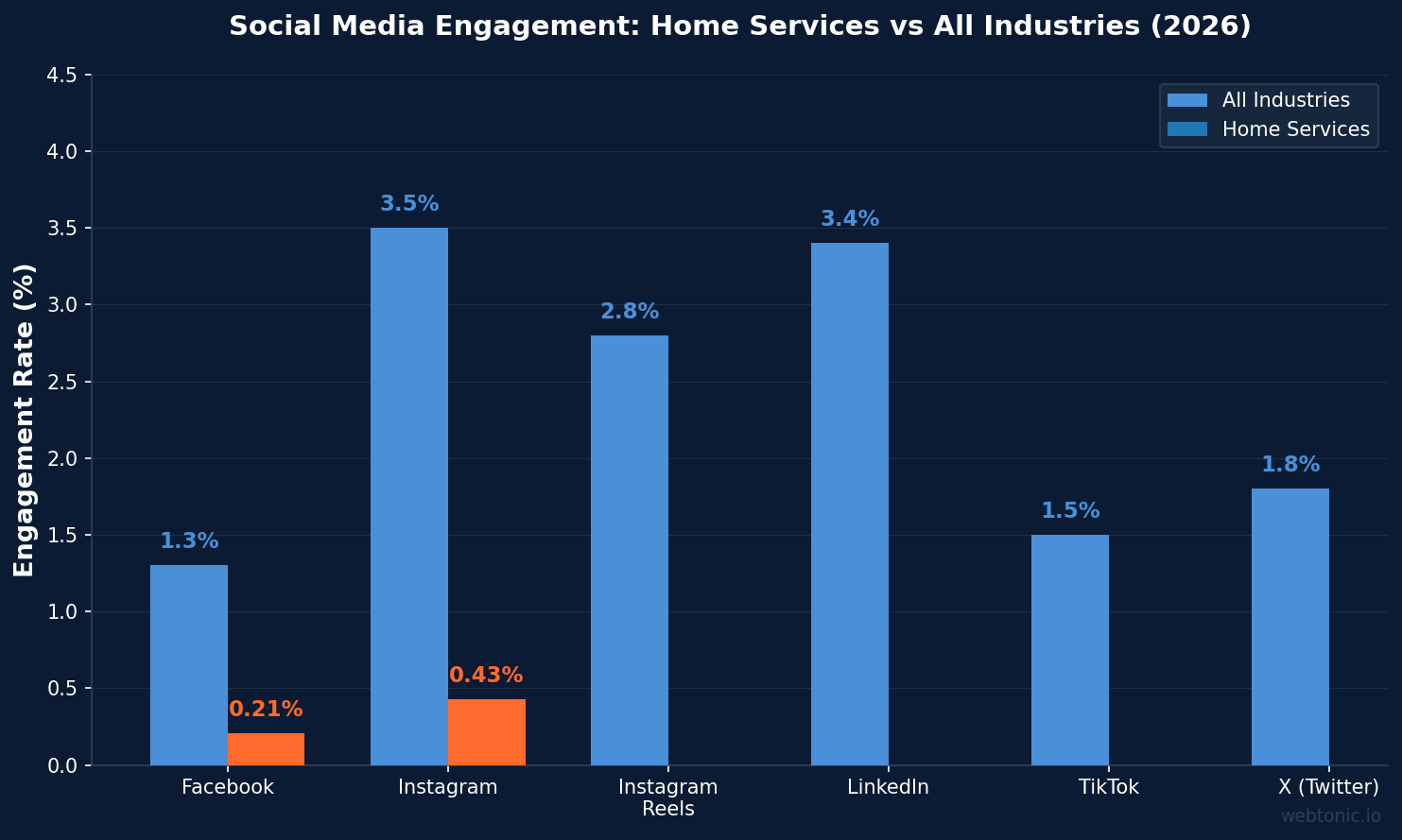
Each social platform delivers different results for HVAC businesses, and the engagement benchmarks vary significantly from all-industry averages. Hootsuite's 2026 engagement rate analysis across 12 industries provides the cross-platform baseline:
| Platform | Avg Engagement Rate | Home Services CPC | Best Use for HVAC |
|---|---|---|---|
| 3.5% (all industries) | $0.84 | Before/after project photos, Reels | |
| Instagram Reels | 2.8% | — | Quick-tip videos, seasonal alerts |
| 1.3% (all industries) | $0.88 | Local community groups, paid lead gen | |
| 3.4% | $5–$12 | Commercial HVAC, B2B relationships | |
| TikTok | 1.5% | $0.50–$1.50 | DIY/educational content, brand awareness |
| X (Twitter) | 1.8% | $0.50–$2.00 | Seasonal promotions, local news |
Home services Facebook engagement averages 0.21% with a CPC of $0.88, while Instagram runs at 0.43% engagement and $0.84 CPC, per 2025 benchmark data from Sprout Social cited by PipelineOn. These rates are well below the all-industry averages (1.3% and 3.5% respectively), reflecting the inherently lower organic reach of service businesses compared to consumer brands, entertainment, and education content.
The gap between home services engagement and the overall average does not mean social media is ineffective for HVAC — it means organic reach is limited and paid amplification is essential. The contractors winning on social media in 2026 are not those with the highest engagement rates. They are those tracking cost per booked job rather than likes.
Paid Social: Meta Ads ROAS and Campaign Data
Paid social media delivers measurable revenue for HVAC contractors who execute correctly. Elev8 Operations' analysis of 200+ contractor accounts found that top-quartile contractor Meta Ads ROAS is 5–8×. The contractors hitting this benchmark all share five traits: video creative, sub-5-minute lead response, Conversion API tracking, properly segmented audiences, and consistent creative testing.
Meta replacement-funnel ROAS for HVAC and roofing runs 4–6× as a typical range, with the 5–8× top quartile representing contractors who have optimized both their ad creative and their lead follow-up speed. The follow-up timing matters because Facebook ad leads cool off rapidly — a 5-minute response converts at dramatically higher rates than a 30-minute response for emergency-adjacent HVAC services.
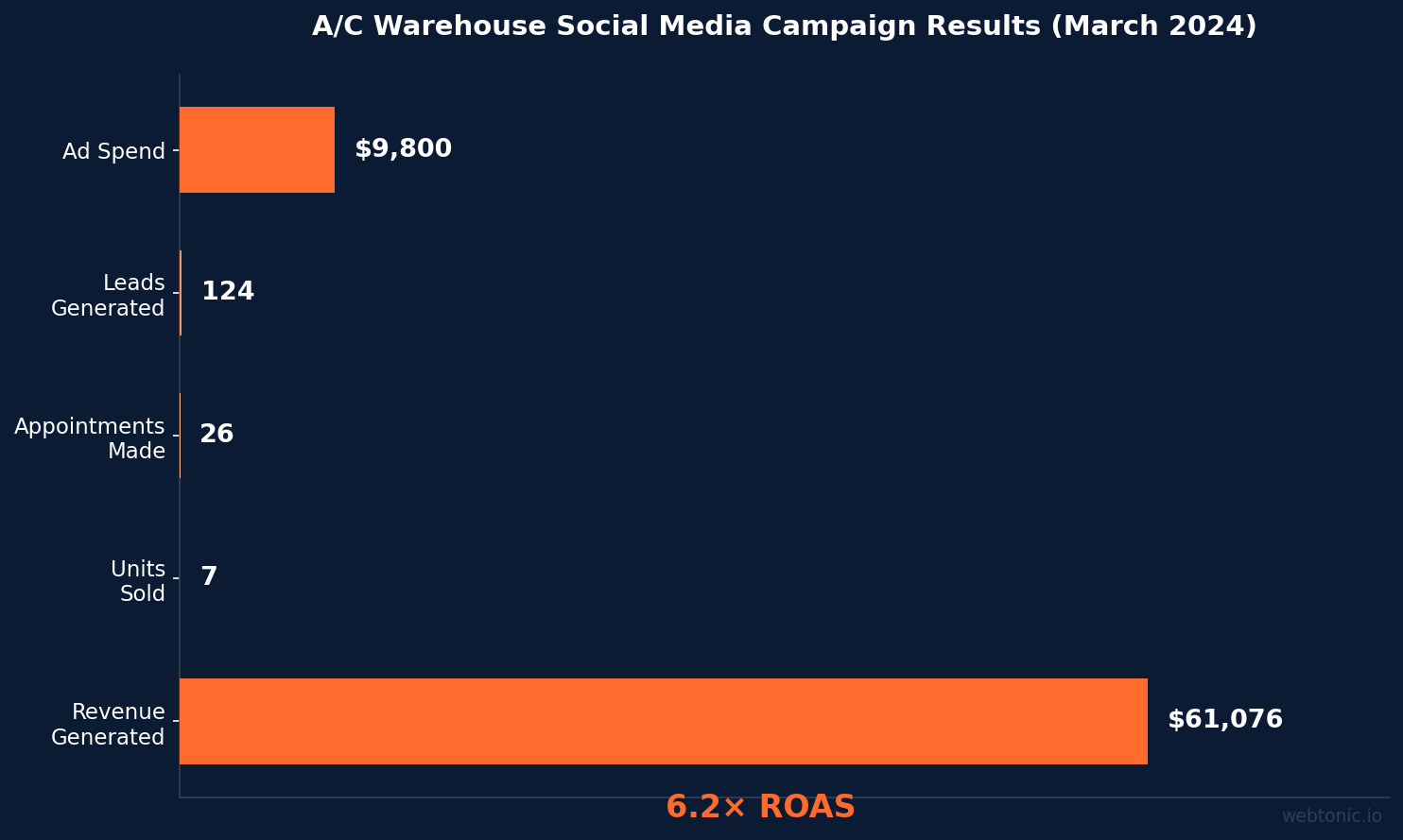
The Rooks Agency case study illustrates what strong execution looks like. A/C Warehouse ran a "March Markdown Sales Event" campaign on Facebook during the typically slow shoulder season:
- Total spend: $9,800
- Leads generated: 124
- Appointments made: 26 (21% of leads)
- Units sold: 7
- Revenue generated: $61,076
- ROAS: 6.2×
- Lead-to-sale conversion rate: 6.4%
The campaign combined compelling offers ($3,950 entry-level units, $2,300 savings), targeted homeowners in service areas, and used automated CRM follow-up with live CSR callbacks — a formula that any HVAC business can replicate with the right infrastructure, per Rooks Agency.
Video Content Performance for HVAC
Video is the highest-performing content format for HVAC social media. HVAC video posts generate 80% more engagement than static image posts, according to Zipdo's industry analysis. This aligns with PipelineOn's observation that the contractors achieving 5–8× Meta ROAS all run video creative — it is not optional at the top tier.
YouTube ads for HVAC carry a 3.1% conversion rate (Zipdo), which significantly outperforms the 1.5–2.5% average for YouTube advertising across all industries. The higher conversion rate reflects HVAC's intent-driven audience: someone watching an HVAC-related video is likely already experiencing or anticipating a heating or cooling problem.
The 3:1 ROAS benchmark is the all-industry average for paid social campaigns, while 5:1 is the strong-paid-campaign benchmark, according to Sprout Social's ROI guidance cited by PipelineOn. One contractor documented tracking through to revenue (not just leads) and achieved a 184:1 ROAS — an outlier, but proof that social media can deliver exceptional returns when measurement follows the customer all the way to a booked and completed job. Most HVAC contractors stop measuring at the lead stage, which understates their actual return.
HVAC Social Media Best Practices Backed by Data
- Lead with video creative — 80% higher engagement than static posts, and all top-quartile contractors use video in their Meta campaigns. Short-form (15–30 seconds) works best for paid; longer educational content for organic.
- Respond to leads within 5 minutes — the difference between 5-minute and 30-minute response time is the single largest conversion lever for HVAC social lead generation. Automated CRM responses plus live CSR follow-up (the A/C Warehouse model) is the proven formula.
- Track cost per booked job, not engagement — home services Facebook engagement averages just 0.21%. Chasing likes misallocates budget; track through to revenue using Meta's Conversion API and offline event matching.
- Target a 5:1 ROAS as your benchmark — 3:1 is average, 5–8× is top-quartile for contractors. If you are below 3:1, diagnose creative quality, audience targeting, and lead follow-up speed before increasing budget.
- Use shoulder-month campaigns strategically — the Rooks Agency case study proved that March social campaigns can drive $61K in revenue from $9.8K in spend. Slow months are actually cheaper to advertise in, with less competition and lower CPMs.
- Invest in before/after content — project transformation photos and videos are the highest-performing organic content type for home services contractors on Instagram and Facebook.
- Budget 5–10% of gross revenue on marketing — contractors below 5% are under-investing; above 12% sustained signals broken unit economics (Elev8 Operations).
Social Media Channel Comparison for HVAC
| Factor | YouTube | TikTok | ||
|---|---|---|---|---|
| Primary use | Paid lead gen + local groups | Brand building + visual proof | Educational video + ads | Awareness + viral reach |
| Engagement rate | 0.21% (home services) | 0.43% (home services) | 3.1% ad conversion | 1.5% (all industries) |
| CPC | $0.88 | $0.84 | $0.10–$0.30 (CPV) | $0.50–$1.50 |
| Best content type | Video testimonials, offers | Before/after Reels, carousels | How-to guides, maintenance tips | Quick tips, seasonal alerts |
| B2B relevance | Low–Medium | Low | Medium | Low |
Measurement and Attribution Challenges
The biggest barrier to HVAC social media success is not creative quality or budget — it is measurement. Only 44% of marketing leaders rate their team as expert-level at measuring social media business impact, per Sprout Social data cited by PipelineOn. For HVAC contractors, who typically have no dedicated marketing staff, the measurement gap is even wider.
A contractor on Reddit tracked his Facebook page for 6 months: 412 page likes, 28,000 reach, 84 link clicks — and zero booked jobs, as documented by PipelineOn. He had been "growing his social media" without any mechanism to connect social activity to revenue. This is the norm, not the exception.
67% of home services companies struggle to understand which channels actually work, according to Click-Vision. The solution is not more social media activity — it is better attribution infrastructure. Contractors who connect Meta's Conversion API to their CRM and track through to booked jobs can identify which campaigns, audiences, and creative generate actual revenue rather than just clicks and impressions.
Cost per booked job is the only metric that matters. Facebook gives you reach, impressions, engagement rate, video plays, and profile visits. Instagram gives you saves, sends, and reach broken out by followers vs. non-followers. None of those metrics correlate directly with revenue. The contractors tracking cost per booked job — not cost per lead — consistently make better budget allocation decisions and achieve the 5–8× ROAS benchmark that defines top-quartile performance.
Seasonal Social Media Strategy for HVAC
HVAC social media performance follows the same seasonal patterns as search demand. Social media mentions of HVAC brands increased by 45% year-over-year according to Zipdo, but this growth is not evenly distributed across the calendar. Summer AC and winter heating campaigns dominate, while shoulder months (spring and fall) offer cheaper CPMs and less competition.
The A/C Warehouse case study from Rooks Agency specifically targeted March — a slow month — and still generated $61,076 in revenue from $9,800 in spend. This proves that shoulder-month campaigns work when the offer is compelling enough to create urgency outside peak season. HVAC businesses that restrict social media advertising to June–August and November–January are missing the most cost-efficient windows of the year.
Smart HVAC marketers use the off-season for brand building and the peak season for conversion campaigns. Pre-season social campaigns launched 30–60 days before peak demand build awareness and retargeting audiences that convert at lower CPAs when temperatures spike and service urgency peaks.
Frequently Asked Questions
Is social media marketing worth it for HVAC companies?
Yes — 22% of HVAC leads come from social media (Zipdo), and top-quartile contractors achieve 5–8× ROAS on Meta ads (Elev8 Operations). The key is treating social media as a paid lead generation channel with rigorous attribution, not a brand awareness exercise measured by likes and followers.
What social media platform works best for HVAC?
Facebook is the primary paid lead generation platform for HVAC, with 80% of home services companies using it (Click-Vision). Instagram adds visual proof through before/after content. YouTube delivers a 3.1% ad conversion rate for HVAC (Zipdo), making it the strongest video advertising channel. LinkedIn is relevant only for commercial HVAC contractors targeting facility managers.
What ROAS should HVAC companies expect from social media ads?
3:1 ROAS is the all-industry average for paid social, while 5:1 is the strong-campaign benchmark (Sprout Social via PipelineOn). Top-quartile HVAC contractors achieve 5–8× consistently. The A/C Warehouse campaign delivered 6.2× during a shoulder month — the season when CPMs are lowest and competition lightest.
How much should an HVAC company spend on social media marketing?
Total marketing spend should be 5–10% of gross revenue for contractors (Elev8 Operations). Within that budget, social media typically accounts for 20–35% of total ad spend, with Meta/Facebook ads taking the largest share. A contractor doing $1M in revenue should allocate $50K–$100K to marketing, with $10K–$35K going to social media channels.
Do HVAC companies need to post organic social content?
Organic social reach for home services is limited — Facebook engagement averages just 0.21% and Instagram 0.43% (PipelineOn). Organic content builds trust and provides social proof for prospects who check your profiles before calling, but it rarely generates leads directly. The ROI comes from paid campaigns targeting homeowners in your service area with video creative and compelling offers.
Sources
https://zipdo.co/marketing-in-the-hvac-industry-statistics/
https://pipelineon.com/blog/analyzing-social-media-campaign-effectiveness/
https://click-vision.com/home-services-marketing-statistics
https://www.elev8operations.com/guides/contractor-marketing-statistics-2026
https://rooksagency.com/case-study-hvac-social-media-marketing/
https://blog.hootsuite.com/average-engagement-rate/


