Table of contents
LinkedIn is the wrong channel for a furnace emergency and the right channel for a $73.24 billion commercial HVAC market where a single retrofit contract outweighs a year of residential service calls. The benchmark gap tells the story: a $5.58 global LinkedIn CPC against a $24 HVAC Google Ads CPC, but a $396 to $686 cost per lead and a sales cycle measured in months. Here is the 2026 data.
Key Takeaways
- LinkedIn's global benchmarks: $5.58 CPC, $33.80 CPM, 0.44%-0.65% CTR on sponsored content.
- B2B cost per lead lands at $686 (standard) and $396 for heavy equipment, the closest analogue to commercial mechanical sales.
- 32% of LinkedIn ad budget is wasted on audiences that cannot buy — $3M of $9.4M audited, about $53,600 per account.
- Only 22% of job-function spend reaches actual ICP roles against a 60% target.
- Lead gen forms complete at ~10%, versus 3.1% for the average HVAC website.
- Commercial HVAC is forecast to reach $73.24B by 2031; US HVAC services grow from $18.98B (2026) to $25.35B.
- LinkedIn reports a 3.6x InMail acceptance lift from prior LinkedIn Live viewers.
- Marketing Solutions revenue reached $7.1B in 2024, 41.3% of LinkedIn's $17.2B total.
LinkedIn Ads Benchmarks at a Glance
The consolidated table below draws on The B2B House benchmark set built on roughly $1M of managed LinkedIn spend and 2026 B2B marketing benchmarks.
| Metric | 2026 benchmark | Note for HVAC advertisers |
|---|---|---|
| Sponsored content CTR | 0.44% - 0.65% | Single image 0.56%, video 0.44%, carousel 0.40% |
| Cost per click (global) | $5.58 | Senior decision-makers $6.40, junior $4.40 |
| Cost per 1,000 impressions | $33.80 | Objective-dependent; some accounts see ~$8.50 |
| Lead gen form completion rate | About 10% | Anything above 10% is good |
| On-platform conversion rate | 5% - 15% | Form-fill and content-download actions |
| Message ads | 3% CTR, 30% open rate | Best used post-engagement, not cold |
| Conversation ads | 50% open, 12% CTR | Highest-engagement paid format |
| Video view-through rate | 29.5% | Engagement rate about 1.8% |
| Event registration cost | $55 - $89 | Without and with a registration form |
| B2B landing page conversion | 2% - 5% | High performers exceed the range |
Read the CPC line next to the residential alternative. 2026 HVAC paid-search benchmarks put the average HVAC Google Ads CPC at $24 with CPCs up 8% to 12% year over year and cost per lead at $145. LinkedIn clicks are four times cheaper and worth a fraction as much per click — the entire question is whether the person clicking can sign a mechanical contract.
1. The Only HVAC Segment LinkedIn Fits
Residential HVAC demand is emergency-led and local. Contractor benchmark data shows Google Local Services Ads delivering booked jobs at $80 to $240 versus Google Search at $330 to $1,100, LSA blended close rates of 43.5% across 888 contractors and $6.72M of tracked spend, and emergency call close rates of 50% to 60%. No LinkedIn campaign competes with that.
Commercial and industrial mechanical work inverts every one of those assumptions. Market forecasts put commercial HVAC at $73.24 billion by 2031, US HVAC services growing from $18.98 billion in 2026 to $25.35 billion by 2031 at a 5.90% CAGR, and North American HVAC equipment moving from $33.22 billion to $48.66 billion at 7.93%. Smart-building requirements and retrofit mandates create planned, committee-driven purchases — exactly the buying motion LinkedIn was built for.
| Segment | Typical buyer | Right channel | Why |
|---|---|---|---|
| Residential emergency repair | Homeowner | LSA, Google Ads, GBP | Intent expires in hours |
| Residential replacement | Homeowner | Google Ads, Meta, referrals | Weeks-long consideration, local |
| Maintenance plans | Existing customer | Email, CRM, GBP | Retention, not acquisition |
| Light commercial service | Property or facility manager | LinkedIn + Google | Named roles, repeat contracts |
| Commercial retrofit / BAS | Facilities director, engineer, procurement | Committee buying, long cycle | |
| Design-build / new construction | GC, developer, mechanical engineer | LinkedIn + relationships | Project-based, firm-level targeting |
2. Cost per Lead Is the Only Number That Matters
LinkedIn looks expensive on CPC and reasonable on CPL, because the platform's native lead forms pre-fill from the member profile. A 10% lead gen form completion rate against a 3.1% average HVAC website conversion rate is a threefold structural advantage that offsets a large share of the CPM premium.
| CPL benchmark | Figure | Source context |
|---|---|---|
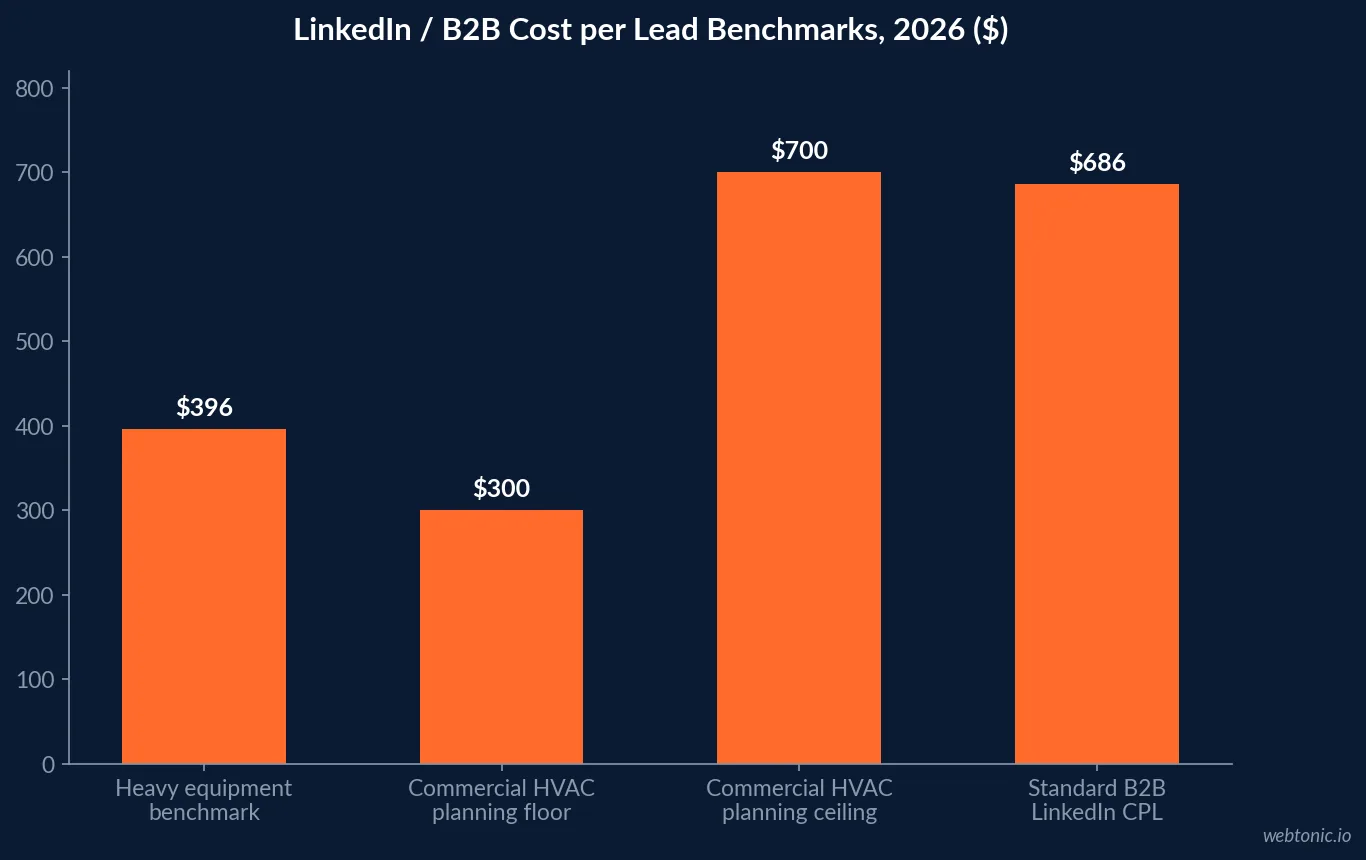
| Heavy equipment marketing | $396 per lead | Closest industrial analogue |
| Standard B2B LinkedIn CPL | $686 | Cross-industry benchmark |
| Typical B2B lead range | $50 to several hundred | All channels, all industries |
| Heavy equipment conversion rate | 1.9% | Site and campaign blended |
| Heavy equipment CAC | $20,842 | Full acquisition cost |
| Implied deal size needed | $69,473 | At a 30% gross margin |
| Referral share of new clients | 4.98% | Paid demand still does the work |
Those heavy-equipment benchmarks are the most useful proxy available for commercial mechanical sales: a $20,842 CAC only works against a $69,473 deal, which is precisely why commercial HVAC can tolerate a $500 lead while a residential shop cannot tolerate a $150 one. Before spending anything here, model backwards from contract value — the approach we use in data intelligence engagements.
3. The 32% Waste Problem
The most actionable LinkedIn research of 2026 is the GrowthSpree audit reported by MarketScale: 56 accounts, $9.4 million of spend, and $3 million reaching audiences with no realistic path to purchase.
| Waste dimension | Figure | Fix |
|---|---|---|
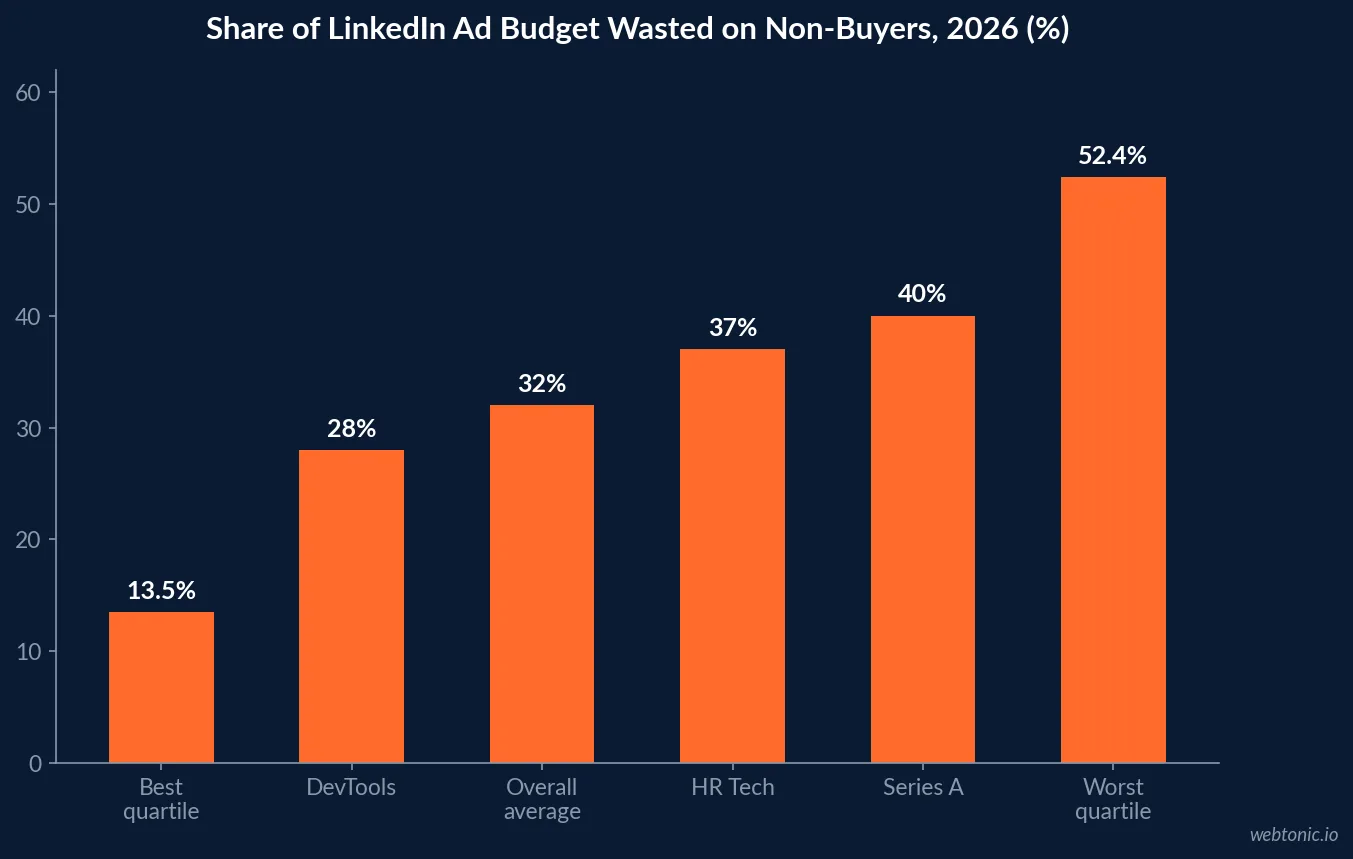
| Average budget wasted | 32% | Rebuild targeting around named roles |
| Waste per account | About $53,600 | Audit before adding budget |
| Best-managed quartile | 13.5% | The realistic floor |
| Worst quartile | 52.4% | More than half the budget |
| Spend reaching real ICP roles | 22% (target 60%+) | The core diagnostic |
| Non-ICP job-function targeting | $903,000 of $3M lost | Largest single drain |
| Seniority mislabelling | $662,000 | Exclude below-manager titles |
| Company-size leakage (<50 staff) | $452,000 | Set hard employee-count floors |
| Waste after a 90-day fix | 11.8% | Achievable with disciplined exclusions |
Three root causes account for 67% of all waste. Translate them into HVAC terms: targeting the job function "operations" reaches warehouse supervisors as well as facilities directors; "manager and above" still includes shift managers with no capital authority; and no employee-count floor puts a chain of coffee shops in the same audience as a hospital system. The audit's 60% ICP-reach threshold is the number to manage toward, and a 90-day corrective plan cut waste to 11.8%.
4. Format Performance and Creative Cost
Format choice moves CTR by roughly 40% between best and worst, and cost of production by considerably more.
| Format | Benchmark CTR | Best use in commercial HVAC |
|---|---|---|
| Sponsored content, single image | 0.56% | Case studies, retrofit results, compliance news |
| Sponsored content, event ad | 0.55% | Webinars on efficiency mandates |
| Sponsored content, video | 0.44% | Site walkthroughs, mechanical room tours |
| Document ad | 0.43% | Spec sheets, energy audit templates |
| Carousel | 0.40% | Multi-building portfolio proof |
| Message ads | 3.0% CTR, 30% open | Warm follow-up only |
| Conversation ads | 12% CTR, 50% open | Post-webinar and post-event nurture |
LinkedIn's own data shows a 3.6x InMail acceptance lift when a sponsored message comes from an individual rather than a company page and the recipient has already viewed a LinkedIn Live from that company — reported without a methodology note, so treat the magnitude as directional. Platform-level context: event ads drive 31% more event viewership, professional event viewership rose 34% year over year, and LinkedIn Live usage has grown 198% year over year. Dreamdata's benchmarks moved from 113% ROAS with 6.8 stakeholders per deal in 2025 to 121% ROAS, 272-day journeys and about 10 stakeholders in 2026.
5. Targeting Costs by Role and Function
CPC varies by more than 60% across job functions, which matters when a commercial HVAC audience spans engineering, operations, procurement and finance.
| Job function | Benchmark CPC | Benchmark CTR |
|---|---|---|
| Information technology | $7.90 | 0.57% |
| Product management | $7.30 | 0.54% |
| Finance | $6.90 | 0.60% |
| Marketing | $6.80 | 0.60% |
| Business development | $6.30 | 0.65% |
| Operations | $5.70 | 0.55% |
| Engineering | $5.10 | 0.57% |
| Accounting | $5.00 | 0.60% |
Two practical notes. Engineering, at $5.10 CPC, is among the cheapest functions to reach and contains many of the people who specify mechanical systems — an unusual efficiency in this category. And senior decision-makers cost $6.40 per click versus $4.40 for junior employees while converting far better, so bidding down to cheap clicks is the fastest way into that 52.4% waste quartile.
6. Attribution Has to Exist Before Launch
With a 272-day journey and roughly 180-day industrial sales cycles, a commercial LinkedIn programme will look like a failure for two quarters under last-click reporting. Anteriad research quantifies the consequence: marketers with strong data foundations are 2.4x more likely to exceed goals, with 45% of attribution leaders exceeding targets versus 24% of laggards, and buying committees have grown to 11.2 stakeholders from 9.7.
| Measurement requirement | Why it matters here | Minimum standard |
|---|---|---|
| CRM opportunity stages | Leads convert months later | Lead source persisted to closed-won |
| Offline conversion import | Contracts close off-platform | Weekly upload cadence |
| Company-level reporting | 10+ stakeholders per deal | Account, not lead, as the unit |
| Pipeline value, not lead count | Lead volume is misleading | Cost per qualified opportunity |
| Long lookback window | 272-day journeys | Minimum 180 days |
Our data intelligence practice covers the tracking stack in detail, including the call-tracking layer that most contractors are missing.
7. Budget Context: What HVAC Firms Actually Spend
Built on Tenth's benchmark research shows top-quartile HVAC operators spending 6% to 9% of revenue on marketing versus 10% to 18% in the bottom quartile, with top performers putting 20% to 28% of budget into Google Search and only 4% to 8% into aggregators.
| Budget question | Benchmark | LinkedIn implication |
|---|---|---|
| Marketing as % of revenue | 5% - 10% of gross | LinkedIn is a slice, not the plan |
| Top-quartile spend | 6% - 9% | $10,000-$15,000/month at $2M revenue |
| Social and other allocation | 4% - 8% (top quartile) | Sets a realistic LinkedIn test budget |
| Minimum viable LinkedIn test | $3,000-$5,000/month, 90 days | Below this, no learning signal |
| Bottom-quartile aggregator spend | 14% - 22% | The budget to reallocate first |
At 4% to 8% of a $12,000 monthly budget, a serious LinkedIn test means reallocating aggregator spend rather than adding budget. Firms structuring that trade-off can see how we sequence it in growth marketing.
8. Why the Platform Is Getting More Expensive
LinkedIn is not under pricing pressure. Segment analysis shows $17.2 billion of 2024 revenue, up 22%, with Marketing Solutions at $7.1 billion (41.3%) growing 24%, an operating margin above 28%, over 950 million members, and 62% of revenue from North America. No single customer exceeds 5% of revenue, which means no advertiser has leverage over pricing.
Meanwhile HVAC consolidation data shows private-equity add-on volume up roughly 88% year over year through mid-2025 and businesses trading at 4x to 7x EBITDA. Consolidated platforms with commercial divisions are exactly the competitors who will fund a 272-day nurture programme — and 78% of HVAC contractors employ fewer than 10 people, so most of the market cannot.
9. Where the Channel Fails
Documented failure modes, each traceable to a number above:
- Running residential offers. A homeowner with a failed furnace is on Google, where 76% of HVAC searches happen on mobile.
- Broad job-function targeting. Only 22% of function-level spend reaches ICP roles today.
- No company-size floor. Sub-50-employee leakage cost $452,000 in the audited sample.
- Cold message ads. The 3.6x acceptance lift depends on prior engagement.
- Judging at 60 days. Against a 272-day journey, that is a quarter of the cycle.
- Website forms instead of lead gen forms. 3.1% versus about 10% completion.
The residential comparison keeps the decision honest: $53 LSA cost per lead versus $104 blended Google Ads, LSA adoption at roughly 70% of contractors in 2025 heading to 80%+ in 2026, and Google Business Profile driving 30% to 50% of contractor calls organically. For the paid-search side of the plan, our Google Ads cost guide sets the baseline.
10. What the Data Recommends
- Only run LinkedIn for commercial, industrial or design-build revenue. Residential belongs to LSA and Google.
- Audit ICP reach before adding budget. Manage toward 60%+ of spend hitting real buying roles.
- Set hard exclusions: employee-count floors, director-and-above seniority, non-ICP functions.
- Use lead gen forms. About 10% completion versus 3.1% on the average HVAC site.
- Lead with single-image sponsored content at 0.56% CTR before testing video or carousel.
- Reserve message and conversation ads for warm audiences to earn the 3.6x acceptance lift.
- Budget $3,000-$5,000/month for 90 days minimum and measure cost per qualified opportunity.
- Build offline conversion import first. 45% of attribution leaders beat goals versus 24% of laggards.
The honest summary: LinkedIn is a specialist tool for the minority of HVAC revenue that is bought by committee. Used against a $69,473-class deal with attribution built in advance, it earns its $396 to $686 cost per lead. Used for residential lead generation, it is the most expensive way to reach people who will call whoever answers first. Teams weighing the whole channel mix can start with our team or the HVAC branding statistics that determine whether any of this converts.
Frequently Asked Questions
Do LinkedIn Ads work for HVAC companies?
For residential HVAC, almost never. Residential demand is emergency-driven and captured on Google, where the HVAC average CPC is around $24 and cost per lead runs $145 with a range of $110 to $185. LinkedIn's global CPC benchmark is $5.58 and its CPM benchmark is $33.80, but the cost that matters is cost per qualified opportunity, and LinkedIn cannot reach a homeowner whose furnace failed an hour ago. Commercial and industrial HVAC is a different business: facility managers, property managers, general contractors, building engineers and procurement leads are all targetable by job function and company size, and deal sizes in commercial retrofit justify a long, expensive nurture cycle.
What is a realistic LinkedIn cost per lead for commercial HVAC?
Plan for $300 to $700 per lead gen form submission and treat anything under $250 as excellent. Cross-industry B2B benchmarks put the standard LinkedIn CPL near $686, while heavy-equipment marketing benchmarks — the closest analogue to commercial mechanical sales — show a $396 CPL and a 1.9% conversion rate against a $20,842 customer acquisition cost. LinkedIn lead gen forms complete at roughly 10%, which is the single biggest reason CPL there beats a website landing page even at a much higher CPC.
How much LinkedIn ad spend is typically wasted?
A GrowthSpree audit of 56 accounts and $9.4 million in LinkedIn spend found 32% of budget reaching audiences with no realistic path to purchase — about $3 million, or roughly $53,600 per account. The best-managed quartile wasted 13.5% and the worst 52.4%. Only 22% of job-function spend reached actual ideal-customer-profile roles against a recommended 60%. For HVAC advertisers the practical translation is that broad targeting like 'facilities' or 'operations' at any seniority burns most of the budget on people who cannot approve a mechanical contract.
Which LinkedIn ad format performs best for mechanical contractors?
Single-image sponsored content posts the highest benchmark click-through rate at 0.56% versus 0.44% for video and 0.40% for carousel, and it is the cheapest format to produce. Message and conversation ads behave differently: conversation ads average a 50% open rate and a 12% click-through rate, and message ads average 3% CTR with 30% open rates. LinkedIn also reports a 3.6x lift in InMail acceptance when the message comes from an individual rather than a brand page and the recipient has already watched a LinkedIn Live from that company.
How long is the sales cycle you have to fund?
Long enough that attribution has to be built before the campaign launches. Heavy-equipment benchmarks reference a roughly 180-day sales cycle, and Dreamdata's 2026 LinkedIn benchmarks show 272-day buyer journeys with about 10 stakeholders per deal and 121% ROAS at the platform level. Anteriad research adds the reason many programmes get killed early: B2B marketers with strong data foundations are 2.4x more likely to exceed goals, with 45% of attribution leaders exceeding targets versus 24% of laggards.
Sources
The B2B House — LinkedIn Ad Benchmarks 2026
MarketScale — 32% of LinkedIn Ad Budgets Wasted (GrowthSpree audit)
WebFX — Heavy Equipment Marketing Benchmarks
eLearning Industry — B2B Marketing Benchmarks 2026
PPC Land — LinkedIn Live and InMail Acceptance
FourWeekMBA — LinkedIn Revenue Breakdown
Barchart — Commercial HVAC Market to $73.24B by 2031
Elev8 Operations — Contractor Marketing Statistics 2026
RYN Digital — HVAC Marketing Statistics 2026
Built on Tenth — HVAC Marketing Benchmarks 2026
DealSeam — HVAC PE Roll-up Tracker 2026