Table of contents
The wellness economy reached $6.8 trillion in 2024 and is forecast to hit $9.8 trillion by 2029 - yet only 5% of consumers trust influencers most, while 75% trust physicians. Wellness branding in 2026 is no longer a pastel-and-promise exercise; it is a credibility engineering problem. Here is the data behind that shift and what it means for identity, packaging and claims.
Key Takeaways
- The global wellness economy hit a record $6.8 trillion in 2024, up 7.9% year over year and roughly double 2013.
- Forecasts put the market at $7.4 trillion in 2025 and $9.8 trillion by 2029, with the U.S. alone at $2.1 trillion.
- U.S. per capita wellness spending passed $6,000 for the first time at $6,293, or 7.33% of national GDP.
- 75% of consumers trust physicians or dermatologists most versus 5% for influencers - a roughly 15x trust gap.
- One in five consumers say trust in product claims fell in the last two to three years, and 63% of them blame overuse of "natural" and "clean".
- 39% of consumers have switched to products perceived as more natural or clean, so the demand is real even as the language decays.
- A functional snacking rebrand delivered a 127% sales increase and 63% distribution expansion; a supplement redesign reported about a 180% all-channel lift.
- Consistent logo use is associated with about 23% revenue uplift, rising toward 27% across eight or more digital channels.
The Market: Growth Is Not the Problem
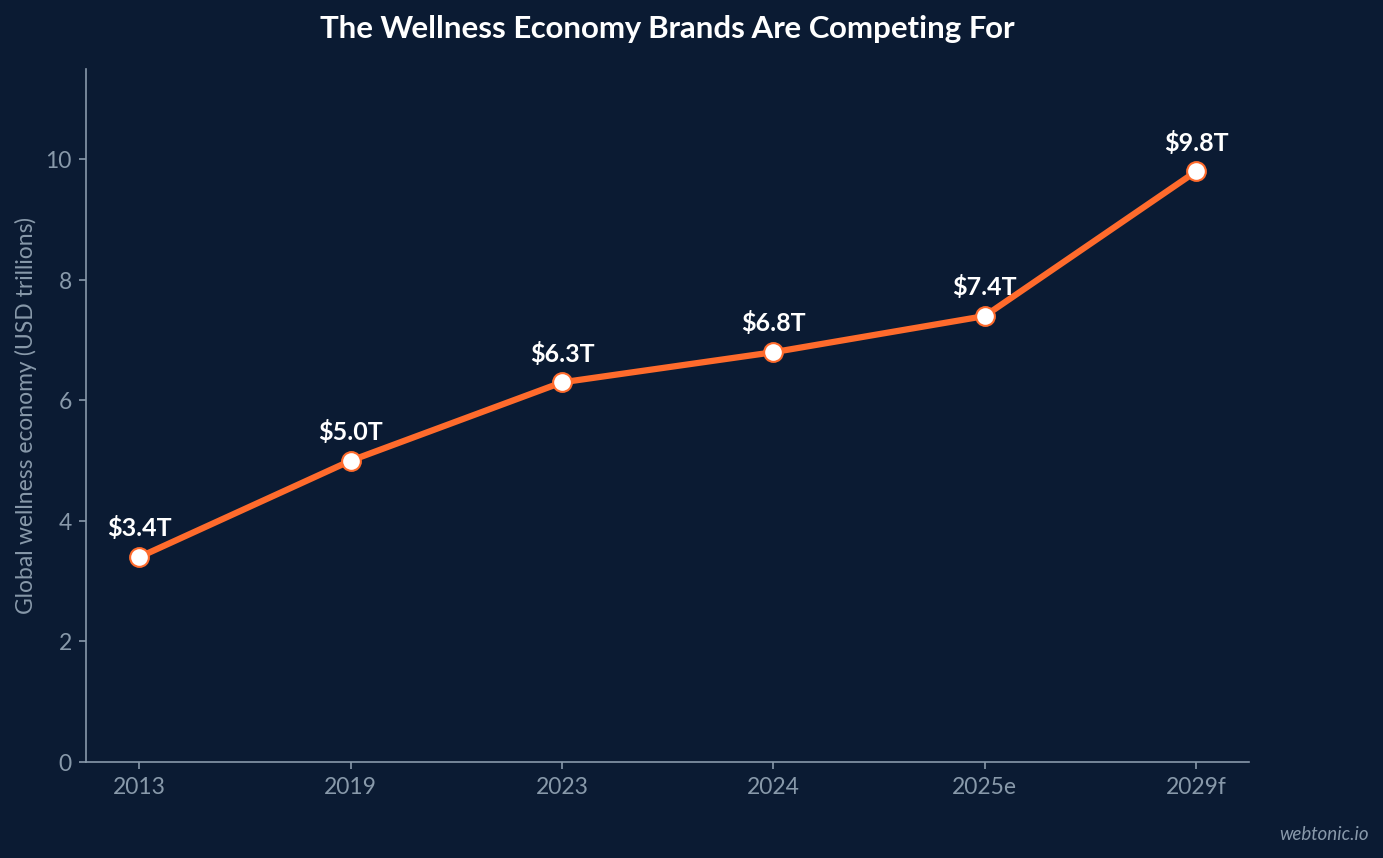
The global wellness economy grew 7.9% from 2023 to 2024 and reached a new peak of $6.8 trillion, having doubled in size since 2013 (Global Wellness Institute). The published trajectory runs $3.4 trillion in 2013, $5 trillion in 2019, $6.3 trillion in 2023, $6.8 trillion in 2024, a projected $7.4 trillion for 2025 and $9.8 trillion by 2029 (PR Newswire).
The U.S. is the anchor market. The American wellness economy reached about $2.1 trillion, per capita spending crossed the $6,000 threshold at $6,293, and the sector now accounts for 7.33% of national GDP (Global Wellness Institute). For a brand strategist, the implication is uncomfortable rather than encouraging: category tailwinds mean every competitor is also growing, so a wellness brand cannot out-market a category trend. It has to out-signal its shelf.
| Year | Global wellness economy | What changed for brands |
|---|---|---|
| 2013 | $3.4 trillion | Wellness as a premium niche positioning |
| 2019 | $5.0 trillion | Mass-market entry; claims inflation begins |
| 2023 | $6.3 trillion | Post-pandemic demand normalises |
| 2024 | $6.8 trillion (+7.9%) | Record peak; category crowding accelerates |
| 2025 (projected) | $7.4 trillion | Trust and substantiation become differentiators |
| 2029 (forecast) | $9.8 trillion | Machine-mediated discovery reshapes packaging data |
Trust: The Only Scarce Resource Left
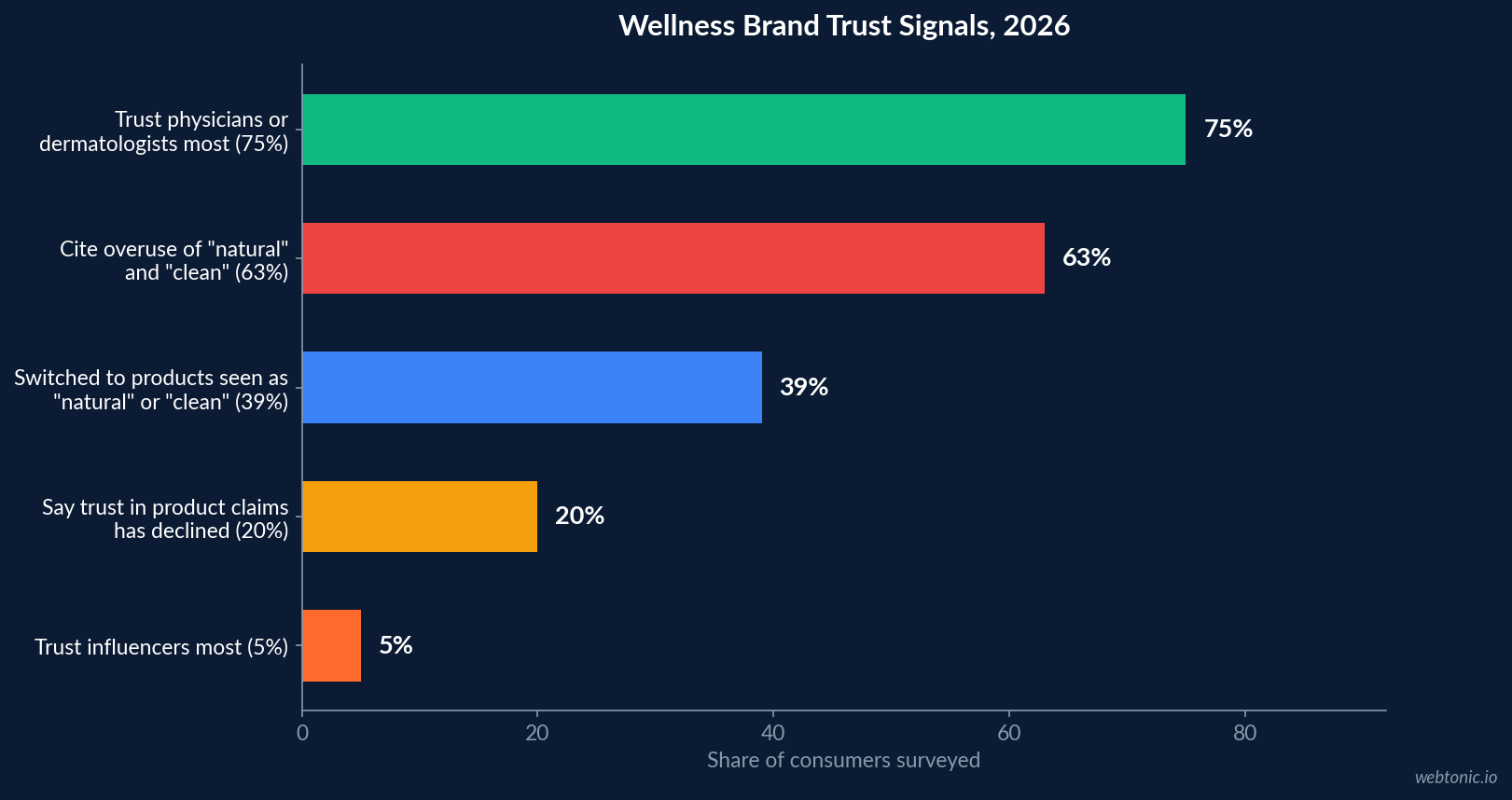
The most consequential branding statistic of 2026 is a ratio, not a market size. A study of more than 1,600 consumers across 16 countries found only 5% trust influencers most, while 75% trust physicians or dermatologists - making doctors about 15 times more trusted than influencers (NERO 2026 FIT study). Wellness brands that built their entire identity around creator seeding are competing in the least credible channel available to them.
The erosion is measurable in claims language too. One in five consumers said their trust in product claims had declined during the previous two to three years, and among that group 63% cited the overuse of terms such as "natural" and "clean" (CHFA study via Retail Insider). Yet demand has not moved with the vocabulary: 39% say they have switched to products perceived as more "natural" or "clean" (Happi). Consumers still want the benefit. They no longer accept the word as evidence.
Price sensitivity sharpens the same point. Shoppers want to understand what makes a product "clean" and why it is worth the premium, and vague or inflated claims are scrutinised harder when budgets are tight (Leger). Intent is strong; tradeoffs are real. A brand that cannot justify its premium in one line on pack loses at the exact moment of comparison.
| Trust signal | 2026 data point | Branding implication |
|---|---|---|
| Physician / dermatologist trust | 75% trust them most | Name real experts; make credentials visible |
| Influencer trust | 5% trust them most | Use creators for reach, never for proof |
| Declining claim trust | 20% report a decline | Substantiate or drop the claim |
| Reason for decline | 63% cite 'natural' and 'clean' overuse | Replace virtue words with specifics |
| Switching behaviour | 39% moved to 'cleaner' products | Demand persists - reframe, do not retreat |
| Premium justification | Clarity beats claim volume | One reason to believe, stated plainly |
Discovery Is Becoming Machine-Mediated
Wellness purchasing is shifting toward the self-directed consumer who researches independently and increasingly shops inside systems that filter, rank and recommend - including emerging agentic AI. In that environment clear ingredient labeling, consistent claims and well-structured product data become essential for visibility as well as trust (NIQ).
This is a branding brief disguised as a data brief. If a product's claim hierarchy differs between the pack, the retailer listing and the brand site, a recommendation engine sees three products. Wellness brands that win the next cycle will treat their claim set as a single structured asset - one canonical ingredient story, one certification list, one benefit hierarchy - rendered consistently everywhere. Our data intelligence team builds that layer alongside creative, because inconsistent product data quietly undoes expensive design work.
Does Rebranding Actually Pay? The Documented Outcomes
The honest answer is that redesign pays when it changes what the product signals, not merely how it looks. The strongest documented case is a functional snacking brand that achieved a 127% increase in sales, expanded distribution by 63% and improved brand perception metrics post-redesign, becoming the fastest-growing brand in its category (WARC). A smaller supplement brand reported roughly a 180% all-channel sales lift, a category best-seller badge by week eight, and stockist expansion from two at-risk accounts to expanded orders plus a national health inquiry after a brand and packaging redesign (SR Orbit).
Aggregate identity research points to smaller but broader effects. Uniform logo use across touchpoints is associated with roughly a 23% revenue uplift, rising toward 27% for brands consistent across eight or more digital channels (Amra & Elma). Consistency, in other words, is worth more than novelty for most wellness brands.
| Documented outcome | Result | What drove it |
|---|---|---|
| Functional snacking rebrand | +127% sales, +63% distribution | Category-defying identity plus retailer confidence |
| Supplement brand and pack redesign | ~+180% all-channel sales | Shelf legibility and best-seller momentum |
| Consistent logo application | ~+23% revenue uplift | Recognition compounding across touchpoints |
| Consistency across 8+ channels | Up to +27% revenue | Cross-channel reinforcement |
| Creative repositioning (DTC wellness) | CAC $68 to $51, LTV +18% at 90 days | Ritual framing and organic unboxing content |
| Perception-first measurement | Leading indicator over 12-24 months | Tracking equity before revenue confirms |
One DTC wellness brand that pivoted its creative positioning from generic wellness to ritual reported blended customer acquisition cost falling from $68 to $51, a 25% improvement, with 90-day new subscriber LTV up 18% driven by retention among customers who discovered the brand through organic unboxing content. That is the clearest illustration of the mechanism: branding work shows up first in acquisition efficiency, then in retention, then in revenue. Teams that only watch revenue miss two quarters of signal - which is why we pair identity work with performance creative testing rather than treating them as separate budgets.
Measuring a Wellness Rebrand Properly
Perception shifts precede behavioural change, which makes perception the leading indicator you can measure before revenue confirms or denies the investment, typically across a 12 to 24 month window (Inkbot Design). A defensible measurement plan for a 2026 wellness rebrand looks like this:
- Baseline brand equity before launch - unaided recall, attribute association, and premium willingness, measured on the same panel you will re-run.
- Track acquisition efficiency weekly; the CAC move (one brand saw $68 to $51) arrives before revenue does.
- Instrument shelf and listing conversion separately from traffic, since packaging changes conversion more than demand.
- Audit claim consistency across every surface, given that 63% of trust decline is attributed to language overuse.
- Add expert proof, not creator volume - the 75% versus 5% trust gap is the cheapest credibility arbitrage available.
- Hold structured product data as a brand asset so recommendation systems read one coherent product.
- Review at 12 and 24 months against the baseline rather than declaring victory on launch-quarter sales.
Wellness brands scaling paid media alongside a rebrand should read these numbers next to channel economics - our Meta Ads benchmarks and Facebook Ads ROI analysis are the usual companions, because a stronger identity lowers media cost before it raises revenue.
Frequently Asked Questions
How big is the wellness market that brands are competing in?
The global wellness economy grew 7.9% from 2023 to 2024 and reached a record $6.8 trillion, roughly double its 2013 size of $3.4 trillion. It is projected at $7.4 trillion for 2025 and $9.8 trillion by 2029. The United States alone accounts for about $2.1 trillion, with per capita wellness spending passing $6,000 for the first time at $6,293 and the sector representing 7.33% of U.S. GDP. Category growth is not the constraint on a wellness brand; differentiation is.
Who do wellness consumers actually trust in 2026?
Professionals, decisively. A 2026 study of more than 1,600 consumers across 16 countries found only 5% trust influencers most, while 75% trust physicians or dermatologists - making doctors roughly 15 times more trusted than influencers. That single ratio should reshape most wellness brand systems: expert endorsement, clinical substantiation and named practitioners outperform creator volume for brands selling efficacy claims.
Is a rebrand or packaging redesign measurable in revenue?
It can be, when the redesign changes what the product signals rather than just how it looks. Documented outcomes include a functional snacking brand achieving a 127% sales increase and 63% distribution expansion after redesign, and a supplement brand reporting roughly a 180% all-channel sales lift plus a category best-seller badge by week eight following a brand and packaging overhaul. Aggregated logo research points to more modest but broader effects, including about a 23% revenue uplift from consistent logo use and up to 27% where consistency spans eight or more digital channels.
How long before a rebrand shows up in revenue?
Perception moves first, revenue follows - typically over a 12 to 24 month horizon for a full identity change. That is why brand equity tracking should be measured before and during a rebrand, not only after: perception shift is the leading indicator that predicts whether behavioural change and revenue will confirm the investment. Brands that only measure sales attribute a slow quarter to the rebrand or credit it for unrelated growth.
What claims language is now a liability for wellness brands?
Vague virtue words. One in five consumers report their trust in product claims declined over the previous two to three years, and among that group 63% cite the overuse of terms such as 'natural' and 'clean' as the reason. Meanwhile 39% say they have switched to products perceived as more natural or clean - so demand persists while the vocabulary loses meaning. The 2026 shift in clean beauty and supplements is away from 'free-from' framing toward transparency, proven performance and measurable impact.
What should a wellness brand prioritise in a 2026 identity project?
Substantiation architecture. As shopping increasingly happens inside systems that filter, rank and recommend products, clear ingredient labeling, consistent claims and well-structured product data become prerequisites for visibility as well as trust. Practically that means branded ingredient callouts, third-party testing marks, named expert endorsement, one claim hierarchy applied identically across pack and digital, and structured product data that machines can read.
Sources
Global Wellness Institute - Global Wellness Economy Monitor
PR Newswire - Global Wellness Economy Hits a Record $6.8 Trillion
Global Wellness Institute - US Wellness Economy Surges to $2.1 Trillion
NERO - 2026 FIT Beauty Trust Study
Retail Insider - Consumers Increasingly Verify Wellness Claims (CHFA Study)
Happi - Clean Beauty Fuels Personal Care Marketplace
Leger - Clean Living in 2026: Intent vs Economic Reality
NIQ - Health and Wellness Consumer Trends 2026
WARC - TRIBE: Redesign case study
SR Orbit - Vitalize Wellness Brand & Packaging Redesign
Inkbot Design - Rebranding ROI: Measure Equity Before You Rebrand
Amra & Elma - Logo Redesign Impact Statistics