



Table of contents
Choosing a growth advisory provider is a diagnosis test, not a credentials test. The firms worth paying for tell you what is actually wrong before they tell you what they sell.
Key Takeaways
- Buy diagnosis, not deliverables. Marketing strategy consulting earns its fee by naming the constraint — targeting, pricing, offer, channel or measurement — and only then writing the plan.
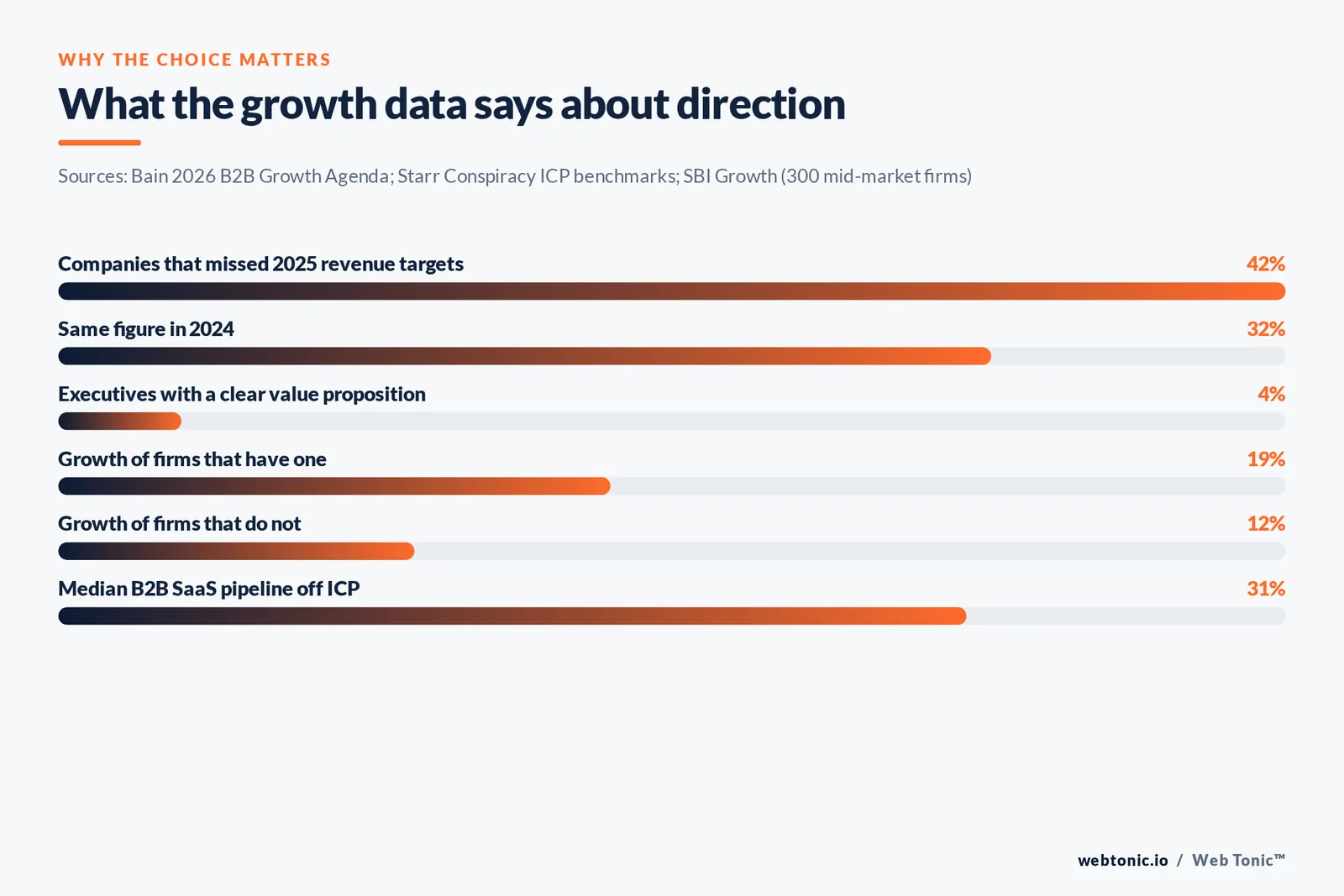
- The stakes are visible in the market data: 42% of companies missed 2025 revenue targets against 32% in 2024, yet 91% remain confident about the year ahead.
- Only 4% of executives say their value proposition is strong and consistently understood, and firms that have one grew 19% versus 12% for those that do not.
- Score providers on three pillars: diagnostic rigour, evidence at your stage, and a contract with named decisions and owners. Anything else is presentation quality.
- Rates give you a sanity check, not a ranking. Marketing strategists commonly bill $150–$300 an hour, with a $142 average across marketing consultants in one 2025 industry survey and a global consulting median near $188.
- Run the selection in four weeks: brief, three diagnostic conversations, a paid scoping step, then a signed scope naming the decisions the engagement must complete.
- The commonest expensive mistake is hiring an execution shop to answer a strategy question, and then judging it on strategy it was never scoped to produce.
Start by deciding what kind of help you are buying
Three different products get sold under the same words. An advisory engagement produces decisions: who you sell to, what you charge, what you say, which two or three channels get funded, and how you will know. An execution engagement produces work: campaigns, content, landing pages, media management. A staffing engagement produces capacity: a person for a number of hours a week.
Get this wrong and no vetting process saves you. If your pipeline is thin because your positioning is generic, more ad management will make the problem more expensive rather than more obvious. Harvard Business Review's work with Egon Zehnder, drawing on more than 500 senior leaders, found that stalled growth usually traces to unclear priorities and weak alignment rather than to insufficient activity. That is an advisory problem.
The market context also raises the cost of choosing badly. Bain's 2026 B2B Growth Agenda, based on over 1,100 senior executives across 18 industries, reports that 42% of companies missed their 2025 revenue targets, up from 32% the year before, while 91% stayed confident about the year ahead. Confidence is not a plan, and it is not a filter for providers either.
Pillar one: diagnostic rigour
The first pillar is the only one you can test in a single conversation. Ask a provider what they would need to see in week one, and listen for specifics: revenue by segment, win and loss reasons, pricing realisation, channel cost per qualified opportunity, and the definition of a qualified lead. A provider who answers with a service list has told you they intend to sell the same engagement to you as to everyone else.
A useful test is to describe a symptom and see whether they resist prescribing. One founder-facing vetting checklist reduces the whole decision to four questions, the first being whether the consultant diagnoses before prescribing. MarketerHire's vetting guide makes the same point from the demand side: most businesses vet consultants like full-time employees, weighing résumés and pitch polish instead of verified outcomes.
The evidence that diagnosis pays is quantitative. The Starr Conspiracy's ICP benchmarks, citing Demandbase data, put the win-rate lift from a properly defined ideal customer profile at 68%, with CAC payback of 14 months on profile against 26 months off it, and a median 31% of B2B SaaS pipeline sitting outside the profile. Targeting work is not a soft deliverable.
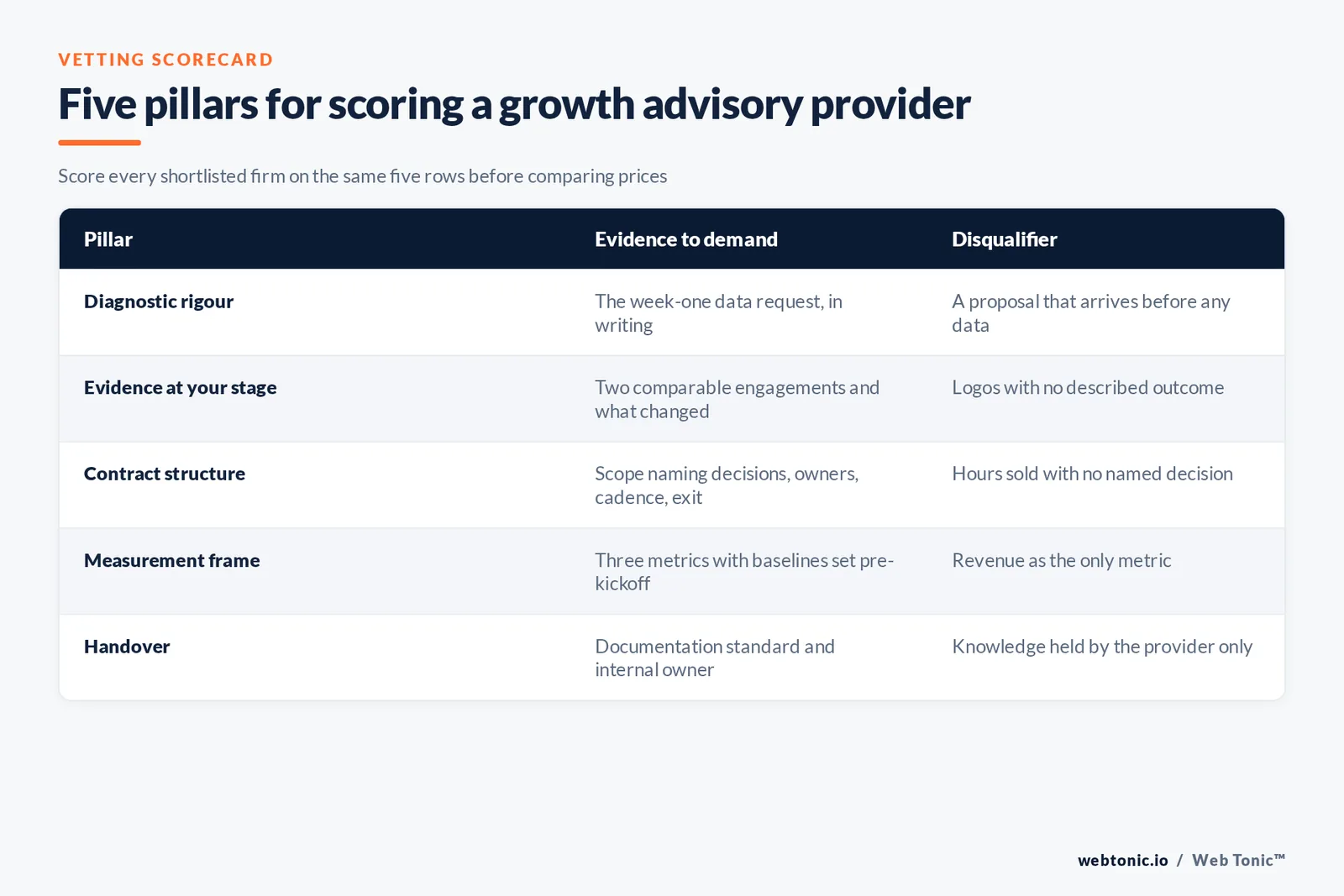
| Pillar | What you are testing | Evidence to demand | Disqualifier |
|---|---|---|---|
| Diagnostic rigour | Whether they find the constraint before selling the fix | The week-one data request, in writing | A proposal that arrives before any data does |
| Evidence at your stage | Pattern recognition for your model and size | Two comparable engagements, what changed, over what period | Logos with no described decision or outcome |
| Contract structure | Whether decisions and owners are named | Scope listing outputs, owners, review cadence, exit | Hours sold with no named decision to complete |
| Measurement frame | Agreement on how success is judged | Three metrics with baselines set before kickoff | "Revenue" as the only metric on a nine-month cycle |
| Handover | Whether the work survives the invoice | Documentation standard and a named internal owner | Knowledge held only in the provider's head |
Pillar two: evidence at your stage, not just your industry
Industry familiarity is worth less than stage familiarity. The constraint on a $3m founder-led business is rarely the constraint on a $30m business with a sales team, even in the same vertical. Ask for two engagements at roughly your revenue and model, and ask a narrow question about each: what decision did you change, and what moved as a result?
Numbers help you interrogate the answer. SBI Growth's study of 300 mid-market firms found leaders generating $0.71 of growth per commercial dollar against a market average of $0.54 — a productivity gap, not an effort gap. Benchmarkit's 2025 B2B SaaS metrics put the median CAC ratio at $2.00 spent per $1.00 of new ARR, up 14% year over year. A provider who cannot discuss which of those two levers your business should pull is not operating at advisory level.
Pricing is the most under-audited lever of all. McKinsey analysis reported by IndustryWeek puts the value of a 1% price improvement at roughly 8.7% of operating profit. If pricing never comes up in a growth conversation, the provider is scoping a channel project.
Pillar three: a contract that names decisions
Advisory work fails quietly when the scope buys time instead of outcomes. A scope that reads "strategic support, 20 hours per month" cannot be judged, renewed or cancelled on evidence. A scope that reads "documented ICP with disqualifiers, value proposition and messaging, pricing policy, funded channel plan, metric tree, all agreed by day 60, each with a named internal owner" can be.
Insist on four contract elements: the decisions to be completed, the internal owner for each, the review cadence, and the handover artefact. Consulting onboarding practice suggests the kickoff itself should run 60–90 minutes and produce three outputs — shared goal, working cadence, immediate next steps — which is a reasonable minimum standard to hold a provider to. Engagement kickoff frameworks add the detail most scopes miss: who has authority to decide when the provider and the internal team disagree.
Use rates as a sanity check, not a ranking
Price tells you what kind of operator you are talking to and very little about whether they will help. Published benchmarks are wide by nature. Consulting fee data by industry puts marketing strategists at roughly $150–$300 an hour, with execution specialists lower at $75–$175, and an average across marketing consultants of about $142 an hour in a 2025 survey. A 2026 marketing consultant rate report shows an even wider band of $50–$500 an hour and project fees from $5,000 for a campaign audit to $50,000 or more for a full go-to-market plan. The 2026 Rate Report puts the median independent consulting rate near $188 an hour globally.
Read those ranges as a filter for mismatch. A quote far below the band usually signals execution capacity rather than strategic judgement; a quote far above it should be backed by senior time on your account rather than a brand name and a junior team. What matters is the price of the decision, not the price of the hour.
| Signal in the pitch | What it usually means | What to do |
|---|---|---|
| Proposal before data | A productised engagement looking for a buyer | Ask for the diagnosis first, paid if necessary |
| Channel answer to a strategy question | Execution shop scoping a retainer | Keep them on the shortlist for delivery, not diagnosis |
| No pricing conversation | Narrow demand-generation lens | Test whether margin work is in scope at all |
| Metrics chosen after kickoff | Reviews will become attribution arguments | Set three baselines before signing |
| Senior in the pitch, junior on delivery | Leverage model priced as advisory | Name the people and their hours in the scope |
A four-week selection process
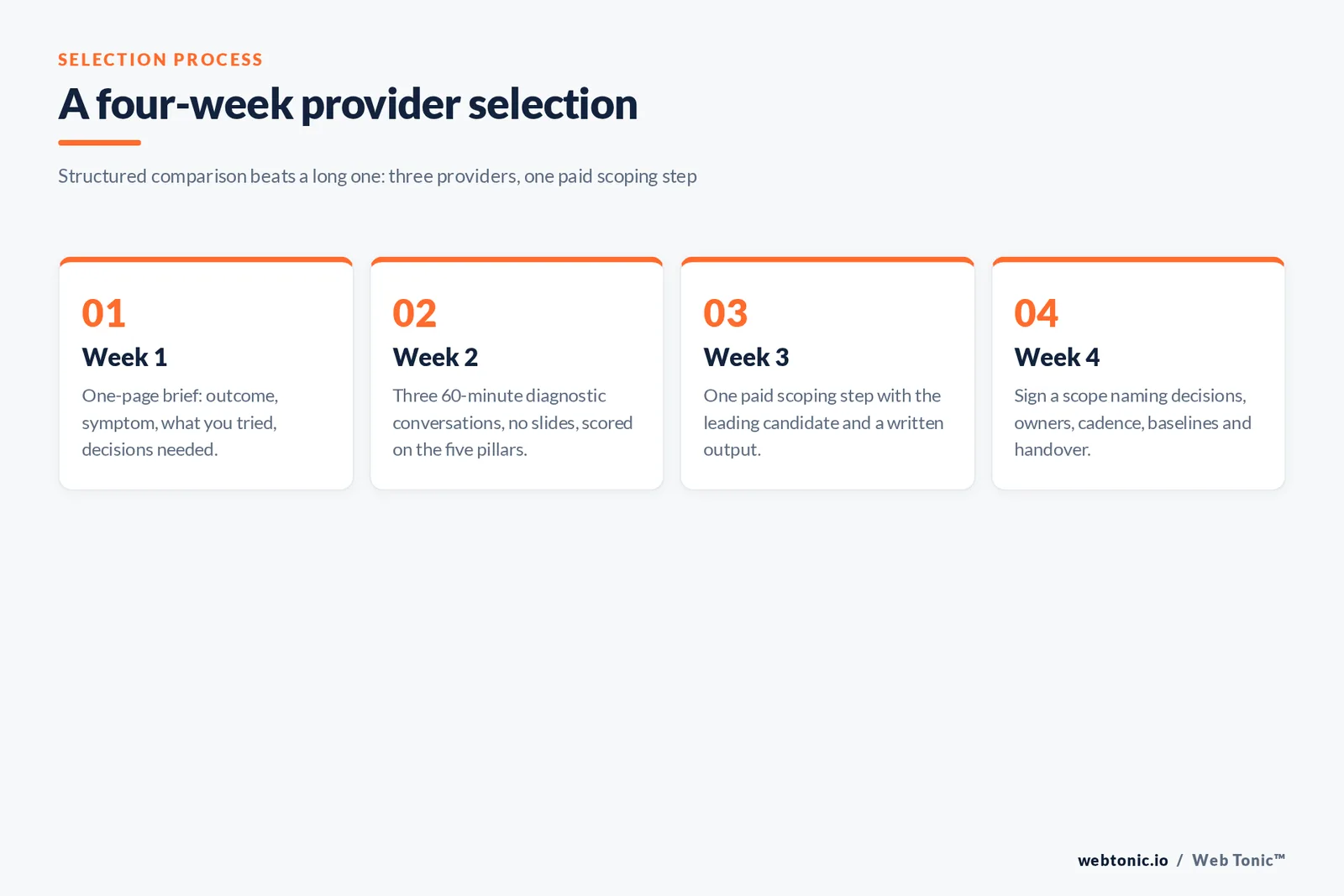
Long selection processes rarely improve the decision; structured ones do. A common six-step hiring sequence — define scope, set budget, source, evaluate references, run a paid trial, measure at 30/60/90 days — compresses comfortably into four weeks.
- Week one: write a one-page brief stating the business outcome, the symptom, what you have already tried, and the decisions you need made. Send the same brief to every provider.
- Week two: three diagnostic conversations, 60 minutes each, no slides. Score each on the five rows of the pillar table.
- Week three: one paid scoping step with the leading candidate — a small, defined diagnostic with a written output. This is the single most reliable predictor of the working relationship.
- Week four: sign a scope that names decisions, owners, cadence, measurement baselines and the handover artefact.
Two guardrails. Do not run more than three providers through the diagnostic stage; comparison quality degrades faster than option value grows. And keep the paid scoping step small enough that walking away is cheap.
What an advisory firm should bring beyond the plan
A good advisory firm brings three things a plan document cannot: expertise that is current, insights drawn from businesses at your stage, and ongoing support while the strategies are executed. Ask which of those you are actually buying. Some firms provide a strategic diagnosis and then leave; others provide ongoing advisors who sit in your operating reviews. Both models work, and they carry different costs and different risks.
Test how current the expertise is with specific, awkward questions. What has changed in the last twelve months in the channels you would fund? Which measurement systems and technology would you keep, replace or switch off? How do you handle a business whose reporting cannot yet answer basic questions? Advisors with real experience answer these in concrete terms and name the trade-offs. Generic answers about "data-driven growth" tell you the expertise is second-hand.
Also settle what support looks like after the plan is agreed. The most common gap is not analysis but follow-through: the strategy is clear, the internal team is busy, and nobody has time to keep the priorities in view. Providers who include a light ongoing cadence — a monthly review of the metric tree, one working session on the current constraint — usually deliver more value per dollar than those who deliver a large document and disappear.
Startups and established businesses face different challenges
The right provider depends on which set of challenges you have. A startup usually needs positioning, an offer that converts, and evidence that one channel works before the technology and systems get built out; the risk is over-engineering a growth engine before the market has confirmed anything. An established business usually has systems, brand equity and channel history, and its constraints are more often segmentation, pricing discipline, and priorities spread too thin across too many goals.
Say which of those you are in the brief. It changes the profile you want: early-stage work rewards advisors who are comfortable making clear calls on thin data, while a business with real history rewards analytical development of what the existing numbers already contain. A firm that recognises the difference without being told is demonstrating exactly the pattern recognition you are trying to buy.
References: ask better questions
Reference calls default to politeness. Replace "were you happy?" with three specific questions: which decision did the engagement change, what did you have to do internally to make it work, and what would you scope differently now? The third question surfaces the failure modes that show up in month four rather than month one.
Also ask what happened after the engagement ended. If the client cannot describe who owns the plan today, the work did not transfer — and transfer is the point. Marketing strategy consulting that leaves no documented plan, owner or dashboard behind has sold you a project rather than a capability.
What good looks like at day 30
You do not need to wait a quarter to know whether the choice was right. By day 30 a competent advisory engagement has produced a baseline of the numbers as they actually are, a shortlist of the two or three constraints worth working on, one uncomfortable finding you did not already know, and a written plan for the next 60 days with owners. Onboarding benchmarks put time-to-first-value at 14 days or less for engagements that go on to retain well, which is a fair standard for a first written finding.
If day 30 arrives with nothing but a status deck and a request for more access, stop and re-scope. That conversation is far cheaper in month one than in month six.

Related reading
- AI Marketing Advisory / AI Readiness: how to choose a provider
- Growth Consulting Statistics: ROI and Payback in 2026
- Marketing Audit / Growth Audit: how to choose a provider
- Marketing Strategy Consulting services at Web Tonic
Frequently Asked Questions
How is growth advisory different from a marketing agency retainer?
Advisory sells decisions and priorities; a retainer sells recurring execution. Both are legitimate, and many companies need each in sequence — the plan first, then the delivery capacity to run it. The failure mode is buying one while expecting the other.
Should I pay for a diagnostic before committing to a full engagement?
Usually yes. A paid diagnostic is the cheapest information you can buy about how a provider thinks, how they handle bad news, and whether their written work is any good. It also gives you a usable output even if you do not proceed.
How many providers should I compare?
Three at the diagnostic stage. Beyond that, conversations blur, timelines stretch, and the deciding factor drifts towards pitch quality rather than diagnostic quality.
What if my data is not good enough to be diagnosed?
That is a finding, not a blocker. Expect the first 30 days to include lead source hygiene, one agreed definition of a qualified opportunity and a single revenue source of truth. A rough baseline captured early beats a perfect dashboard in month four.
How long should a first engagement run?
Long enough to complete the decisions and short enough to judge honestly — typically 90 days for the plan, with an explicit renewal decision tied to the measurement frame agreed at kickoff.
Where to take this next
If you are comparing providers now, score them on the five pillar rows before you compare prices. Our growth advisory engagements are scoped around named decisions and owners, growth marketing delivers against the resulting plan, the wider services lineup covers execution once priorities are set, and the blog has more method detail. If you want a shortlist or a draft scope reviewed before you sign, send it over.
Sources
Bain & Company — 2026 B2B Growth Agenda survey
Harvard Business Review / Egon Zehnder — Why Some Companies Grow Rapidly While Others Stall
The Starr Conspiracy — ICP Benchmarks for B2B GTM
SBI Growth — While Growth Slows for Most, Leaders Take a Different Approach
Benchmarkit — 2025 B2B SaaS Performance Metrics
IndustryWeek / McKinsey — The Payoff from Investing in Pricing Capabilities
Consulting Demand — Consulting Fees & Rates by Industry
GTM 8020 — Marketing Consultant Rates & Comp Report
Sam Landenwitsch — The 2026 Rate Report
MarketerHire — How to Vet a Marketing Consultant
MarketerHire — How to Hire a Marketing Consultant
MyConsultBase — Consulting Client Onboarding Checklist


