Table of contents
A kitchen gut-renovation gives a contractor two minutes of footage for free: the demolition and the reveal. No study prices video marketing specifically for general contracting and remodeling, so this page applies Wyzowl's 2026 cross-industry adoption and ROI benchmarks, labelled honestly as cross-industry, against Houzz's renovation-scope and motivation data to size an actual video budget for the trade.
Key Takeaways
- 91% of businesses use video as a marketing tool in 2026, per Wyzowl (cross-industry).
- 93% of video marketers call it important to their overall strategy.
- Reported positive ROI fell to 82%, down from 93% in 2025.
- 92% of video marketers plan to spend the same or more on video in 2026.
- 69% of video marketers made social media video, the single most common format.
- 85% say video helped generate leads; 83% say it directly increased sales.
- 67% of non-users plan to start using video in 2026.
- 24% cite cost as their reason for not using video, tied with "not needed."
- 63% of video marketers have used AI to create or edit video, up from 51% in 2025.
- 67% of 2026 remodelers will keep or expand project scope, per Houzz.
- 78% of kitchen-renovating homeowners change the entire style, a visual transformation by definition.
- 91% of homeowners with a planned 2026 project say they will proceed regardless of caution.
- Median planned 2026 renovation spend is $15,000, down from $20,000 in 2025.
- The top 10% of 2025 projects reached $150,000+ in spend, per Houzz.
What "everyone uses video" actually means, cross-industry
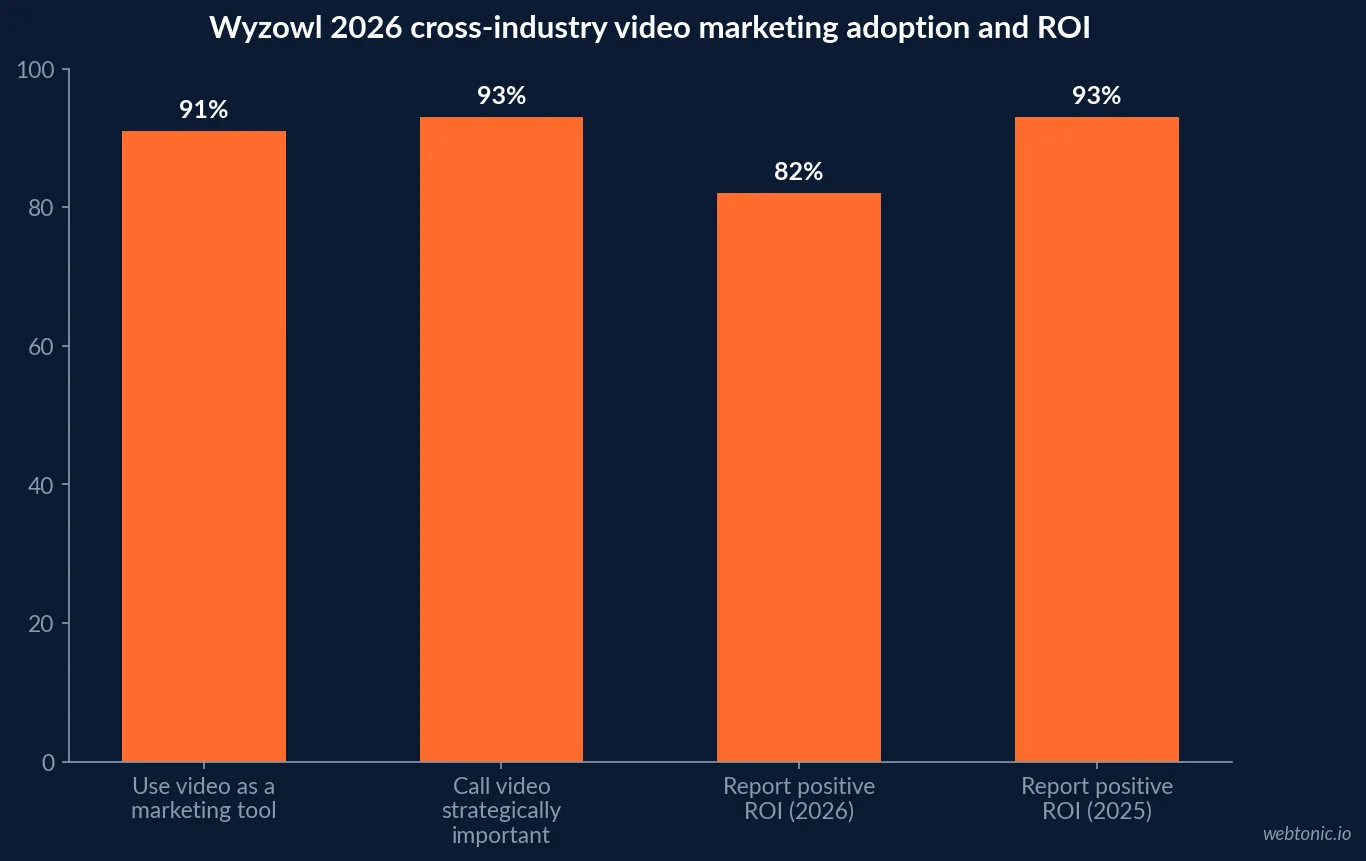
Wyzowl's State of Video Marketing 2026 report, its 12th consecutive year of the same tracking questions, surveyed 266 unique respondents in late 2025, splitting marketers from consumers with a screening question. It finds 91% of businesses use video as a marketing tool, back near its all-time high after a slight 2025 dip, and 93% of video marketers call it an important part of their overall strategy. None of that sample is remodeling-specific; it spans every industry the panel touched, and the report itself is self-reported perception data, not an audited outcome study.
The report's own reasons for non-adoption matter for a contractor sizing a first video budget: among the minority who still skip video, 24% say it is not needed and another 24% call it too expensive, with 19% citing lack of time. A trade that already stages a demolition and a reveal on every job removes most of that cost objection before the budget conversation starts.
| Wyzowl 2026 video marketing metric (cross-industry) | Figure |
|---|---|
| Businesses using video as a marketing tool | 91% |
| Video marketers who call it strategically important | 93% |
| Video marketers reporting positive ROI | 82% (down from 93% in 2025) |
| Plan to spend the same or more on video in 2026 | 92% |
| Non-users who plan to start in 2026 | 67% |
| Video marketers who have used AI to create/edit video | 63% (up from 51%) |
Why the ROI figure fell while adoption held
The gap is the real story: adoption stayed at 91% while reported ROI dropped nine points to 82%. Wyzowl does not isolate a single cause, but the same report shows 85% of video marketers say video helped generate leads and 83% say it directly increased sales, both still large majorities. The most defensible read is that more businesses are now measuring video against a standard rather than assuming it works, which is exactly the discipline a remodeling contractor should apply before setting a budget: film the transformation, then track it against form fills or booked estimates, not against a vague brand-awareness goal.
| Video marketing outcome (Wyzowl 2026, self-reported) | Share of video marketers |
|---|---|
| Helped generate leads | 85% |
| Directly increased sales | 83% |
| Increased website traffic and dwell time | 82% |
| Reported a good ROI overall | 82% |
| Made social media video (most common single format) | 69% |
The renovation itself is the production budget
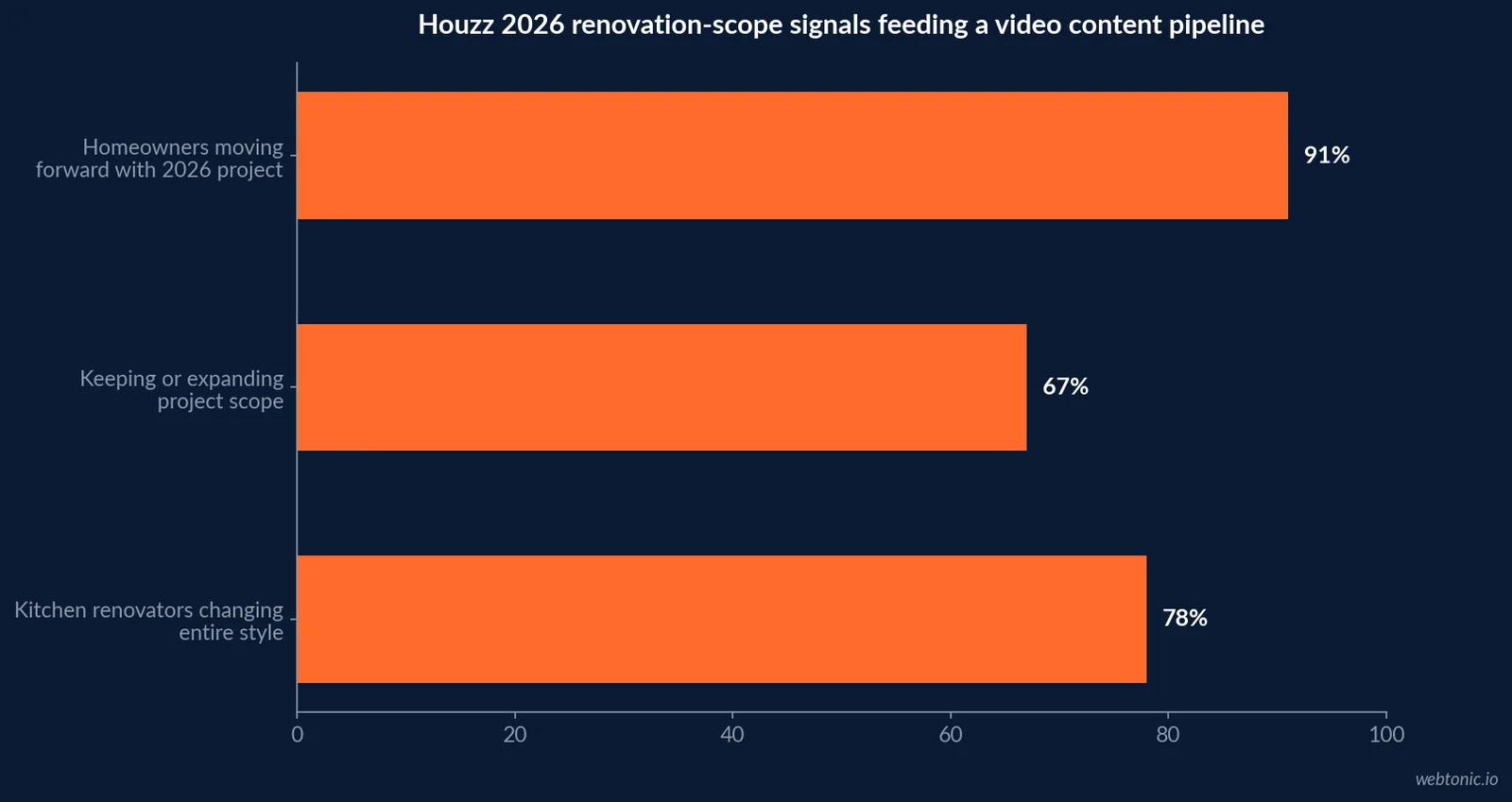
Houzz's 2026 U.S. Homeowner Renovation Plans Report found 91% of homeowners with a planned project say they will move forward regardless of broader caution, and 67% will keep or even expand their project scope rather than trim it. Separately, Houzz's 2026 Kitchen Trends Study, based on a survey of 1,780 U.S. homeowners, found 78% of renovating homeowners changed their kitchen's entire style, meaning most remodels are dramatic before/after transformations, not incremental touch-ups, which is the exact raw material a phone-shot time-lapse or reveal video needs.
That gives a general contractor a production shortcut most industries do not have: the job site supplies the footage. WordStream's 2026 Google Ads Benchmarks report separately puts Home & Home Improvement's average paid-search click-through rate at 6.47%, a normal result that means the same audience already clicking a remodeling ad will also watch a video once one is embedded on the page that click lands on. The budget question becomes editing, distribution and paid amplification of social video, not shooting it from scratch, which is where Wyzowl's 69% social-video figure and its adoption data actually apply.
| Houzz 2026 renovation-scope signal | Figure | What it gives a video budget |
|---|---|---|
| Homeowners moving forward with planned 2026 project | 91% | A steady pipeline of jobs to film |
| Homeowners keeping or expanding scope | 67% | Bigger, more visual transformations |
| Kitchen renovators changing the entire style | 78% | Dramatic before/after contrast |
| Median 2025 renovation spend | $20,000 | A budget that can absorb light production cost |
| Top 10% of 2025 project spend | $150,000+ | Flagship jobs worth a dedicated video |
A budget framework, not a guessed number
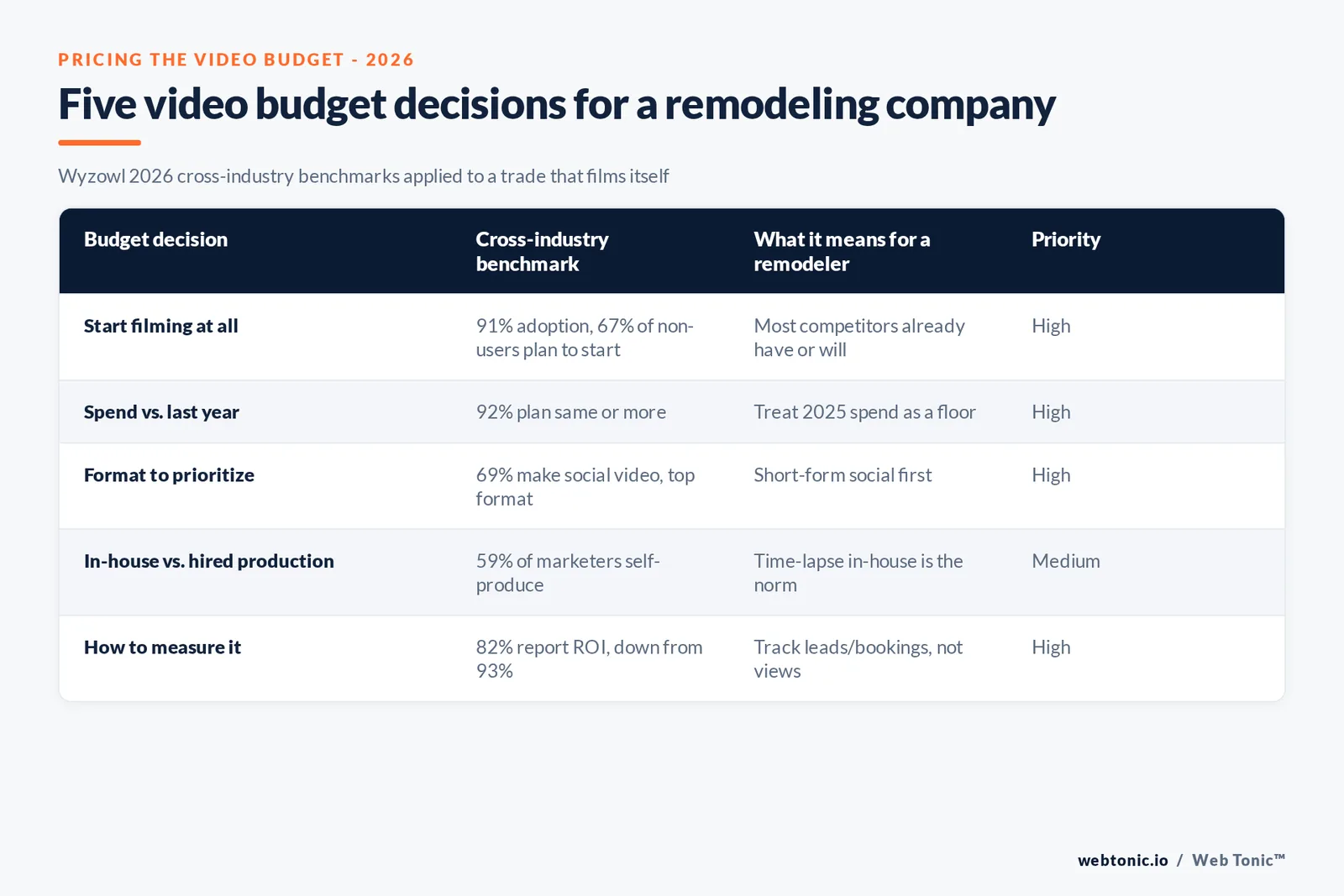
No named study prices a remodeling company's video line item in dollars, so the responsible framework is proportional, not absolute: treat video as replacing existing photography and testimonial spend first, then scale with the 92% of current video marketers who plan flat-to-up spending in 2026. A contractor already paying for after-project photos is close to a video budget already; the incremental cost is largely editing time and, per Wyzowl, a growing share (63%, up from 51%) now use AI tools to cut that cost further.
| Budget decision point | Cross-industry benchmark it maps to | What it means for a remodeler |
|---|---|---|
| Should we start filming at all | 91% adoption, 67% of non-users plan to start | Yes, most competitors already have or will |
| How much to spend relative to last year | 92% plan same or more | Treat 2025 spend as a floor, not a ceiling |
| Which format to prioritize | 69% make social video, the top single format | Short-form social first, long-form second |
| Whether to hire production or shoot in-house | 59% of marketers create video themselves | In-house time-lapse is the norm, not the exception |
| How to measure it | 82% report ROI vs. 93% a year earlier | Track leads/bookings, not just views |
Video is landing inside a review-driven decision, not instead of it
BrightLocal's 2026 Local Consumer Review Survey found consumers are increasingly turning to video-based sites for local recommendations, part of a wider shift where 41% now "always" read reviews first, up from 29% in 2025, and Google's own share of that review traffic slipped from 83% in 2025 to 71% in 2026 as consumers diversify across platforms. A reveal or time-lapse video embedded on a Google Business Profile or a review-adjacent page is landing in front of a homeowner who is already primed to trust visual, third-party-feeling proof over a text testimonial alone.
That same survey found 89% of consumers expect a business owner to respond to reviews and 80% are more likely to use a business that responds to every one, which argues for pairing video content with active review management rather than treating the two as separate marketing lines.
| BrightLocal 2026 signal relevant to video placement | Figure |
|---|---|
| Consumers who "always" read reviews before choosing a business | 41% (up from 29%) |
| Google's share of review traffic, 2025 to 2026 | 83% down to 71% |
| Consumers who expect an owner to respond to reviews | 89% |
| Consumers more likely to use a business that responds to every review | 80% |
The channels a video budget should actually feed
CallRail's "From Conversations to Conversions" report, drawn from 1.1 million de-identified leads across seven industries, found the top three channels driving qualified leads are Google Ads (47%), organic search (23%) and Google My Business (15%). None of those three is a native video platform, which means the practical home for a remodeling company's video content in 2026 is embedded on the landing pages and Business Profile those channels already send traffic to, not built around a stand-alone video-platform ad buy the trade has no pricing data for yet.
| Channel driving qualified leads (CallRail, cross-industry) | Share | Where video should live |
|---|---|---|
| Google Ads | 47% | Video embedded on the landing page the ad sends traffic to |
| Organic search | 23% | Video embedded on service pages ranking organically |
| Google My Business | 15% | Video posts and reels on the Business Profile itself |
The demand backdrop a video budget is filming against
The renovation pipeline funding this video content is itself resilient: Harvard's Joint Center for Housing Studies projects $519 billion in annual home improvement and repair spending through mid-2027, and NAHB's Remodeling Market Index held at 61 in Q2 2026, in positive territory for a full year. Neither figure is video-specific, but both argue against treating a video program as a discretionary line item that gets cut first when a contractor tightens its budget; the underlying demand for the work being filmed is not the part of the business that is softening.
Where this fits with the rest of the marketing mix
Video works best once it has somewhere to send the viewer; our Facebook Ads cost breakdown and social media marketing benchmarks cover the distribution side of that pairing. If your remodeling company is sitting on unedited job-site footage from every project this year, our performance creative team can turn it into a budgeted video program instead of a folder of clips, or talk to us about where to start.
Frequently Asked Questions
Is there a remodeling-specific video marketing study?
No. Wyzowl's State of Video Marketing report, now in its 12th year and built from 266 marketer and consumer respondents surveyed in late 2025, is a cross-industry, self-reported study, not a remodeling-only sample. Every adoption, ROI and spend figure below is that cross-industry benchmark, labelled as such, applied to a trade that happens to generate footage as a byproduct of the job itself: a gutted kitchen and a finished one, filmed for free.
What share of a remodeling contractor's marketing budget should go to video?
There is no published per-trade allocation figure, so the honest anchor is adoption plus intent: 91% of businesses across Wyzowl's panel already use video, and 92% of current video marketers plan to spend the same or more in 2026. For a remodeling company, most of that spend replaces existing photography and testimonial budgets rather than adding a new line item, since a phone-shot time-lapse of a real job costs closer to the price of a tripod than a production budget.
Why did reported video ROI drop from 93% to 82% in one year?
Wyzowl's own 2026 data shows video marketers reporting a positive ROI fell from 93% in 2025 to 82% in 2026, even as adoption held at 91%. The report does not give a single cause, and this is a self-reported perception metric, not an audited revenue figure, but the gap between near-universal adoption and softening reported ROI is itself the signal: more businesses are now measuring video against a standard, not just running it because everyone else does.
Does the renovation itself give a contractor something worth filming?
Yes, repeatedly. Houzz's 2026 Renovation Plans Report found 67% of committed 2026 remodelers plan to keep or expand their project scope, and separately its Kitchen Trends Study shows 78% of renovating homeowners are changing their kitchen's style entirely, meaning most jobs are dramatic, visual transformations by definition, the exact format (69% of Wyzowl's video marketers cite social video, the single most common use case) video marketing already over-indexes on.
What is the actual downside of skipping video as a remodeling contractor?
Per Wyzowl, 24% of non-video businesses cite cost as their reason for not using it and another 24% say it is simply not needed, but those are self-reported justifications, not evidence video failed for them; the same report finds 67% of current non-users plan to start in 2026 anyway. For a trade whose raw material is a literal before-and-after transformation, the cost argument is weaker than in most industries, since production cost can be a phone and a tripod rather than a crew.
Sources
Wyzowl - State of Video Marketing Statistics 2026
Houzz - 2026 U.S. Homeowner Renovation Plans Report
Houzz - 2026 U.S. Houzz Kitchen Trends Study
Houzz - 2026 U.S. Houzz and Home Renovation Trends Study
NAHB - Remodeling Market Index Full Report, Q2 2026
Harvard Joint Center for Housing Studies - Leading Indicator of Remodeling Activity, July 2026
WordStream - Search Advertising Benchmarks by Industry 2026
BrightLocal - Local Consumer Review Survey 2026
CallRail - From Conversations to Conversions: How Small Businesses Can Market Smarter