Table of contents

A homeowner planning a kitchen remodel is not on LinkedIn during that decision, but the architect who refers the job, the subcontractor a contractor is trying to hire, and the property manager commissioning a multifamily renovation program all are. No published study prices LinkedIn specifically for general contracting and remodeling, so this page separates those three real B2B buyers and applies the best available 2026 data to each, labelling every cross-industry figure as such.
Key Takeaways
- Residential architecture firm billings have declined since 2022, per AIA's Q2 2026 survey.
- Kitchen/bath remodeling billings are still growing as a share of that shrinking pie.
- Residential remodeling employment fell to 454,100 workers in Q2 2026, down 1.0% year over year.
- Remodeling now represents over 49% of all residential building construction employment.
- Remodeler input costs rose 6.6% year over year in Q2 2026, per NAHB's Remodeling Input Price Index.
- 72% of multifamily investors plan to expand their portfolios in 2026, per Berkadia.
- Value-Add strategy, which depends on unit renovation, is investors' top pick for 2026.
- A good cross-industry LinkedIn cost per lead is under $67 for a content offer (Kiin Labs).
- Civil Engineering's LinkedIn content lead costs $73, the closest adjacent-trade figure published.
- A good LinkedIn Lead Gen Form completion rate is 18.7%, median 10.8%.
- 91% of thought leader ad clicks never reach a landing page at all, cross-industry.
- NAHB's Remodeling Market Index held at 61 in Q2 2026, its leads component alone at 51.
Three B2B buyers, not one homeowner
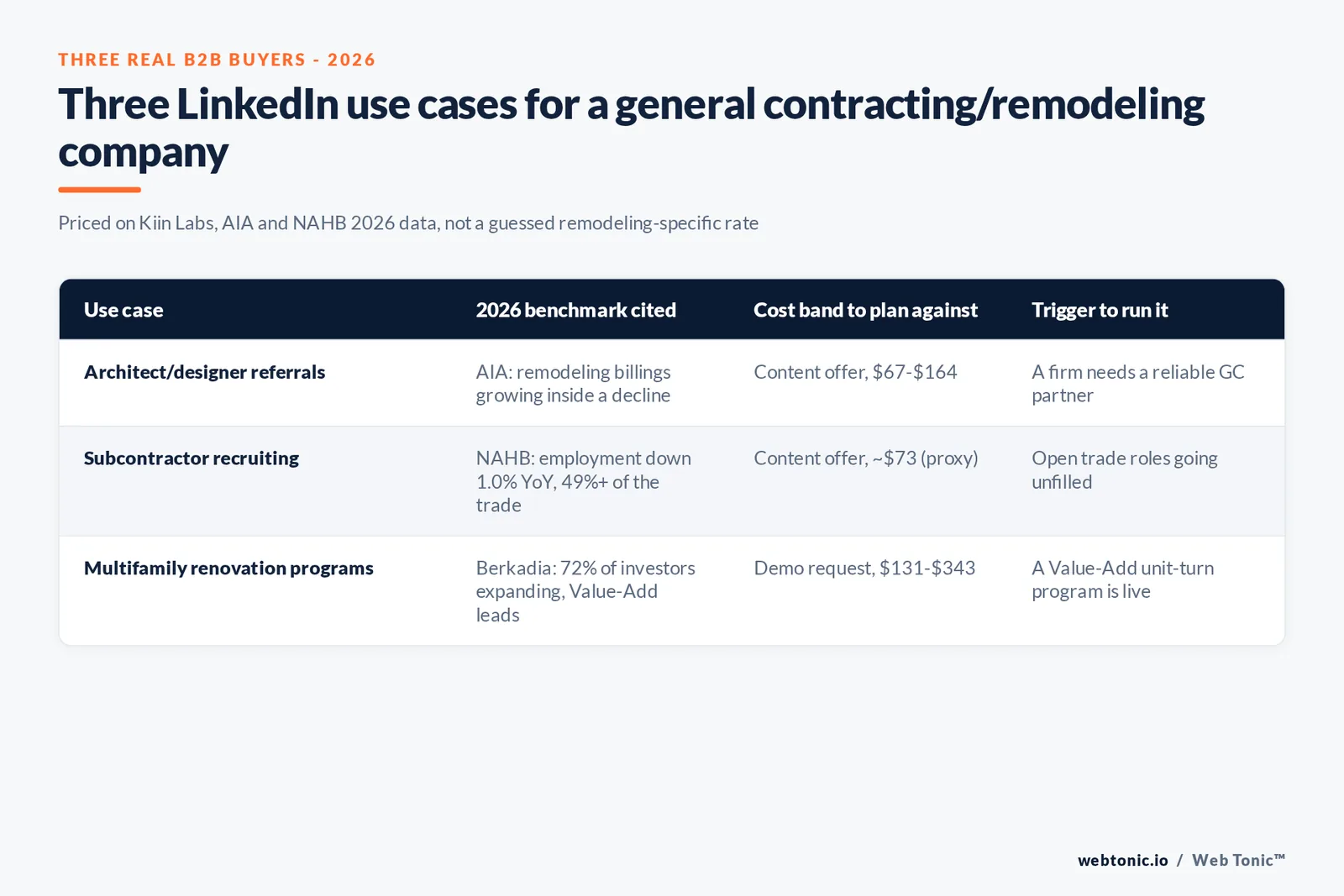
LinkedIn's targeting is built from job titles and company data, which points a remodeling contractor at exactly three plausible audiences: referring architects and interior designers who recommend a contractor to their own clients, subcontractor and tradesperson candidates a growing remodeling segment needs to hire, and multifamily or property-management decision-makers commissioning unit-renovation programs at scale. None of the three resembles the retail homeowner shopping a single kitchen remodel, and treating LinkedIn as a consumer-facing channel wastes budget that belongs in search or social instead.
| LinkedIn use case | Who is targeted | Evidence it exists as a real buyer | What it cannot do |
|---|---|---|---|
| Architect/designer referral relationships | Principals, project architects | AIA billings show remodeling share growing inside a shrinking pie | Cannot replace direct homeowner leads |
| Subcontractor/trade recruiting | Certified tradespeople, foremen | Remodeling employment down 1.0% YoY despite 49%+ share of the trade | Thin reach among newest trade-school entrants |
| Multifamily renovation programs | Asset/property managers | 72% of investors plan portfolio expansion, Value-Add is the top strategy | Not a path to single-unit retail jobs |
| General homeowner awareness | Retail remodeling shoppers | No evidence they are reachable here | Nothing distinctive; wrong channel entirely |
The architect referral channel is shrinking but concentrating in remodeling
AIA's Q2 2026 Home Design Trends Survey, drawn from a panel of 300+ residential architecture firms, shows overall project billings, inquiries and design contracts on a downward trajectory since 2022. Inside that decline, the survey's own project-type breakdown shows remodeling (kitchen/bath and additions/alterations) among the categories still growing, while custom/luxury new-build work and first-time-buyer/affordable home design have pulled back further. A residential architecture firm doing more of its surviving business in remodeling is a firm more likely to need a reliable general-contractor referral partner, and LinkedIn is the channel where that firm's principals and project architects are professionally reachable.
| AIA Q2 2026 Home Design Trends Survey signal | Direction since 2022 | Relevance to a remodeling GC |
|---|---|---|
| Overall project billings | Declining | Fewer total architect-referred jobs in the pipeline |
| Design contracts | Declining | Slower-moving referral relationships to build |
| Kitchen/bath remodeling billings | Growing | The exact project type a remodeling GC wants referred |
| Additions/alterations billings | Growing | A second growing referral category |
| Custom/luxury new-build billings | Declining sharply | Architect firms shifting focus toward remodel work |
The cross-industry LinkedIn cost data, applied honestly
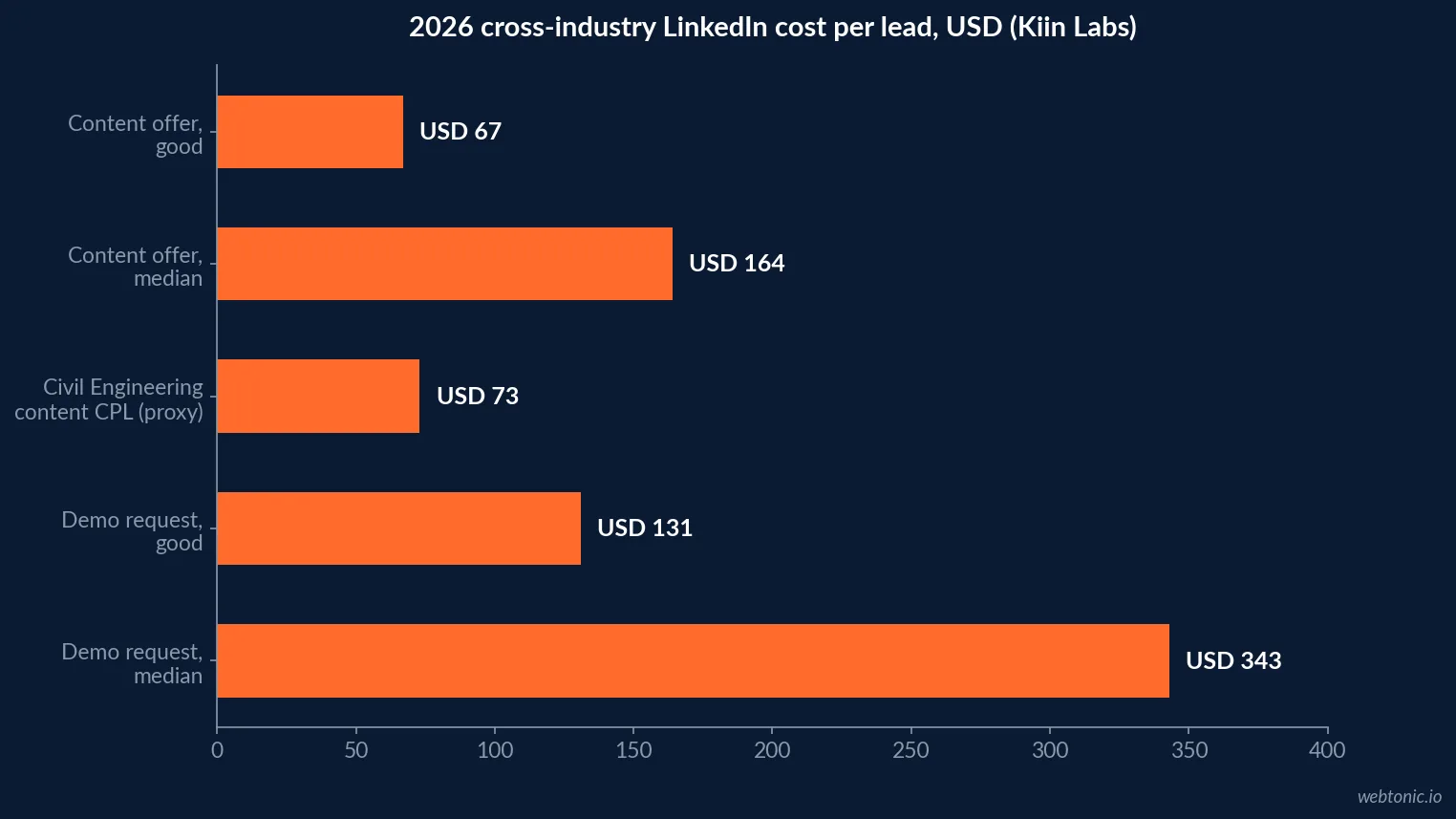
Kiin Labs' 2026 LinkedIn Ads Benchmarks, built from a whole-panel cut of 1,000-plus advertiser accounts and $58 million of spend across every format and objective from September 2025 to September 2026, reports a good cost per lead under $67 for a content offer (median $164) and under $131 for a demo request (median $343), a good Lead Gen Form completion rate of 18.7% (median 10.8%), and a striking 91% of thought leader ad clicks that never reach a landing page at all. No industry cut in that dataset isolates general contracting or remodeling; the closest adjacent-trade figure published is Civil Engineering at $73 for a content-offer lead, which this page uses as the most defensible proxy available, not a quote.
| Metric (Kiin Labs 2026, cross-industry) | Good | Median | Which remodeling use case it maps to |
|---|---|---|---|
| Cost per lead, content offer | <$67 | $164 | Architect/designer newsletter or resource downloads |
| Cost per lead, demo request | <$131 | $343 | Multifamily renovation program inquiries |
| Civil Engineering CPL, content (closest adjacent-trade figure) | n/a | $73 | Best available proxy for skilled-trade content |
| Lead Gen Form completion rate | 18.7% | 10.8% | Recruiting and referral-partner forms |
| Thought leader ad clicks reaching a landing page | 9% | n/a | Sets expectations for awareness-only spend |
The strongest case: recruiting inside a shrinking, growing-share workforce
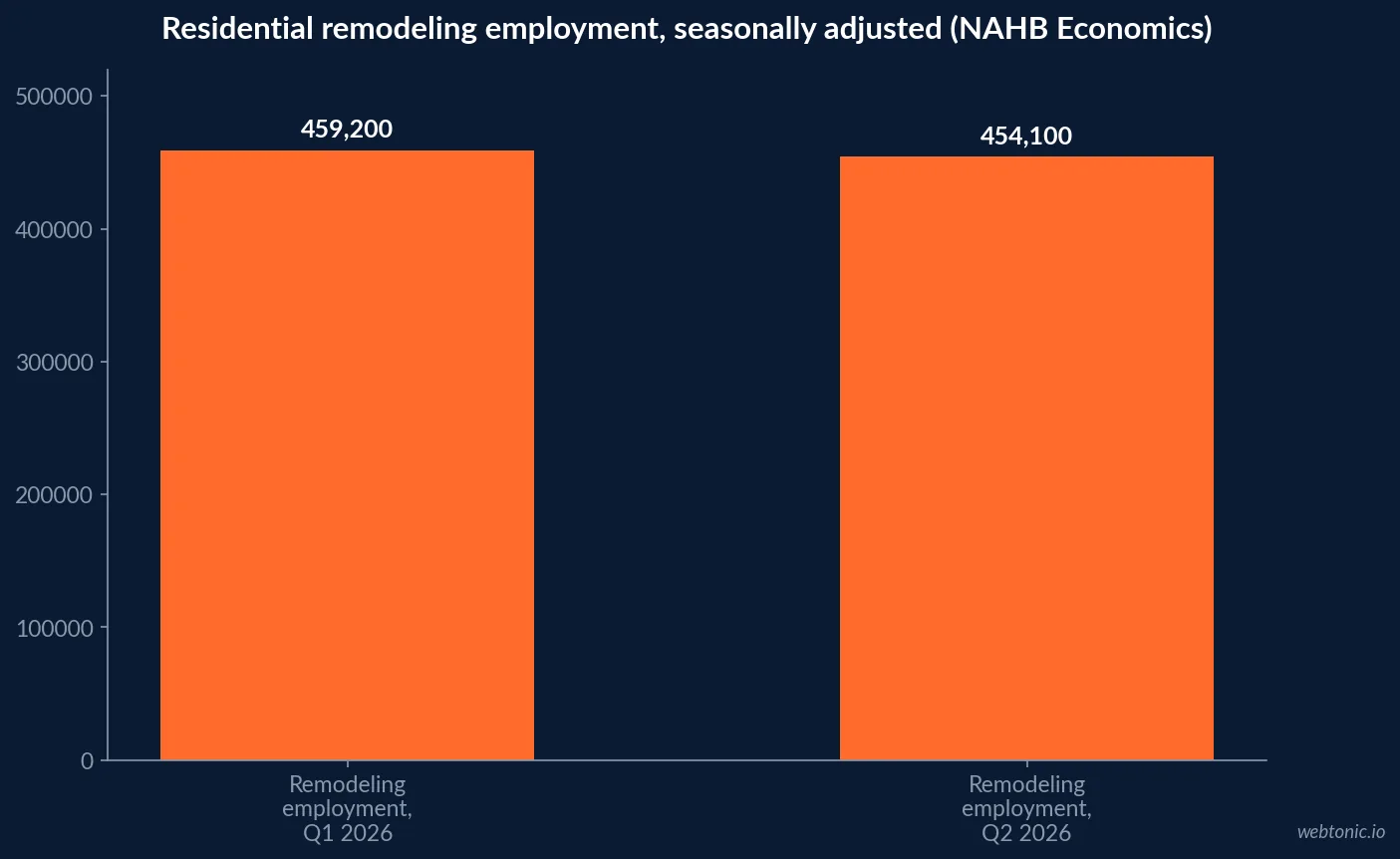
NAHB Economics reports residential remodeling employment at 454,100 workers in Q2 2026, down 5,100 from Q1 2026 and down 1.0% year over year, even as remodeling now accounts for over 49% of total residential building construction employment, up more than 19% from its pre-pandemic level. Input costs for remodelers, tracked by NAHB's Remodeling Input Price Index, rose 6.6% year over year in the same quarter, up from 3.9% the prior quarter. A workforce that is shrinking while its share of the trade grows, inside rising input costs, is a hiring problem LinkedIn's seniority and certification filters are built to solve, more directly than either of the other two use cases.
| NAHB remodeling labor/cost signal, Q2 2026 | Figure |
|---|---|
| Residential remodeling employment | 454,100 workers |
| Change vs. Q1 2026 | -5,100 |
| Year-over-year change | -1.0% |
| Share of residential building construction employment | 49%+ |
| Growth vs. pre-pandemic level | +19% |
| Remodeling Input Price Index, YoY | +6.6% |
| Remodeling Input Price Index, prior quarter | +3.9% |
Why the labor gap matters more now, not less
The workforce shortage above is landing on top of rising demand, not falling demand. Harvard's Joint Center for Housing Studies projects $519 billion in annual remodeling and repair spending through mid-2027, and Houzz's 2026 U.S. Houzz & Home Study found the top 10% of renovation projects reached $150,000 or more in 2025, up from $140,000 the year prior. A contractor short on qualified tradespeople heading into that demand curve has a narrower window to win the architect referrals and multifamily contracts covered above before capacity, not demand, becomes the limiting factor.
The multifamily renovation buyer, priced separately
Berkadia's second annual Multifamily Investor Sentiment Survey, covering 250+ senior-level clients plus 79 investment sales advisors and 131 mortgage bankers, found 72% of investors plan to moderately expand their portfolios in 2026, with Core-Plus and Value-Add strategies named the most desirable for risk-adjusted returns. Value-Add investing depends on unit-level renovation to justify higher rents, which makes the asset managers and property operators executing that strategy a genuine LinkedIn-reachable buyer for a remodeling contractor built to handle multi-unit turn programs, distinct from either the architect-referral or the recruiting use case above.
The industry-wide labor backdrop behind the recruiting case
The Associated General Contractors of America and NCCER's 2026 Workforce Survey, covering construction firms nationally, found 87% of firms have open hourly craft positions and 82% have open salaried positions, with 88% of firms with craft openings reporting those roles as hard or harder to fill than a year ago, including 50% calling them harder. Half of respondents say available candidates lack the skills or certification the role requires. Despite 37% of firms cutting headcount by at least 5% in the past year against softer market conditions, nearly three-quarters (73%) still expect to add employees in the next 12 months, evidence that this is a structural skills gap, not a cyclical hiring pause a contractor can wait out.
| AGC/NCCER 2026 Workforce Survey signal | Figure |
|---|---|
| Firms with open hourly craft positions | 87% |
| Firms with open salaried positions | 82% |
| Craft openings as hard or harder to fill than a year ago | 88% |
| Firms calling craft openings harder to fill | 50% |
| Firms citing unqualified candidates as the top hiring obstacle | 50% |
| Firms cutting headcount 5%+ in the past year | 37% |
| Firms still expecting to add employees in the next 12 months | 73% |
The cheapest lead format on the platform, if recruiting is the goal
Kiin Labs' companion research on LinkedIn message and conversation ads, drawn from $7.7 million of sponsored messaging spend across 263 accounts, found message ads produce the cheapest lead format on the platform: $56 per content-offer lead and $175 per demo-request lead, both well under the Lead Gen Form medians of $164 and $343 covered above. For a recruiting message aimed at a certified tradesperson, a direct message format priced near $56 is a more defensible test budget than a broad content-offer campaign priced at the $164 median.
| LinkedIn ad format (Kiin Labs 2026, cross-industry) | Content-offer CPL | Demo-offer CPL |
|---|---|---|
| Lead Gen Form (feed) | $164 median | $343 median |
| Message/conversation ad | $56 | $175 |
A launch checklist before spending on LinkedIn
- Pick exactly one use case per campaign: architect referrals, trade recruiting, or multifamily renovation programs. Do not blend them into one generic "remodeling company" ad.
- Budget architect-referral and recruiting content against the content-offer band (under $67 good, $164 median); budget multifamily program outreach against the demo-request band ($131-$343).
- Use the Civil Engineering $73 content-CPL figure only as a directional proxy, never a promised cost, since no dataset actually measures general contracting or remodeling on LinkedIn.
- Track recruiting campaigns against the 454,100-worker, -1.0% YoY backdrop; a flat hire rate in that market is a good result, not a failure.
- Reserve a small test budget rather than a full media shift, since 91% of thought leader ad clicks never reach a landing page regardless of industry.
Where this fits alongside your other channels
LinkedIn is a supporting, B2B-only channel here; the retail homeowner search demand still runs through Google Ads and landing page conversion work, which our other pages in this series cover in depth. If architect referrals, trade recruiting or a multifamily renovation pipeline is a real revenue line for your company, our growth marketing team can scope a narrowly targeted LinkedIn test against the benchmarks above, or talk to us about which of the three use cases fits first.
Frequently Asked Questions
Should a residential remodeling contractor advertise on LinkedIn at all?
Only to reach the three buyers who are actually there: referring architects and interior designers, skilled-trade subcontractor candidates, and multifamily or property-management decision-makers commissioning unit renovations. A homeowner shopping a kitchen remodel is not scrolling LinkedIn during that decision; a residential architecture firm deciding which general contractor to recommend for its next project is a far more plausible LinkedIn audience, and that referral relationship is measurable through AIA's own billings data.
Is there a published LinkedIn benchmark specifically for general contracting and remodeling?
No. Kiin Labs' 2026 studies, pooling more than 1,000 advertiser accounts and $58 million of spend across every industry, do not break out a general-contracting or remodeling row; their published industry cut lists Civil Engineering at $73 for a content-offer lead, the closest adjacent trade category available, and every cost figure applied to remodeling in this article is that cross-industry or adjacent-industry data, labelled as such rather than presented as a remodeling-specific quote.
Why would architects matter to a general contractor's LinkedIn strategy?
Because referral flow between them is real and currently under pressure. AIA's Q2 2026 Home Design Trends Survey, a panel of 300+ residential architecture firms, shows overall billings, inquiries and design contracts on a downward trajectory since 2022, even as the remodeling sub-segment (kitchen/bath and additions/alterations) keeps growing as a share of that shrinking pie. A contractor with a LinkedIn presence aimed at architecture firms is fishing in a smaller pond that is nonetheless growing its remodeling share.
Is subcontractor recruiting a stronger LinkedIn use case than architect outreach?
The labor data says it might be the strongest use case of the three. NAHB Economics reports residential remodeling employment at 454,100 workers in Q2 2026, down 5,100 from Q1 and down 1.0% year over year, even as the segment now represents over 49% of all residential building construction employment. A shrinking labor pool inside a growing employment share is exactly the kind of seniority- and skill-filtered recruiting problem LinkedIn's targeting was built to solve.
What does a multifamily renovation buyer look like on LinkedIn?
A property manager or asset manager, not a resident. Berkadia's 2026 Multifamily Investor Sentiment Survey found 72% of investors planning to moderately expand their portfolios in 2026, with Core-Plus and Value-Add strategies (which depend on unit renovation to raise rents) named the most attractive risk-adjusted approach for the year. That is a distinct commercial buyer from either the architect referral relationship or the retail homeowner, and LinkedIn's company-size and job-title targeting reaches that buyer far better than a consumer channel would.
Sources
AIA - Home Design Trends Survey, Q2 2026
NAHB Eye on Housing - Q2 2026 Remodeling Market Update: Labor and Input Costs
NAHB - Remodeling Market Index Full Report, Q2 2026
Kiin Labs - LinkedIn Ads Benchmarks 2026
Kiin Labs - LinkedIn Cost Per Lead by Industry 2026
Berkadia - 2026 Multifamily Investor Sentiment Survey
Associated General Contractors of America / NCCER - 2026 Workforce Survey
Kiin Labs - 100 LinkedIn Ads Statistics for 2026
Harvard Joint Center for Housing Studies - Leading Indicator of Remodeling Activity, July 2026
Houzz - 2026 U.S. Houzz and Home Renovation Trends Study