Table of contents
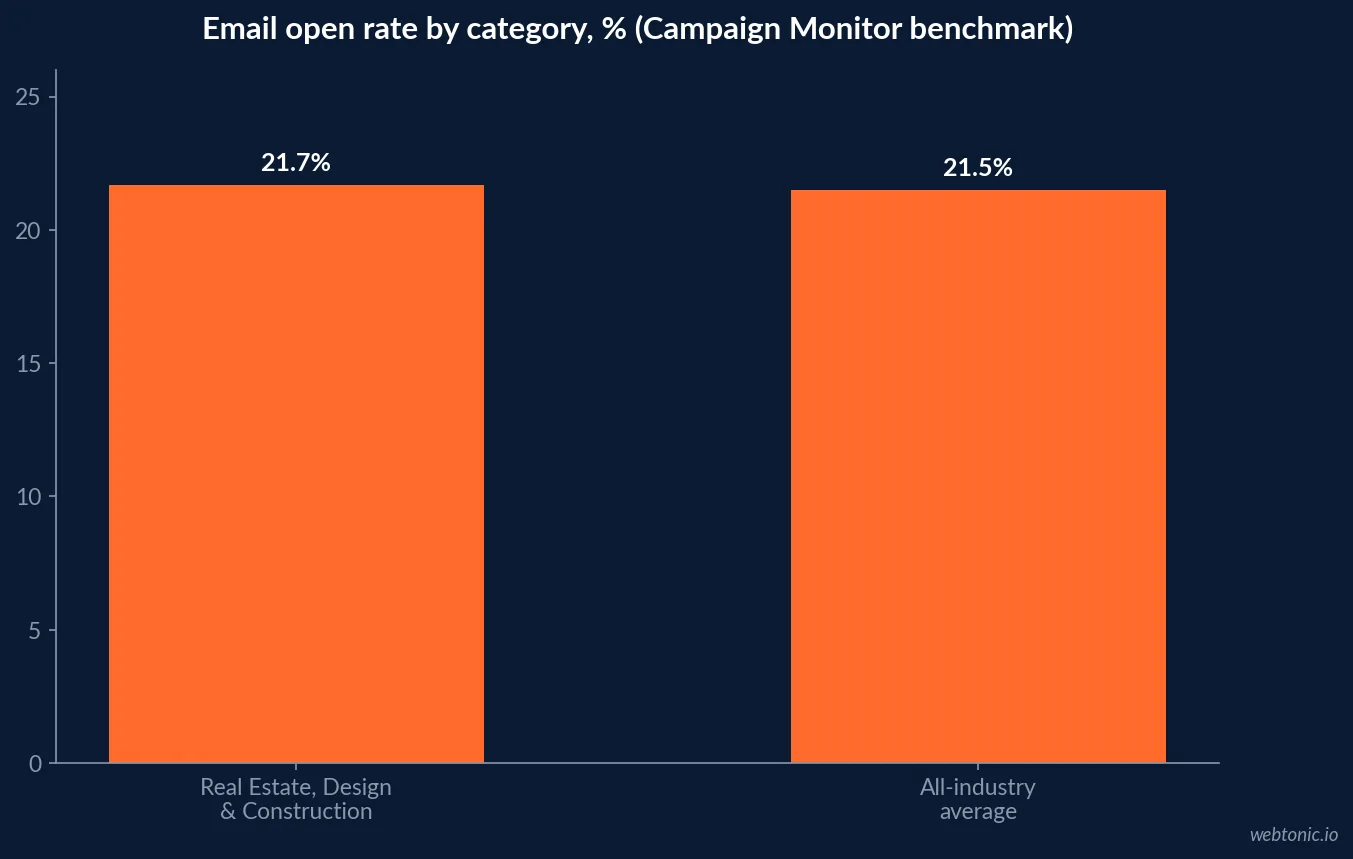
Campaign Monitor's benchmark data puts the Real Estate, Design & Construction email category at a 21.7% open rate, almost exactly the 21.5% all-industry average. This page treats that number as a starting line, not a target, and splits a remodeling contractor's email program into two distinct jobs: cold prospecting email and the homeowner newsletter.
Key Takeaways
- The Real Estate, Design & Construction category posts a 21.7% open rate.
- That is close to the 21.5% all-industry average open rate.
- The category sits in the 3-5% click-through-rate band, above the 2.3% all-industry average.
- All-users email benchmarks show a 35.63% average open rate and 2.62% click rate on newer platform data.
- 45% of home-services leads convert on the call once a person answers.
- Only 52% of inbound calls to home-services businesses are answered at all.
- 58% of recent pro-hirers completed a repair, not a remodel, in the past month.
- 63% completed maintenance work instead of a discretionary renovation.
- 47% of consumers won't use a business with fewer than 20 reviews.
- 74% only trust reviews written in the last three months.
- The median 2025 renovation spend held at $20,000 per Houzz's 2026 study.
- 91% of renovating homeowners hire at least one professional for their project.
- The average project uses 1.6 hired professionals, per the same Houzz study.
- 75% of homeowners set an initial budget, and 37% exceed it.
The category benchmark, and why it is close to average
Campaign Monitor's benchmark report groups remodelers, architects and real estate firms under one "Real Estate, Design & Construction" line. That category posted a 21.7% open rate, landing almost exactly on the 21.5% all-industry average. Where the category distinguishes itself is engagement after the open: it sits among the higher click-through-rate bands Campaign Monitor tracks - roughly 3-5%, alongside Education and Agriculture - against a 2.3% all-industry click-through average.
A newer cross-platform read gives a rough sense of where benchmarks sit today: an all-users average of 35.63% open rate and 2.62% click rate. The two data sets come from different platforms and years, so treat the gap as a reminder to benchmark against your own list rather than chase either number directly.
| Email metric | Real Estate, Design & Construction | All-industry benchmark | Source |
|---|---|---|---|
| Open rate | 21.7% | 21.5% | Campaign Monitor |
| Click-through rate | 3-5% band | 2.3% | Campaign Monitor |
| Open rate (newer, all-users) | n/a category-specific | 35.63% | Mailchimp (all users) |
| Click rate (newer, all-users) | n/a category-specific | 2.62% | Mailchimp (all users) |
Cold email: reaching the audience that isn't on your list yet
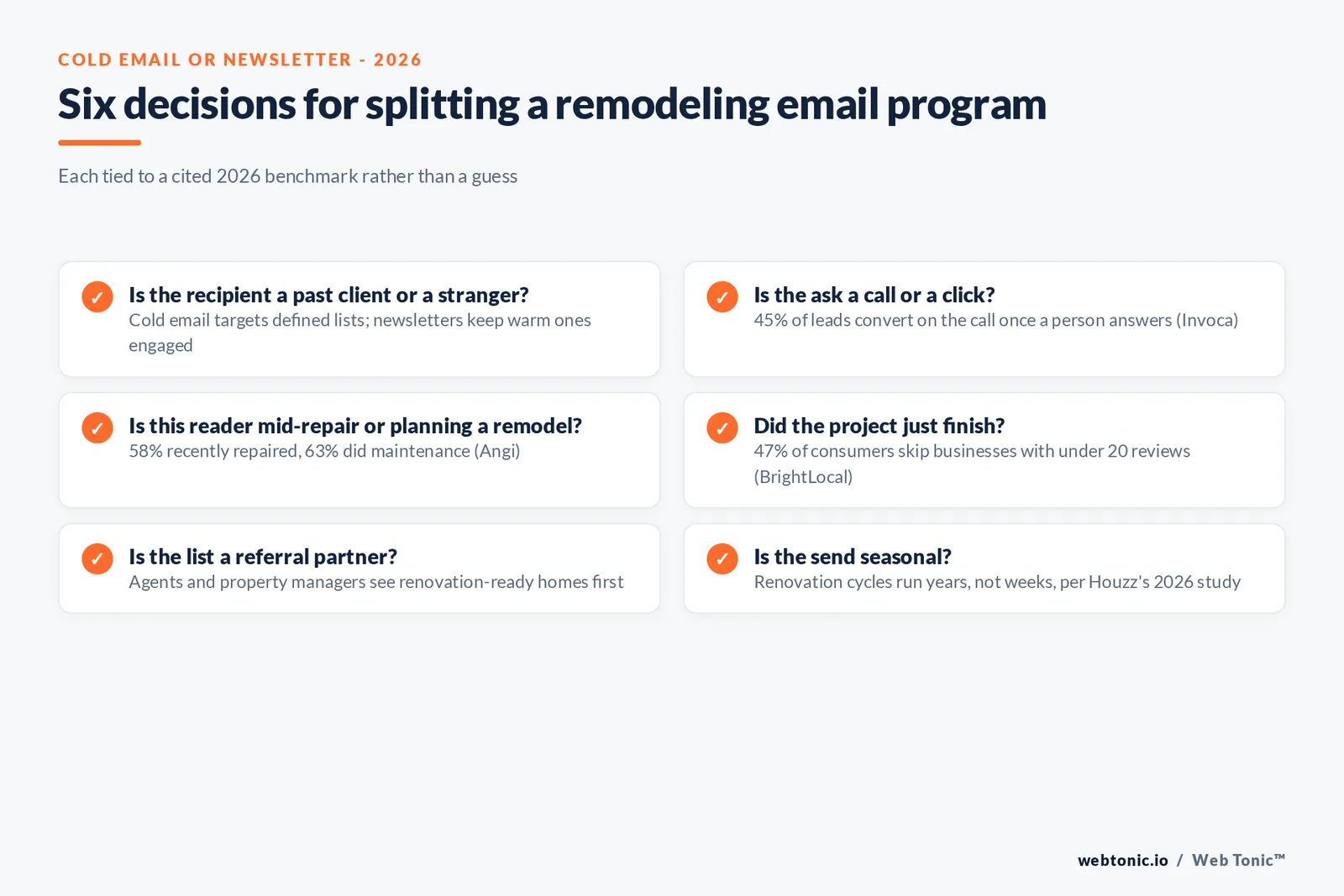
Cold email works on a defined universe - property managers with recurring maintenance contracts, general contractors' past clients due for a follow-up project, or referral partners like real estate agents and interior designers who see renovation-ready homeowners before a contractor does. The goal is never the open; it is the reply or the call, and Invoca's 2026 data on what happens next is the number that actually matters: 45% of leads convert on the call once a person picks up, but only 52% of inbound calls are answered by a person at all.
A cold email that routes to a phone number nobody answers is not an email problem - it exposes a staffing gap that no subject line can fix. Fix call coverage before scaling cold volume.
| Cold email target list | Why it converts | What to send first |
|---|---|---|
| Past clients (12-36 months out) | Renovation cycles run years, not weeks | A project-specific follow-up, not a blast |
| Property managers / landlords | Recurring, higher-frequency need | A maintenance-contract pitch |
| Real estate agents | See renovation-ready homes pre-listing | A referral-partnership offer |
| Past estimate requests, no close | Already qualified once | A revised scope or seasonal reminder |
The newsletter: staying visible through a multi-year renovation cycle
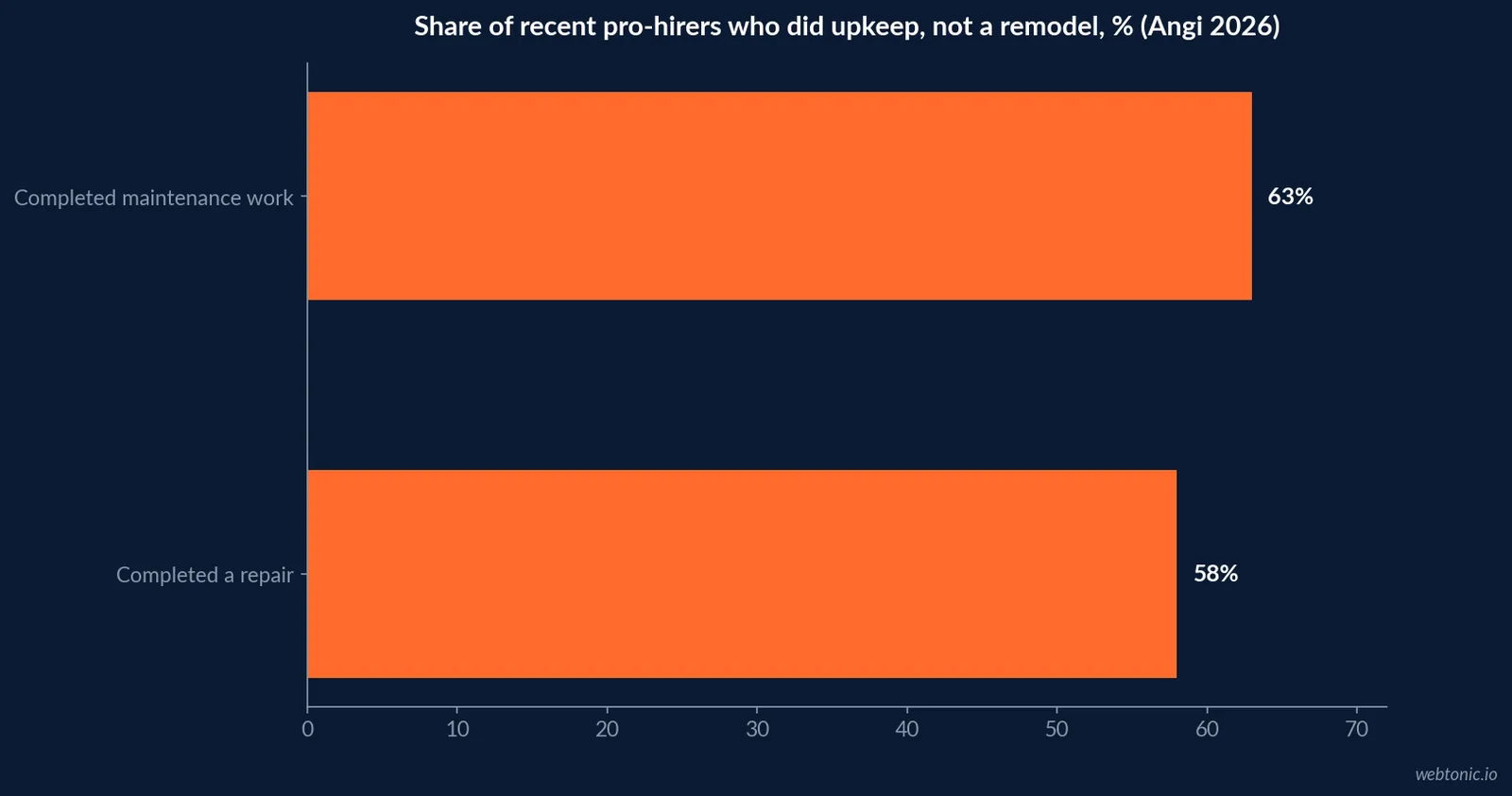
Houzz's 2026 U.S. Houzz & Home Renovation Trends Study shows why a newsletter earns its keep even when nobody replies to it: the median 2025 renovation spend held at $20,000, and 91% of renovating homeowners hire at least one professional, using an average of 1.6 professionals per project. That is not a fast-moving purchase decision, and Angi's 2026 data shows most of the audience is not even in remodel mode right now: 58% completed a repair and 63% completed maintenance work in the past month rather than a discretionary renovation.
A newsletter's job is to stay in that inbox across the gap between "just fixed something" and "ready to remodel," using seasonal maintenance reminders, past-project photos and a review-request cadence that does not require the reader to be ready to buy today.
| Newsletter content type | Who it's for | What it should drive |
|---|---|---|
| Seasonal maintenance reminders | The 58-63% currently in repair mode | Smaller, faster-close bookings |
| Past-project photo features | Homeowners early in planning | Estimate requests, portfolio views |
| Post-completion review requests | Every recently completed job | Review volume and recency |
| Budget/financing explainers | The 37% who exceed their set budget | Realistic scoping conversations |
Why the review-request email is the highest-leverage send
BrightLocal's 2026 survey found 47% of consumers won't use a business with fewer than 20 reviews, and 74% only trust reviews written in the last three months - meaning review recency, not just volume, decides whether a contractor clears the threshold that also gates paid search and local pack clicks. An automated post-completion email asking for a review is a near-zero-cost send that compounds into every other channel's conversion rate, which is why it belongs in the newsletter workflow rather than as an afterthought.
If you're building this out, our growth marketing team wires review requests directly into the project-completion trigger so it never depends on someone remembering to send it manually. For the broader benchmark picture across industries, see our email marketing statistics roundup, and if you're comparing agencies, our best email marketing agencies list is a useful starting point. Talk to us about building the split program.
A simple send calendar for a two-person marketing team
Most remodeling contractors are not running a dedicated email department, which is exactly why the cold-versus-newsletter split needs to be simple enough to actually execute. A realistic cadence runs one newsletter a month to the full homeowner list, one seasonal maintenance reminder tied to weather or permit season, one automated review-request trigger per completed job, and cold outreach run in short bursts - a two-week push to a fresh list of property managers or referral partners rather than a standing daily send.
The point of keeping it this light is deliverability as much as time: a list that only hears from you once a month opens at a higher rate than one hit weekly with generic content, which is part of why the 21.7% category benchmark sits close to, not below, the 21.5% all-industry average despite construction not being seen as a "content-heavy" vertical.
| Send type | Frequency | Trigger | Primary goal |
|---|---|---|---|
| Homeowner newsletter | Monthly | Calendar date | Stay visible across the renovation cycle |
| Seasonal maintenance reminder | 2-4x/year | Weather or permit season | Capture repair-stage leads |
| Review-request automation | Per completed job | Project marked complete in the CRM | Review volume and recency |
| Cold prospecting burst | Quarterly, 2-week window | New target list identified | Fill pipeline gaps |
Measuring the program against the right number
Open rate and click rate are useful for tuning subject lines and content, but they are not the number that pays a remodeling contractor's bills. The number that matters is calls booked per send, which requires tracking a phone number or a trackable link back to the specific email that generated it. Given that Invoca's data shows only 45% of connected leads convert on the call, an email program that drives calls into a team that answers consistently will outperform one that drives more opens into a team that doesn't pick up.
If your CRM already logs project completions, that is the cheapest place to wire in the review-request trigger described above - our data and analytics team builds that kind of trigger without adding a manual step for the crew in the field.
| What to track instead of open rate alone | Why it's the better number |
|---|---|
| Calls booked per 1,000 sends | Ties directly to revenue, not just engagement |
| Review-request completion rate | Feeds every other channel's conversion rate |
| Time from send to first reply (cold email) | Signals list quality and offer fit |
| Unsubscribe rate on the newsletter | Early warning that content has gone stale |
Frequently Asked Questions
What is a good email open rate for a general contracting or remodeling business?
Campaign Monitor's benchmark report groups remodelers under Real Estate, Design & Construction, which posted a 21.7% open rate against a 21.5% average across every tracked industry - a category performing almost exactly at the market average. The same category sits among the higher click-through-rate bands Campaign Monitor tracks (3-5%, alongside Education and Agriculture), against a 2.3% all-industry average, which suggests the audience opens at a typical rate but engages with content slightly above typical once it lands.
Should a remodeling contractor use cold email or a newsletter?
They solve different problems and the industry data supports running both. Cold email targets a defined list - property managers, past clients due for a follow-up project, or referral partners like real estate agents - with a specific ask. A newsletter keeps a warm homeowner list engaged between projects, which matters because Houzz's 2026 data shows the typical renovation cycle spans years, not weeks; a contractor with no newsletter has no mechanism to stay top-of-mind for the next kitchen or bath job.
What should a remodeling newsletter actually contain?
Content that earns the next call, not just brand awareness. Given that Angi's 2026 data shows 58% of recent pro-hirers completed a repair and 63% completed maintenance work rather than a full remodel, a newsletter that shares seasonal maintenance reminders, past-project photos and review requests captures readers at whatever stage - repair or remodel - they are actually in, rather than only pitching the large project a cold email would target.
How does email connect to phone call conversion for contractors?
It is the entire point of the email. Invoca's 2026 Home Services Lead Conversion Benchmarks Report found that 45% of leads convert on the call once a person picks up, and email's job - cold or newsletter - is to get that phone to ring with a homeowner who already has some context. A cold email that skips straight to 'call us' with no project specifics produces a colder call than one that references a homeowner's actual project type or neighborhood.
Is a review-request email worth automating for a remodeling business?
The review data says yes. BrightLocal's 2026 survey found 47% of consumers won't use a business with fewer than 20 reviews, and 74% only trust reviews from the last three months - which means review velocity, not just review total, decides whether a contractor clears the threshold. An automated post-completion email asking for a review is one of the highest-leverage, lowest-cost emails a remodeling business can send, because it feeds directly into every other channel's conversion rate.
Sources
Campaign Monitor - Email marketing benchmarks by industry
Mailchimp - Email Marketing Benchmarks & Industry Statistics
Invoca - Home Services Lead Conversion Benchmarks Report 2026
Angi - 2026 State of Home Spending Pulse Report
Houzz - 2026 U.S. Houzz and Home Renovation Trends Study
BrightLocal - Local Consumer Review Survey 2026