Table of contents
70% of remodelers say a personal referral makes them more likely to take on a project, and 70% of construction firms now lean on AI for pre-project visuals - two 2026 data points that point the same direction: creative built on a real, local, recently finished job is doing more work than a polished brand ad.
Key Takeaways
- 70% of remodelers say a referral raises their odds of accepting a project.
- 41% say a referral makes them "much more likely" to accept it.
- 63% of remodelers rate a repeat client as easiest to work with, ahead of any other type.
- 74% of construction firms use AI for social media content.
- 70% now use AI for pre-project visuals, up from 42% a year earlier.
- 64% of construction firms point AI at sales and marketing, the top use case.
- Home & Home Improvement's Meta lead-ad CPL sits at USD 42.95.
- That category's Meta conversion rate is just 5.32%, among the weakest tracked.
- Meta cost per click for the category is USD 2.18.
- Home and Home Improvement carries a USD 8.33 Google Ads CPC, the 2nd-highest tracked.
- 91% of businesses now use video as a marketing tool (cross-industry).
- 82% of video marketers report a positive ROI, down from 93% the prior year.
- Construction firms save 4.7 hours a week using AI, worth about USD 244,000 a year.
- 32% of construction firms save 8+ hours a week with AI, nearly double the industry rate.
- 37% of professionals are concerned about AI reliability, up from 33% in 2025.
The proof problem: remodeling sells on trust, not on the offer
Pro Remodeler's national poll of remodelers found 70% say a personal referral makes them more likely to accept a project - 41% "much more likely," 29% "somewhat more likely" - and 63% rate a repeat client as their easiest type of homeowner to work with, far ahead of a referred client (15%) or a past remodeling customer (12%). No first-time remodeler was rated "easiest" by anyone.
That is a contractor-side finding, but it maps onto the creative problem directly: if reputation and familiarity are what make a remodeler say yes to a job, a homeowner is running the same trust check in reverse before they'll call. A creative built around a generic before/after stock template skips the one signal - a real, local, recently finished job - that the industry's own gatekeepers say matters most.
| Trust signal (remodeler poll, 2026) | Share | Source | Creative implication |
|---|---|---|---|
| Referral makes acceptance more likely | 70% | Pro Remodeler poll | Feature real referral/testimonial content |
| Referral makes it "much more likely" | 41% | Pro Remodeler poll | Named, specific referrals beat generic praise |
| Repeat client rated easiest to work with | 63% | Pro Remodeler poll | Retargeting past clients pays off in creative, too |
| Referred client rated easiest | 15% | Pro Remodeler poll | Referral creative should feel personal, not templated |
| Occasionally decline a project over homeowner fit | 71% | Pro Remodeler poll | Qualifying creative (scope, budget cues) filters leads early |
AI is already producing the creative, whether the brief says so or not
The 2026 U.S. Houzz State of AI in Construction & Design survey of 601 U.S. construction and design businesses found 41% of firms use AI for everyday business tasks, up 7 points year over year. Within marketing specifically, AI use in sales and marketing nearly doubled year over year to become the top function at 64%, ahead of planning and design (61%). Inside that, AI is used most to create social media content (74%) and pre-project visuals (70%, up from 42% the prior year).
The productivity case is real too: construction firms using AI save 4.7 hours a week on average, and 32% save eight or more hours a week - nearly double the industry-wide rate of 18% - worth an estimated USD 244,000 in annual productivity gains per firm. The caution flag is real as well: 37% of professionals remain concerned about AI reliability and accuracy, up from 33% in 2025.
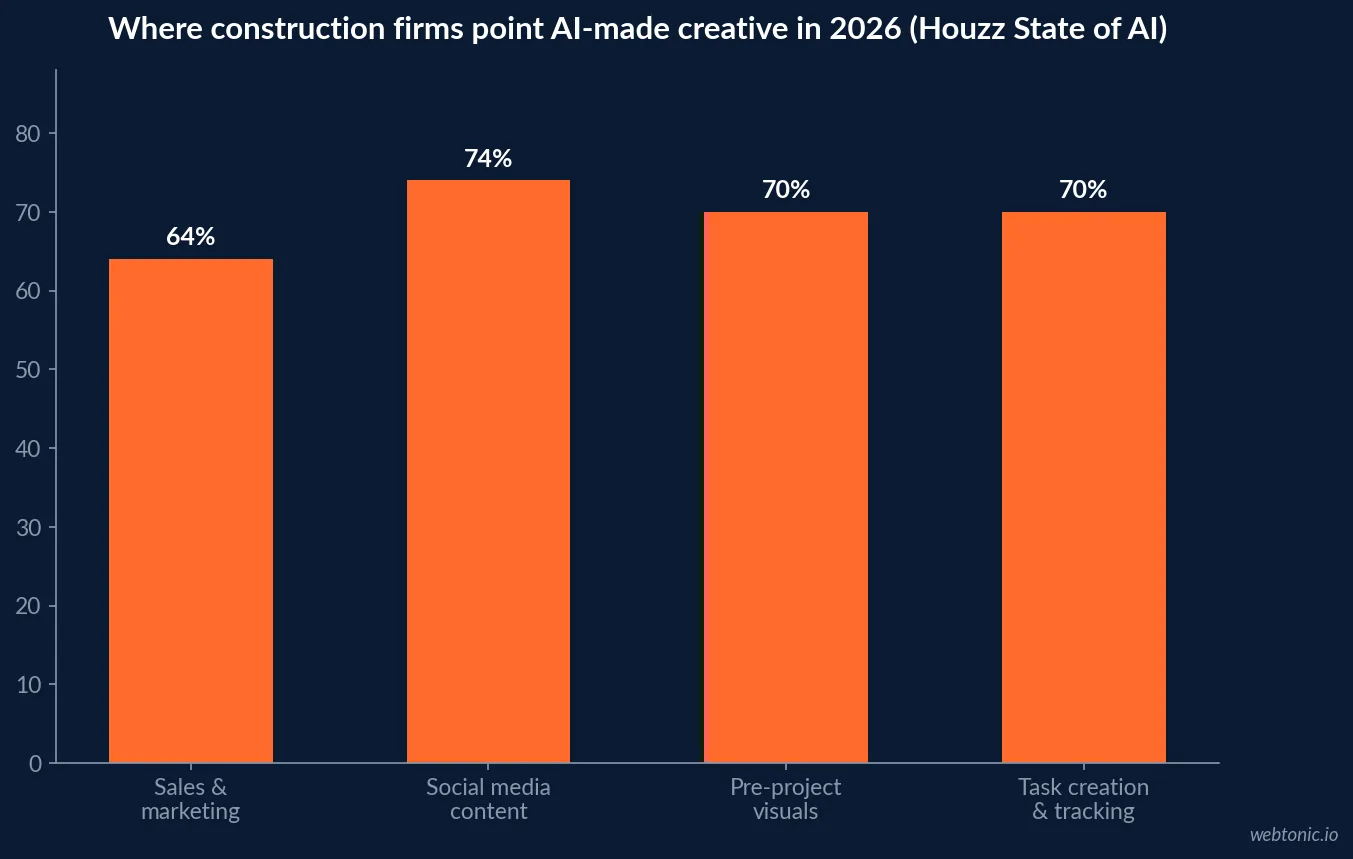
| AI-assisted creative use (construction firms, 2026) | Adoption | Change vs 2025 | Source |
|---|---|---|---|
| Social media content creation | 74% | Fastest-growing creative use | Houzz State of AI 2026 |
| Pre-project visuals | 70% | Up from 42% | Houzz State of AI 2026 |
| Sales and marketing overall | 64% | Nearly doubled | Houzz State of AI 2026 |
| Task creation and tracking | 70% | Up from 33% | Houzz State of AI 2026 |
| Estimates or proposals | 87% | Most common AI application overall | Houzz State of AI 2026 |
What the paid-media numbers say about the format that's running today
WordStream's 2026 Facebook Ads Benchmarks place Home and Home Improvement's lead-objective cost per lead at USD 42.95 - the third-highest of the tracked categories, behind Dentists and Dental Services (USD 61.56) and Beauty and Personal Care (USD 50.91) - with a conversion rate of just 5.32%, among the weakest tracked, and cost per click of USD 2.18. Year over year, category CPL rose a modest 4.10%, far calmer than swings in health-adjacent or personal-services categories.
On Google, WordStream's Search Advertising Benchmarks put Home and Home Improvement at a USD 8.33 average cost per click, the second-highest of 23 tracked industries behind Attorneys and Legal Services (USD 9.87). Read together: this category pays a premium for both the click and the lead, which raises the cost of creative that doesn't convert on the first look.
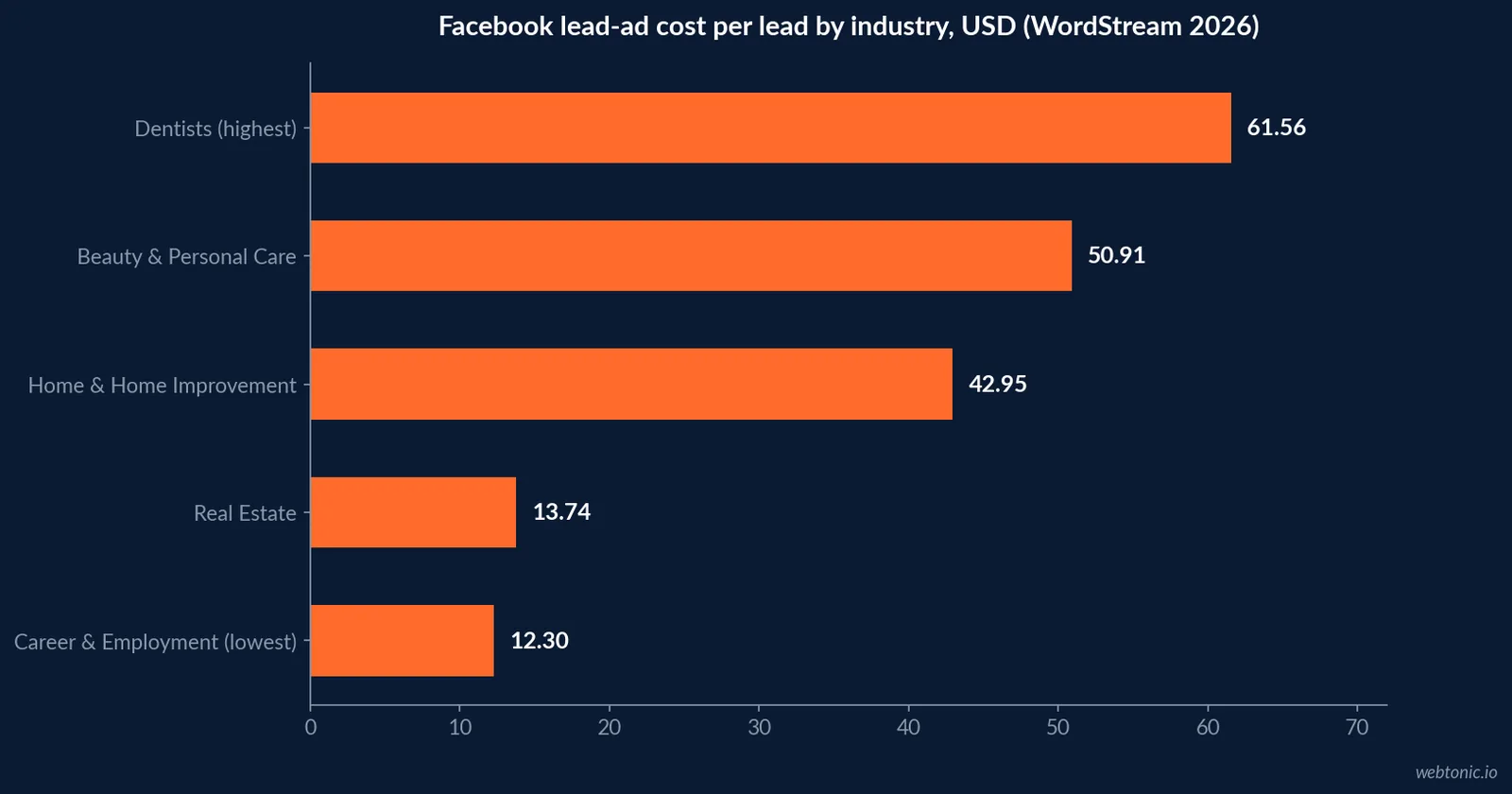
| Paid-media benchmark, Home & Home Improvement (2026) | Figure | Source |
|---|---|---|
| Meta lead-objective cost per lead | USD 42.95 | WordStream by LocaliQ, 2026 Facebook Ads Benchmarks |
| Meta lead-objective conversion rate | 5.32% | WordStream by LocaliQ, 2026 Facebook Ads Benchmarks |
| Meta lead-objective cost per click | USD 2.18 | WordStream by LocaliQ, 2026 Facebook Ads Benchmarks |
| Meta CPL, year over year | +4.10% | WordStream by LocaliQ, 2026 Facebook Ads Benchmarks |
| Google Ads average cost per click | USD 8.33 | WordStream by LocaliQ, 2026 Google Ads Benchmarks |
Where video fits, honestly
No 2026 study benchmarks video specifically for general contracting or remodeling, so this is a cross-industry figure, labeled as such: Wyzowl's 2026 State of Video Marketing survey (266 respondents, marketers and consumers) found 91% of businesses now use video as a marketing tool, back to a joint all-time high after a 2025 dip, and 82% of video marketers report a positive ROI - down from 93% the year before, which Wyzowl attributes to a maturing, more competitive format rather than declining effectiveness. Applied to remodeling, that argues for jobsite-specific footage - a real crew, a real timeline - over a templated explainer that looks like every competitor's.
| Video marketing signal (cross-industry, 2026) | Figure | Source |
|---|---|---|
| Businesses using video as a marketing tool | 91% | Wyzowl 2026 (cross-industry) |
| Marketers who rate video important to strategy | 93% | Wyzowl 2026 (cross-industry) |
| Marketers reporting positive video ROI | 82%, down from 93% | Wyzowl 2026 (cross-industry) |
| Marketers who don't use video, citing cost or need | 24% each reason | Wyzowl 2026 (cross-industry) |
A five-format starting brief
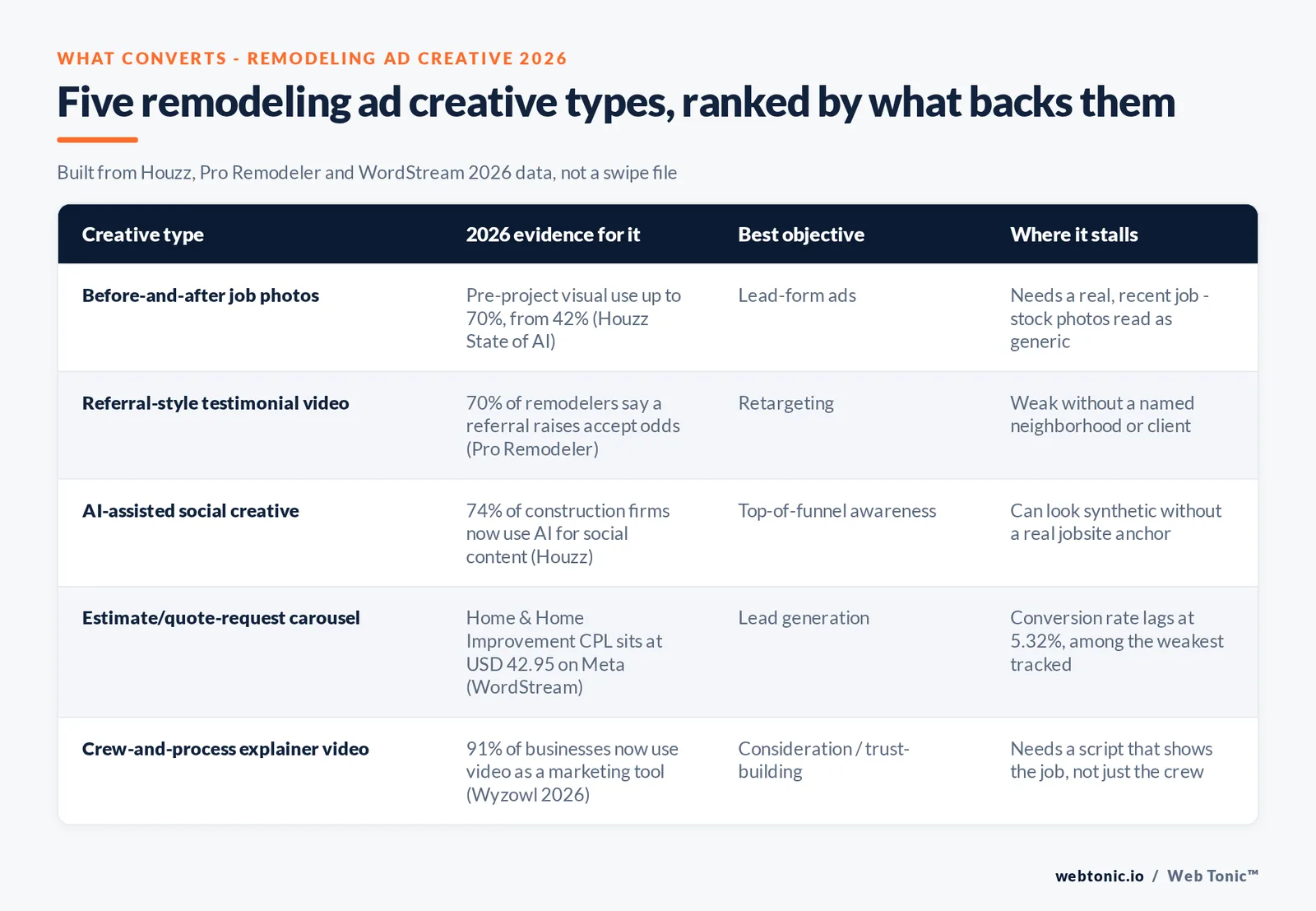
Weighed against the evidence above, five formats carry most of the case for remodeling creative in 2026: real before-and-after job photography, a referral-anchored testimonial, AI-assisted social content built from that same real job (not a generic template), an estimate-request carousel tuned to the category's weak 5.32% Meta conversion rate, and a short crew-and-process video that shows the job rather than narrates it. None of these require a bigger budget - they require briefing the creative team to shoot the actual jobsite before the campaign launches, not after a stock library search.
If the gap is production, not strategy, our performance creative practice builds the shot list from the job schedule, our data and analytics team can confirm which format is actually converting once ads are live, and our guide to when Facebook ads are worth the investment is a useful gut-check before committing the budget.
What the AI-reliability caution flag means for the brief
Houzz's 2026 data shows adoption climbing fast, but the same survey found 37% of construction and design professionals remain concerned about AI reliability and accuracy, up from 33% in 2025 - a caution that grew even as usage grew. Read alongside the creative-format evidence above, that argues for a specific production discipline rather than a blanket rule: use AI to generate volume and iterate on a real, verified job photo or a real crew shot, not to generate the underlying scene itself. A homeowner deciding whether to trust a remodeler with tens of thousands of dollars is exactly the audience most likely to notice - and discount - an obviously synthetic "after" photo.
That discipline also protects the referral economics covered above. If 70% of remodelers say a referral raises their odds of taking a job because it carries borrowed credibility, an ad creative that looks synthetic works against the same trust mechanism the industry already runs on informally. The practical brief is narrow: let AI tools speed up variant production, copy testing and resizing across placements, but anchor every variant to a photo or clip from a real, named job, ideally with the city or neighborhood stated in the copy so the local-proof signal survives the production speed-up.
| AI creative caution signal (2026) | Figure | Source |
|---|---|---|
| Concerned about AI reliability/accuracy | 37%, up from 33% in 2025 | Houzz State of AI 2026 |
| Familiar with AI tools built for construction/design | 75%, up 16 points | Houzz State of AI 2026 |
| Firms saving 8+ hours/week using AI | 32%, vs 18% industry-wide | Houzz State of AI 2026 |
| Est. annual productivity gain per construction firm using AI | USD 244,000 | Houzz State of AI 2026 |
Frequently Asked Questions
What ad creative format converts best for home remodeling?
No single 2026 study ranks remodeling creative formats head to head, so the honest answer is triangulated: before-and-after job photography and referral-style testimonials are the two formats with direct 2026 evidence behind them. Houzz's State of AI survey found pre-project visual use among construction firms jumped to 70% (from 42% a year earlier), and Pro Remodeler's national poll found 70% of remodelers say a personal referral makes them more likely to accept a project - both point to real-project proof, not stock photography or generic brand messaging.
How much does a Meta lead ad cost in this category?
WordStream's 2026 Facebook Ads Benchmarks put Home and Home Improvement's lead-objective cost per lead at USD 42.95, the third-highest of the industries tracked, with a conversion rate of 5.32% - among the weakest tracked categories, and up only 4.10% year over year against much larger swings elsewhere. Cost per click for the category sits at USD 2.18.
Is video worth the production cost for a remodeling brand?
Cross-industry data supports it, though no remodeling-specific video benchmark exists yet. Wyzowl's 2026 State of Video Marketing survey (266 respondents) found 91% of businesses now use video as a marketing tool and 82% of video marketers report a positive ROI - down from 93% the year before as the format matures and gets more competitive, which argues for differentiated jobsite footage over generic templates.
Are AI-generated visuals actually being used by contractors yet?
Yes, at scale. Houzz's 2026 State of AI in Construction & Design survey of 601 U.S. businesses found 41% of construction and design firms now use AI for everyday tasks, and within that, AI is used most for social media content (74%) and pre-project visuals (70%, up from 42%). Sales and marketing is the single fastest-growing AI use case for construction firms specifically, at 64% adoption.
Does the creative need to mention the neighborhood or city?
The available evidence says trust signals travel locally in this category. Pro Remodeler's poll found 63% of remodelers rate a repeat client as the easiest to work with, ahead of referred clients (15%), and 70% say a referral raises the odds they accept the job - both point to reputation that is locally anchored, which argues for naming the city or neighborhood in the creative rather than running a single national ad.
Sources
Pro Remodeler - Poll Results: The Client Test and Why You Sign On or Walk Away
Houzz - 2026 U.S. Houzz State of AI: Construction & Design Industry
WordStream by LocaliQ - Search Advertising Benchmarks by Industry 2026
PPC Land - reporting on WordStream's 2026 Facebook Ads Benchmarks
Wyzowl - Video Marketing Statistics 2026