Table of contents
Most funeral providers cannot trace a call or an online arrangement back to the page, ad or referral that produced it, even as more families shop, compare and complete paperwork digitally before they ever pick up the phone. This page uses 2025 data from NFDA, CANA and one public operator's own disclosed adoption numbers to size the gap.
Key Takeaways
- Only about 64% of funeral industry companies run Google Analytics at all.
- Nearly 30% of families now complete arrangements entirely online.
- 40% found their funeral home through Facebook, up from 21% in 2023.
- The 2025 U.S. cremation rate is projected at 63.4% against 31.6% burial.
- By 2045 cremation is projected to reach 82.3% of U.S. dispositions.
- 31.8% of families now prefer a hybrid online-plus-director planning path.
- 19.4% have pre-planned and prepaid arrangements in advance.
- 44% say they would not feel confident planning without a director present.
- Carriage Services hit 80%+ field adoption of its sales-tracking platform in one year.
- salesEDGE 2.0 produced $2.6M in tracked preneed production in its first quarter live.
- 11,202 insurance-funded preneed contracts were written in 2025, up 27.4% year on year.
- 36% of NFDA member firms already offer online cremation arrangements.
- Another 25% plan to add online arrangements within four years.
- The FTC Funeral Rule (16 CFR 453) still does not require online price posting.
- The Rule's paperwork clearance was up for a 3-year extension in 2026.
- 46% of families used three or more information sources before comparing homes, per NFDA's tracking of consumer research habits.
How much of the industry is even instrumented
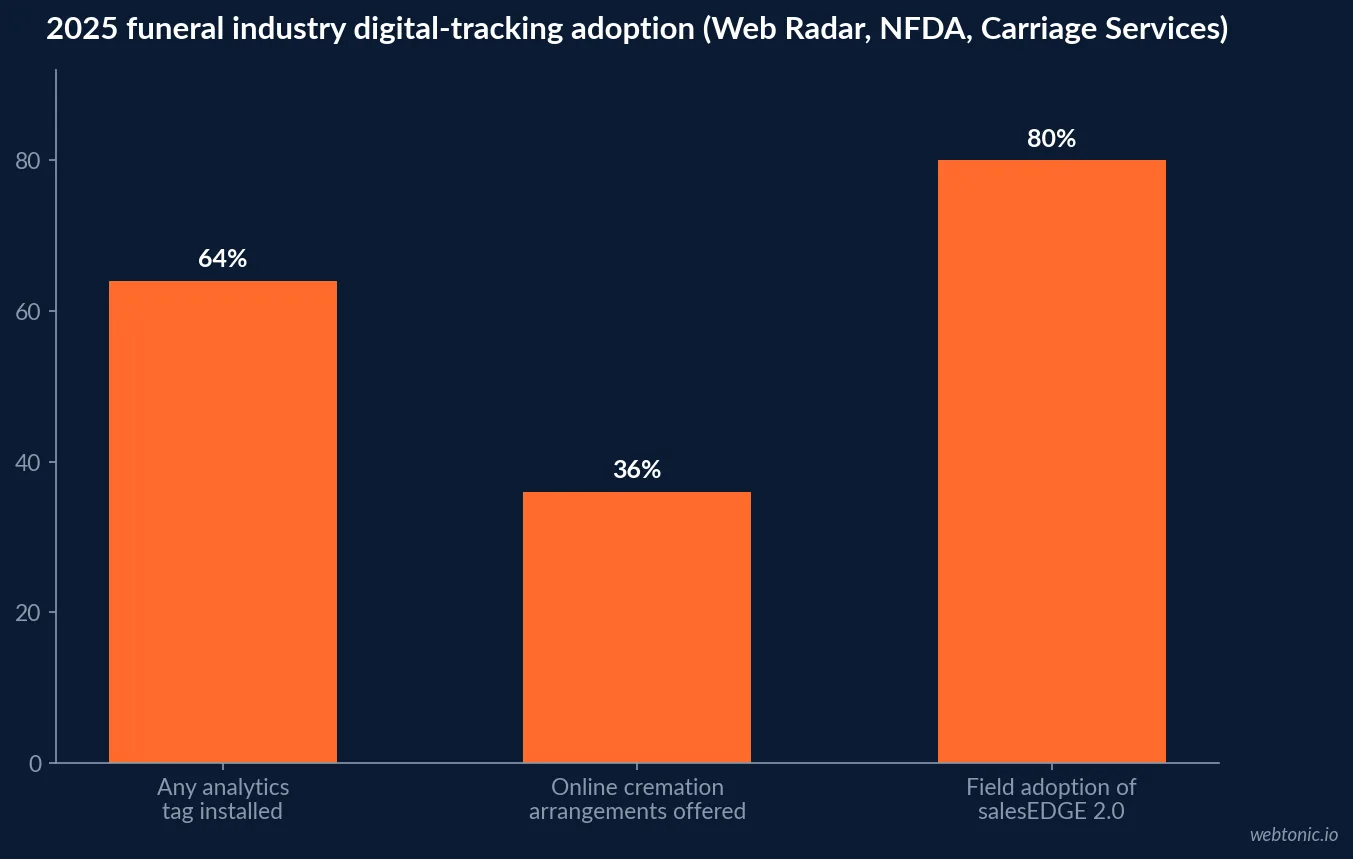
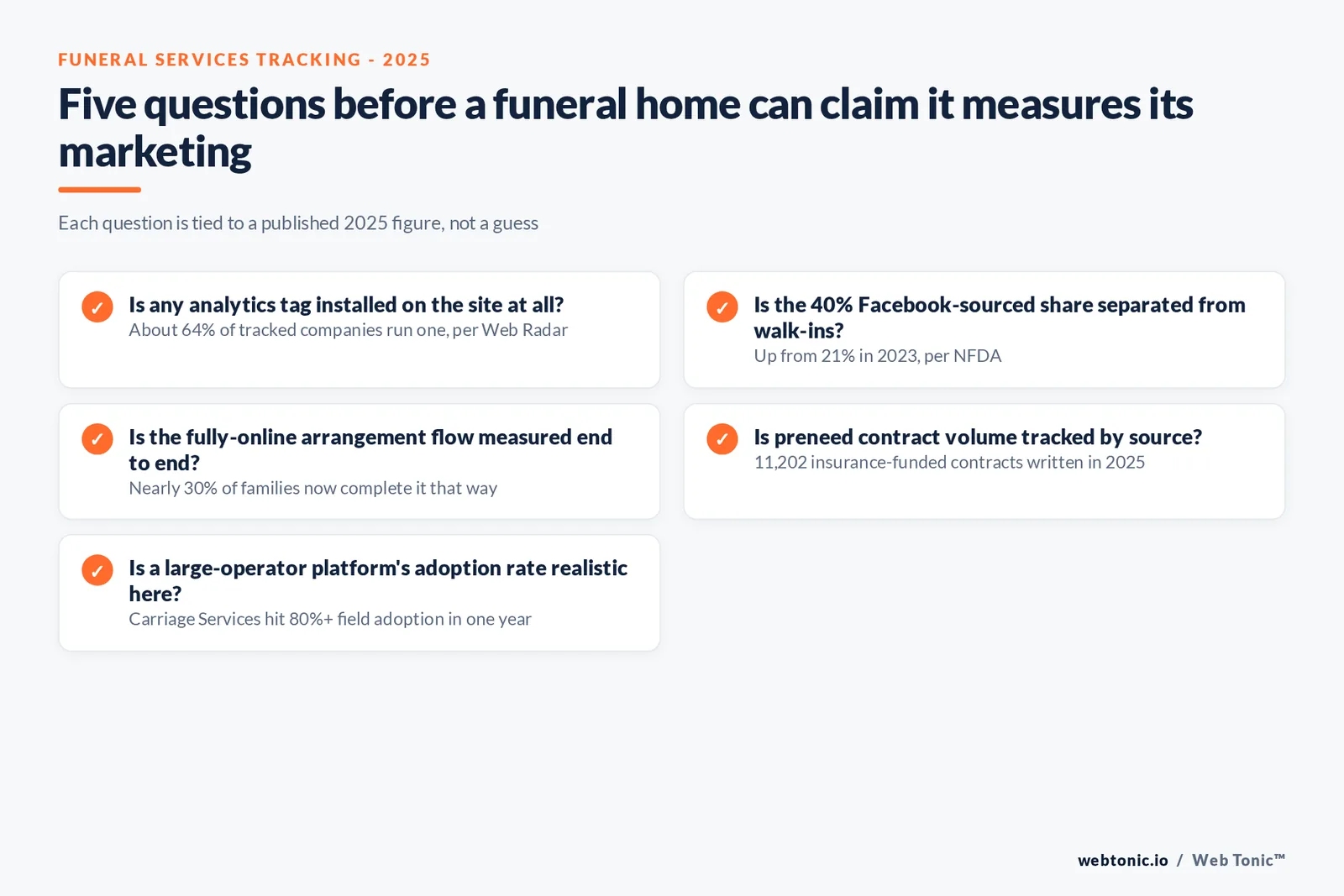
Web Radar's technology census of 522 companies in the funeral industry finds Google Analytics installed at 336 of them, roughly 64%, out of 20 distinct technologies tracked across the sector. That leaves more than a third of tracked firms with no analytics tag on their own site at all, before any question of whether the tag is configured to separate paid, organic, social and referral traffic. Installing an analytics tag and building a source-of-arrangement report are two different projects, and the second one is rarer than the first.
A funeral home's own NFDA membership data backs this up indirectly: online capability is being added feature by feature - online cremation arrangements, online price lists, chat - without a parallel push to measure which of those features actually converts a visit into a call.
| Tracking layer | Share instrumented (2025) | Source | What it is missing |
|---|---|---|---|
| Any website analytics tag | ~64% of tracked companies | Web Radar technology census | The other ~36% have no tag at all |
| Online cremation arrangement capability | 36% of NFDA member firms | NFDA 2025 Cremation & Burial Report | Conversion tracking on that flow specifically |
| Planned online-arrangement rollout | +25% within four years | NFDA 2025 Cremation & Burial Report | A baseline to measure the rollout against |
| Enterprise sales-funnel platform (public operator) | 80%+ field adoption in year one | Carriage Services 2025 annual report | Independent single-location proof points are still rare |
| Insurance-funded preneed contract volume tracked | 11,202 contracts in 2025 | Carriage Services 2025 annual report | Up 27.4% YoY, but attribution per contract is operator-specific |
The behavior that is going untracked
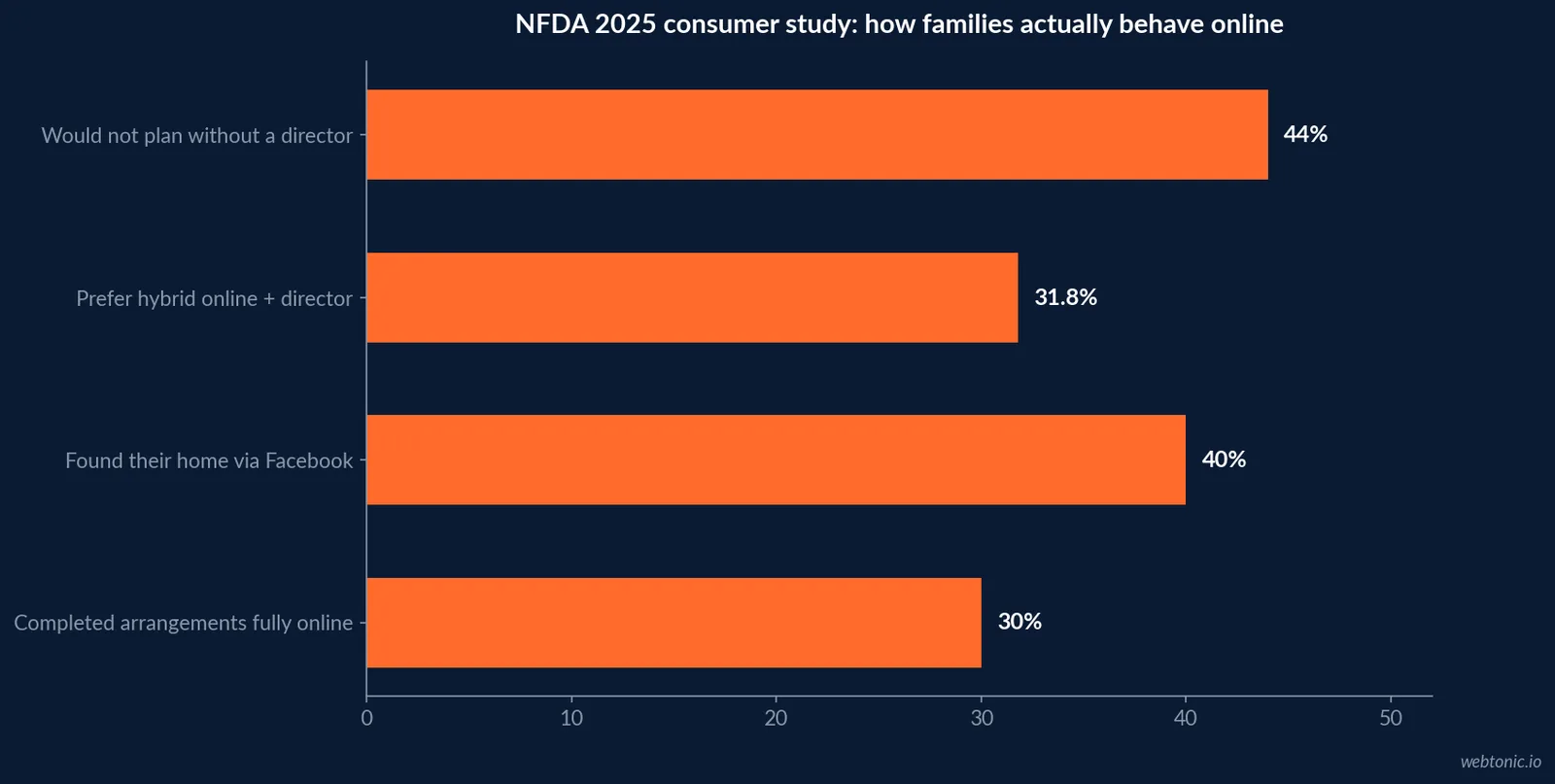
NFDA's 2025 Consumer Awareness & Preferences Study, surveying 1,126 Americans age 40 and older, found nearly 30% of families now complete all funeral arrangements online and 40% have used the services of a funeral home they found on Facebook, almost double the 21% who said the same in 2023. At the same time, 44% say they would not feel confident planning without a funeral director, and 31.8% prefer a hybrid path that mixes online research with a direct conversation.
Every one of those behaviors leaves a digital footprint - a Facebook click, a price-list page view, an online arrangement form started and abandoned - and most of it is currently invisible to the provider because the tag either is not installed or is not built to separate the channels.
| Family behavior (NFDA 2025) | Share of respondents | Trackable signal it produces | Typically captured? |
|---|---|---|---|
| Completed arrangements fully online | ~30% | Form completion, session recording | Rarely, beyond a raw form submit |
| Found the home via Facebook | 40% | Social referral traffic, ad click ID | Rarely tagged with UTM parameters |
| Prefer hybrid online + director | 31.8% | Page visit followed by inbound call | Almost never call-tracked |
| Pre-planned and prepaid in advance | 19.4% | Preneed funnel stage, insurance-funded contract | Tracked at large operators, not most independents |
| Would not plan without a director | 44% | Call duration, appointment booking | Rarely tied back to the originating page |
What the disposition shift does to the tracking problem
CANA's 2025 Annual Statistics Report and NFDA both put the 2025 U.S. cremation rate at 63.4% against a 31.6% burial rate, with cremation projected to reach 82.3% by 2045 while burial falls to 13.0%. CANA's own release for the year is titled around the finding that national cremation growth is slowing as more states approach saturation - which does not reduce the tracking problem, it relocates it: providers now compete on the research and comparison phase that precedes a cremation decision, not on the funeral-home visit that used to come first.
A burial-heavy market rewarded being the closest chapel to a hospital. A cremation-heavy market rewards whoever's price list, reviews and online scheduling the family found first - and that is a question only a tracking stack can answer.
| Disposition metric | 2025 figure | 2045 projection | Source |
|---|---|---|---|
| U.S. cremation rate | 63.4% | 82.3% | NFDA 2025 Cremation & Burial Report |
| U.S. burial rate | 31.6% | 13.0% | NFDA 2025 Cremation & Burial Report |
| Canada cremation rate | Rising toward 91.2% by 2045 | 91.2% | NFDA 2025 Cremation & Burial Report |
| States/DC over 50% cremation by 2035 | All 50 plus DC | n/a | NFDA 2025 Cremation & Burial Report |
The one public proof point at scale
Carriage Services' 2025 annual report discloses that its salesEDGE 2.0 sales-enablement platform, fully deployed October 20, 2025, reached over 80% adoption by year-end and gave sales leadership visibility into lead progression, conversion efficiency and overall sales productivity that the prior system did not surface. In its first full quarter, the platform generated USD 2.6 million in tracked preneed production, about 12% of total fourth-quarter preneed property sales, with an internal target of scaling that to 20% monthly. The operator also wrote 11,202 insurance-funded preneed funeral contracts in 2025, up 27.4% from 8,792 in 2024.
This is a large, multi-location operator's numbers, not a template every single-location home can copy wholesale. The transferable finding is smaller and cheaper: a named lead source on every inquiry, reviewed monthly, is what let a company this size see - for the first time - which quarter of its preneed pipeline was actually working.
What the FTC Funeral Rule does and does not require
The FTC's Complying with the Funeral Rule guide confirms 16 CFR Part 453 requires an itemized General Price List be given in person, shown for caskets and outer burial containers on request, and disclosed by phone - but the Rule predates the internet and, per the FTC's own periodic review filings, still carries no explicit requirement to post prices online. A 2026 Federal Register filing shows the agency seeking a routine three-year extension of the Rule's paperwork clearance rather than a substantive online-disclosure mandate. Tracking who views a price-list page and whether they later call is not restricted by the Rule; it is simply a data set most providers have not built yet, Rule or no Rule.
| Funeral Rule fact | Status (2026) | Source | Tracking implication |
|---|---|---|---|
| In-person GPL disclosure | Mandatory | FTC Complying with the Funeral Rule | Not a tracking question |
| Phone price disclosure | Mandatory | FTC Complying with the Funeral Rule | Call tracking can confirm compliance and source |
| Online price-list posting | Not currently mandated | FTC periodic review filings | Free to track price-page visits without new disclosure duty |
| Rule's PRA clearance | Up for 3-year extension in 2026 | Federal Register, 2026-05-14 | No near-term rule change to plan around |
A minimum tracking stack that matches where the data already is
The gap is not exotic software; it is basic attribution discipline applied to a sector that has historically not needed it. A workable minimum: install analytics with UTM-tagged links on every paid and social placement, add call tracking on the phone number shown on Facebook and Google listings so the 40% Facebook-sourced share stops being a guess, and add one required field - "how did you hear about us" - to the online arrangement form the ~30% fully-digital families are already completing. None of this requires the scale Carriage Services operates at; it requires only that someone reads the report monthly.
Our data and analytics practice builds exactly this kind of lightweight attribution stack for local service businesses that have never had one before.
Where this leaves a single-location provider
The honest baseline is this: most of the industry has not closed the loop between a rising share of digital-first family behavior and the reporting needed to see it. That is not a criticism unique to funeral service - many local, relationship-led categories are behind on this - but the size of the shift (63.4% cremation, 40% Facebook-sourced, 30% fully online) makes the cost of not tracking larger here than in most categories, because the decision itself has moved online even where the emotional weight of the purchase has not.
If you want a source-of-arrangement report built before your next budget cycle, talk to us, or see how we approach the harder question of proving whether a Facebook-sourced lead is worth the spend in a comparably relationship-driven category.
Frequently Asked Questions
Do most funeral homes track where their leads come from?
Not with much precision. Web Radar's technology census of 522 funeral industry companies finds Google Analytics installed at only 336 of them - about 64% - and most of the rest run no analytics tag at all. Installing the tag is also not the same as reading it: NFDA's own guidance to members treats call and web-form attribution as a gap to close, not a solved problem, because most homes have no CRM stage that ties a specific ad, page or referral to the arrangement that follows.
What is actually changing in how families reach a funeral home?
NFDA's 2025 Consumer Awareness & Preferences Study, surveying 1,126 Americans 40 and older, found nearly 30% of families now complete arrangements entirely online and 40% have used a funeral home they found on Facebook, nearly double the 21% who said so in 2023. A funeral home that cannot separate Facebook-sourced families from walk-ins and referrals is flying blind on the fastest-growing channel it has.
Why does the cremation shift make tracking more urgent?
CANA's 2025 Annual Statistics Report shows the disposition mix keeps moving away from the traditional, in-person path: NFDA projects the 2025 U.S. cremation rate at 63.4% against 31.6% for burial, and CANA's own model shows the growth rate itself slowing as cremation approaches saturation in many states. Cremation-first families do more of their research and comparison shopping online before any phone call, so a provider without page-level and call-level data cannot see the moment it lost or won that family.
Is enterprise-grade sales tracking realistic for a small funeral home?
The evidence says yes if a large operator did it in a year. Carriage Services reports its salesEDGE 2.0 platform reached over 80% field adoption by the end of 2025 after launching in October, and produced funnel-level visibility into lead progression and conversion efficiency the operator did not have before. A single-location home does not need enterprise software to copy the underlying discipline: a named source field on every inquiry and a monthly review of where arrangements actually originated.
Does the FTC Funeral Rule limit what can be tracked or shown online?
It limits pricing disclosure, not analytics. The FTC's Funeral Rule (16 CFR Part 453) requires an itemized General Price List be given in person and over the phone, and current FTC guidance still does not mandate that price list be posted online - a policy point under periodic review since 2020. Tracking who reaches a price-list page, and whether they call after reading it, is compliance-neutral; it is simply data most homes are not yet collecting.
Sources
NFDA - 2025 Consumer Awareness & Preferences Study release
NFDA - 2025 Cremation & Burial Report release
CANA - 2025 Annual Statistics Report preview
Carriage Services - 2025 Annual Report (SEC filing)
FTC - Complying with the Funeral Rule (2024 guidance)
FTC - Shopping for Funeral Services Online report
Web Radar - Funerals industry technology census
NFDA - What Today's Families Really Want