Table of contents
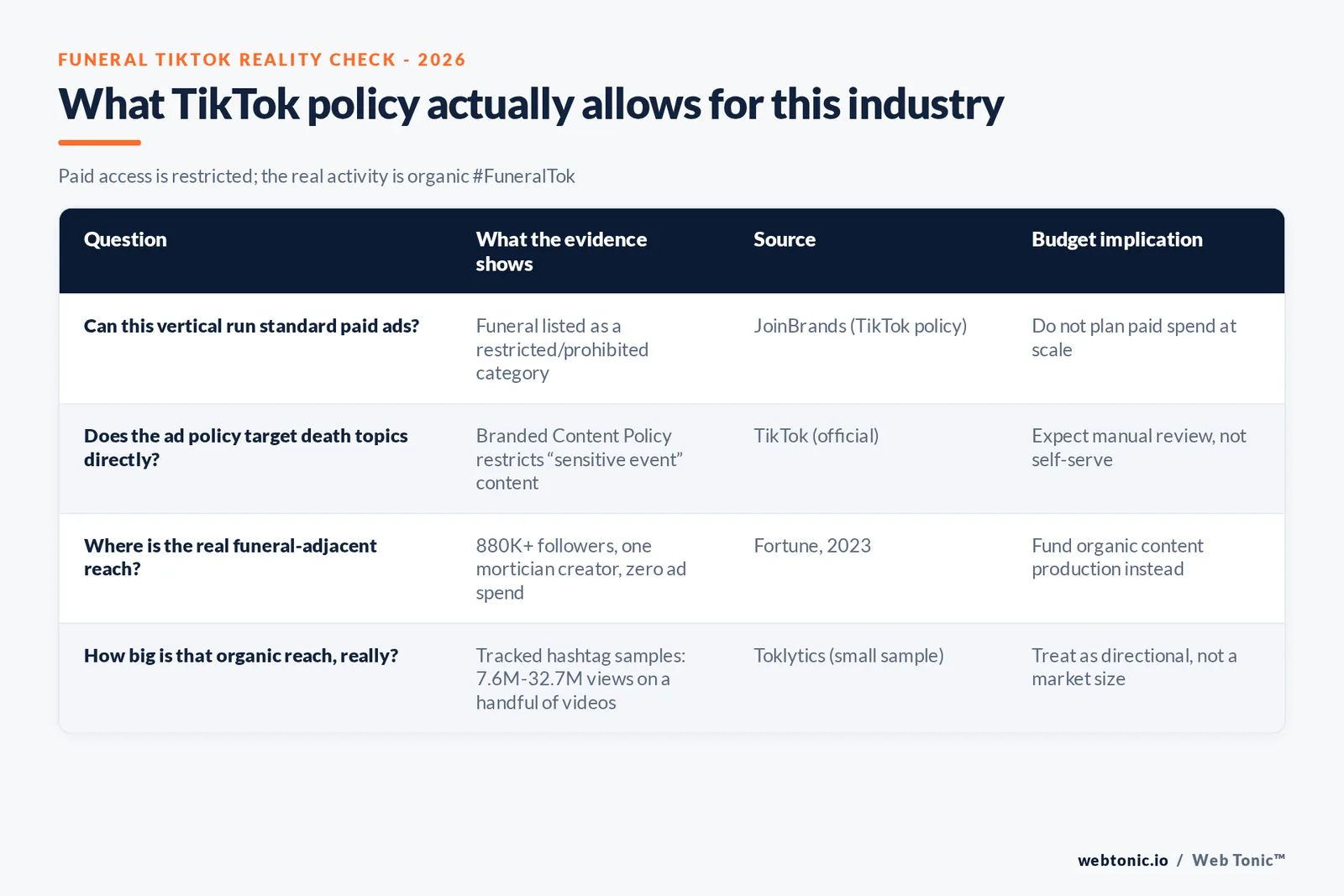
The honest budget for funeral services TikTok ads is close to zero, because TikTok's own advertising policy restricts or prohibits the category outright. Third-party documentation of TikTok's prohibited-industries list names funeral services directly alongside abortion services and hazardous chemical products, and TikTok's own Branded Content Policy separately restricts any content that "refers to a sensitive event or topic (e.g. deaths...)" and involves selling goods or services. The real activity on this platform is organic: #FuneralTok and individual mortician creators, built without a media budget at all.
Key Takeaways
- Funeral services is listed among TikTok's restricted/prohibited advertiser categories, per platform-policy documentation (TikTok's own Branded Content Policy; corroborated by JoinBrands' help center, which summarizes TikTok's published prohibited-industries list).
- TikTok's Branded Content Policy explicitly restricts content referring to "a sensitive event or topic (e.g. deaths...)" when it involves selling goods or services (TikTok, official Branded Content Policy).
- One mortician creator built more than 880,000 followers discussing embalming and mortuary work with zero paid promotion (Fortune, 2023 feature).
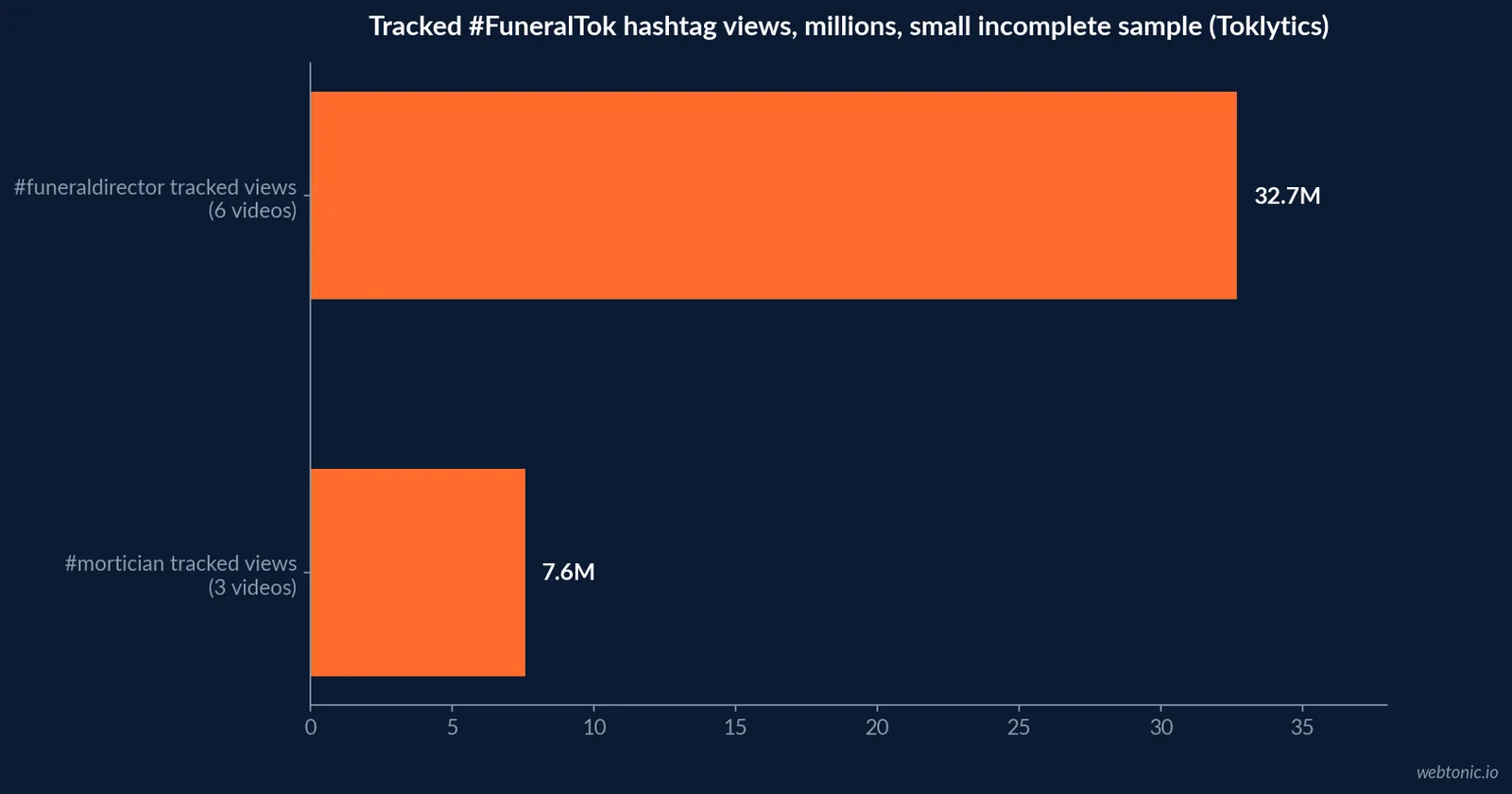
- A tracked sample of #funeraldirector videos shows tens of millions of views from a handful of posts, per Toklytics, a third-party hashtag tracker covering only a small tracked sample, not TikTok's own total counts - cited here as directional evidence of organic reach, not a platform-verified figure.
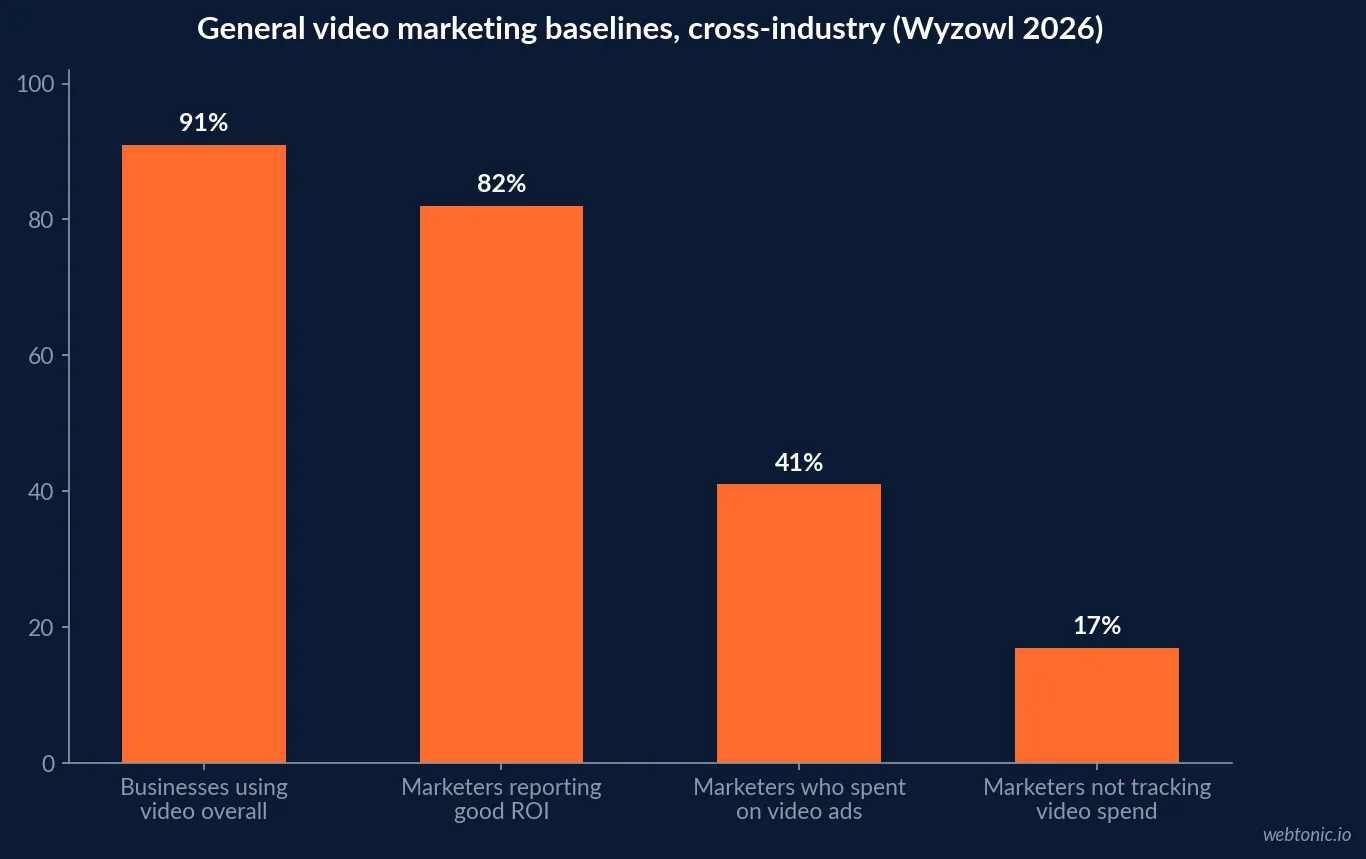
- 91% of businesses overall use video as a marketing tool in 2026 (Wyzowl, cross-industry, 266 respondents) - a general baseline for why funeral operators still have reason to be on video platforms, even without a paid TikTok lane.
- 15,401 funeral homes operate in the US, and roughly 75% are family- or privately-owned (NFDA, 2025) - the exact profile of business least likely to have in-house policy-compliance staff to navigate a restricted ad category.
- 63.4% of 2025 US dispositions are projected to be cremation (NFDA, 2025 Cremation & Burial Report), a demographic and behavioral shift that is reshaping what funeral content resonates organically, independent of any paid channel.
What TikTok's own policy actually says
TikTok's Branded Content Policy, an official platform document, states that branded content is restricted when it "refers to a sensitive event or topic (e.g. deaths, natural or industrial disasters, violent attacks, civil disorder, etc.)" and involves "the selling of goods or services" among other flagged behaviors. Separately, documentation from JoinBrands' help center, a creator-marketplace platform summarizing TikTok's own prohibited-industries list for its advertisers, places "funeral" directly under "Inappropriate Businesses, Products, or Services," alongside abortion services and hazardous chemical products. Both point to the same conclusion from different angles: a funeral home's core commercial message is structurally the kind of content TikTok's ad policy was written to keep off the paid platform.
| TikTok ad policy signal | What it says | Source |
|---|---|---|
| Branded Content Policy, sensitive events | Restricts content referring to deaths when selling goods/services | TikTok (official) |
| Prohibited-industries documentation | Lists “funeral” under Inappropriate Businesses | JoinBrands help center (summarizing TikTok policy) |
| Practical implication | Case-by-case regional review is the norm, not standard self-serve approval | Inference from the above two sources |
Where the real activity is: organic #FuneralTok
With paid access this constrained, the platform's actual funeral-adjacent activity lives entirely in organic creator content. Fortune's 2023 feature on morticians using TikTok profiled creators like @funeralbabe, who built an audience of more than 880,000 followers posting about embalming and dead-body handling, entirely without a media budget. Third-party hashtag trackers such as Toklytics show a small tracked sample of #funeraldirector videos (six, at the time this page's research was conducted) accumulating tens of millions of views. These trackers cover only the videos they've indexed, not TikTok's platform-wide total, so treat the figure as evidence that individual funeral- adjacent creators can go organically viral, not as a market-size number.
| Organic funeral-adjacent TikTok signal | Figure | Source |
|---|---|---|
| Followers, one mortician creator (@funeralbabe) | 880,000+ | Fortune, 2023 feature |
| Tracked #funeraldirector videos / views (small sample) | 6 videos / 32.7M views tracked | Toklytics (third-party tracker, incomplete sample) |
| Tracked #mortician videos / views (small sample) | 3 videos / 7.6M views tracked | Toklytics (third-party tracker, incomplete sample) |
The industry structure that shapes who could even try
NFDA counts 15,401 funeral homes in the US, with roughly 75% family- or privately-owned. A restricted ad category that requires manual platform review is a much harder lift for a business this size than for a national operator with legal and compliance staff, which is one structural reason the organic, creator-led lane (no policy gate, no account review) has become the default path onto TikTok for anything death-care adjacent, rather than a deliberate strategic choice. NFDA's figures also show the industry generating USD 16.3 billion in funeral home revenue, with a further USD 4.274 billion from crematories and cemeteries - a large aggregate market made up mostly of operators too small to run dedicated ad-policy compliance review.
| NFDA 2025 industry structure figure | Value |
|---|---|
| Funeral homes in the US | 15,401 |
| Share family- or privately-owned | ~75% |
| People employed industry-wide | 105,300 |
| Projected 2025 US cremation rate | 63.4% |
The demographic mismatch behind the policy reality
Even setting the ad-policy restriction aside, TikTok's own audience skews away from the demographic that actually plans and pays for funeral arrangements. Sprout Social's 2026 compilation of platform demographic data puts TikTok users aged 55 and above at just 8.4% of the platform, against 30.7% aged 18-24 and 35.3% aged 25-34 - the two youngest brackets making up more than two-thirds of the user base. At-need funeral purchase decisions are overwhelmingly made by an older buyer, and even preneed planning, NFDA's own data shows, skews toward people well past their 20s and 30s. That mismatch is a second, independent reason a paid TikTok budget for direct-response funeral advertising makes little sense here, on top of the platform's own restricted-industry rules: even an approved ad account would be paying to reach an audience TikTok itself reports is only 8.4% in the buyer's likely age bracket.
The organic picture is different, and this is where the platform-audience mismatch cuts the other way. Younger viewers are exactly the audience #FuneralTok's mortician creators have built their followings with, and that content plays a recruiting and industry-awareness role distinct from direct-response advertising. NFDA has flagged workforce recruitment as an ongoing industry concern given an aging funeral-director population, and organic TikTok content that makes mortuary work visible to a demographic TikTok itself confirms it reaches best (18-34 year-olds) plausibly supports that pipeline, even though no study has directly measured hiring outcomes from #FuneralTok content.
| TikTok age demographic (Sprout Social, 2026 compilation) | Share of users |
|---|---|
| 18-24 | 30.7% |
| 25-34 | 35.3% |
| 35-44 | 16.4% |
| 45-54 | 9.2% |
| 55 and above | 8.4% |
What a realistic 2026 TikTok plan looks like for this industry
Given the policy reality above, planning TikTok as a paid-media line item the way a funeral marketer would plan Google or Meta ads is not supported by the evidence. The defensible 2026 plan redirects that budget line into content production: staff or freelance time to post short, educational, behind-the-scenes content similar in tone to the organic creators cited above, which requires no ad-account approval and carries none of the restricted-category risk. Any paid test should be budgeted as a small, exploratory exception pending manual TikTok review, not as a reliable, scalable channel.
| 2026 TikTok budget line | Recommendation | Why |
|---|---|---|
| Paid TikTok ad spend | Do not budget at scale | Funeral listed under restricted/prohibited categories |
| Organic content production (staff/freelance time) | Primary budget line | This is where all measured funeral-adjacent reach actually lives |
| Exploratory paid test | Small, contingent on manual account review | Some accounts may be approved case-by-case; treat as exception |
Where to go from here
Our growth marketing practice plans channel mix around what a platform's own policy actually allows, not a generic benchmark - exactly the gap this page documents for funeral services on TikTok. Our performance creative team can also help produce the organic content pipeline the evidence above points toward. For a channel with a clearer paid lane, our breakdown of whether Facebook ads are worth it in 2026 is a useful comparison read.
Frequently Asked Questions
Can a funeral home actually run paid TikTok ads?
Rarely, and often not at all. Funeral services appear directly on TikTok advertising policy documentation, referenced through TikTok's own Branded Content Policy restrictions on sensitive-event content and echoed in third-party platform documentation (JoinBrands' help center, which summarizes TikTok's own prohibited-industries list) as an 'inappropriate business' category alongside abortion services and hazardous chemical products. Where an ad account is approved at all, it typically sits under case-by-case regional review, not a standard self-serve campaign path most other verticals use.
Why is funeral content restricted on TikTok's ad platform specifically?
TikTok's own Branded Content Policy states directly that content 'refers to a sensitive event or topic (e.g. deaths, natural or industrial disasters, violent attacks, civil disorder, etc.)' and restricts branded content around it, particularly where it involves 'the selling of goods or services.' A funeral home's core offering is definitionally about death, which places nearly any promotional ad squarely inside the policy TikTok wrote to prevent commercial exploitation of sensitive events.
So how did #FuneralTok and mortician creators get so popular?
Entirely organically, and that is the real budget opportunity this page identifies. Journalistic coverage (Fortune, 2023) profiled creators like @funeralbabe, who built an audience of more than 880,000 followers discussing embalming and mortuary work without running a single paid ad. Third-party hashtag trackers (Toklytics), which independently track a small, incomplete sample of tagged videos rather than TikTok's own total view counts, show hashtags like #funeraldirector accumulating tens of millions of views from just a handful of tracked videos - a sign of high organic reach concentrated in a few creators, not evidence of a broad paid ecosystem.
What should a funeral home actually budget for TikTok in 2026?
Content production and creator relationships, not a media-buying line item. Given the restrictions above, the realistic 2026 TikTok budget for most funeral operators is staff or freelance time to post organic educational and behind-the-scenes content in the same vein as #FuneralTok's biggest creators, plus, where a local ad account is reviewed and approved, a small test budget treated as an exception, not a channel to plan around at scale the way Google or Meta ads are planned.
Does this restriction apply to all death-care-adjacent advertisers, or just funeral homes?
TikTok's policy language is written around the sensitive topic (death, sensitive events), not a single business category, so it plausibly extends to cemeteries, cremation providers, and preneed insurance sellers as well, though TikTok's public documentation names 'funeral' specifically. Any advertiser in this category should assume manual review and plan for possible rejection rather than budgeting TikTok ad spend as a reliable, self-serve channel.
Sources
TikTok - Branded Content Policy (official)
JoinBrands help center - TikTok Boost Ads Policy Violations (summarizing TikTok policy)
Fortune - Morticians on TikTok, 2023
Toklytics - #funeraldirector hashtag tracker
Sprout Social - TikTok Stats, 2026
NFDA - Statistics (2025 data)
Wyzowl - Video Marketing Statistics 2026