Table of contents
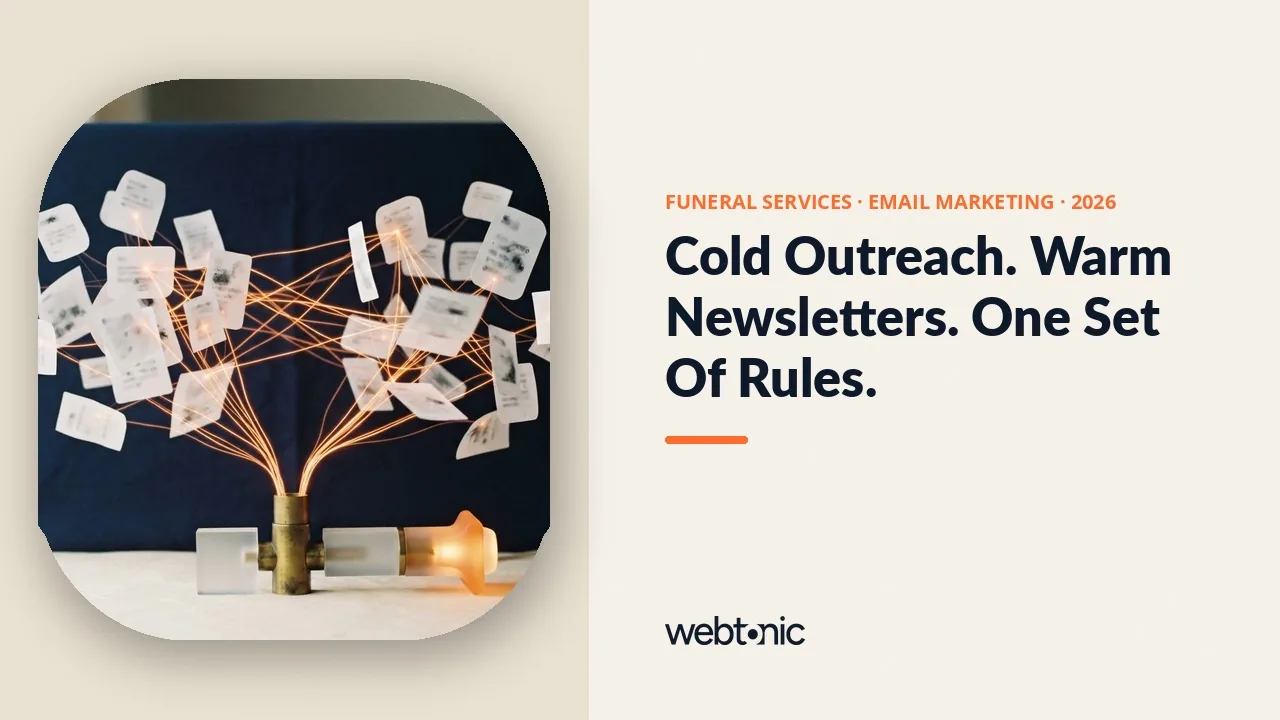
No published study benchmarks funeral home email as its own category, so the honest version of "cold outreach versus newsletters" is two different audiences under two different rules, each measured against the closest labeled cross-industry data available.
Key Takeaways
- No vendor publishes a funeral-specific email benchmark for open rate, CTR or ROI.
- Mailchimp's all-industry average open rate is 34.23%, with government email highest at 40.55%.
- MailerLite's 2025 dataset (3.6 million campaigns) found a 43.46% median open rate.
- Email's average ROI across all industries is USD 36 per USD 1 spent, per Litmus.
- AI-adopting senders are 75% more likely to reach ROI above 45:1, per Litmus's 2026 report.
- Single opt-in programs show an 80% higher ROI than double opt-in on average.
- NFDA's own member newsletter, The Bulletin, reaches 12,600 subscribers biweekly.
- CAN-SPAM's opt-out window is 10 business days under the FTC's own compliance guide.
- Mailchimp's cross-industry average click-through rate is 2.66%.
- 82.4% of consumers prefer a firm that posts its price list online, a fact any newsletter can restate.
- Nearly 30% of families complete arrangements entirely online, per NFDA, a newsletter conversion opportunity.
Two emails, two audiences, two rulebooks
A funeral home realistically sends two kinds of email that have almost nothing in common except the send button. Cold outreach goes to referral partners with no prior relationship - hospice coordinators, senior living activity directors, life insurance agents, estate attorneys - people who did not ask to hear from the business. Newsletters go to an owned list: pre-need clients, previously served families, community subscribers who opted in. Treating both as one "email marketing" line item is how a compliant newsletter program gets tangled up with cold-outreach risk it never actually carries.
This page keeps the two separate and benchmarks each against the labeled cross-industry data closest to its shape, because no vendor has published a funeral-specific number for either.
Newsletters: what the closest proxy industries show
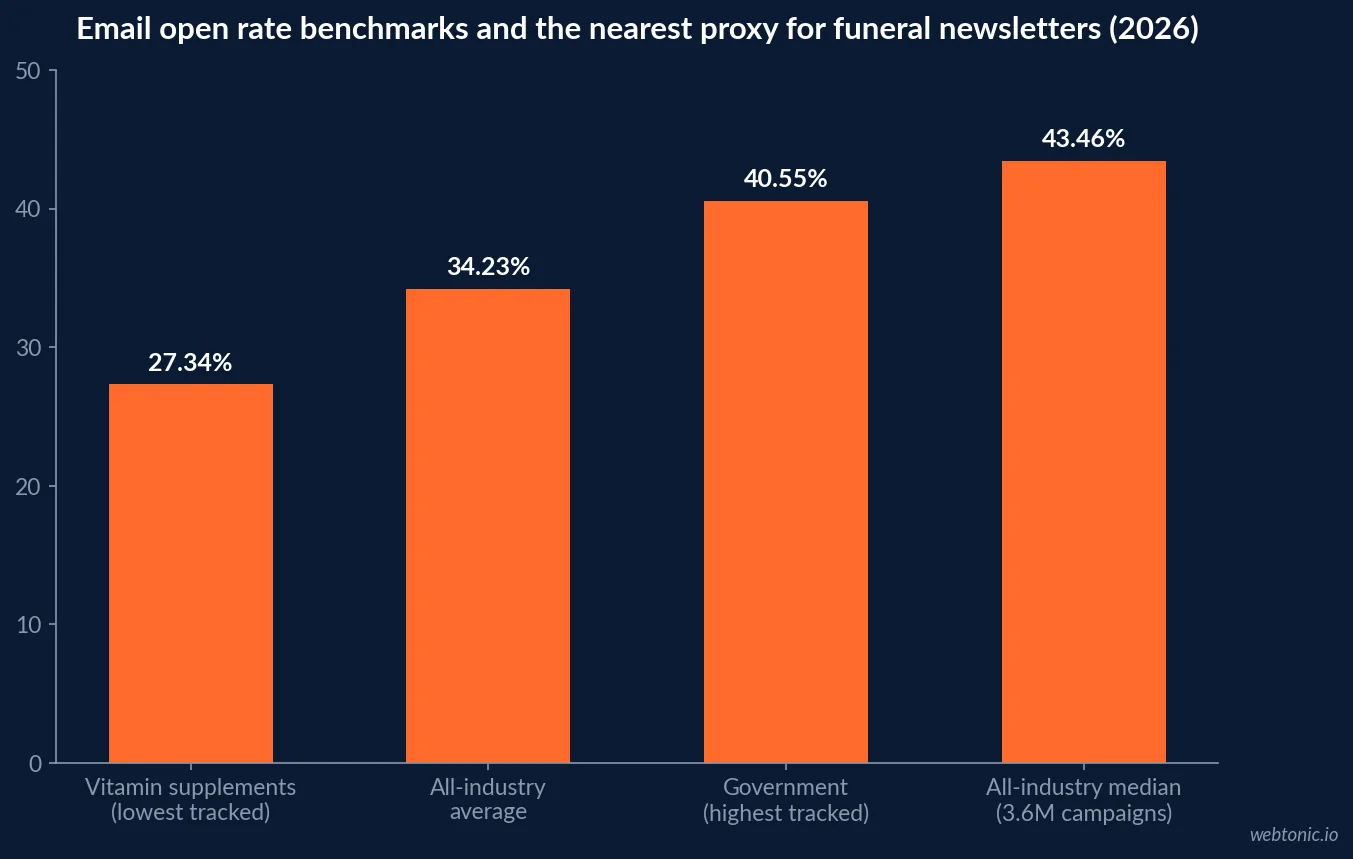
Mailchimp's own email marketing benchmarks report an all-industry average open rate of 34.23% and click-through rate of 2.66%, with Government email highest at 40.55% open and lowest at 27.34% for vitamin supplements - a spread that shows trust-based, low-frequency senders (government, and by extension, community and civic institutions) consistently outperform promotional retail email. That pattern is the reason to treat Government and Non-Profit email data as the nearer-fit proxy for a funeral home newsletter, not Retail or e-commerce benchmarks.
A separate, larger dataset backs the direction: MailerLite's analysis of 3.6 million campaigns found a median open rate of 43.46%, with industry results ranging from 30.1% to 55.71% - evidence that a permission-based, relevant list beats the all-industry average by a wide margin regardless of vertical.
| Proxy industry (2026 benchmarks) | Open rate | Source | Why it is the nearer fit |
|---|---|---|---|
| Government | 40.55% | Mailchimp | Trust-based, low-frequency, civic communication |
| All-industry average | 34.23% | Mailchimp | Baseline floor for comparison |
| All-industry median (3.6M campaigns) | 43.46% | MailerLite 2025 data | Larger sample, permission-based lists skew higher |
| Vitamin supplements (lowest tracked) | 27.34% | Mailchimp | Promotional retail email, the wrong proxy for death care |
What a newsletter is actually for here
NFDA's own consumer research gives a newsletter two ready-made, sourced messages instead of generic promotional copy: 82.4% of consumers say they are more likely to engage a firm that posts its General Price List online, and nearly 30% of families now complete arrangements entirely online. A quarterly or monthly newsletter that restates the price list link and the online-planning option is answering two documented preferences, not just staying in touch.
NFDA runs its own version of this at trade-association scale: The Bulletin, its biweekly member email digest, reaches 12,600 subscribers according to its 2026 supplier media kit - proof that even a niche, low-volume-purchase industry supports a sustained email cadence when the content stays useful rather than promotional.
What the ROI data says, and its limit
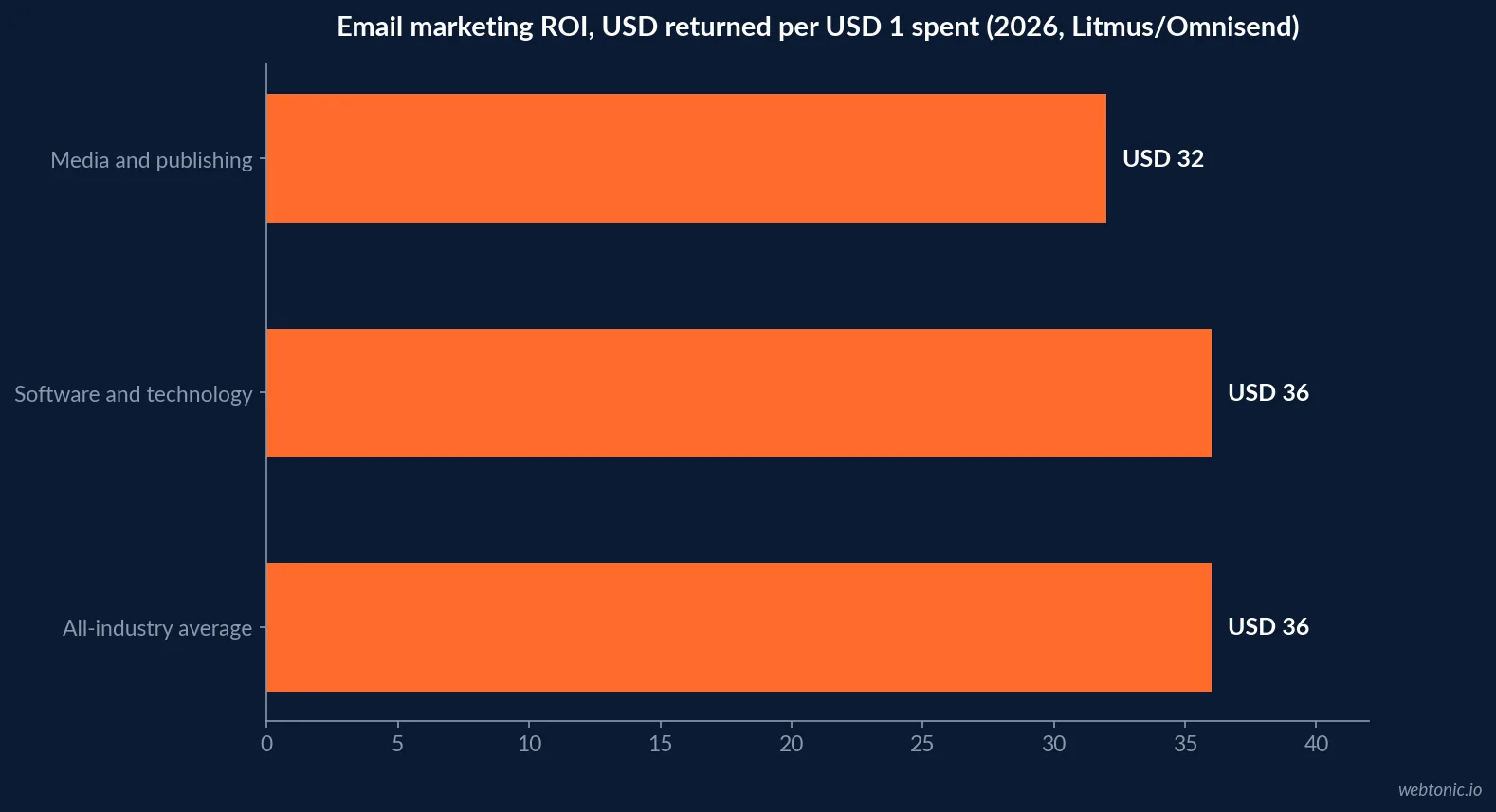
Litmus's own email ROI research puts the average return at USD 36 for every USD 1 spent, calling email the highest-ROI channel in the toolkit, and its State of Email 2026 report found that companies using AI in their email program were 75% more likely to achieve ROI above 45:1. The same research found single opt-in (SOI) programs delivering an 80% higher ROI than double opt-in (DOI) programs on average - a genuinely useful signal for a funeral home's own-list newsletter, where DOI's extra confirmation step often costs more subscribers than it protects.
None of this is death-care-specific. It is the best available cross-industry evidence, and it should be read as a target to test toward with a funeral home's own list, not a promise.
| Email ROI signal (Litmus, 2026) | Figure | Applies to | Caveat |
|---|---|---|---|
| Average ROI, all industries | USD 36 per USD 1 | Newsletter, referral outreach | Cross-industry average, not death-care specific |
| AI-adopter likelihood of 45:1+ ROI | 75% more likely | Newsletter with automation/personalization | Self-reported by Litmus respondents |
| SOI vs. DOI ROI difference | 80% higher for SOI | Newsletter opt-in design | Weigh against local consent-law requirements |
| Mailchimp all-industry CTR | 2.66% | Newsletter click performance benchmark | Cross-industry average, directional only |
Cold outreach: the CAN-SPAM floor that does not move
Referral-partner outreach to hospices, senior living communities and insurance agents is commercial email to a business inbox, and it is still governed by the FTC's CAN-SPAM Act Compliance Guide. The Act requires accurate "From" and routing information, a non-deceptive subject line, the sender's valid physical postal address, and a working opt-out mechanism honored within 10 business days. None of these obligations soften because the message is B2B rather than consumer-facing, and none of them apply differently to a funeral home than to any other commercial sender.
Unlike the FTC's Funeral Rule, which is death-care-specific and governs price disclosure, CAN-SPAM is general-purpose commercial email law that a funeral home shares with every other industry sending referral-partner outreach - which is exactly why generic cross-industry compliance guidance, not a funeral-specific one, is the right reference here.
| CAN-SPAM requirement (FTC guide) | Applies to cold outreach | Applies to newsletters | Practical note |
|---|---|---|---|
| Accurate From/routing information | Yes | Yes | No disguised sender names on either list |
| Non-deceptive subject line | Yes | Yes | "Following up" cold subject lines are a common violation |
| Valid physical postal address | Yes | Yes | Include the funeral home's licensed address |
| Working opt-out honored in 10 business days | Yes | Yes | One unsubscribe link, actually wired to suppress sends |
| Identification as an ad where applicable | Usually yes for cold outreach | Rarely triggers for owned-list newsletters | Confirm with counsel before a large referral-partner push |
Building the program without a funeral-specific benchmark
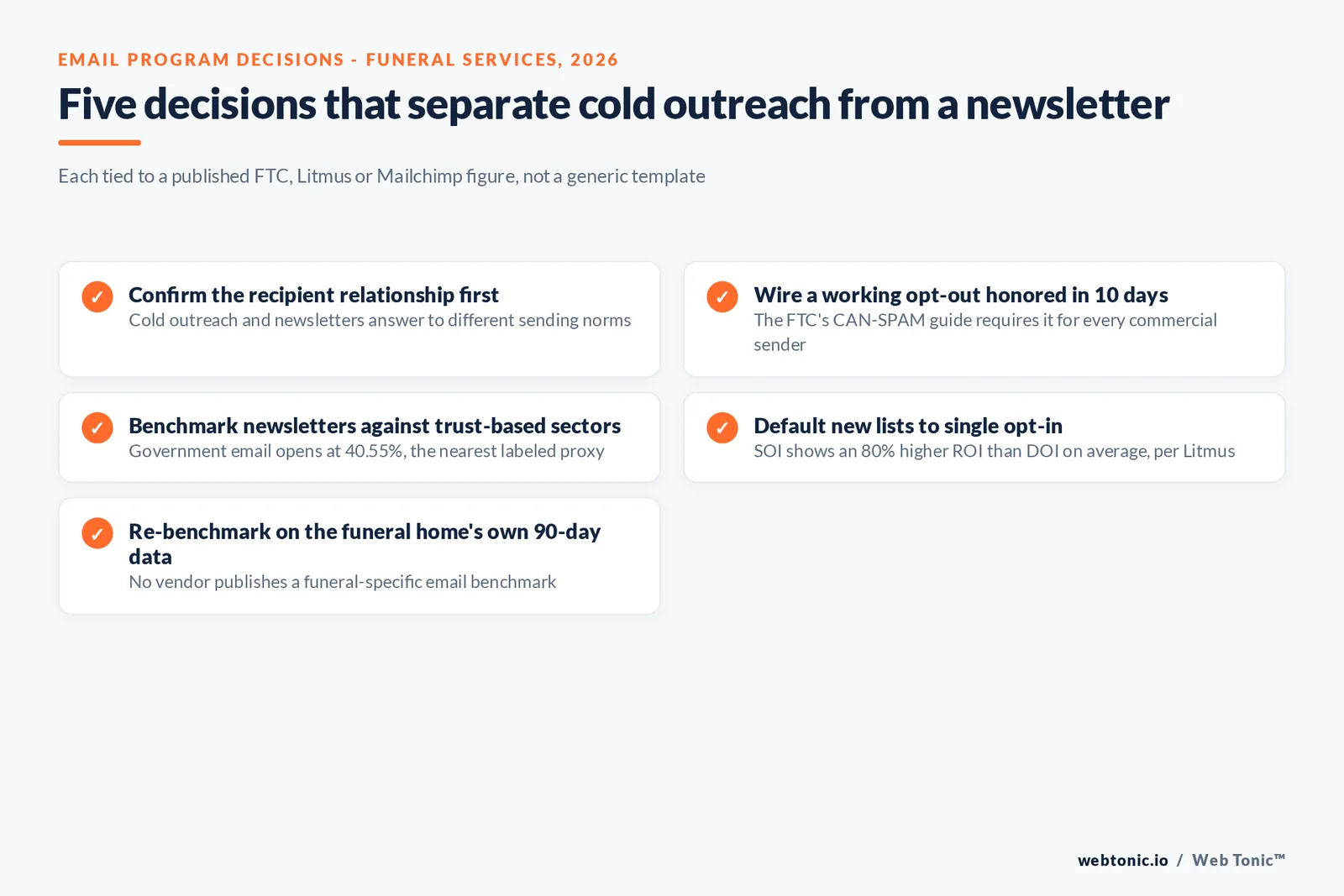
The honest sequence is: build the referral-partner list first and keep it CAN-SPAM-clean from message one, since that is a legal floor rather than a target to optimize; then build the newsletter against the closest labeled proxy (Government/Non-Profit-style benchmarks, not Retail), and re-benchmark against the funeral home's own 90-day results rather than a borrowed number once there is real data to work from.
Our growth marketing team runs exactly this two-track build for local-service clients, and our take on channel ROI generally is in our Facebook Ads ROI analysis, useful context for anyone weighing email against paid social budget. Our team can also help scope which list - referral partners or served families - is worth building first for a given book of business.
A practical send calendar for each list
Referral-partner outreach performs best as a slow, low-volume cadence: one relevant message a month to hospice and senior-living contacts, built around something genuinely useful to their job (a printable pre-need checklist, a veterans'-benefits explainer, an update to the price list) rather than a sales pitch, because CAN-SPAM's opt-out and identification requirements apply the same whether the send converts or not, and a low-frequency list of professional contacts tolerates far less noise than a consumer list ever would.
The newsletter to served and pre-need families can run more often - quarterly at minimum, monthly if there is enough genuinely new content - because it is permission-based and the subscriber has already signaled interest by opting in. The content mix that the sourced data above supports is straightforward: a seasonal note, a price-list reminder, a green or natural-burial option explainer, and a short answer to one of the frequently asked questions below, rotated so no single issue reads as a sales pitch to a family that may still be grieving.
| List | Suggested cadence | Content anchored to sourced data |
|---|---|---|
| Referral partners (cold outreach) | Monthly, low volume | A useful resource, not a pitch; CAN-SPAM opt-out honored |
| Served/pre-need families (newsletter) | Quarterly to monthly | Price-list reminder (82.4% preference), green options (61.4% interest) |
Frequently Asked Questions
Is there a published open rate for funeral home emails specifically?
No. The closest labeled proxies are cross-industry benchmarks for categories that share funeral service's low-frequency, high-trust communication style. Mailchimp's own benchmark data puts Government email at the high end (40.55% open rate) and reports a 34.23% all-industry average; MailerLite's analysis of 3.6 million campaigns found a 43.46% median open rate. Neither firm publishes a funeral or death-care category, so any number quoted as "the funeral home open rate" is an estimate dressed as a fact.
What is the real difference between cold outreach and a newsletter here?
The audience and the legal basis. Cold outreach targets referral partners a funeral home has no prior relationship with - hospices, senior living communities, life insurance agents - and falls squarely under the FTC's CAN-SPAM Act rules for unsolicited commercial email, including a working opt-out and accurate header information. A newsletter goes to families already in the funeral home's own list - pre-need clients, past-served families, community subscribers - which is permission-based relationship email, not cold outreach, even though CAN-SPAM's opt-out and identification rules still apply to both.
Does email actually pay back for a small funeral home's marketing budget?
Directionally, yes, by cross-industry evidence. Litmus's own ROI research puts the average return at $36 for every $1 spent across all industries and channels, and its State of Email 2026 report found that companies using AI in their email program were 75% more likely to reach ROI above 45:1. No study isolates death care, so treat $36 as a ceiling to test toward, not a guarantee.
Does single or double opt-in matter for a pre-need newsletter?
Litmus's own research found single opt-in (SOI) programs delivering an 80% higher ROI than double opt-in (DOI) programs on average, though DOI remains the safer default anywhere local regulation requires explicit reconfirmation. For a newsletter built from an already-served family list, SOI with a clean, honored unsubscribe link is usually the better-performing and still-compliant choice.
What does CAN-SPAM actually require for a referral-partner outreach email?
The FTC's own CAN-SPAM Act Compliance Guide requires accurate "From," "To" and routing information, a non-deceptive subject line, clear identification as an advertisement where applicable, the sender's valid physical postal address, and a working opt-out mechanism honored within 10 business days. None of that changes because the recipient is a hospice coordinator instead of a consumer - commercial email to a business inbox is still commercial email under the Act.
Sources
Mailchimp - Email Marketing Benchmarks
Litmus - The ROI of Email Marketing
Litmus - State of Email 2026
Federal Trade Commission - CAN-SPAM Act Compliance Guide for Business
NFDA - 2026 Supplier Media Kit (The Bulletin subscriber data)
NFDA - What Today's Families Really Want (2026 study recap)
NFDA - 2025 Consumer Awareness and Preferences Study release