Table of contents
The 2025 Annual Franchise Marketing Report puts a number on the exact gap automation is sold to close: 85% of franchisors push local marketing spend, and 48% still let that spend run untracked at the franchisee level. This page prices the shared platforms that close that gap against the fragmented status quo the survey describes.
Key Takeaways
- 85% of franchisors recommend or require franchisee investment in local marketing.
- 48% leave franchisees to track that local spend independently - the manual default.
- Digital advertising takes 42% of total franchise marketing budget.
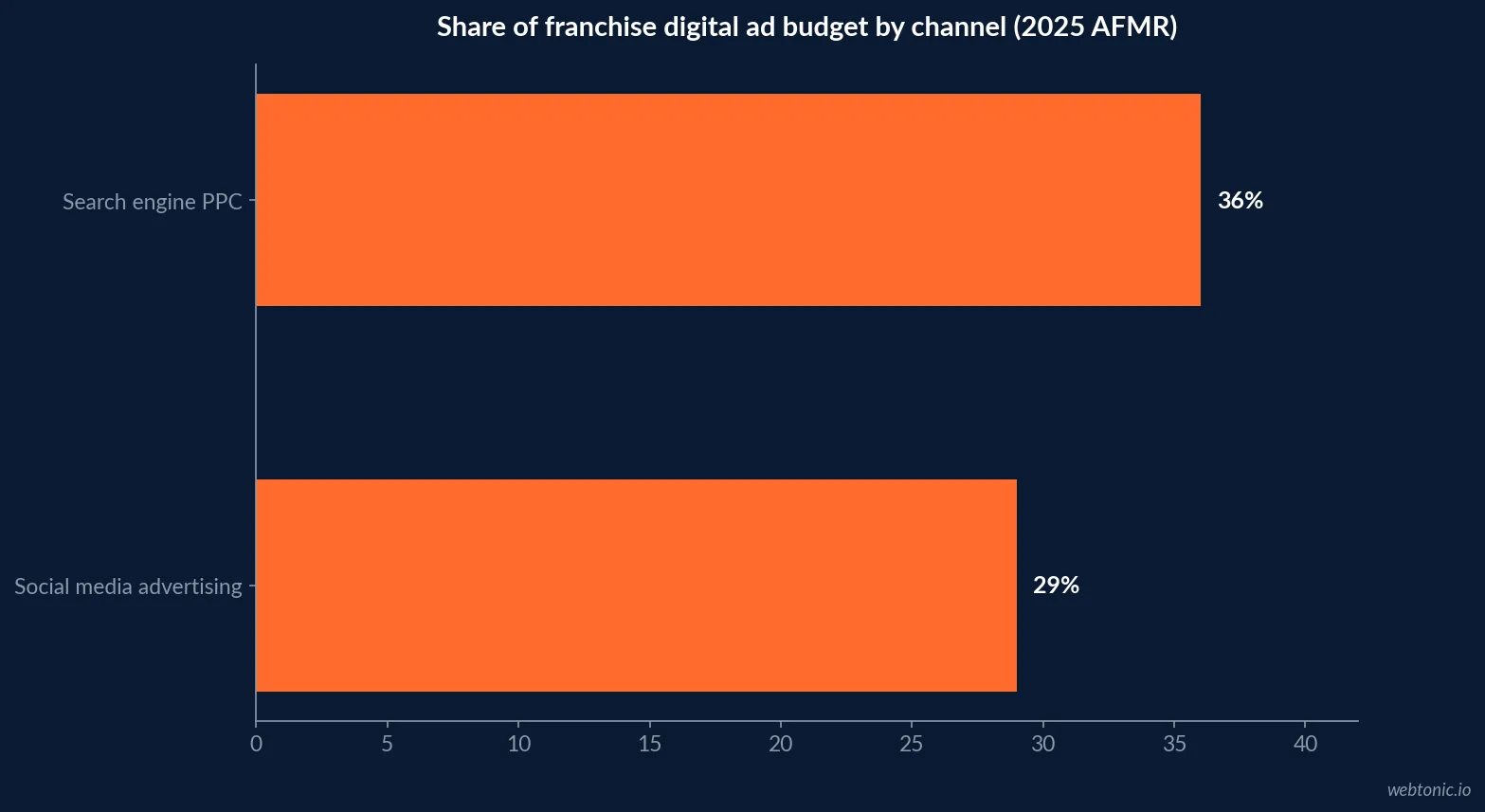
- Search engine PPC alone is 36% of budget, the single largest line item.
- Social media advertising is 29% of budget, the second largest.
- Social media overall (paid and organic) claims 22% of total spend.
- Websites take 12% of budget; print ads and PR take 8% each.
- 39% of franchise marketers saw leads and traffic rise year over year.
- 38% saw leads and traffic hold steady, and 21% saw a decline.
- Every brand surveyed has a formal process for measuring customer experience in 2025.
- Mailchimp's Standard plan starts at USD 20 a month, published on Mailchimp's own pricing page.
- HubSpot Marketing Hub Professional runs USD 890 a month for 3 seats plus a USD 3,000 onboarding fee.
- HubSpot's contact-tier overage adds roughly USD 250 a month per 1,000 extra contacts.
- TCR's Agents and Franchises 10DLC campaign fee is USD 30 a month where texting is part of the stack.
- 75% of retail (non-food) franchises rank PPC their top lead driver, the highest of any sector.
The gap automation is actually priced to close
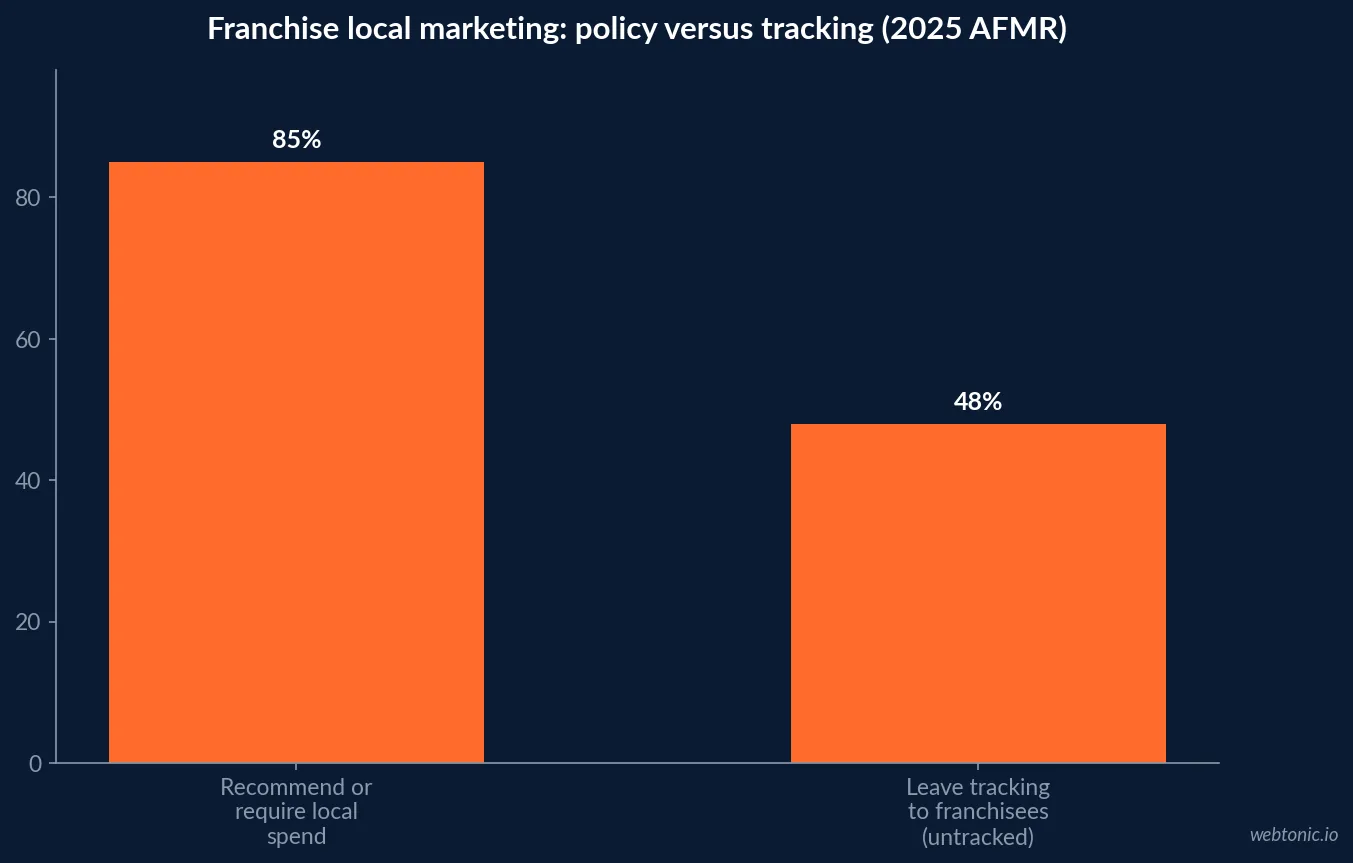
Franchise marketing automation is not usually sold against "no marketing" - it is sold against marketing that already happens, unevenly, without a shared record. Franchise Update Media's 2025 Annual Franchise Marketing Report (AFMR, its seventh year, drawn from franchise CEOs, CMOs and marketing leaders) found 85% of respondents recommend or require franchisees to invest in local marketing. But nearly half - 48% - leave franchisees to independently track and manage that spend. The report's own framing calls this a missed-opportunity risk, not a budget shortfall.
That is the manual-versus-automated question in one statistic: the money moves either way; the visibility does not.
| AFMR 2025 finding | Share | What it implies | Source |
|---|---|---|---|
| Franchisors requiring/recommending local spend | 85% | Local marketing is policy, not optional | Franchise Update Media AFMR 2025 |
| Franchisors leaving tracking to franchisees | 48% | Half the system runs on manual, unlinked records | Franchise Update Media AFMR 2025 |
| Leads/traffic rising year over year | 39% | Growth exists but is not evenly distributed | Franchise Update Media AFMR 2025 |
| Leads/traffic holding steady | 38% | The bulk of the system is neither gaining nor losing | Franchise Update Media AFMR 2025 |
| Leads/traffic declining | 21% | A meaningful minority needs attention a shared dashboard would surface | Franchise Update Media AFMR 2025 |
Where the budget already goes
The same 2025 AFMR breaks the total franchise marketing budget down by channel: digital advertising takes 42%, social media 22%, websites 12%, print ads and PR 8% each, and broadcast TV/radio and streaming TV/radio 7% each, with community events at 7% and direct mail at 3%. Inside the digital line specifically, 36% goes to search engine PPC and 29% to social media advertising - the two channels a workflow tool is built to route leads from into a shared CRM.
By business category, a companion AFMR breakdown shows PPC is the top digital driver almost everywhere: 75% of retail (non-food) brands name it their most effective method, followed by 63% of brick-and-mortar service brands and 40% of non-brick-and-mortar service brands.
| Channel | Share of total marketing budget | Notes | Source |
|---|---|---|---|
| Digital advertising | 42% | Largest single category | Franchise Update Media AFMR 2025 |
| Social media (paid + organic) | 22% | Second largest | Franchise Update Media AFMR 2025 |
| Websites | 12% | Owned-channel spend | Franchise Update Media AFMR 2025 |
| Print ads / PR | 8% each | Tied for third | Franchise Update Media AFMR 2025 |
| Broadcast / streaming TV/radio | 7% each | Legacy and streaming now roughly equal | Franchise Update Media AFMR 2025 |
| Direct mail | 3% | Smallest tracked line item | Franchise Update Media AFMR 2025 |
What a shared platform costs versus fragmented per-franchisee tools
A franchisor deciding whether to centralize automation is comparing one bill against dozens of smaller ones. Mailchimp's own pricing page lists its Standard plan starting at USD 20 a month, with a 15% discount in the first year above 10,000 contacts - a price point individual franchisees could plausibly already be paying on their own, uncoordinated, with no shared reporting between locations.
Centralizing on a platform built for marketing operations rather than single-location sending costs more per seat but buys shared automation: HubSpot's own pricing page lists Marketing Hub Professional at USD 890 a month for three seats (USD 800 billed annually), with a mandatory USD 3,000 one-time onboarding fee, and contact-tier overage that adds roughly USD 250 a month per additional 1,000 contacts once the included 2,000-contact tier is exceeded - a scaling cost that a franchise system spanning dozens of local email lists reaches quickly.
| Platform / plan | Monthly price | What it centralizes | Source |
|---|---|---|---|
| Mailchimp Standard | USD 20 (per-location baseline) | Single-location sending and basic automation | mailchimp.com |
| HubSpot Marketing Hub Professional | USD 890 (3 seats) | Shared workflows, lead routing, reporting across locations | hubspot.com |
| HubSpot onboarding (one-time) | USD 3,000 | Implementation across a multi-location structure | hubspot.com |
| HubSpot contact-tier overage | ~USD 250 per 1,000 contacts | Cost of scaling a shared list past 2,000 contacts | hubspot.com |
The texting layer, where it applies
Franchise systems that add SMS to the automation stack inherit a specific 10DLC use case. The Campaign Registry's own Fees and Pricing guide lists an "Agents and Franchises" campaign use case at USD 30 a month per campaign - three times the USD 10 general Marketing use case rate - reflecting the higher per-message volume and multi-location routing carriers expect from that category. That fee sits on top of whatever the chosen platform charges per message.
Why 48% "untracked" is the real automation case
The AFMR's own framing is worth repeating in full: leaving local tracking to franchisees "could mean missed opportunities and wasted spend," in the words of Franchise Update Media's own EVP presenting the findings. That is not a hypothetical efficiency claim - it is the report's stated read of its own data. A workflow platform's core pitch to a franchisor is not more marketing spend; it is converting that 48% from opaque to visible, using the same 85%-of-systems local budget that already exists.
Our growth marketing team treats that visibility gap, not raw channel mix, as the first question in any multi-location automation build - a shared dashboard is worth little if the underlying franchisee spend still bypasses it.
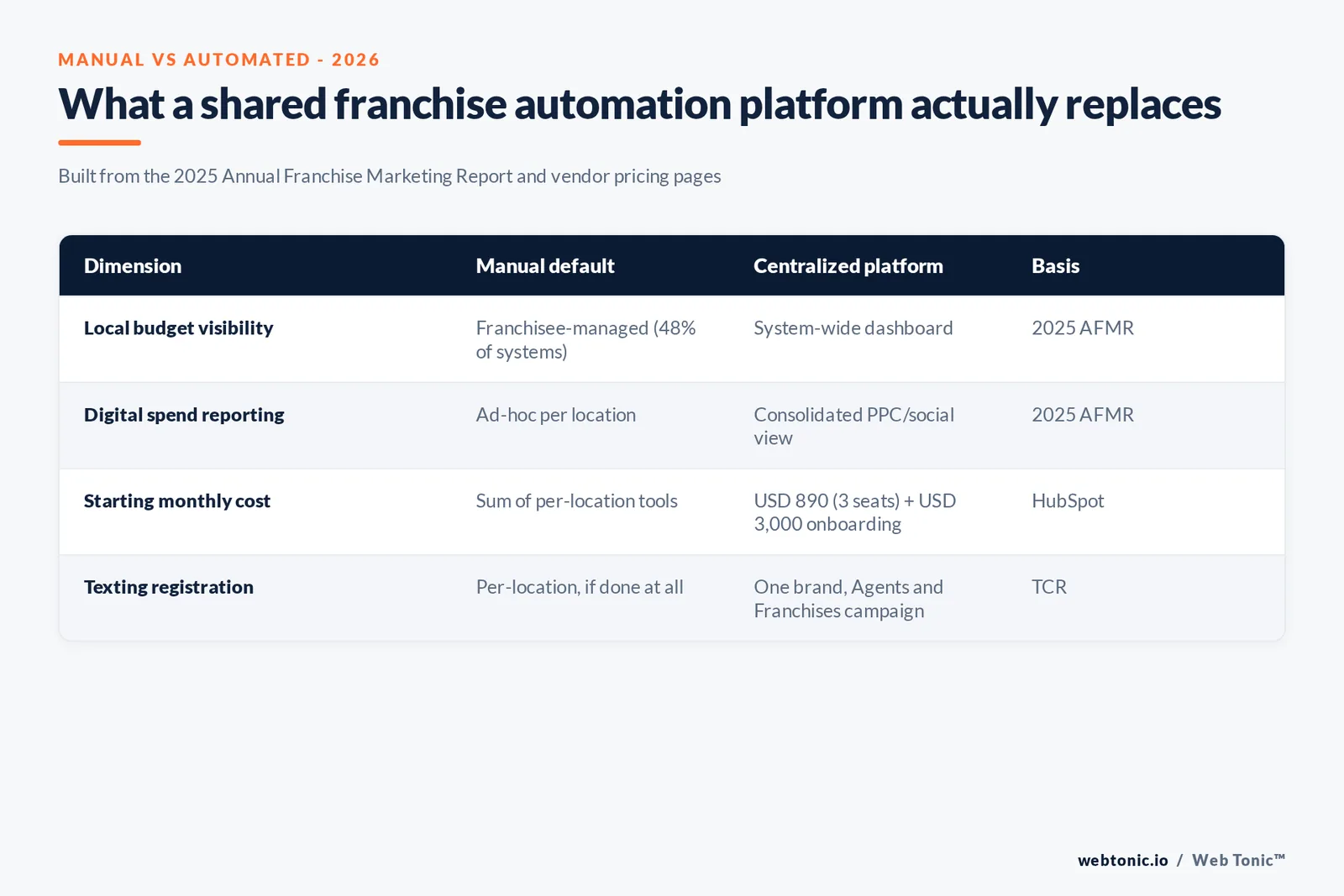
| Dimension | Manual, per-franchisee default | Centralized automation platform | Source basis |
|---|---|---|---|
| Local budget visibility | Franchisee-managed, per AFMR's 48% | System-wide dashboard | Franchise Update Media AFMR 2025 |
| PPC/social spend reporting | Ad-hoc per location | Consolidated 36%/29% split visible system-wide | Franchise Update Media AFMR 2025 |
| Lead source attribution | Compared informally across locations | Routed and logged centrally | HubSpot Marketing Hub (vendor page) |
| Cost to start | Sum of individual per-location tools | USD 890/mo plus USD 3,000 one-time onboarding | hubspot.com |
What this does not answer
No source reviewed for this page publishes a franchise-specific "automated versus manual" controlled comparison - the AFMR measures adoption and budget allocation, not a before/after lift number. Any claim of a specific percentage lift from automating franchise marketing that cannot be traced to a named study should be treated the same way this article treats unsourced SMS open-rate claims: repeated often, proven rarely. The honest position is that automation targets a documented tracking gap (the 48%), not a documented performance gap.
Adoption gap: marketers already know their stack is under-used
Franchise systems are not unusual in leaving automation half-configured. Ascend2's ongoing State of Marketing Automation research reports that 54% of marketers say they are not using their automation tools to their fullest potential, and that roughly two-thirds describe their automation stack as only somewhat or not at all integrated with the rest of their tech. A franchisor buying a shared platform to close the 48% tracking gap inherits that same risk if the rollout stops at purchase - the platform has to be configured location by location, not just licensed centrally, or it becomes one more under-used tool sitting next to the franchisee spreadsheets it was meant to replace.
That is also the labor context the IFA's own 2025 Annual Franchisor Survey describes: with labor availability still the top business challenge for 37% of franchisor executives, headcount to manually reconcile forty or more local marketing budgets is exactly the constraint a shared platform is meant to remove, not a nice-to-have.
| Ascend2 State of Marketing Automation finding | Share | What it means for a franchise rollout |
|---|---|---|
| Not using automation to its fullest potential | 54% | Licensing a platform is not the same as configuring it per location |
| Automation only somewhat/not integrated with other tools | ~66% | A shared platform still needs its own integration budget |
| Quality data cited as the top lever to improve results | Majority | The 48% tracking gap is a data problem before it is a tooling problem |
Frequently Asked Questions
What is the actual manual-vs-automated gap in franchise marketing?
It's tracking, not spending. The 2025 Annual Franchise Marketing Report (Franchise Update Media) found 85% of franchisors recommend or require franchisee local marketing spend, but 48% leave franchisees to track and manage that spend independently. The money is being spent either way; automation platforms exist to make that spend visible at the system level rather than to create new spend.
Where does franchise marketing budget actually go?
By the same 2025 AFMR, digital advertising takes 42% of total marketing budget, social media 22%, websites 12%, print ads and PR 8% each, and broadcast and streaming TV/radio 7% each. Inside digital, 36% of budget goes to search engine PPC and 29% to social media advertising - the two channels most commonly connected to a marketing automation platform's lead-routing rules.
What does a shared automation platform cost across a franchise system?
Two public rate cards anchor this: Mailchimp's own pricing page lists its Standard plan starting at USD 20 a month (with a 15% first-year discount above 10,000 contacts), and HubSpot's own pricing page lists Marketing Hub Professional at USD 890 a month for three seats plus a USD 3,000 one-time onboarding fee. A franchisor centralizing ten to twenty locations on one of these platforms is comparing that single bill against dozens of franchisees each buying their own tools independently.
Is franchise lead generation actually growing or shrinking?
Mixed but net positive per the 2025 AFMR: 39% of franchise marketers reported rising leads and traffic, 38% reported levels holding steady, and 21% reported a decline. Automation's role here is attribution more than volume - a shared platform is what lets a franchisor see which 21% is falling and which local market is driving the 39% gain.
Does automating local marketing replace the franchisee's own workflow?
It replaces the tracking piece, not the local judgment. The AFMR shows franchisors already push local investment - 85% recommend or require it - the open question is whether that spend routes through one shared, reportable workflow or stays inside each franchisee's own untracked ledger.
Sources
Franchise Update Media, 2025 Annual Franchise Marketing Report findings (via Franchising.com)
Franchise Update Media, AFMR 2025: how franchises drive leads
Franchise Update Media, AFMR 2025: franchise marketing funds
Mailchimp pricing (vendor page)
HubSpot Marketing Hub pricing (vendor page)
The Campaign Registry, Fees and Pricing (2026)
Ascend2, State of Marketing Automation research
International Franchise Association, 2025 Annual Franchisor Survey
Web Tonic growth marketing services
Web Tonic data and analytics services
Web Tonic: marketing automation statistics hub