Table of contents
The honest starting point for this topic is that Google's own eligibility rules exclude pure online-only stores from having a Business Profile at all - so a headline like "e-commerce GBP management spend" only applies to the omnichannel slice of retail, not to every online store. This page names that limitation up front, then maps where the spend genuinely belongs: physical showrooms, pickup points, and Google's actual free listing surface for pure online catalogs.
Key Takeaways
- Google's own guidance states online-only e-commerce shops are not eligible for a Business Profile.
- Lead-generation agents, brands with no storefront, and other online-only businesses are explicitly listed as ineligible.
- Eligibility instead requires in-person contact with customers during stated hours.
- Google Merchant Center's free listings program is the actual no-cost surface for a pure online catalog.
- Free listings can appear on Search, the Shopping tab, Google Images, and Google Lens.
- Free listings are supported in the United States and dozens of other countries.
- US retail e-commerce sales hit 16.6% of total retail sales in Q4 2025 (Census Bureau, seasonally adjusted).
- Full-year 2025 e-commerce sales were an estimated USD 1,233.7 billion, up 5.4% on 2024.
- E-commerce accounted for 16.4% of total 2025 retail sales, versus 16.1% in 2024.
- An omnichannel retailer's physical showroom or pickup point is fully GBP-eligible even if most revenue is online.
- 68% of local agencies already offer GBP management as a service, most bundled into a broader SEO retainer (BrightLocal 2024).
Google's own rule: online-only stores don't qualify
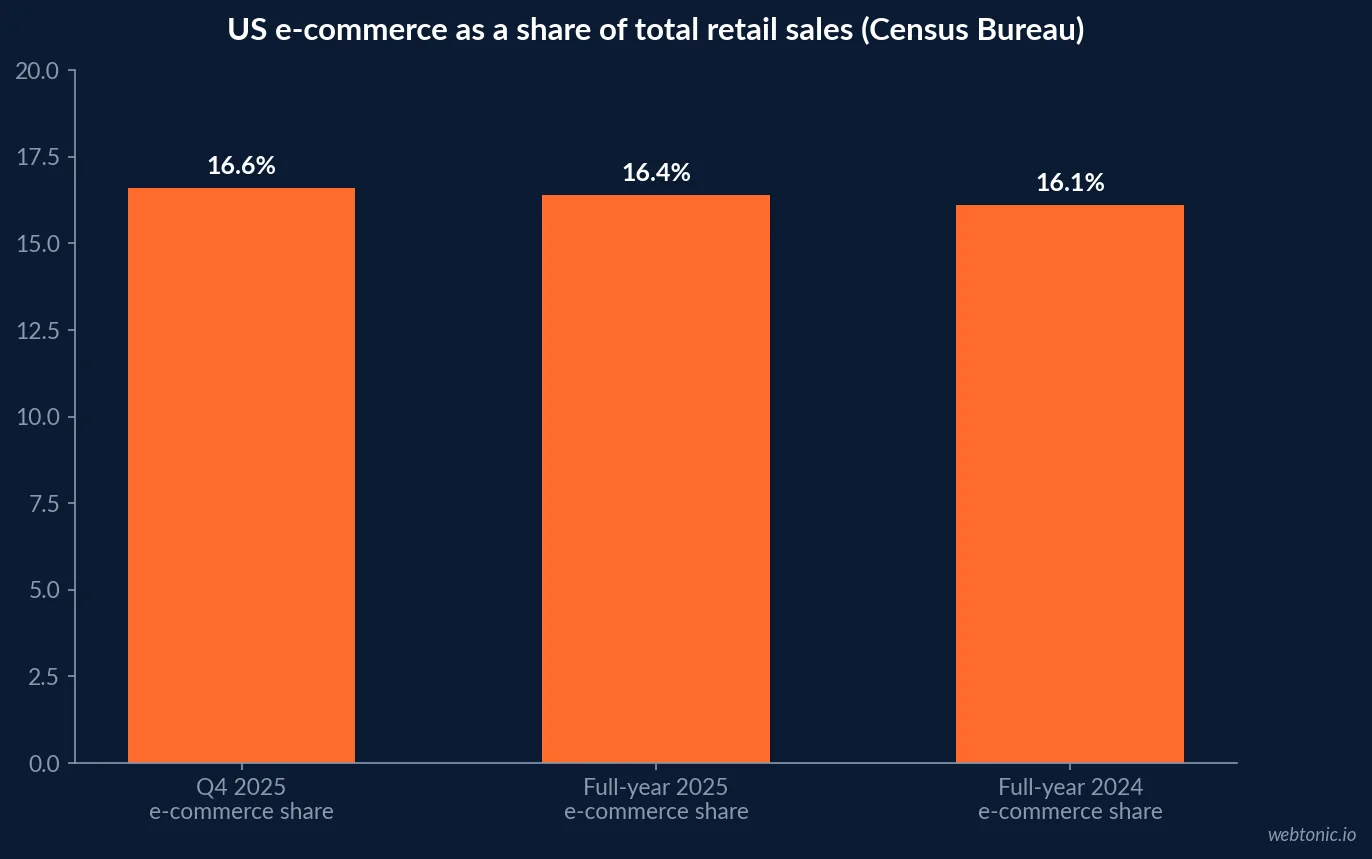
Google's Business eligibility and ownership guidelines state plainly that a business must make in-person contact with customers during its stated hours to qualify for a Business Profile, and the same page explicitly lists "brands, organizations, artists, and other online-only businesses" among the categories that are not eligible, alongside lead generation agents or companies. Google's own verification help is just as direct: its video verification guidance states that "if your business operates online-only, like e-commerce shops with a virtual shop front, and doesn't offer any in-person services, you're not eligible for a Business Profile and can't be verified."
That is not a soft recommendation - it is a hard eligibility gate. Any e-commerce brand being pitched "Google Business Profile management" for a store with zero physical presence is being sold a service Google's own rules say cannot exist for that store.
| Business type | Eligible for a Business Profile? | Source |
|---|---|---|
| Pure online store, no physical location | No | Google eligibility guidelines |
| Brand/organization with no storefront | No | Google eligibility guidelines |
| Lead-generation agent or company | No | Google eligibility guidelines |
| Omnichannel retailer with a showroom | Yes, for that address | Google eligibility guidelines |
| Warehouse or store with a pickup counter | Yes, for that address | Google eligibility guidelines |
| Sales/leasing office for otherwise-ineligible rental property | Yes, specifically for the office | Google eligibility guidelines |
The real free surface for a pure online catalog: Merchant Center
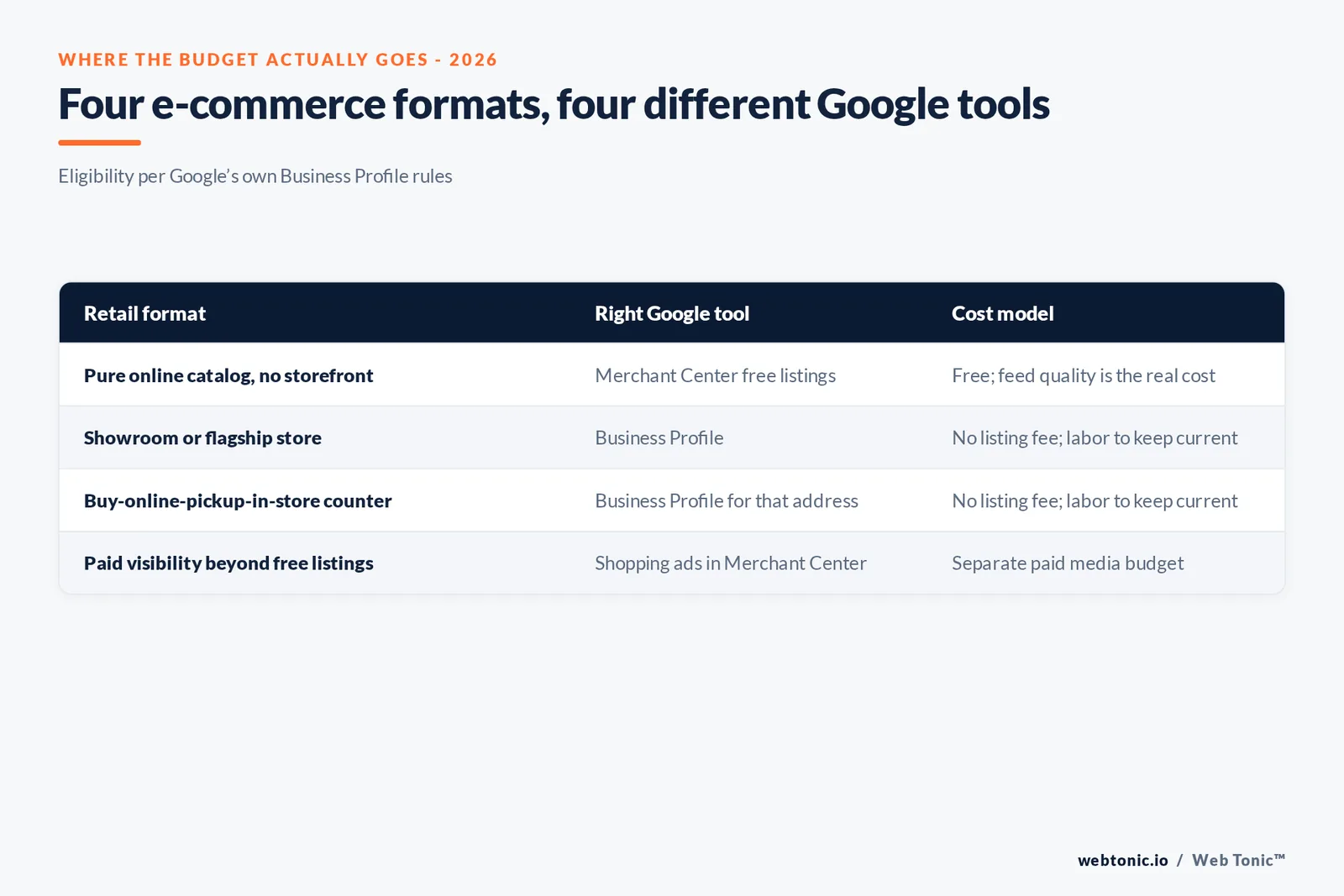
The correct budget line for a store with no physical footprint is Google Merchant Center's free listings program, not a Business Profile. Per Google's own documentation, eligible stores that sync product data to Merchant Center can have those products appear for free across the Shopping tab, YouTube, Google Search, Google Images, and Google Lens - in the United States and dozens of other supported countries - with no Business Profile and no storefront address required.
The catch Google states directly: products are not guaranteed to show, since matching depends on the quality of the product data supplied. That makes feed quality, not physical eligibility, the actual variable a pure online retailer should be spending management time and budget on.
| Spend target | Right tool | Why | Cost model |
|---|---|---|---|
| Pure online catalog, no storefront | Merchant Center free listings | The only surface Google offers this business type | Free; product feed quality is the real cost driver |
| Showroom or flagship store | Business Profile | Meets Google's in-person eligibility rule | No listing fee; labor to keep it current |
| Buy-online-pickup-in-store counter | Business Profile for that address | The pickup point is a genuine in-person touchpoint | No listing fee; labor to keep hours/photos current |
| Paid product visibility beyond free listings | Shopping ads inside Merchant Center | Free listings alone are not guaranteed placement | Paid media budget, separate from GBP spend |
How big is the online layer this decision actually serves
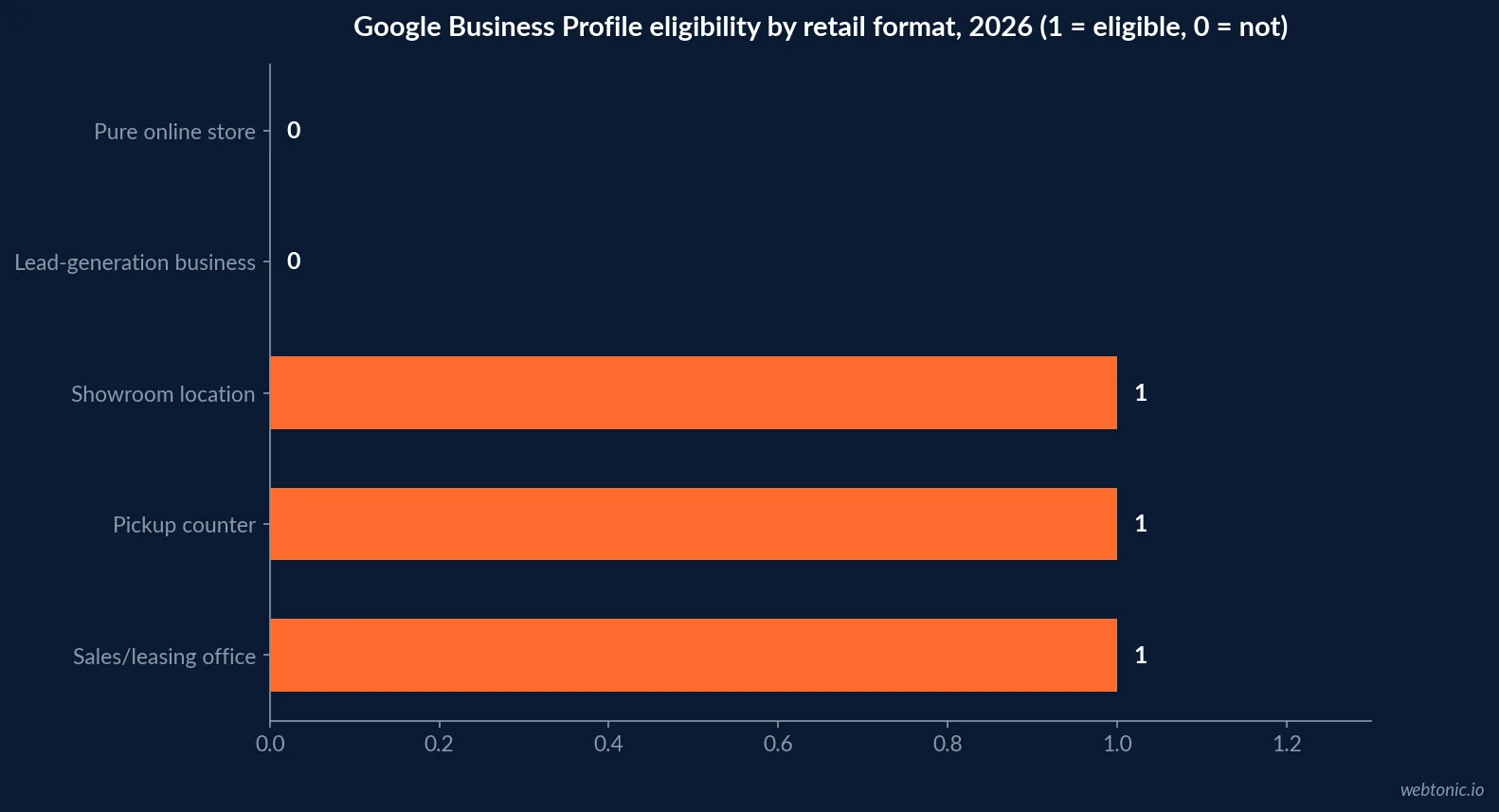
The Census Bureau's Quarterly Retail E-Commerce Sales report for Q4 2025 puts seasonally adjusted e-commerce sales at USD 316.1 billion for the quarter, 16.6% of total retail sales, up 5.3% year over year. For the full 2025 calendar year, the same report estimates total e-commerce sales at USD 1,233.7 billion, a 5.4% increase on 2024, accounting for 16.4% of total 2025 retail sales versus 16.1% the year before. That is real, growing spend - but it is spend flowing through product listings and shopping surfaces, not through the profile-and-directions mechanics a Business Profile is built to manage.
| Metric (Census Bureau) | Q4 2025 | Full-year 2025 | Full-year 2024 |
|---|---|---|---|
| E-commerce sales, seasonally adjusted | USD 316.1B | USD 1,233.7B | n/a (2024 comparison only) |
| E-commerce share of total retail sales | 16.6% | 16.4% | 16.1% |
| Year-over-year e-commerce growth | 5.3% | 5.4% | n/a |
| Total retail sales, seasonally adjusted | USD 1,900.5B | n/a (quarterly figure) | n/a |
Where the omnichannel middle ground actually spends
The retailers this topic genuinely applies to are the ones with at least one in-person touchpoint layered on top of an online-first business: a flagship showroom, a buy-online-pickup-in-store counter, or a returns desk a customer can physically visit. Each of those addresses is independently eligible under Google's own rule, and each should carry its own Business Profile - accurate hours, a working phone number so the Calls metric can register, and photos current enough to match what a customer finds on arrival.
BrightLocal's 2024 Agency Survey found 68% of local agencies already offer GBP management, typically bundled into a broader SEO retainer rather than billed as a stand-alone service - a structure that fits an omnichannel retailer better than it fits a store trying to buy GBP management for a location that, per Google's own rules, does not qualify to have one.
Where on-site product reviews fit versus a store-level rating
The reputation layer an e-commerce brand does control - regardless of Business Profile eligibility - is the on-site product review, and its effect on conversion is well documented. The Medill Spiegel Research Center's ongoing research found that purchase likelihood for a product carrying five reviews rises roughly 270% against the same product with none, that the conversion lift is larger for higher-priced items than cheaper ones, and that purchase likelihood typically peaks when ratings sit in the 4.0 to 4.7 range before declining as reviews approach a suspiciously perfect score. None of that data comes from Google or from a Business Profile - it is product-page reputation, a separate discipline from store-level GBP management, and the one every e-commerce brand can act on regardless of physical footprint.
Conflating the two - assuming a strong product-review program on-site substitutes for Google Business Profile eligibility, or vice versa - is the same category error covered in our analysis of what actually drives ROI for a paid channel versus an owned one: different systems, different levers, and both need their own budget line.
| Reputation layer | What it measures | Controlled by | GBP-eligible business required? |
|---|---|---|---|
| On-site product reviews | Conversion lift per product page | The brand's own site/CMS | No |
| Google Business Profile | Discovery/trust for a physical address | Google, per its eligibility rules | Yes |
| Merchant Center free listings | Product-level discovery across Google | The brand's product feed | No |
| Seller ratings on Google Ads | Aggregate store rating shown in ads | Google, based on review sources | No, separate program |
Fake product reviews carry the same federal risk as fake store reviews
The distinction between on-site product reviews and store-level ratings does not exempt either from federal scrutiny. The FTC's 2024 final rule, codified at 16 CFR Part 465, prohibits fake or incentivized reviews and testimonials wherever they appear - a product page on an e-commerce brand's own site is covered just as directly as a Google Business Profile review would be for a physical retailer. An e-commerce brand cannot treat its on-site review widget as lower-risk than a Google review simply because Google itself is not the eligibility gatekeeper for that surface.
Google's own Business Profile product page and its Performance-report metrics remain the correct reference point for any location within the same brand that does clear the eligibility bar.
| Compliance layer | Covers on-site product reviews? | Covers Google Business Profile reviews? |
|---|---|---|
| FTC 16 CFR Part 465 | Yes | Yes |
| Google review policy (support.google.com) | No - applies to Google surfaces only | Yes |
| Consumer Review Fairness Act, 15 U.S.C. § 45b | Yes, voids gag-clause contract terms | Yes |
The Consumer Review Fairness Act adds a separate protection on top of the fake-review rule: it voids any contract clause that tries to stop a customer from posting an honest review, whether that review lands on the brand's own product page or on a third-party platform - one more reason treating product-page reviews as a lower-compliance-risk surface than a Google review is a mistake.
Can a business just misclassify itself to get a profile anyway?
Google's overview of Business Profile policies repeats the same in-person-contact requirement found on its dedicated eligibility page and applies it consistently in enforcement - a profile created for an ineligible online-only business remains subject to removal once identified, no matter how it was originally categorized. Routing around the rule by listing a warehouse with no customer access, for example, risks a suspension under the same fake-engagement and misrepresentation policies covered earlier, rather than producing a durable workaround.
The budgeting takeaway
Spend the "GBP management" line only on addresses that clear Google's own eligibility bar - showrooms, pickup counters, sales offices. Spend the online-catalog budget on Merchant Center feed quality instead, since that free-listings surface is the one Google actually built for a store with no physical location. Fund on-site product-review collection as its own line, since the Spiegel Research Center data shows that lever moves conversion independent of anything Google-profile-related. Conflating any of these three wastes budget on a system Google's guidelines say should not exist for that store, while under-investing in the two levers that actually decide whether a customer converts.
Our growth marketing practice maps this split for omnichannel and online-first retail clients, our data and analytics team instruments the feed-quality and conversion metrics behind it, and our team can review a specific catalog's eligibility before a budget commitment is made.
Frequently Asked Questions
Can a pure online store get a Google Business Profile?
No. Google's own eligibility documentation states plainly that businesses which operate online-only, like e-commerce shops with a virtual storefront and no in-person service, are not eligible for a Business Profile and cannot be verified. Google's broader eligibility guidance also lists brands, organizations, and other online-only businesses as explicitly ineligible, alongside lead-generation companies. Any e-commerce brand budgeting for 'GBP management' needs to know this before spending a dollar on it.
So where does GBP spending actually apply for an e-commerce brand?
At the point where the brand has a real, in-person customer touchpoint: a retail storefront, a showroom, a warehouse pickup counter, or a returns location a customer can physically visit. Google's eligibility rule is built around in-person contact during stated hours - omnichannel retailers that operate any such location can and should manage a profile for that specific address, even if the majority of their revenue is transacted online.
What's the actual free alternative for a pure online store?
Google Merchant Center's free listings program. Per Google's own Merchant Center documentation, eligible stores can have their synced product data shown for free across Google Search, the Shopping tab, Google Images, and Google Lens, in dozens of supported countries including the US - without needing a Business Profile or a physical address at all. This is the correct budget line for a store with no storefront, not a Business Profile subscription.
How big is the e-commerce share this spending decision has to serve?
The Census Bureau's Q4 2025 retail e-commerce report puts e-commerce at 16.6% of total US retail sales for the quarter (seasonally adjusted), with full-year 2025 e-commerce sales estimated at USD 1,233.7 billion, up 5.4% on 2024 and accounting for 16.4% of total 2025 retail sales. That is the addressable online layer a Merchant Center free-listing strategy serves, separate from whatever in-person retail footprint a brand also operates.
Does an omnichannel retailer need both a Business Profile and Merchant Center?
Yes, and they serve different jobs. The Business Profile covers discovery and trust for a physical location a customer can walk into - directions, calls, hours. Merchant Center's free listings cover product-level discovery for the online catalog, regardless of whether that product is also available in-store. Running only one of the two leaves half of an omnichannel customer's research-and-buy journey unmanaged.
Sources
Google Business Profile Help - Business eligibility and ownership guidelines
Google Business Profile Help - Verify your business with a video recording
Google Merchant Center Help - Free listings
Google Merchant Center Help - Show your products for free on Google
US Census Bureau - Quarterly Retail E-Commerce Sales, 4th Quarter 2025
BrightLocal - Local Marketing Industry Survey: Agency Edition 2024
Medill Spiegel Research Center - How Online Reviews Influence Sales
Google Business Profile Help - Overview of Business Profile policies
Federal Trade Commission - Final rule banning fake reviews and testimonials, 2024
eCFR - 16 CFR Part 465, Trade Regulation Rule on the Use of Consumer Reviews and Testimonials
Google - Google Business Profile product page
GovInfo (US Government Publishing Office) - 15 U.S.C. § 45b, Consumer Review Fairness Act