



Table of contents
Franchise systems with centralized brand guidelines reduce marketing inconsistencies by over 40% — yet 93% of franchisees call local creative adaptation critical to their success. This tension between brand consistency and local relevance defines the franchise ad creative landscape in 2026.
Key Takeaways
- Franchise PPC campaigns deliver 3.5× average ROI, making paid search one of the most predictable lead channels for multi-location businesses (MarketingLTB).
- Paid ads capture 39% of franchise marketing budgets but return only 81% ROI, while email/SMS at 4% spend returns 595% (NeilPatel).
- 87% of franchise brands planned to use Google Ads for franchise development campaigns in 2025 (MarketingLTB).
- Centralized brand guidelines reduce marketing inconsistencies by over 40% across franchise locations (MarketingLTB).
- 93% of franchisees call local marketing critical to their business success (IFA/Uberall).
- UGC-style video outperforms polished creative by 29–34% on click-through and conversion rates (GreenFrogLabs).
- Average Google Ads CTR across industries is 6.64% with franchise campaigns in high-intent categories regularly exceeding this (Hawky).
- Content and creative production gets 20% of national advertising fund budgets in franchise systems (SalesOptima).
Franchise Ad Creative Benchmarks at a Glance
| Metric | Franchise Benchmark | Source |
|---|---|---|
| PPC Campaign ROI | 3.5× | MarketingLTB |
| Google Ads Avg. CTR | 6.64% | Hawky |
| Google Ads Avg. CVR | 8.18% | Hawky |
| Google Ads Avg. CPC | $5.42 | Hawky |
| Paid Ads Budget Share | 39% | NeilPatel |
| Paid Ads ROI | 81% | NeilPatel |
| Email/SMS ROI | 595% | NeilPatel |
| Brand Guideline Consistency Lift | 40%+ fewer inconsistencies | MarketingLTB |
| Franchise CPL Target | Under $200 (strong: $100–150) | LatitudePark |
| UGC vs. Polished CTR Lift | +29% | GreenFrogLabs |
Franchise Marketing Channel ROI Comparison
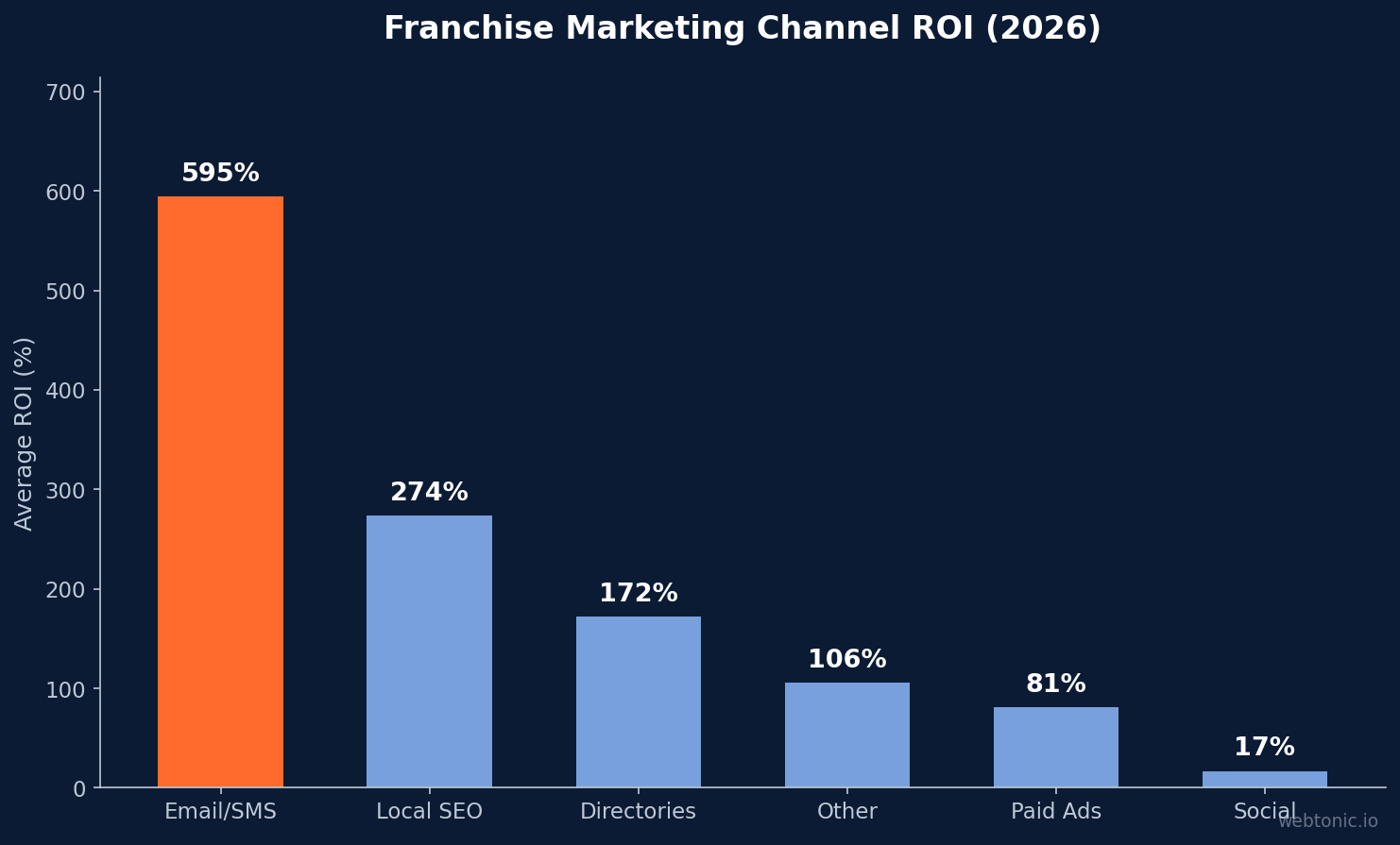
Understanding which creative channels deliver the best returns is essential for franchise marketing budget allocation. NeilPatel's 2026 franchise channel ROI analysis reveals dramatic disparities:
- Email/SMS: 4% of budget, 595% ROI — the highest-return channel by a wide margin.
- Local SEO: 28% of budget, 274% ROI — the best ROI at scale.
- Directories: 11% of budget, 172% ROI — consistently undervalued.
- Paid Ads: 39% of budget, 81% ROI — the largest spend category but relatively lower returns.
- Social Media: 6% of budget, 17% ROI — the lowest return among major channels.
The data clearly suggests that franchise systems significantly over-allocate marketing budget to paid advertising at the expense of higher-ROI channels like email campaigns and local SEO optimization. MarketingLTB's comprehensive franchise statistics confirm that multi-location franchises generate higher digital ad efficiency through shared creative assets, but this efficiency advantage only manifests when creative production is centralized and systematically tested.
Google Ads Creative Performance for Franchises
Hawky's 2026 Google Ads benchmarks establish the performance baseline that franchise creative must beat:
- Average CTR: 6.64% across all industries.
- Average CVR: 8.18% — franchise campaigns in high-intent categories regularly exceed this.
- Average CPC: $5.42 across all verticals.
- Average CPL: $66.69 across all industries.
LatitudePark's franchise Google Ads guide sets more specific franchise targets: a healthy franchise system should aim for a CPL under $200, with strong brands achieving $100–$150. For franchise development campaigns specifically (recruiting new franchisees), Reshift Media reports that CTR spiked in late 2025 and remained unusually strong through December and January, signaling heightened interest from prospective franchise buyers. Building Google Ads strategies that leverage both brand and location-level creative assets is critical for franchise systems managing multiple markets simultaneously.
MarketingLTB notes that 87% of franchise brands planned to use Google Ads for franchise development campaigns in 2025, making it the most popular paid channel for franchise recruitment. Creative that combines brand-level messaging with location-specific proof points — local reviews, community involvement, and territory-specific unit economics — consistently outperforms generic franchise opportunity ads.
Brand Consistency vs. Local Creative Adaptation
The central tension in franchise ad creative is balancing brand consistency with local market relevance. The IFA and Uberall's March 2026 survey of 352 US franchise brands and franchisees reveals the scale of this challenge: 93% of franchisees call local marketing critical to their business success, yet only 39% feel they receive adequate marketing tools from their franchisor.
MarketingLTB's analysis shows that franchise systems with centralized brand guidelines reduce marketing inconsistencies by over 40%. The most effective approach is what franchise marketing experts call the "templatized localization" model — corporate provides approved creative templates, brand-compliant imagery, and copy frameworks, while individual franchisees customize geographic targeting, local offers, and market-specific messaging.
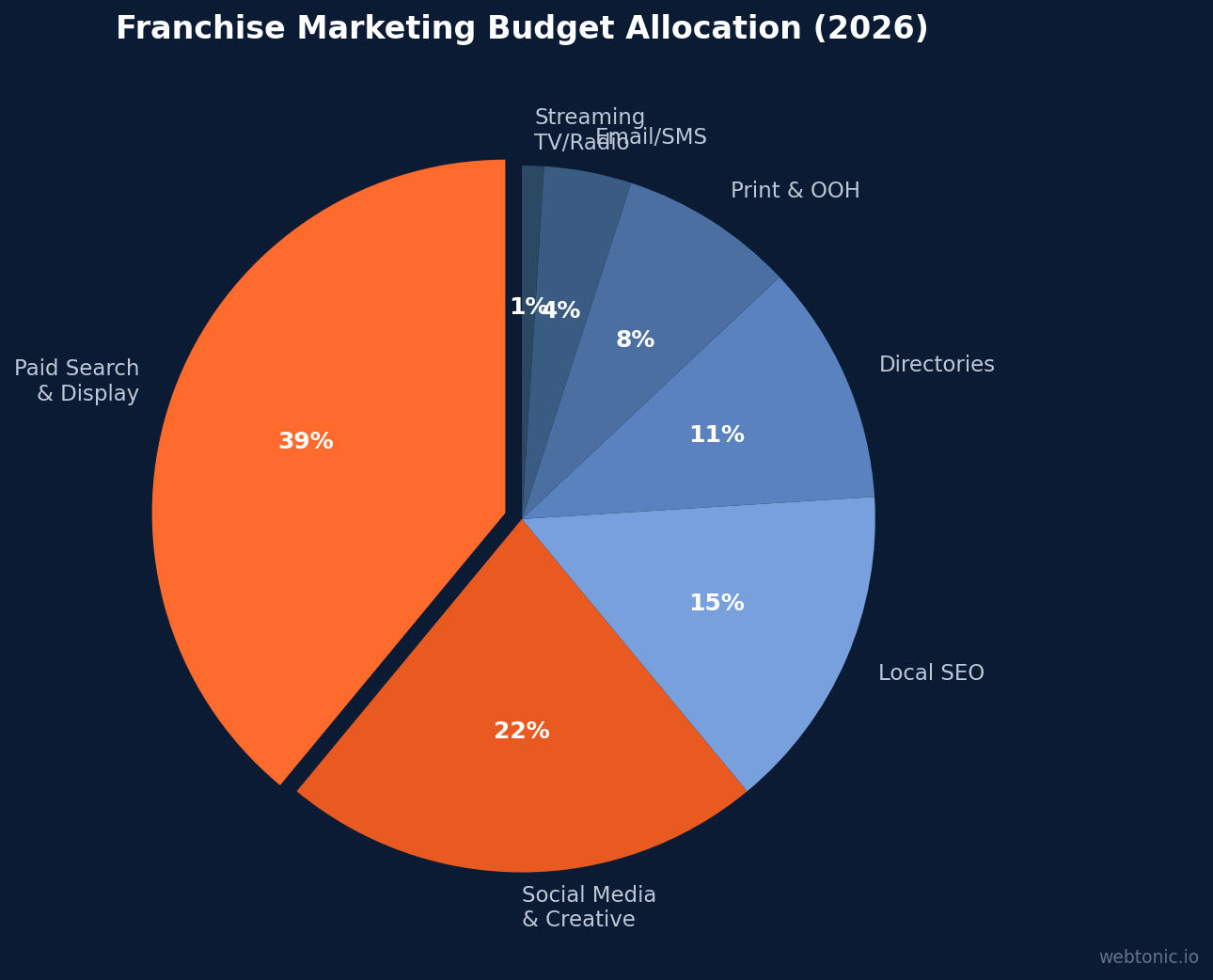
The 2025 Annual Franchise Marketing Report from Franchising.com reveals how franchise systems currently allocate budgets across creative channels: social media claims 22% of total marketing budgets, while traditional channels like print ads hold 8% and streaming TV/radio now matches legacy broadcast at 7% each. For franchise systems investing in performance creative, the shift toward digital-first channels creates opportunities to test creative at scale across multiple locations.
UGC and Video Creative Performance in Franchises
User-generated content has emerged as a particularly powerful creative format for franchise systems. GreenFrogLabs' 2026 performance data across six metrics shows that UGC-style video outperforms polished professional creative by 29% on CTR and 34% on conversion rates. Landing pages featuring UGC-style video achieve 47% higher conversion rates than those with professionally produced content.
Eevy.ai's 2026 UGC video conversion data confirms that UGC video has moved from a nice-to-have to a core conversion driver, with the strongest performance gains in sectors where authenticity and trust play a role in purchase decisions — precisely the territory where franchise brands operate. For Meta Ads campaigns specifically, UGC-style creative allows franchisees to produce locally relevant content that feels authentic while maintaining brand guidelines.
The franchise advantage with UGC is scale: a system with 200 locations can source testimonials, behind-the-scenes content, and customer stories from across the network, creating a content library that no single-location competitor can match. Franchise systems that encourage and systematize UGC collection from franchisees build a competitive creative moat over time.
Creative Testing Strategy for Multi-Location Franchises
Franchise systems have a unique structural advantage in creative testing: they can A/B test ads across dozens or hundreds of markets simultaneously. FranchiseRamp's 2025 analysis of high-performing franchise ads found that consistency across hundreds of franchise locations reduces wasted impressions and strengthens local credibility. The best-performing franchise ad creative combines national brand authority with local proof points — customer reviews from specific locations, community event photos, and area-specific offers.
For franchise systems running Facebook and Meta Ads, the templatized approach extends to dynamic creative optimization (DCO). Corporate provides approved headline variants, image libraries, and call-to-action options; the platform's algorithm then assembles the highest-performing combination for each local market. This approach maintains brand consistency while allowing the machine learning layer to optimize for local audience preferences.
End-to-end attribution remains the biggest measurement challenge for multi-location franchise creative. Tracking a user from ad click to in-store visit or online action requires UTMs, conversion APIs, and location-level reporting. Franchise systems that invest in proper attribution infrastructure — connecting ad platform data with point-of-sale or CRM systems — consistently identify which creative elements drive actual revenue rather than proxy metrics like impressions or clicks.
Creative Budget Allocation in Franchise Systems
SalesOptima Digital's franchise budget template breaks down how national advertising funds are typically allocated within franchise systems:
- Brand advertising: 40% of NAF — national campaigns and brand awareness.
- Digital infrastructure and website: 25% — platform maintenance and optimization.
- Content and creative production: 20% — the budget directly funding ad creative development.
- Analytics and technology: 15% — measurement and reporting infrastructure.
With franchise marketing budgets typically ranging from 1% of revenue ($30,000–$50,000 per year for mid-size locations), the 20% creative allocation means most individual locations are working with $6,000–$10,000 annually for creative production. This constraint makes shared creative assets, template-based localization, and systematic creative reuse essential for maintaining production quality and consistency across the entire franchise system. Building a data intelligence layer that identifies which creative assets perform best across locations enables smarter allocation of limited creative budgets.
| Creative Format | Budget Share | Performance Signal |
|---|---|---|
| Search Text Ads | 30–40% | 6.64% CTR, 8.18% CVR avg. |
| Social Video / UGC | 20–25% | +29% CTR vs. polished video |
| Display / Retargeting | 10–15% | Lower CTR, strong conversion assist |
| Local Landing Pages | 10–15% | 47% higher CVR with UGC video |
| Email / SMS Creative | 5–10% | 595% ROI (highest channel) |
| Print / OOH | 5–8% | Awareness support, low direct ROI |
Best Practices for Franchise Ad Creative
- Rebalance budget from paid ads to email/SMS. Email delivers 595% ROI at just 4% of budget — most franchise systems dramatically underinvest in this channel relative to its return.
- Implement templatized localization. Provide approved creative templates that franchisees can customize with local targeting and offers while maintaining 40%+ consistency improvement from brand guidelines.
- Prioritize UGC-style creative. UGC outperforms polished video by 29% on CTR and 34% on conversions — source authentic content from franchisees across the network.
- Set CPL targets below $200. Strong franchise brands achieve $100–$150 CPL through optimized Google Ads creative and landing page alignment.
- A/B test creative across markets simultaneously. Multi-location systems have a natural testing advantage — use it to validate creative before rolling out systemwide.
- Track channel-level ROI rigorously. The gap between 595% ROI (email) and 17% ROI (social) demands data-driven creative budget decisions, not legacy allocations based on habit.
- Invest in shared creative libraries. Centralizing high-performing creative assets for reuse across locations generates higher ad efficiency and reduces per-location creative costs through growth marketing strategies.
Related reading
- What Trucking Ad Creatives Actually Convert Freight Leads?
- Garage Door and Window Ad Creative Benchmarks
- 2026 Ad Creative Stats for Automotive: Benchmarks That Matter
- Branding services at Web Tonic
Frequently Asked Questions
What is a good ROI for franchise advertising creative?
Franchise PPC campaigns deliver 3.5× average ROI according to industry survey data. However, channel matters enormously: email/SMS returns 595% ROI while social media returns only 17%. For Google Ads specifically, franchise campaigns should target a CPL under $200, with well-optimized systems achieving $100–$150 per lead.
Should franchise creative be centralized or localized?
The most effective approach is hybrid. Centralized brand guidelines reduce inconsistencies by over 40%, but 93% of franchisees consider local marketing critical to their success. The best franchise systems provide corporate-approved creative templates that franchisees customize with local targeting, offers, and community-specific messaging while maintaining brand integrity.
Does UGC outperform professional creative for franchises?
Yes, consistently and often by a significant margin. UGC-style video outperforms polished professional content by 29% on CTR and 34% on conversion rates according to GreenFrogLabs' 2026 data across six key performance metrics. Landing pages with UGC video convert 47% higher than those with studio-quality production. Franchise systems have a unique advantage here because they can source authentic content from hundreds of locations simultaneously, creating a content library that scales naturally with the network's growth and builds consumer trust through real customer experiences.
How much should franchises allocate to creative production?
Creative production typically receives 20% of the national advertising fund in franchise systems. With NAF budgets ranging from 1% of revenue ($30,000–$50,000 per year for mid-size locations), this means $6,000–$10,000 annually per location for creative work. Shared creative assets and template-based localization are essential for maintaining quality at this budget level.
What Google Ads benchmarks should franchise creative beat?
The 2026 cross-industry averages are 6.64% CTR, 8.18% CVR, $5.42 CPC, and $66.69 CPL according to Hawky. Franchise campaigns in high-intent categories should exceed these benchmarks. A healthy franchise system targets a CPL under $200, with strong brands achieving $100–$150 through optimized creative and landing page alignment. The cost of Google Ads varies by vertical, but franchise systems benefit from brand recognition that typically drives above-average CTR when creative includes brand-level trust signals alongside local proof points and geographic relevance.
Sources
marketingltb.com/blog/statistics/franchise-marketing-statistics
neilpatel.com – franchise marketing channel ROI
hawky.ai/blog/google-ads-benchmarks
latitudepark.ai – franchise Google Ads guide
reshiftmedia.com – franchise development trends 2026
franchising.com – 2025 AFMR findings
franchiseramp.com – anatomy of high-performing franchise ads
greenfroglabs.com – UGC vs professional video data
eevy.ai – UGC video conversion stats 2026
franchise.org – closing the franchise gap
salesoptimadigital.com – franchise marketing budget template


