



Table of contents

A fractional CMO costs $5,000 to $25,000 per month on a retainer in 2026, or $200 to $500 per hour for advisory work, with most engagements running 10 to 20 hours a week. The number you land on is set by scope and stage, not by the title.
Key Takeaways
- Independent 2026 benchmarks cluster the monthly retainer between $5,000 and $25,000, with the working mid-zone at $8,000 to $15,000 depending on days per week.
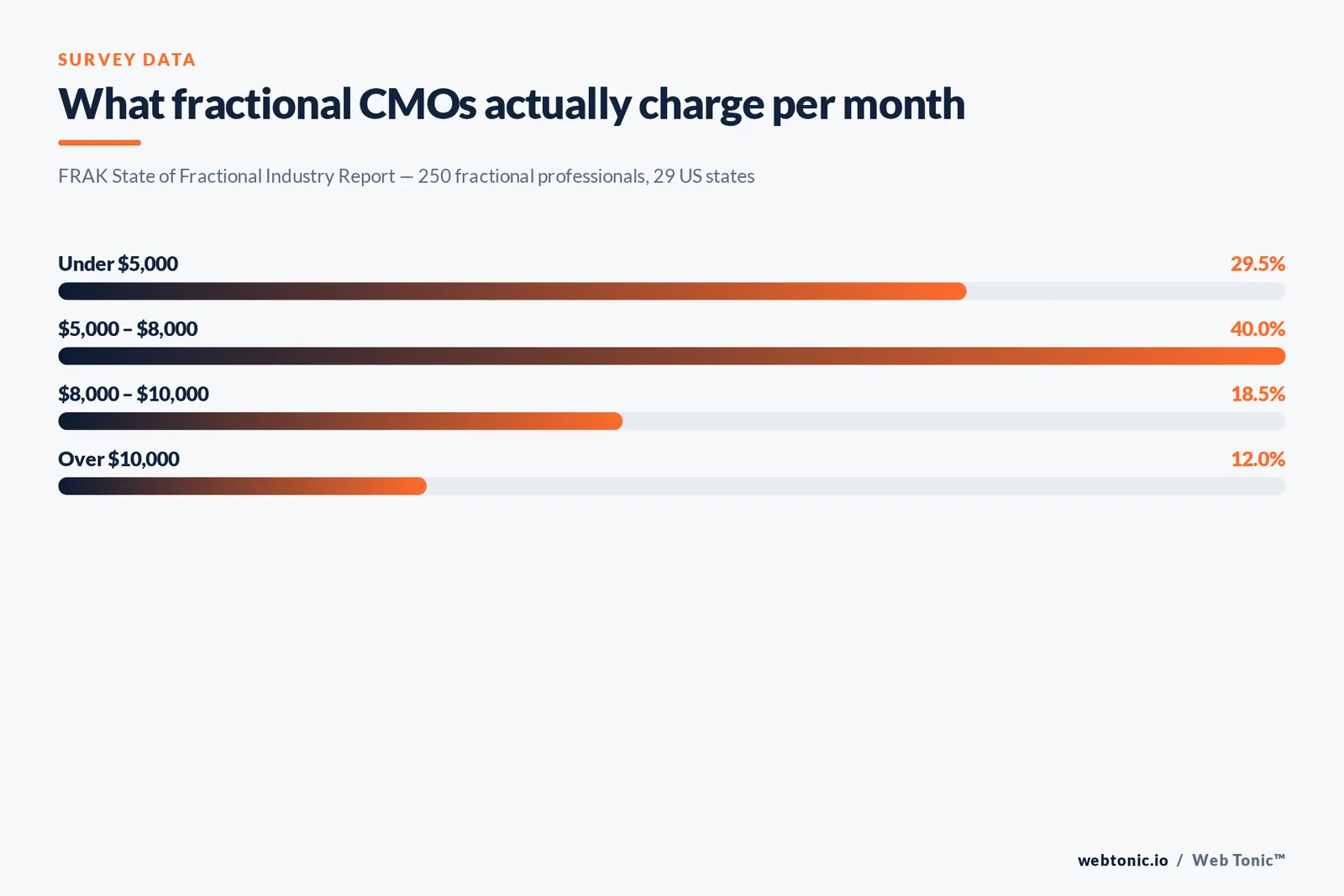
- The FRAK State of Fractional survey of 250 fractional professionals found 40% charging $5,000–$8,000 a month, 29.5% under $5,000, 18.5% at $8,000–$10,000 and 12% above $10,000.
- Hourly advisory runs $200 to $500; day rates $1,200 to $2,500; defined projects $8,000 to $50,000.
- The full-time comparison: average US CMO total compensation is $293,575 (Built In, 2026) and the all-in full-time equivalent is $300,000 to $500,000 a year (Treetop, 2026).
- That puts a fractional CMO at roughly 25% to 50% of the full-time cost — before you count recruiting fees, equity, severance and a ramp measured in months.
- Cost per outcome beats cost per hour. A $10,000 monthly retainer covering 30 hours is about $333 an hour; the same retainer buying 8 hours is not the same purchase.
Fractional CMO pricing models in 2026
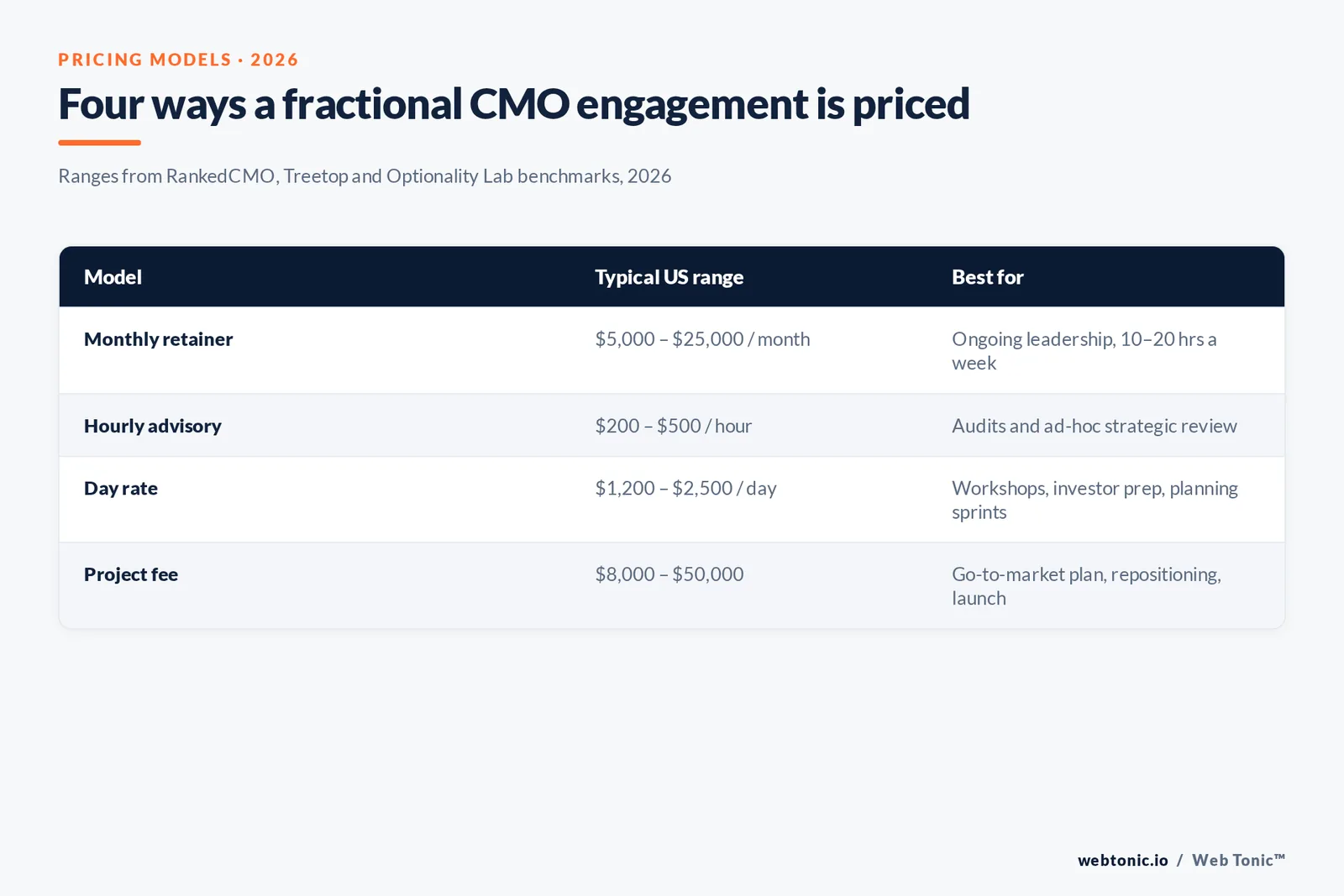
Four pricing structures cover almost every fractional CMO engagement. Each answers a different question about how much strategic leadership your business needs and how predictable you want the monthly budget to be.
| Pricing model | Typical 2026 range | Best for | Typical commitment |
|---|---|---|---|
| Monthly retainer | $5,000 – $25,000 / month | Ongoing marketing leadership plus team and agency management | 10–20 hours per week, 6+ months |
| Hourly advisory | $200 – $500 / hour | Audits, ad-hoc strategic review, board prep | 5–15 hours per month |
| Day rate | $1,200 – $2,500 / day | Workshops, investor prep, intensive planning | Bursts, not continuity |
| Project fee | $8,000 – $50,000 | Go-to-market plan, repositioning, launch | 1–3 months, fixed scope |
RankedCMO's 2026 pricing guide puts the headline retainer at $5,000–$25,000 per month and hourly advisory at $200–$500, with most engagements at 10–20 hours per week. Optionality Lab's synthesis of multiple benchmark sources lands slightly lower on the floor — $4,000–$20,000 a month — and places the average US retainer at $10,000–$12,000, with most working engagements in the $8,000–$15,000 mid-zone. Treetop's 2026 fractional executive pricing report, focused on mid-market B2B, narrows it to $8,000–$25,000 per month for one to two days a week at $200–$400 an hour.
The spread between those sources is the single most useful fact on this page: three credible benchmarks, one overlapping band. If a proposal sits far outside $5,000–$25,000, ask what is different about the scope before you assume the pricing is wrong.
What the survey data says fractional CMOs actually charge
Benchmarks describe the market; surveys describe practitioners. The FRAK State of Fractional Industry Report, a 2024 survey of 250 fractional professionals across 29 US states, breaks the monthly retainer down like this: 29.5% charge under $5,000, 40% charge $5,000 to $8,000, 18.5% charge $8,000 to $10,000, and 12% charge over $10,000. The same analysis notes that 73% of fractional executives carry 15+ years of experience, and that 36% name pricing correctly as their biggest challenge — which is why two quotes for identical scope can differ by a factor of two.
Supply-side data agrees on seniority. Duct Tape Marketing's survey of 260+ marketers found 48.6% currently working as fractional CMOs and over 70% with more than 10 years of experience, with strategic planning (92.67%) and marketing strategy development (88.67%) as their most-sold services. You are paying for judgement, and judgement is the part of the marketing budget that does not scale with hours.
Stage matters as much as seniority. Fractional Pulse, which tracks 1,049 qualified listings across 652 companies with 531 disclosing pay, prices fractional executives by company stage rather than by title alone — early-stage retainers sit well below growth-stage ones because the hours and the mandate are smaller.
Cost by stage and scope
Use this as a planning table. It maps the ranges above onto the hour bands that Prose publishes for fractional CMO scopes, so the monthly number always has a job description attached.
| Company stage | Hours / week | Indicative retainer | What the engagement covers |
|---|---|---|---|
| Pre-revenue / seed | 5–8 | $4,000 – $8,000 | Advisory leadership: positioning, priorities, coaching the marketing lead |
| Early growth ($1M–$5M) | 8–12 | $6,000 – $12,000 | Owns the quarterly plan, budget allocation and one agency or freelancer bench |
| Growth ($5M–$20M) | 12–20 | $10,000 – $18,000 | Leads an internal marketing team, multiple channels, full demand generation model |
| Scale / mid-market ($20M+) | 20+ | $15,000 – $25,000 | Interim ownership, turnaround or launch, reassessed after 90 days |
Ranges synthesised from the Treetop, RankedCMO, Optionality Lab and Fractional Pulse benchmarks cited above; verify against two or three live quotes before you budget.
What drives the price up or down
- Days per week. The clearest lever. Moving from one day to two roughly doubles the retainer, because the fractional CMO is giving up capacity they could sell elsewhere.
- Team management. Managing five people and three vendors is a different job from advising a founder, and it prices differently.
- Industry. Regulated categories — financial services, healthcare, legal — carry a premium for the compliance judgement that comes with the expertise.
- Individual versus firm. Independent operators quote their own rate; an agency-backed fractional CMO usually costs more per month but brings a delivery bench, cover during absence and shared measurement infrastructure.
- Engagement length. Six- and twelve-month commitments typically price below month-to-month, because the operator carries less sales overhead.
- Equity. Cash-plus-equity structures appear at seed stage and are uncommon later. Treat equity as a discount on cash cost, never as a substitute for a clear mandate.
Fractional CMO cost versus a full-time CMO
The honest comparison includes everything payroll adds. Built In's 2026 data reports average US CMO base salary at $225,908, additional cash compensation at $67,667 and average total compensation at $293,575. PayScale reports $191,624 on average with a range of about $99,000 to $298,000. Treetop models the all-in full-time equivalent, including benefits and overhead, at $300,000 to $500,000 a year.
| Cost line | Fractional CMO | Full-time CMO |
|---|---|---|
| Cash cost | $60K–$300K a year at $5K–$25K per month | $293,575 average total compensation (Built In, 2026) |
| Benefits and payroll tax | None — invoiced as a vendor | Typically 20–30% on top of base salary |
| Recruiting | Days to shortlist, no search fee | Retained search fees plus months of leadership time |
| Ramp | Diagnosis inside the first 30 days | Notice period plus onboarding, commonly 2–6 months |
| Exit cost | Notice period in the contract | Severance, backfill and lost momentum |
| Duration risk | Month-to-month or 3–12 months by design | 4.1-year average S&P 500 tenure (Spencer Stuart, 2026) |
That last line is the one finance teams underrate. Spencer Stuart measures average CMO tenure in the S&P 500 at 4.1 years against 5.0 years for all C-suite roles. A permanent hire is not permanent; it is a four-year commitment with a severance tail, so the cost comparison should be run over a three-year horizon rather than a single month.
How to compare quotes without getting fooled by the monthly number
- Convert everything to an effective hourly rate. A $10,000 retainer covering 30 hours a month is roughly $333 an hour; the same retainer for 8 hours is $1,250. Both can be correct — but only one is what you thought you were buying.
- Separate leadership hours from execution hours. If the retainer quietly includes content production or ad management, you are paying executive rates for specialist work.
- Price the measurement layer. Someone has to rebuild reporting before the strategy can be judged. Ask whether that sits inside the retainer or arrives as a separate project fee.
- Ask what happens in month seven. Renewal terms, notice period and handover deliverables belong in the first conversation.
- Compare against the alternative use of the money. Sometimes the better purchase is media budget plus a strong growth marketing team, not more leadership hours.
Cost per outcome is the metric that matters. Track qualified pipeline, customer acquisition cost and revenue contribution against the retainer from month one, using one shared dashboard — the discipline our data intelligence team builds for exactly this reason. If you want the leadership layer and the execution bench under one accountable roof, that is how our fractional CMO service is structured, and you can ask us to scope it against your own numbers.
Building the business case for the investment
A fractional CMO is a marketing investment, and it should clear the same bar as any other senior spend. The core question is not "can we afford $10,000 a month" but "what performance does this spend have to unlock to pay for itself, and how soon can we see it".
Start from real numbers. If your average deal is worth $25,000 and your close rate on qualified opportunities is 25%, a senior marketing leader who adds four qualified opportunities a month adds roughly $25,000 in new revenue a month at that close rate. Against a $12,000 retainer, the investment clears on volume alone — before any efficiency gain on existing spend. Run that calculation with your own deal size, close rate and sales cycle length before you compare quotes, and be specific about the sales cycle: a nine-month business-to-business cycle means the revenue proof lands in month ten even when the pipeline signal lands in month three.
The second half of the case is efficiency on money you already spend. Most growth-stage companies carry an internal media budget that has never been reallocated on evidence. A clear allocation model, a real attribution baseline and a monthly performance review routinely move 15% to 30% of that budget from weak channels to strong ones. On a $40,000 monthly media spend, that reallocation is worth more than the retainer itself, which is why the measurement workstream should never be the thing you cut to save money.
| Business case input | What to use | Why it matters |
|---|---|---|
| Average deal value | Trailing 12 months, not best case | Sets how many opportunities the investment must create |
| Close rate | Qualified opportunity to closed-won | Converts pipeline movement into real revenue |
| Sales cycle | Median days, by segment | Sets when the board should expect proof |
| Current media spend | Monthly total across channels | Efficiency gains here often exceed the retainer |
| Internal cost | Leadership hours the engagement absorbs | The hidden line in every fractional model |
Costs the retainer does not cover
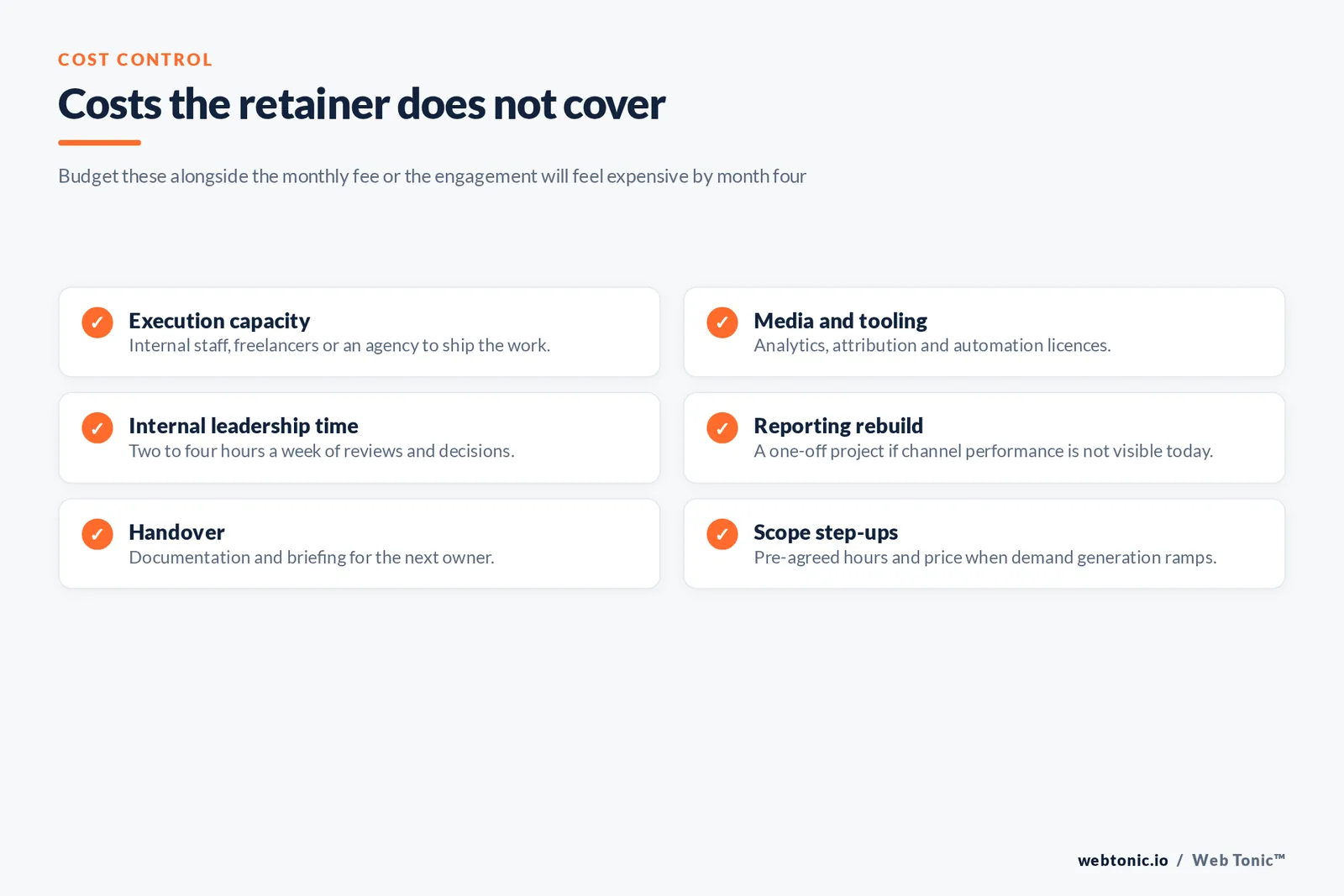
Every quote covers the senior leader's time. Several real costs sit outside it, and leaving them out of the budget is the most common reason a well-priced engagement feels expensive by month four.
- Execution capacity. A strategy needs people to ship it. Whether that is internal staff, freelancers or an agency, the delivery line is separate from the leadership line and is usually the larger of the two.
- Media and tooling spend. Analytics, attribution and marketing automation licences are a business cost, not a consulting cost.
- Internal time. Expect your leadership team to give the engagement two to four hours a week in reviews and decisions at the start. That is not overhead; it is the mechanism by which a part-time leader gets clear direction and gives it back.
- Reporting rebuild. If your current reporting cannot show channel-level performance, budget a one-off project to fix it. Without it, nobody can judge the investment on evidence.
- Handover. When the mandate ends, someone documents the model and briefs the next owner. Good operators include it; ask, rather than assume.
One more level of detail is worth agreeing in writing: what happens to the retainer when demand generation ramps. Many engagements start at an advisory level and step up as the marketing function grows. A pre-agreed step-up — specific hours, specific price, specific trigger — keeps the conversation about performance instead of about renegotiation.
When the economics flip to a full-time hire
Fractional marketing leadership is the cheaper answer right up to the point where it is not. Three thresholds tend to flip the economics for growing companies.
- More than three days a week of leadership work. Once the core strategic workload fills three days, the retainer approaches full-time cost without full-time availability, and a permanent chief marketing officer becomes the better buy.
- A marketing team past roughly eight people. Direct management, hiring and performance conversations do not compress well into a part-time week.
- Marketing as the primary growth engine. When the board reviews marketing performance every month because it is the main lever on revenue, companies generally want that owner in the building full time.
Below those thresholds, fractional CMOs give smaller companies access to a level of experience they could not otherwise employ. Many businesses run the model for 12 to 24 months, then hire in-house with a plan, a working measurement stack and a candidate profile written by someone who has already done the job for them — which usually makes the eventual hire cheaper and faster too.
Questions to ask before you sign
- What exactly is in scope, and what is execution? Get the split in writing so the strategic work and the delivery work are priced separately.
- How many hours, and on which days? Availability during your leadership meeting matters more than the raw number.
- Which two or three metrics judge this engagement? Agree them, then agree the reporting cadence and format for the board.
- What is your relevant experience at our stage and in our industry? Ask for two comparable companies and what changed in the first quarter.
- Who covers you? An agency-backed fractional CMO has a bench; an independent operator should still name a plan.
- What is the notice period and the handover? A clean exit clause is a sign of confidence, not of doubt.
Price is the last question, not the first. Once the mandate, the hours and the metrics are clear, the quotes become genuinely comparable — and the difference between a $7,000 and a $15,000 retainer usually explains itself in one sentence about scope.

Frequently Asked Questions
How much does a fractional CMO cost per month?
Most 2026 benchmarks put the monthly retainer at $5,000 to $25,000, with the average landing near $10,000 to $12,000 and the majority of engagements in the $8,000 to $15,000 mid-zone. Survey data from practitioners skews lower, with 40% charging $5,000 to $8,000.
What is a typical fractional CMO hourly rate?
Hourly advisory work runs $200 to $500, with $200 to $400 the most common band for mid-market engagements. Day rates for workshops or investor prep run $1,200 to $2,500.
Is a fractional CMO cheaper than a full-time CMO?
Usually yes. A fractional engagement typically costs 25% to 50% of the all-in full-time equivalent of $300,000 to $500,000 a year, with no benefits load, search fee or severance exposure. The saving shrinks if you buy more than three days a week — at that point a full-time hire is often the better economic answer.
How many hours a week should the retainer cover?
Between 8 and 20 hours in steady state: 5–8 for advisory-only scopes, 12–20 when the fractional CMO manages a team or several agencies, and 20+ for the first 30 to 90 days of a launch or turnaround.
Should you pay a fractional CMO in equity?
Equity appears mainly at seed stage and is uncommon beyond it. Treat it as a partial discount on cash, keep the scope and notice period in writing, and never let equity substitute for a measurable mandate.
Sources
RankedCMO — Fractional CMO Cost (2026)
Treetop — 2026 Fractional Executive Pricing Report
Optionality Lab — Fractional CMO Rates in 2026
Randy Wattilete — Fractional CMO cost, incl. FRAK State of Fractional survey
Fractional Pulse — Fractional Executive Cost Guide
Prose — Fractional CMO hours per week benchmarks
Built In — CMO salary in US (2026)
PayScale — Chief Marketing Officer salary (2026)
Spencer Stuart — CMO Tenure 2026
Duct Tape Marketing — Fractional CMO Insights Survey


