



Table of contents
A fractional CMO's first 90 days should follow one sequence: diagnose in month one, decide and align in month two, execute and prove in month three. If month three is still discovery, the engagement has drifted.
Key Takeaways
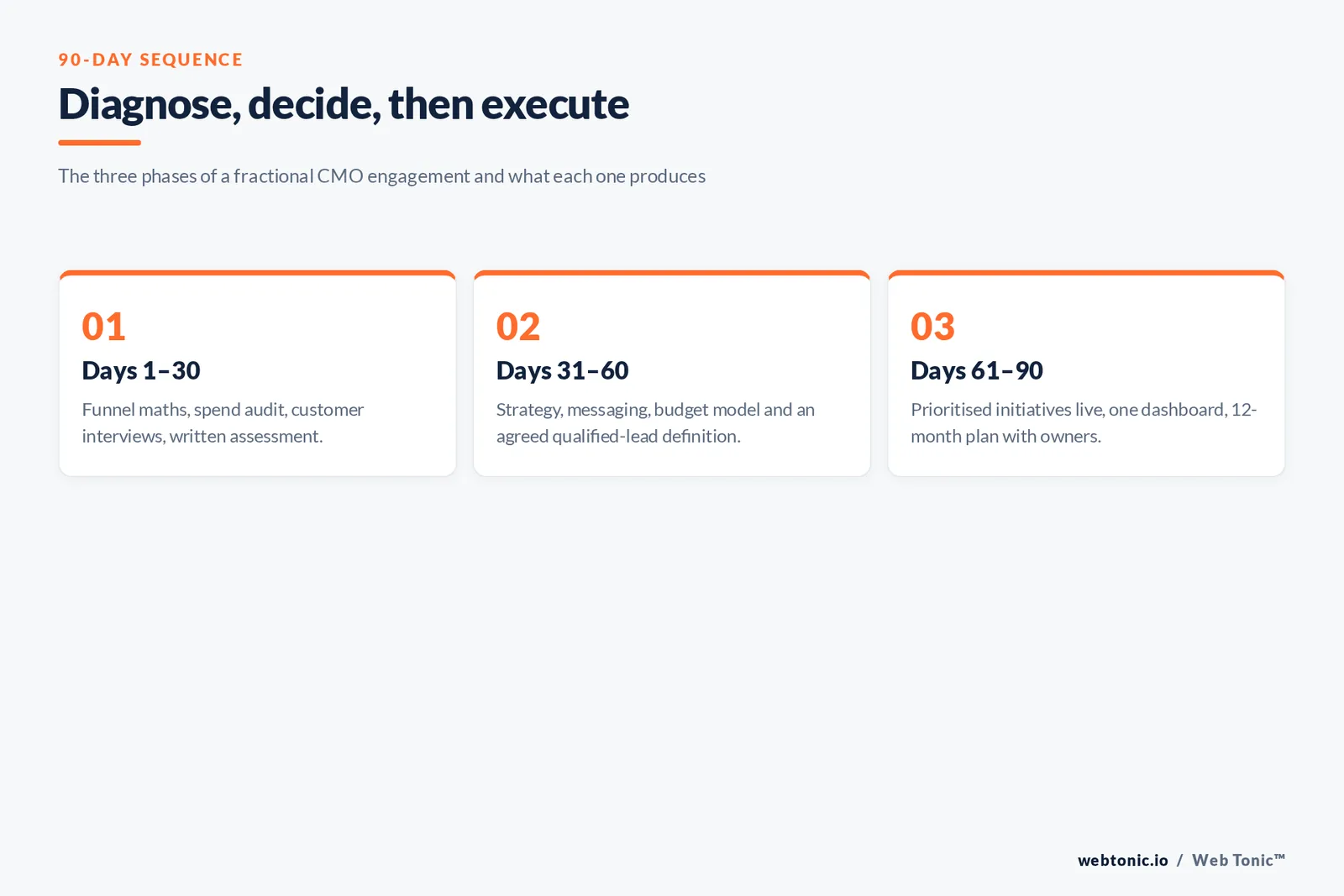
- Month 1 is diagnosis — funnel maths, spend audit, customer interviews and a written assessment; month 2 locks marketing strategy, messaging and the plan; month 3 ships and measures.
- Working time is scarce: most fractional CMO engagements run 8 to 20 hours a week, so the first 90 days must be sequenced rather than improvised.
- Expect 20+ hours a week in the first 30 to 90 days for a launch, turnaround or leadership gap, then a reassessment down to steady state.
- The deliverables that matter by day 90: a written strategy, a budget allocation model, an agreed definition of a qualified lead, one dashboard, and a 12-month plan with owners.
- Integration and communication are the top failure modes reported by companies engaging fractional CMOs, not strategy quality — a standing weekly leadership slot fixes most of it.
- Judge business outcomes on a realistic clock: pipeline signal by month three, revenue contribution usually months four to six, depending on your sales cycle.
Why the first 90 days decide the engagement
A fractional chief marketing officer does not get the ramp a full-time hire gets. They are brought in precisely because the company needs senior marketing leadership working now, and the clock is visible to everyone: the CEO, the sales team, and whoever was running marketing before. Prose's 2026 benchmarks put steady-state scopes at 8 to 20 hours a week, rising above 20 hours for the first 30 to 90 days of a launch, repositioning or leadership gap. That is between 100 and 250 hours for the whole first quarter — enough to change the trajectory of a growth-stage company, and nowhere near enough to waste.
The pressure is real because the alternative is expensive. Built In puts average US CMO total compensation at $293,575, and Spencer Stuart measures average S&P 500 CMO tenure at 4.1 years against 5.0 years for the wider C-suite. Companies choose fractional marketing leadership partly to compress the time between hiring and clarity. The 90-day plan is how that promise is kept.
Days 1–30: diagnose before you decide
Month one is evidence collection. A fractional CMO who arrives with a channel plan in week one is selling a template, not leadership. The work splits into four blocks.
- Business and pipeline maths. Revenue by segment, average deal value, close rate, sales cycle length, current customer acquisition cost, and the real cost of the existing marketing team and vendors.
- Demand and channel audit. What every active channel produced over the last 12 months, what it cost, and which numbers are trustworthy. Most audits find at least one channel nobody can defend.
- Voice of customer. Five to ten interviews with recent wins and losses. This is where positioning problems surface faster than any dashboard will show them.
- Team and capability review. Who does what, who is under-used, and where content production or campaign execution is the real bottleneck rather than strategy.
Month one ends with a written assessment and a ranked list of initiatives — not a deck of observations. The single most useful artefact is a one-page picture of how a dollar becomes a customer today, with the leaks marked.
| Phase | Focus | Deliverables | Signal it is on track |
|---|---|---|---|
| Days 1–30 | Diagnosis: funnel, spend, customers, team | Written assessment, ranked initiatives, quick wins started | Leadership learns something it did not know |
| Days 31–60 | Decisions: strategy, messaging, budget, alignment | Marketing strategy, allocation model, agreed qualified-lead definition | Sales and marketing repeat the same story |
| Days 61–90 | Execution: launch, measure, adjust | Live campaigns, one dashboard, 12-month plan with owners | Pipeline movement in the prioritised channels |
Days 31–60: decisions, messaging and alignment
Month two converts evidence into commitments. Four decisions carry most of the value.
- Who you are selling to, and what you say. Ideal customer profile, segment priorities and a messaging framework the sales team can actually use. Ambiguity here quietly taxes every campaign that follows.
- Where the money goes. A budget allocation model tied to pipeline targets, not to last year's split. Expect the fractional CMO to propose stopping something; a plan with no subtractions is not a plan.
- What counts as a lead. One written definition of a qualified lead, agreed by marketing and sales. This is the highest-leverage alignment work in the entire engagement, and it is why the sales leader belongs in these sessions.
- How work gets made. Whether content production and campaign execution sit with internal team members, freelancers or an agency, and who reviews quality before launch.
Alignment is a deliverable, not an atmosphere. By day 60 the CEO, the sales lead and the marketing team should be able to state the strategy in the same three sentences. Where that alignment does not exist, no amount of channel work in month three will compensate.
Month two is also when the reporting layer gets rebuilt. Duct Tape Marketing's survey of 260+ marketers found strategic planning (92.67%) and marketing strategy development (88.67%) are the services fractional CMOs sell most, and both are unprovable without trustworthy measurement. One dashboard, one source of truth, reviewed weekly — the layer our data intelligence team stands up before any strategy conversation starts.
Days 61–90: execute and prove
Month three is about visible movement. Two or three prioritised initiatives go live, the weekly review has real numbers in it, and the fractional CMO starts trading opinions for evidence.
- Ship the prioritised initiatives. Typically one demand generation play, one conversion fix and one content or messaging change — enough to learn from, few enough to run well.
- Run the weekly performance review. Same agenda every week: pipeline against target, spend against plan, what we learned, what changes.
- Fix the sales handoff. Speed to lead, follow-up sequence and feedback loop. This often produces more revenue in month three than any new channel.
- Publish the 12-month plan. Quarterly objectives, budget, owners and hiring needs, so the board can see beyond the quarter.
- Reassess the hours. Launch-intensity time drops back to steady state, or the scope steps up deliberately. Either is fine if it is a decision rather than a drift.
Set expectations on timing honestly. Pipeline signal usually appears by month three; revenue contribution follows in months four to six, and later still for businesses with long enterprise sales cycles. Judging an engagement on closed revenue at day 90 punishes exactly the companies that most needed a strategic reset.
What the company owes the fractional CMO
Engagements fail on integration far more often than on strategy. A survey of 340 startup founders and SMB owners found satisfaction with fractional CMOs is generally high, but flagged integration into the existing team and inconsistent communication as the leading challenges. Four things from the company side remove most of that risk.
- Access. Analytics, ad accounts, CRM and the customer list in week one — not week five.
- A standing leadership slot. One recurring meeting with the CEO and sales lead. Async updates alone are not enough during the first quarter.
- Decision rights. Authority over the marketing budget and vendor relationships within an agreed envelope. Responsibility without authority produces reports.
- Execution capacity. Someone has to build the campaigns. If nobody does, the strategy stalls at slide 14 — which is why our growth marketing and performance creative teams sit alongside the advisory layer in our fractional CMO service.
Red flags in the first 90 days
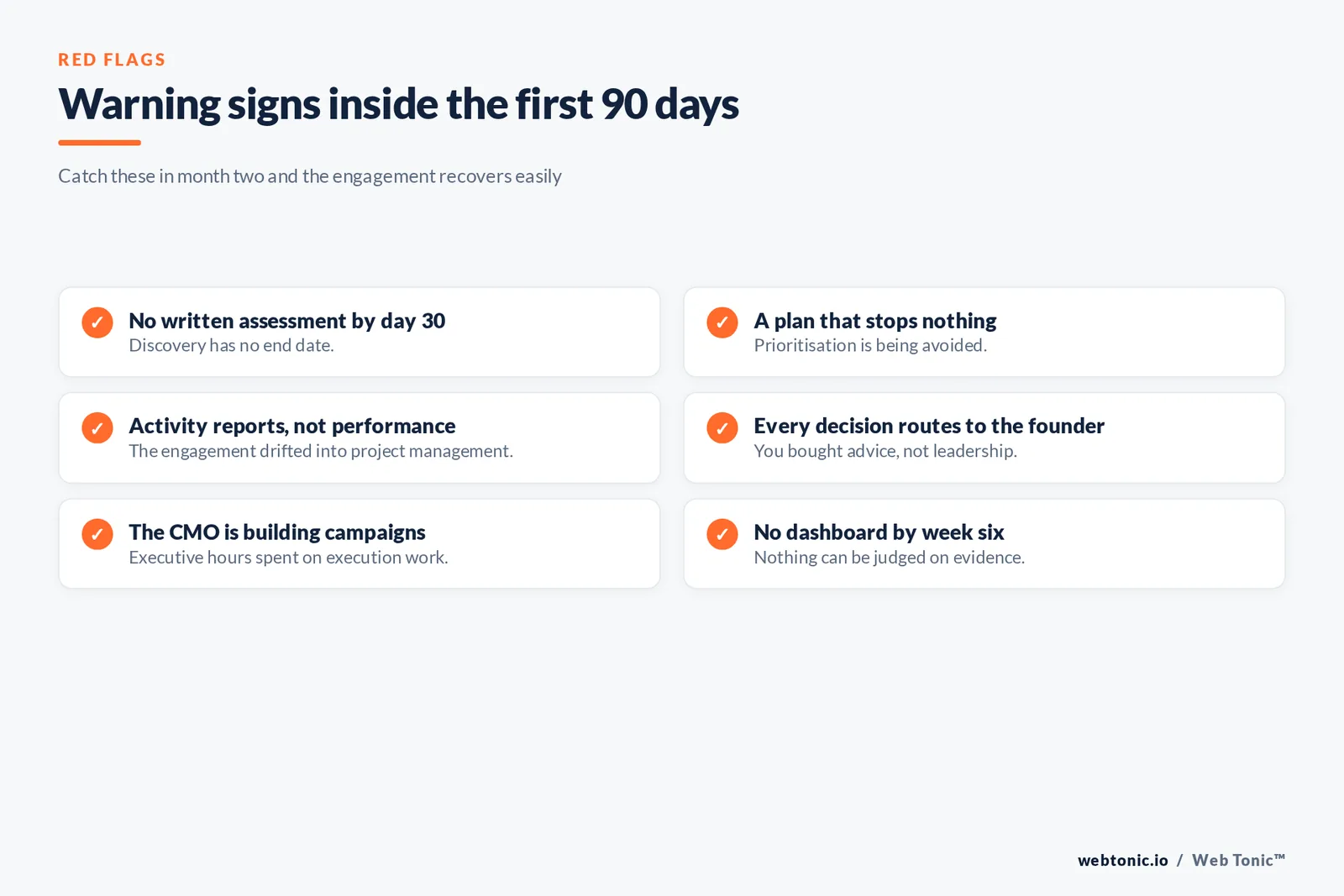
| Warning sign | What it usually means | Fix |
|---|---|---|
| No written assessment by day 30 | Discovery has no end date | Require the diagnosis document as a milestone |
| Strategy that adds channels but stops nothing | Avoiding hard prioritisation | Ask which two things you will stop doing |
| Reports of activity, not performance | The engagement drifted into project management | Reset the monthly report to pipeline and cost metrics |
| Every decision still routes to the founder | You bought advice, not leadership | Write down the decision rights explicitly |
| The fractional CMO is building campaigns personally | Executive hours spent on execution work | Add delivery capacity and return the leader to strategy |
Catch these in month two and the engagement recovers easily. Catch them in month eight and you have paid senior rates for a project manager.
The marketing infrastructure a 90-day plan has to build
Strategy is only half the first quarter. The other half is the system that lets the strategy run without the fractional CMO in the room: the data, the tools and the processes an early-stage or growth-stage company usually never had time to build.
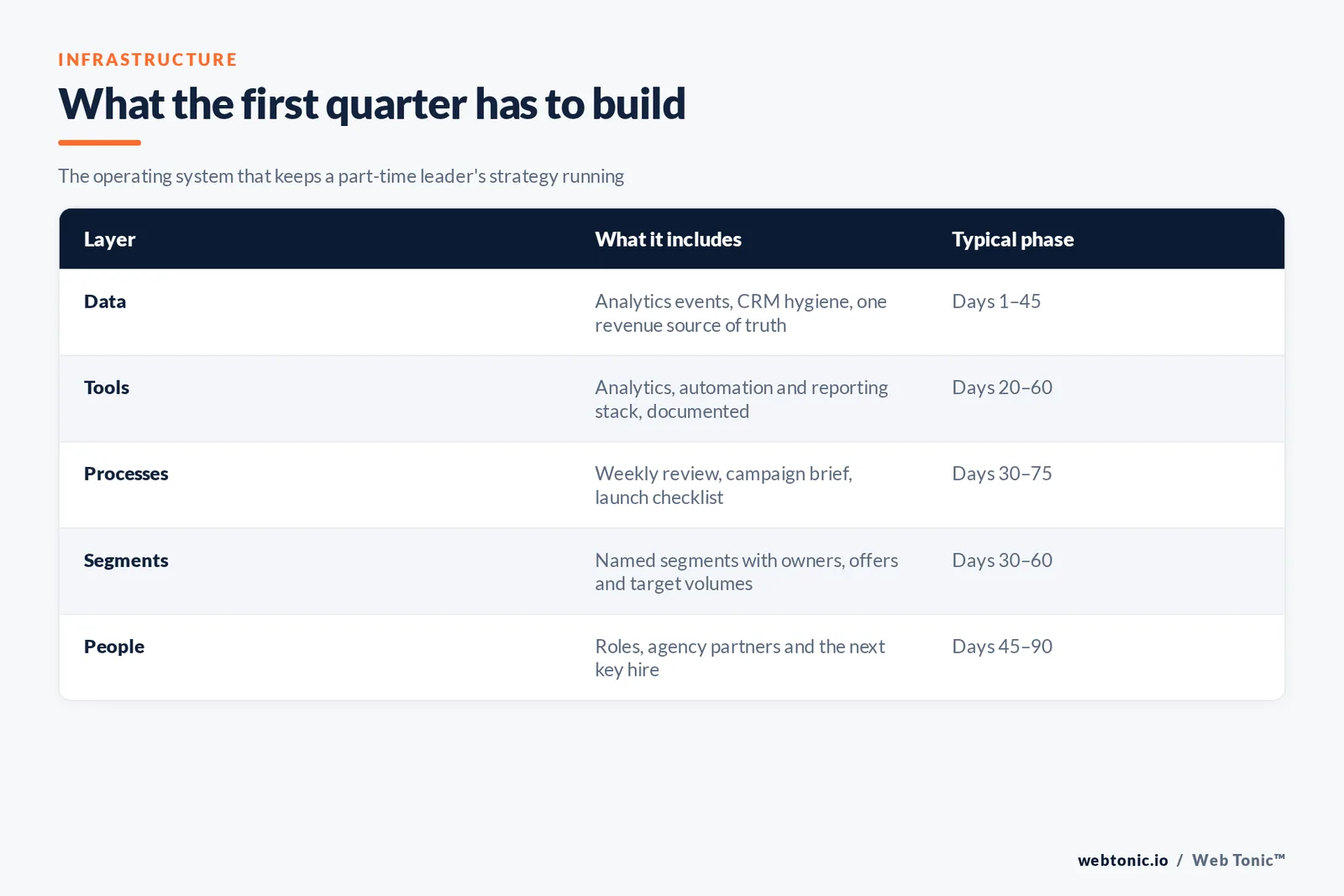
| Layer | What it includes | Typical phase |
|---|---|---|
| Data | Analytics events, CRM hygiene, one revenue source of truth | Days 1–45 |
| Tools | Analytics, automation and reporting stack, consolidated and documented | Days 20–60 |
| Processes | Weekly review, campaign brief template, launch checklist, approval path | Days 30–75 |
| Segments | Named customer segments with owners, offers and target volumes | Days 30–60 |
| People | Roles, freelancers or agency partners, and the next key hire | Days 45–90 |
Two of these carry outsized weight. First, the data layer: without clean attribution infrastructure, every later decision is an argument. Second, the process layer — a repeatable campaign brief and a weekly review are how a part-time senior leader keeps a full-time team moving between sessions.
Segments deserve their own note. Early in an engagement it is tempting to keep marketing to "everyone who might buy". A clear framework of two or three named segments, each with its own offer and its own key metric, is what makes the budget model defensible and the demand generation plan testable at scale.
A simple 90-day scoreboard
Give the leadership team one page that shows whether the engagement is working. Build it in week two, not week ten, and keep the same format for the whole first quarter.
- Pipeline created, by segment and channel, against target.
- Cost per qualified lead and blended customer acquisition cost, trended weekly.
- Conversion rates at each key stage, so the team can see where the funnel actually leaks.
- Spend against plan, including what was stopped and what was reallocated.
- Initiative status, with the working owner and the date each one goes live.
Long-term strategy still matters, but in the first 90 days the scoreboard is what turns a senior executive's judgement into something the whole business can see. It also makes the eventual decision — extend, scale the scope, or hand over to a full-time hire — an evidence-based one rather than a matter of taste.
What changes after day 90
The end of the first quarter is a decision point, and it typically includes three options: continue at the same scope, scale the engagement up around a bigger mandate, or start the handover to a permanent marketing leader. Each is a legitimate outcome, and the diagnosis, strategy and infrastructure built in the first 90 days make all three cheaper than they would otherwise be.
What should be different by then is the operating system, not just the campaigns. The company has a clear framework for deciding where money goes, a reporting system nobody argues with, documented processes for briefing and launching work, and a strategic plan with named owners. That is the durable asset — the part that keeps compounding whether the fractional CMO stays for another quarter or hands the wheel to a full-time executive.
Set the review date in the contract at the start. A scheduled day-90 review, with the scoreboard on the table, turns an awkward renewal conversation into a normal business decision.

Frequently Asked Questions
What should a fractional CMO deliver in the first 30 days?
A written diagnosis: funnel and pipeline maths, a channel and spend audit, customer interview findings, a team and capability review, and a ranked list of initiatives. Quick wins can start immediately, but the assessment is the deliverable.
How many hours a week does the first 90 days take?
More than steady state. Benchmarks suggest 20+ hours a week during the first 30 to 90 days of a launch, turnaround or leadership gap, settling back to 8 to 20 hours once the plan is running.
When should we expect results from a fractional CMO?
Pipeline signal by month three in most growth-stage businesses, revenue contribution in months four to six, and compounding gains from months seven to twelve. Long enterprise sales cycles push every milestone later.
Who should the fractional CMO report to?
The CEO or founder, with the marketing team reporting into the fractional CMO. Any other structure blurs accountability and slows every decision in the first quarter.
What if the first 90 days do not go well?
Diagnose before you replace. Most stalled engagements trace to missing access, missing execution capacity or missing decision rights rather than to the operator. Fix the structure, agree new milestones for the next 60 days, and set a clear exit if they are missed.
Sources
Prose — Fractional CMO hours per week benchmarks
Rick Ramos — State of Fractional CMO Engagement
Duct Tape Marketing — Fractional CMO Insights Survey
Built In — CMO salary in US (2026)
Spencer Stuart — CMO Tenure 2026
Lightcast — The Rise of Fractional Leadership
Treetop — 2026 Fractional Executive Pricing Report


