



Table of contents

Most wasted fractional CMO retainers are not talent failures. They are structural: vague scope, no decision rights, no execution capacity behind the strategy, and a contract that renews before anyone checks the results.
Key Takeaways
- The dominant failure mode is treating a fractional chief marketing officer as a vendor on retainer — a monthly report and an invoice, with no strategic conversation.
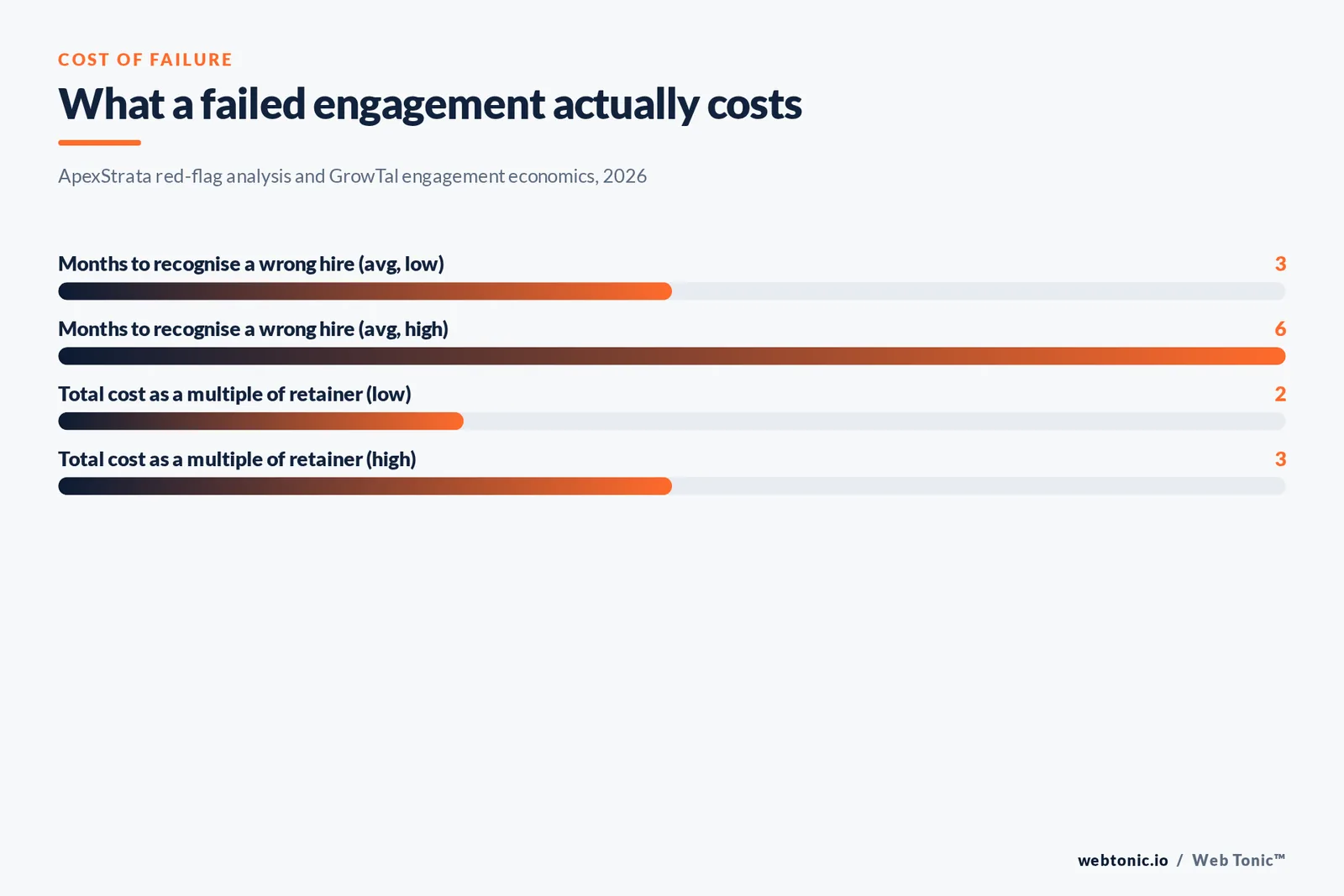
- Wrong-hire recognition typically takes 3 to 6 months, so the loss compounds well beyond the fees paid.
- Analyses of failed fractional engagements put the total cost at roughly 2 to 3 times the retainer once onboarding time, delay and re-search costs are counted.
- Long minimum terms with automatic renewals are a structural trap: they lock in cost regardless of performance.
- Buying leadership and then withholding decision rights over channels, spend and messaging guarantees an expensive stalemate.
- Scope mismatch is common: engagements run 8 to 20 hours a week, and no one delivers a transformation on five hours a month.
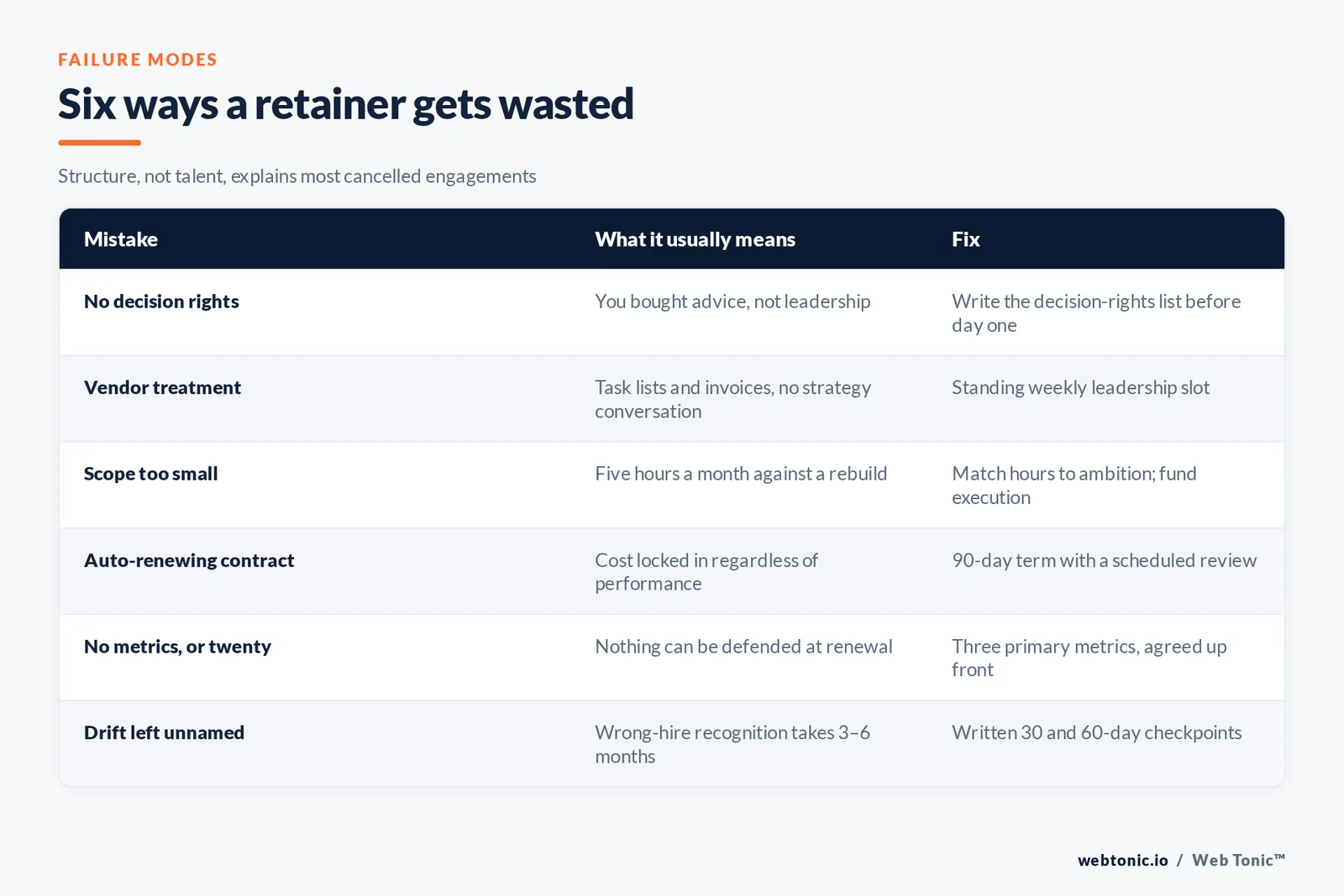
Mistake 1: hiring leadership, then refusing to let it lead
The most expensive mistake is also the quietest. A company pays senior rates for marketing leadership, then keeps final say on channels, creative, spend and messaging with the founder. The operator becomes a highly paid recommender, decisions queue behind one calendar, and by month four the honest verdict is that nothing shipped.
Practitioner analyses of the wrong-hire scenario are direct about this: if you are not willing to hand over the strategy seat, hire execution support instead and keep the seat. That is a legitimate choice. What does not work is paying for leadership and then declining to be led.
The fix is a written decision-rights list before day one: budget authority up to a threshold, agency and freelancer selection, channel mix, messaging sign-off, and which decisions still route to the CEO. Ten lines settle a quarter's worth of friction.
Mistake 2: treating the engagement as a vendor relationship
The second pattern practitioners see repeatedly is the client who hands over a task list, withholds data access, and never gives the operator a seat in the leadership conversation. The setup, not the person, is the problem — and it produces exactly the deliverables it deserves: activity reports.
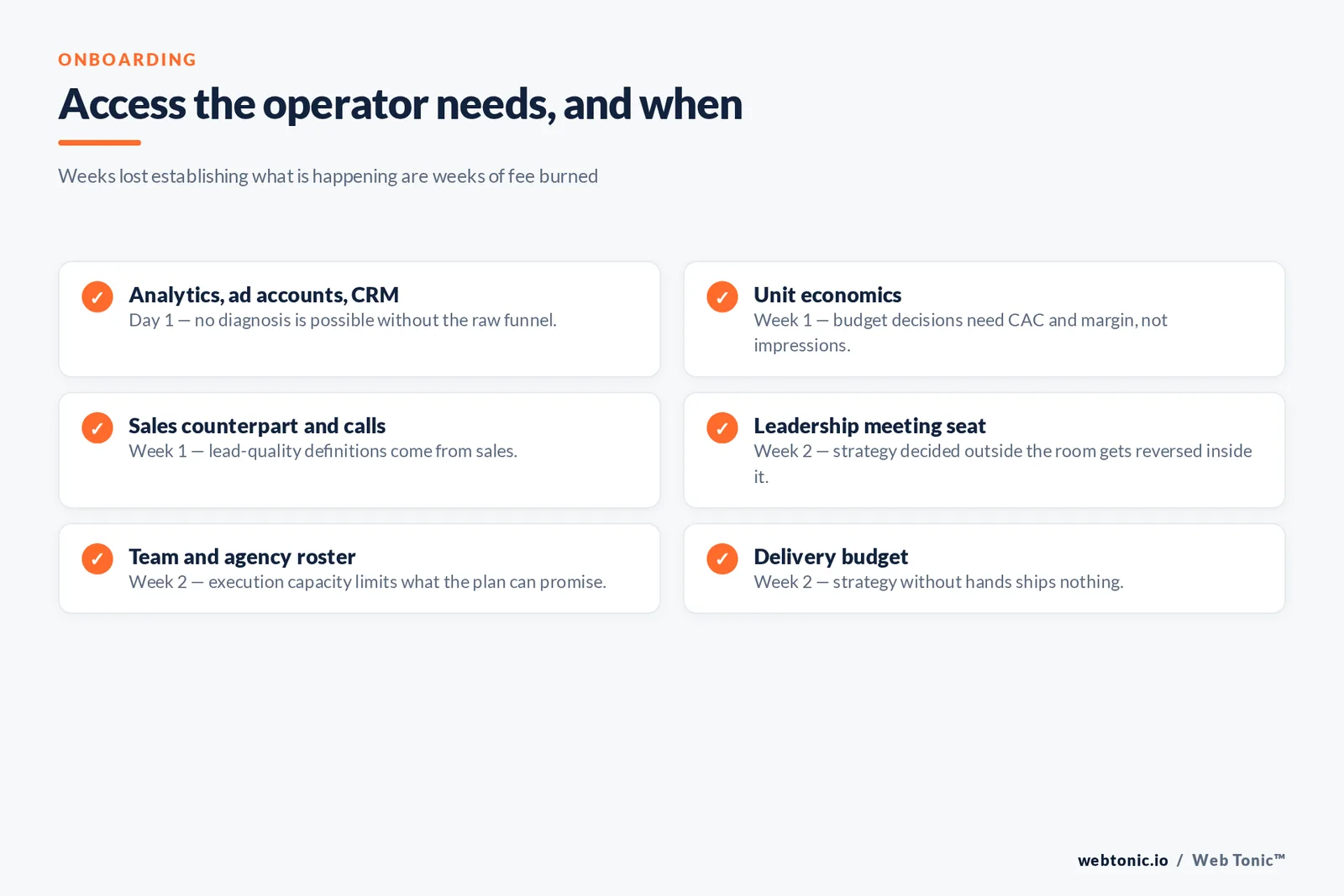
GrowTal's list of hiring mistakes adds the onboarding half of the same failure. Marketing leadership needs data, tools, feedback loops and people who can execute; when onboarding is skipped on the assumption that "they'll figure it out", weeks disappear just establishing what is actually happening. On an eight-hour week, three lost weeks is most of a month's fee.
| Access | Why it matters | Deadline |
|---|---|---|
| Analytics, ad accounts and CRM | No diagnosis is possible without the raw funnel | Day 1 |
| Financials: CAC, margin, LTV inputs | Budget decisions need unit economics, not impressions | Week 1 |
| Sales counterpart and call recordings | Lead-quality definitions come from sales, not marketing | Week 1 |
| Leadership meeting seat | Strategy decided outside the room gets reversed inside it | Week 2 |
| Team, agency and freelancer roster | Execution capacity determines what the plan can promise | Week 2 |
Mistake 3: scope that does not match the ambition
Scope mismatch is the most common way a part-time CMO engagement is set up to fail. Prose's hours benchmarks put steady-state engagements at 8 to 20 hours a week, with more than 20 hours needed during the first 30 to 90 days of a launch, repositioning or leadership gap. Hire five hours a month and expect a rebuild, and the arithmetic — not the operator — is what fails.
The second half of the mismatch is execution capacity. Strategy without hands produces a plan nobody ships. Every fractional engagement should be scoped alongside the delivery it implies, whether that is an internal marketer, freelancers, or an agency bench such as our growth marketing and performance creative teams.
| Ambition | Realistic leadership scope | Execution you must fund |
|---|---|---|
| Sanity-check an existing plan | 5–8 hrs/week advisory | Existing team only |
| Own the quarterly plan and one channel bench | 8–12 hrs/week | One marketer plus freelancers or an agency |
| Lead a team across several channels | 12–20 hrs/week | Internal team of two to four |
| Launch, turnaround or interim cover | 20+ hrs/week for 30–90 days | Dedicated delivery capacity from week one |
Mistake 4: a contract that renews before anyone checks
GrowTal's review of fractional contracts found long minimum durations coupled with automatic renewals, locking companies into high-cost commitments regardless of performance. That is a structural waste generator: the review conversation only happens when someone is already unhappy.
Three clauses prevent it. A 90-day initial term with a scheduled review date written into the agreement. Named deliverables with dates — a written assessment by day 30, a strategy and allocation model by day 60, a dashboard and 12-month plan by day 90. And a handover clause covering documentation and a briefing for the next owner, so an ending engagement leaves the asset behind.
Also watch the incentive shape. A flat fee with no agreed outputs rewards minimum viable effort on both sides; heavy revenue-share in a six-month sales cycle rewards short-term lead volume. Modest milestone bonuses against the agreed 90-day deliverables age better than either extreme.
Mistake 5: no metrics, or twenty of them
An engagement with no scoreboard cannot be defended at renewal, and an engagement with twenty KPIs cannot be read. The workable shape is three primary metrics agreed before the first working session: one business outcome, one or two leading indicators, one operating-health measure.
Benchmarks make those targets defensible. Pedowitz Group puts marketing-sourced pipeline across B2B at 20–30% of total, rising to 40–55% in mature programmes, and flags under 15% as marketing operating as a cost centre. Benchmarkit data reported by MarketScale found teams with full-funnel attribution are nearly twice as likely to exceed goals — which is why a first month spent fixing measurement is investment, not delay. Rebuilding that layer is the job of our data intelligence practice.
Set the clock realistically as well. Leading indicators can move by month three; revenue contribution usually lands in months four to six, later with enterprise cycles. Judging a strategy hire on month-two revenue is the fastest way to cancel something that was working.
Mistake 6: waiting too long to name the problem
ApexStrata's red-flag analysis makes the cost of drift explicit: recognising a wrong hire takes 3 to 6 months on average, and the loss is not only the fees — it is pipeline, time and competitive position that compound every month the situation continues. GrowTal's economics of failed engagements put the all-in cost at roughly 2 to 3 times the retainer across months one to six once onboarding, delay and re-search are included.
Run a written 30-day and 60-day checkpoint so drift has to surface early. These are the signals worth acting on:
| Warning sign | What it usually means | Fix |
|---|---|---|
| No written assessment by day 30 | Discovery has no end date | Make the diagnosis document a contractual milestone |
| Reports of activity, not performance | The engagement drifted into project management | Reset the monthly report to pipeline and cost metrics |
| The operator is building campaigns personally | Executive hours spent on execution work | Add delivery capacity; return the leader to strategy |
| Every decision still routes to the founder | You bought advice, not leadership | Write the decision rights down explicitly |
| A plan that adds channels but stops nothing | Prioritisation is being avoided | Ask which two activities you will stop this quarter |
| Scope creep with no exit criteria | The engagement is being extended by default | Agree written exit criteria and a handover date |
What a well-structured engagement looks like instead
The counter-pattern is unglamorous and it works. Write the mandate before the shortlist: two or three outcomes, a date, and the decisions the operator owns. Scope hours against the ambition, and fund the execution the plan will require. Start with a paid 30-day diagnostic or a 90-day initial term with a review date in the contract.
Then run it like a leadership role, not a subscription: data access in week one, a sales counterpart, a standing weekly slot, and one dashboard with three primary metrics. Review at day 90 with the scoreboard on the table and pick one of three outcomes — continue, scale the mandate, or begin the handover to a full-time hire. All three are successes if the diagnosis, the strategy and the reporting infrastructure stay with the company.
The market backdrop rewards getting this right. Lightcast counted at least 34,000 US workers with a "fractional" job title in 2025, up 265% since 2019, and Vendux sizes the global market at $5.7 billion, growing around 14% a year. Against average US CMO total compensation of $293,575, a well-structured retainer remains one of the cheapest ways to buy senior judgement — provided the structure is there. That structure is what our fractional CMO service is built around; more practical guides sit on the Web Tonic blog, and you can bring us the mandate whenever it is written.
Mistake 7: no plan for what comes after the retainer
A fractional engagement is by design temporary, yet most contracts describe the start and say nothing about the finish. The result is a slow, expensive drift: the company keeps paying for a strategic function it now needs permanently, or the operator leaves and the operating system leaves with them.
Decide the destination up front. There are only three honest end states, and each is planned differently.
| End state | When it fits | What has to be in place first |
|---|---|---|
| Steady-state advisory | Marketing is running; you need judgement, not hours | A capable internal owner and a working dashboard |
| Permanent in-house hire | Leadership demand exceeds roughly 30 hours a week | Hiring profile, comp band, documented plan and processes |
| Managed handover to a partner | Strategy is settled; execution is the constraint | Briefs, budgets, reporting and a named account owner |
The pricing conversation belongs in the same discussion. A permanent hire carries a compensation, recruiting and severance profile; an advisory retainer carries a smaller, cancellable monthly cost; a delivery partner carries a fee tied to output. Comparing the monthly retainer against a salary alone ignores ramp time, recruiting fees and the risk of a mis-hire in a market where product and channel fit change every year.
Whatever the end state, one artefact makes all three cheaper: a written operating system. Segment definitions, the qualified-lead definition, the budget allocation model, the campaign brief template, and the dashboard with its owner. If those exist and are current, the business keeps the value of the engagement regardless of who holds the seat next quarter — and the retainer stops being an expense and becomes an asset transfer.

Frequently Asked Questions
Why do fractional CMO engagements fail?
Usually structure rather than talent: no decision rights, no data access, no execution capacity behind the strategy, scope too small for the ambition, and no agreed metrics. The engagement then drifts into activity reporting and is cancelled for the wrong reason.
How much does a failed fractional engagement really cost?
More than the fees. Recognition of a wrong hire averages 3 to 6 months, and analyses of failed engagements put the total cost at roughly 2 to 3 times the retainer across the first six months once onboarding time, delayed initiatives and a second search are included.
How do I know if it is the operator or our setup?
Test the setup first. If the operator lacks CRM and ad-account access, has no sales counterpart, has no budget authority, or has no one to execute the plan, the structure is the constraint. Fix those, set 60-day milestones, and agree a clear exit if they are missed.
Should a fractional CMO contract have a minimum term?
A short one. A 90-day initial term with named deliverables and a scheduled review protects both sides. Long minimums with automatic renewal lock in cost regardless of performance and remove the natural moment to reassess.
When is a fractional CMO the wrong hire entirely?
When leadership will not delegate strategic authority, when the real gap is execution capacity rather than direction, or when the company needs more than about 30 hours of leadership a week. In those cases, execution support or a full-time hire is the better purchase.
Sources
GrowTal — 5 mistakes to avoid when hiring a fractional CMO
GrowTal — Why your fractional CMO contract is a structural failure
GrowTal — Economics of failed fractional marketing engagements
ApexStrata — 5 red flags when hiring a fractional CMO
Foxtown Marketing — Signs you hired the wrong fractional CMO
Prose — Fractional CMO hours per week benchmarks
Pedowitz Group — Revenue Marketing Benchmarks for B2B (2026)
MarketScale — Benchmarkit B2B marketing benchmarks 2026
Lightcast — The Rise of Fractional Leadership
Vendux — 10 numbers on fractional executives in 2026
Built In — CMO salary in US (2026)


