



Table of contents

Choosing a fractional CMO provider is a scoping decision before it is a people decision. Write the mandate, score candidates on stage fit, operating proof and accountability, then buy a short paid trial rather than a twelve-month lock-in.
Key Takeaways
- Score every candidate on three pillars — stage and motion fit, operating proof, accountability — and treat a weakness in any single pillar as a disqualifier.
- Stage fit carries the most weight in credible hiring frameworks: leading a Series B demand engine and launching a seed-stage category are different jobs.
- Ask for the operating contract, not the deck: who owns which KPI, what the exit clause looks like, and whether the operator sits in the finance meeting.
- Most engagements run 8 to 20 hours a week, so hours, decision rights and execution support decide the outcome as much as the CV does.
- The market is deep enough to be selective — at least 34,000 US workers carried a "fractional" job title in 2025, up 265% since 2019, inside a global market of about $5.7 billion.
- Get real references. Two calls with former clients, asking what moved and what did not, beats any case-study PDF.
Start with the mandate, not the shortlist
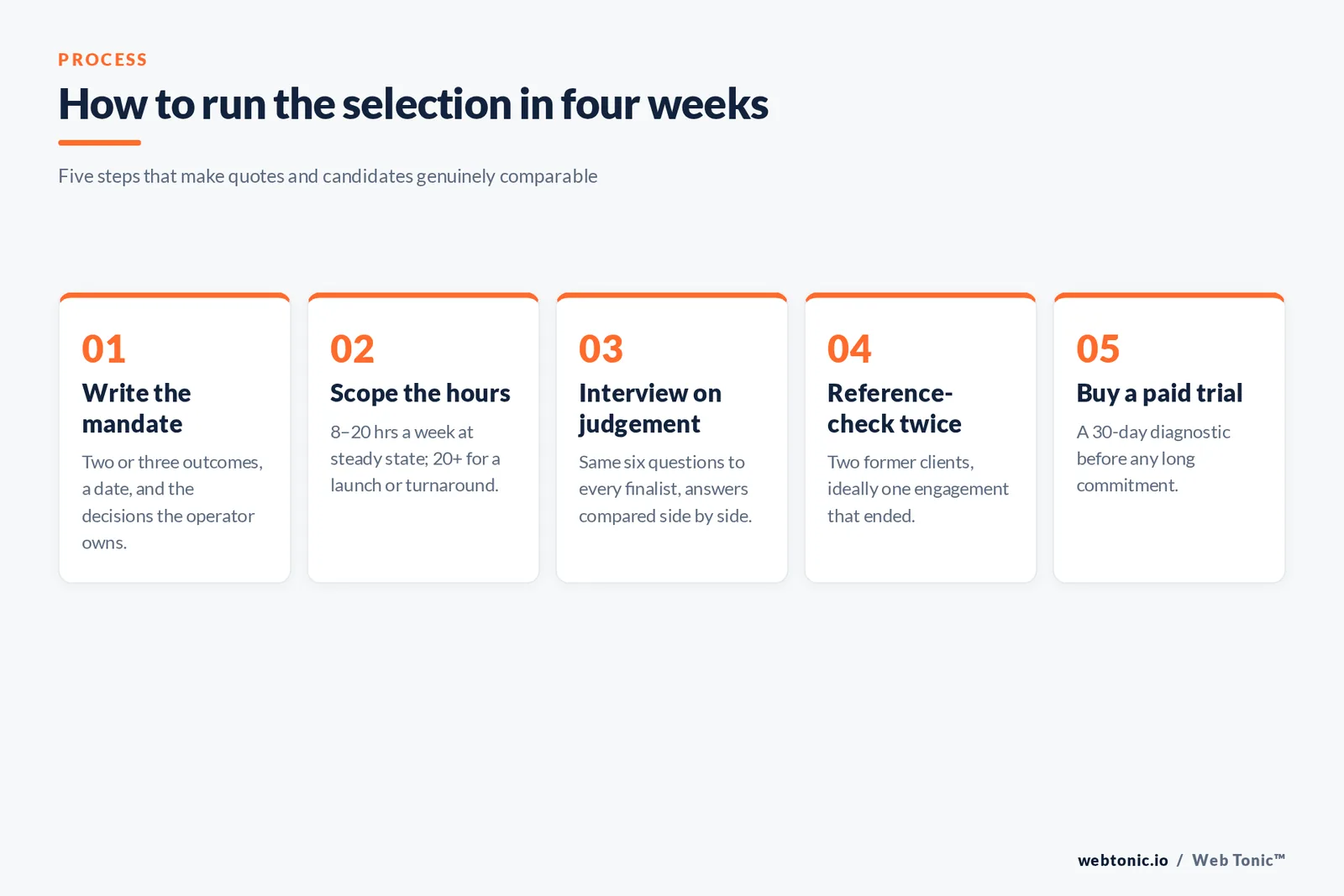
Most disappointing engagements were mis-scoped before anyone was interviewed. Before you speak to a single fractional chief marketing officer, write half a page that answers four questions: what outcome must change, by when, what marketing capacity already exists to execute, and which decisions the operator will be allowed to make alone.
That last one is decisive. If the founder keeps final say on channels, creative, spend and messaging, you are buying execution support with a strategy label on it — a legitimate choice, but priced and measured differently. Marketing leadership only pays back when it is allowed to lead.
Scope the hours honestly too. Prose's benchmark data puts steady-state engagements at 8 to 20 hours a week, rising above 20 hours during the first 30 to 90 days of a launch, repositioning or leadership gap. A mandate that quietly assumes full-time availability will fail whoever you pick.
The three pillars every candidate must clear
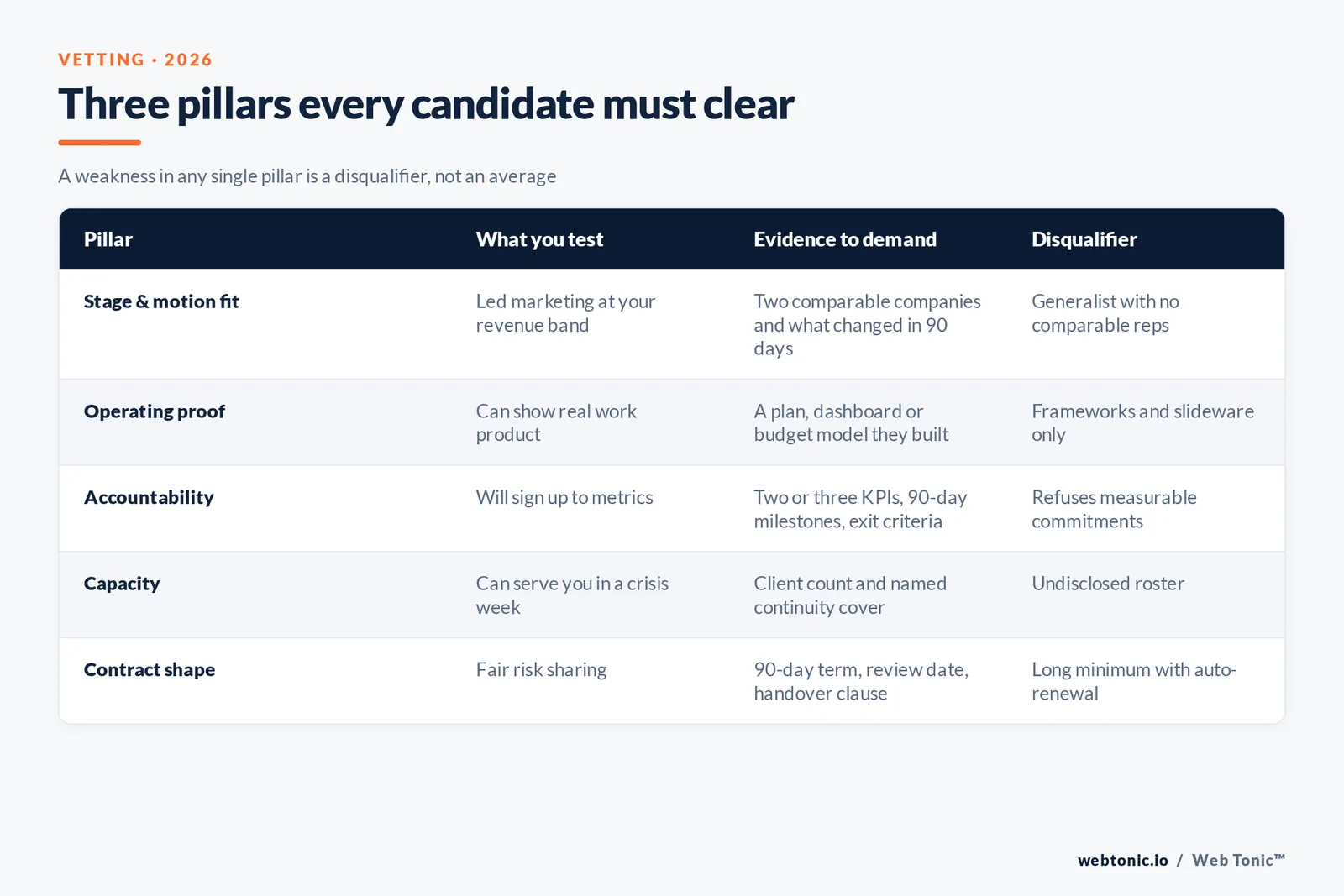
ApexStrata's vetting checklist scores candidates across three dimensions and treats a weakness in any one as a disqualifier rather than something to average away. It is the right instinct: a brilliant strategist with no operating proof and a friendly operator with no accountability both fail in the same quarter.
| Pillar | What you are testing | Evidence to demand | Disqualifier |
|---|---|---|---|
| Stage & motion fit | Has led marketing at your revenue band and go-to-market motion | Two comparable companies, what changed in 90 days, ACV band and channel mix | Generalist with no comparable stage reps |
| Operating proof | Can show the actual work product, not just a strategy deck | A real plan, a real dashboard, a real budget model they built | Only frameworks and slideware |
| Accountability | Will sign up to metrics and an exit | Two or three agreed KPIs, 90-day milestones, written exit criteria | Refuses measurable commitments |
MarkCMO's seven-step hiring framework weights stage and industry fit heaviest — around 20% of the scorecard on that criterion alone — precisely because pattern recognition is the thing you are renting. Operator guides to fractional leadership reach the same conclusion from the founder's side: relevant stage experience, operational proof, and working-style fit.
Solo operator, boutique firm or marketplace?
"Provider" covers three different purchases, and the right one depends on how much execution and continuity you need alongside the leadership.
| Provider type | Strength | Watch-out | Best fit |
|---|---|---|---|
| Independent operator | Direct senior time, lowest overhead, fast start | No cover when they are unavailable; capacity ceiling | A capable team that needs a strategy owner |
| Boutique advisory or agency | Leadership plus execution bench and continuity | Confirm who actually does the work each week | Thin internal team, several channels to run |
| Marketplace or network | Speed of shortlist, vetted pool, easy swaps | Matching quality varies; references can be thin | Urgent interim cover or a defined project |
O-CMO reference-checks operators with former clients and peers before publishing a profile; you can run a lighter version yourself with two calls per finalist. Ask what the operator changed, what they did not get to, and whether the client would hire them again at the same scope.
The interview: twelve minutes of real questions
Most interviews test communication skill, which every good part-time CMO already has. These questions test judgement instead.
- "Walk me through a company at our stage. What did you change in the first 90 days, and what did it move?" Listen for numbers, sequence and things they stopped doing.
- "What would you need from us in month one?" Strong operators ask for data access, a sales counterpart and decision rights. Weak ones say "just point me at the funnel".
- "Which two or three metrics should this engagement be judged on?" Vagueness here predicts vagueness in the reporting.
- "What is your exit plan?" Good fractional leaders have explicit exit criteria; scope creep with no endpoint is a business model, not a strategy.
- "How many other clients do you carry, and what happens in a crisis week?" Capacity honesty now saves an escalation later.
- "Show me a dashboard or plan you actually built." Redacted is fine. Absent is not.
Then compare the answers side by side. MarketerHire's process adds a practical filter worth keeping: strong candidates welcome a short paid trial before a long commitment. Anyone who insists on a twelve-month minimum before you have worked together is asking you to underwrite their risk.
Read the operating contract, not the proposal
Two proposals can quote the same hours and the same fee and describe completely different engagements. One CEO-side evaluation guide makes the point precisely: the differences are in the operating contract — who owns which KPI, what the 90-day exit clause looks like, and whether the operator sits in the finance meeting or just emails a report.
Check these clauses before signing:
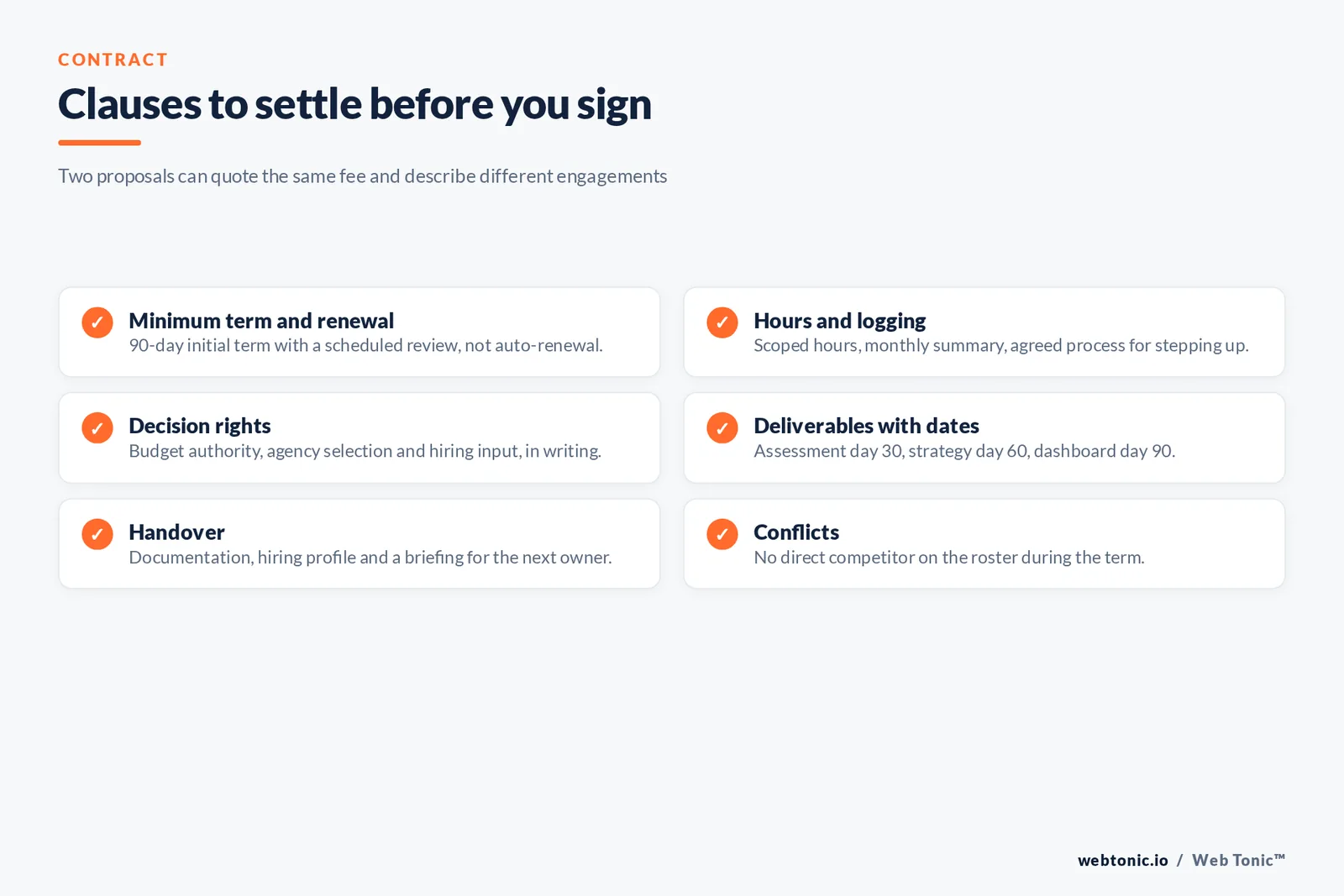
- Minimum term and renewal. GrowTal's contract analysis found long minimums coupled with automatic renewals locking companies into high-cost commitments regardless of performance. Prefer a 90-day initial term with a documented review.
- Hours and how they are logged. Scoped hours, a monthly summary, and an agreed process for stepping up when a launch demands it.
- Decision rights. Written, not implied — budget authority, agency selection, hiring input.
- Deliverables with dates. Written assessment by day 30, strategy and allocation model by day 60, dashboard and 12-month plan by day 90.
- Handover. Documentation, hiring profile and a briefing for the next owner, whether that is an in-house hire or a successor.
- Exclusivity and conflicts. No direct competitor on the roster during the term.
Cost: how to compare quotes fairly
Fractional pricing varies more by scope than by seniority, so compare on the mandate rather than the monthly number. Broad third-party market ranges put fractional CMO retainers roughly between $5,000 and $25,000 a month, with advisory work priced hourly and planning sprints priced by day or project — a wide band precisely because "10 hours of advice" and "owning three channels and an agency bench" both get called fractional.
The comparison that matters is against the alternative. Built In puts average US CMO total compensation at $293,575, and Spencer Stuart measures average S&P 500 CMO tenure at 4.1 years versus 5.0 for the wider C-suite. Meanwhile Vendux sizes the global fractional executive market at $5.7 billion growing about 14% annually, and Lightcast counts 34,000 US fractional job titles in 2025, up 265% since 2019. Supply is not your constraint; clarity of scope is.
Budget three things beyond the fee: execution capacity to ship the work, tooling and reporting, and two to four hours a week of your own leadership time. Companies that skip the second line usually conclude the retainer "did not work" when what failed was delivery capacity — the reason our growth marketing and performance creative teams are usually scoped alongside a leadership engagement.
Run a 30-day paid trial before the long commitment
A short paid engagement is the cheapest possible reference check. Scope it as a diagnostic: funnel and spend audit, a handful of customer interviews, a written assessment, and a ranked plan with a budget model. You get a real work product, they get paid, and both sides learn how the other makes decisions.
Score the trial on four things: did leadership learn something it did not already know; is the plan specific about what to stop; are the metrics defined well enough to build a dashboard from; and was the working rhythm comfortable? If three of four are yes, extend. If not, you have spent a month rather than a year.
Then set the review date in the contract at the start. A scheduled day-90 review with the scoreboard on the table turns renewal into a normal business decision instead of an awkward conversation. If you would rather have that operating system designed and owned end to end, see our fractional CMO service, browse more guidance on the Web Tonic blog, or tell us what you are trying to move.
Where the right candidate usually comes from
Sourcing quality varies more than fee levels do, and the best route depends on how specific your requirements are. SaaS companies with a product-led motion, professional services firms and consumer brands need genuinely different operators, so treat industry expertise as a filter rather than a bonus.
| Source | What it is good for | How to qualify it fast |
|---|---|---|
| Investor and board referrals | Operators already vetted at your stage | Ask the referrer what the operator actually changed |
| Fractional marketplaces and networks | Speed, choice, easy replacement | Request two attributable client references |
| Boutique agencies and advisory firms | Leadership plus an execution bench and cover | Confirm who does the weekly work by name |
| Direct outreach to operators | Deep niche expertise in one motion | Check capacity and conflicting clients up front |
Whichever route you use, insist on the same evidence. Ask which businesses in your category the candidate has led marketing for, which acquisition channels they personally know well enough to challenge an agency on, and what they would want to stop in your current plan. Strong operators answer those questions with specifics inside ten minutes; weaker ones retreat to generic strategies and brand language.
It also helps to decide what you are not buying. If your gap is delivery — content, media, creative production — a leadership retainer will not fix it, and services such as our performance creative and data intelligence teams are the cheaper answer. Companies that separate the two purchases tend to get better value from both, because the executive is judged on decisions and the delivery partner on output.

Frequently Asked Questions
What should I look for in a fractional CMO?
Stage and go-to-market fit first, then operating proof — an actual plan, dashboard or budget model they built — then willingness to sign up to two or three measurable outcomes and a written exit. Treat a clear weakness in any of those three as a disqualifier rather than something to average out.
How long should a fractional CMO contract be?
Start with a 30-day paid diagnostic or a 90-day initial term with a scheduled review. Long minimums with automatic renewals lock you into cost regardless of performance, which is exactly the structural failure contract reviews keep finding.
Is a solo fractional CMO better than an agency-provided one?
Neither is better in the abstract. A solo operator gives you direct senior time and the lowest overhead; a firm or marketplace gives continuity cover and an execution bench. Choose on how much delivery capacity you already have in-house.
How many hours a week should I scope?
Typically 8 to 20 hours a week at steady state, and above 20 hours during the first 30 to 90 days of a launch, turnaround or leadership gap. Write the number into the contract along with how extra hours are approved.
What references should I ask for?
Two former clients at a comparable stage, ideally one engagement that ended. Ask what changed in the first 90 days, what never got done, how reporting worked, and whether they would re-engage at the same scope and price.
Sources
ApexStrata — How to vet a fractional CMO
MarkCMO — How to hire a fractional CMO: 7-step framework
MarketerHire — Hiring a fractional CMO
O-CMO — How to hire a fractional CMO
GrowTal — Why your fractional CMO contract is a structural failure
MDDM — How to evaluate a fractional CMO proposal
Prose — Fractional CMO hours per week benchmarks
Built In — CMO salary in US (2026)
Spencer Stuart — CMO Tenure 2026
Lightcast — The Rise of Fractional Leadership
Vendux — 10 numbers on fractional executives in 2026


