Table of contents
Hiring a CMO and outsourcing marketing are answers to two different questions. The 2026 sourcing data shows how often they get collapsed into one decision - and what it costs.
Key Takeaways
- 59.5% of marketing activity is built in-house.
- 38.5% is delivered by outside partners.
- Agencies deliver 15.5% of activity.
- Consultancies deliver 12.7% and other partners 10.4%.
- Only 1.9% is handled by automation.
- Outside partners deliver 33.6% of digital activity.
- Education firms build 83.0% of marketing in-house.
- Professional services firms build 70.0%.
- Firms under USD 10 million build 64.1%.
- 66% of client firms keep at least 26% of work in-house.
- 60% now have some in-house agency capability, up from 40%.
- Bandwidth is the top outsourcing reason at 22%.
- Speed follows at 18% and expertise at 15%.
- Cost efficiency is only the fourth reason at 13%.
- Hybrid structures account for 35% of B2B teams.
- 31% of S&P 500 companies have no CMO title.
- A senior mis-hire can cost 213% of salary.
- Marketing headcount growth fell 50% year on year.
The market has already answered part of this
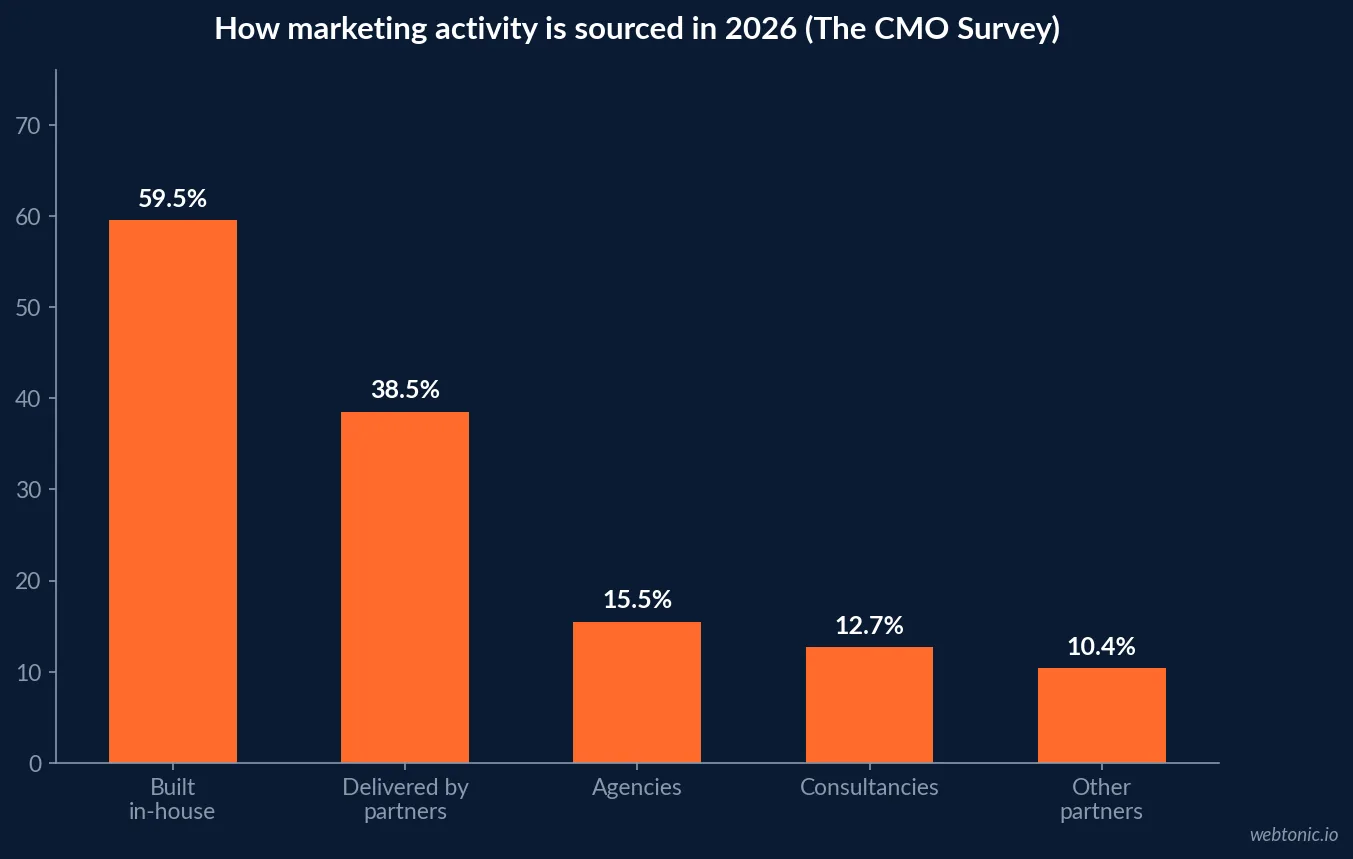
The CMO Survey 2026 reports 59.5% of marketing activity built in-house, 38.5% delivered by partners - agencies 15.5%, consultancies 12.7%, other partners 10.4% - and 1.9% handled by automation. In-house share has crept up from 57.9% in 2020.
So the default is a majority-internal team that buys specific capability from outside. The question is never build or buy in the abstract; it is which slice of the work sits on which side of the line, and who owns the plan that decides.
| Sourcing route | Share of marketing activity | What it is good at | What it will not do |
|---|---|---|---|
| Built in-house | 59.5% | Context, speed on familiar work | Give you a new point of view |
| Agencies | 15.5% | Channel craft and production volume | Own your P&L trade-offs |
| Consultancies | 12.7% | Diagnosis and structure | Run the week-to-week |
| Other partners | 10.4% | Specialist gaps | Integrate themselves |
| Automation | 1.9% | Repetitive execution | Decide priorities |
The leadership seat is a separate decision
Spencer Stuart reports median CMO tenure of 4.1 years against a 5.0-year C-suite average, 31% of S&P 500 companies with no CMO title, and 77% of vacancies filled within six months.
Meanwhile the CMO Survey reports marketing headcount growth down 50% year on year and budgets at 9.0% of revenue with 1.7% spend growth. A vacant seat in that environment is far more likely to be filled by a fractional arrangement than by a requisition - which is how leadership and execution end up being bought from the same invoice, and mismanaged.
Why teams outsource, in their own words
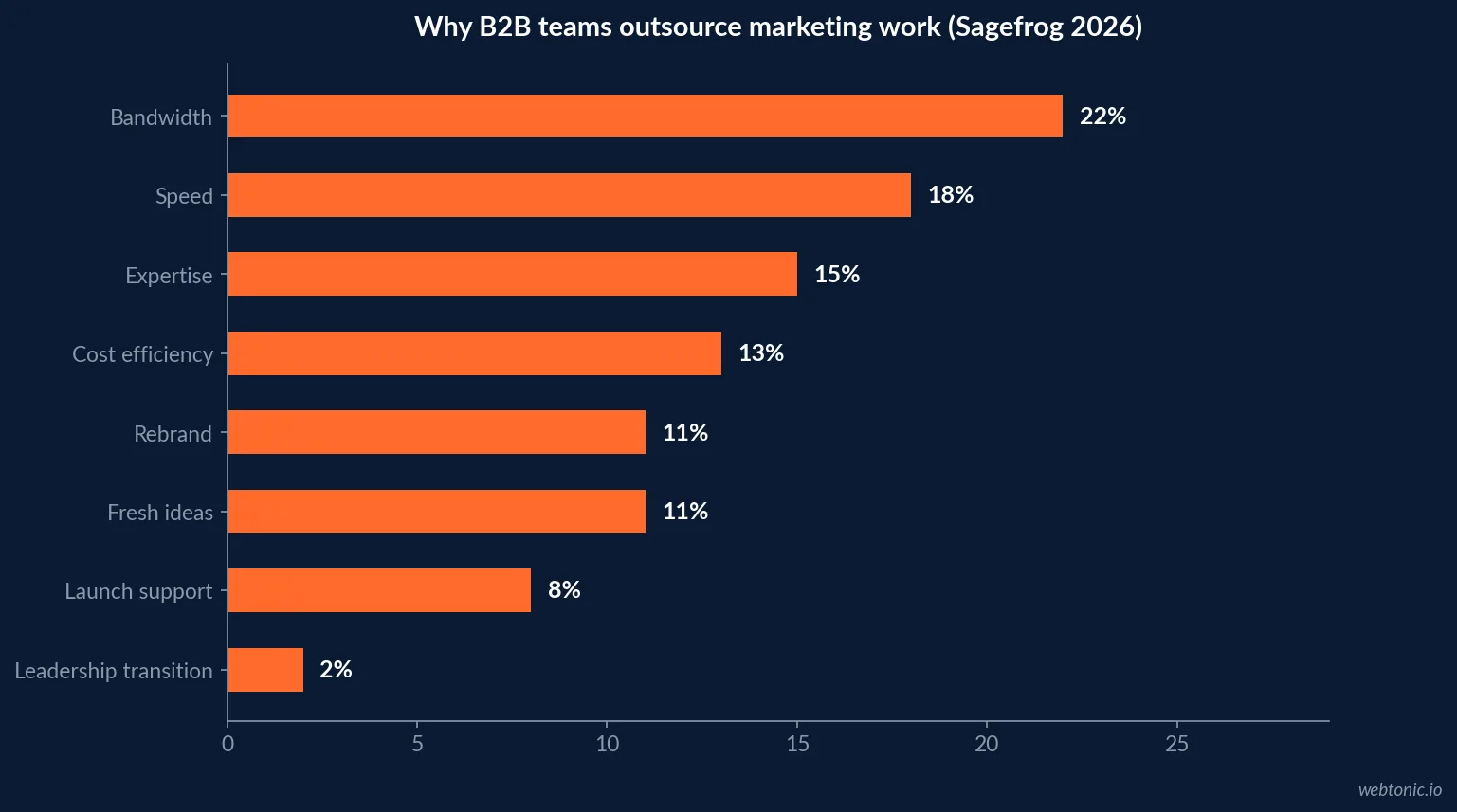
Sagefrog's 2026 B2B Marketing Mix Report ranks the reasons: bandwidth 22%, speed 18%, expertise 15%, cost efficiency 13%, rebrand 11%, fresh ideas 11%, launch support 8% and leadership transition 2%.
Three of the top four are capacity and capability, not price. That matters because an outsourcing decision justified on cost tends to be reviewed on cost, and the first budget squeeze cancels work that was actually bought for speed.
In-house capability is growing - and ageing fast
RSW/US's 2026 New Year Outlook reports 66% of client firms keeping at least 26% of work in-house and 60% holding some in-house agency capability, up from 40% a year earlier. The same report finds roughly 61% of external agencies using generative AI in 2025 against 17% of in-house agency teams.
Building capacity and keeping it current are different projects. A team can be fully staffed and still two tool generations behind, which is the strongest practical argument for a hybrid structure rather than a binary choice.
| Signal | 2026 figure | Reading |
|---|---|---|
| Firms keeping 26%+ of work in-house | 66% | In-house is the default, not the exception |
| Firms with in-house agency capability | 60%, from 40% | Capacity is being built quickly |
| External agencies using generative AI | ~61% | Method currency sits outside |
| In-house agencies using generative AI | 17% | The gap is capability, not headcount |
| Digital activity delivered by partners | 33.6% | A third of digital already sits outside |
Sector and size change the answer
The CMO Survey reports the most build-oriented sectors as education at 83.0%, consumer services at 73.3% and professional services at 70.0%, with firms under USD 10 million in revenue building 64.1%. On the other side, outside partners deliver 48% of digital activity for B2C product firms and 44% for B2C services, against 28% and 25% for B2B.
Small professional services firms build because the work is relationship-led. Consumer brands buy because the work is production-heavy. Knowing which pattern you sit in prevents a lot of expensive benchmarking against the wrong peer group.
What the hybrid majority actually looks like
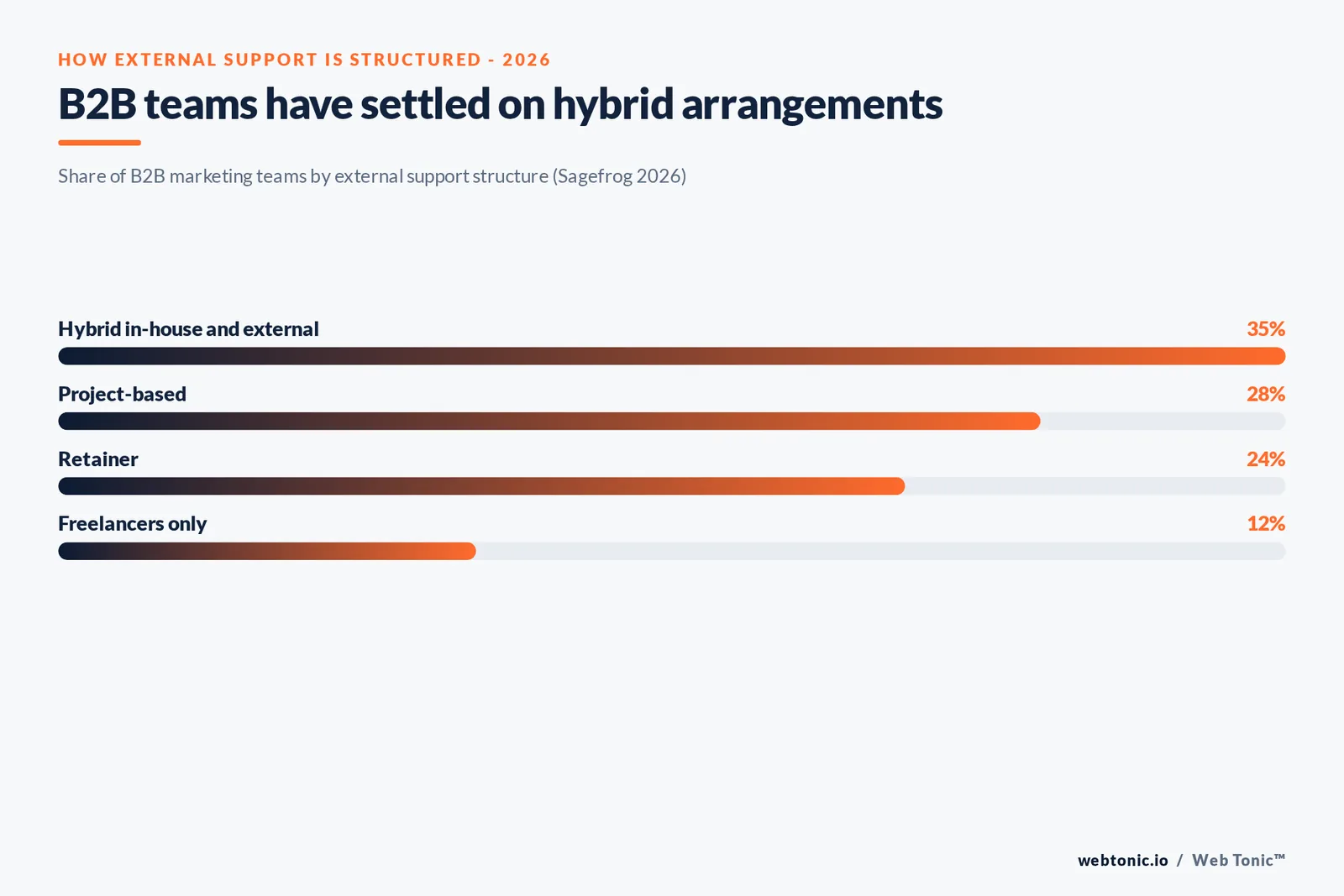
Sagefrog reports external support structured as hybrid at 35%, project-based at 28%, retainer at 24% and freelancers at 12%. In practice that is an internal owner, a retained partner for the channel that compounds, and projects for everything with an end date.
A fractional CMO fits that picture as the owner of the plan rather than as another vendor. Our growth marketing team usually sits in the retained slot while an internal lead keeps the roadmap, and our paid social practice works the same way.
| Decision | Fractional leadership | Agency or partner | Permanent hire |
|---|---|---|---|
| Owns the plan | Yes | No | Yes |
| Owns a channel outcome | No | Yes | Sometimes |
| Typical commitment | 6-12 months plus notice | Project or retainer | Permanent |
| Cost of being wrong | Notice period | Contract term | Up to 213% of salary |
| Fits which 2026 pattern | Vacant seat, 31% have no CMO | 38.5% partner-delivered work | Sectors building 70%+ in-house |
What in-house teams quietly stop doing
Hinge's 2026 High Growth Study finds 80% of professional services firms running some research - competitive research at 46.1% and client research at 45.2% - while 20% run none at all. Use of SEO and keyword research fell from 33.5% to 27.0%, and referrals still supply 39.5% of leads against 23.5% from outbound.
The work that disappears first is the work nobody is accountable for. That is the practical case for a named owner of the plan - whether internal or fractional - before any execution is outsourced.
| Activity | 2026 figure | Who usually keeps it alive |
|---|---|---|
| Competitive research | 46.1% of firms | Fractional or consultancy |
| Client research | 45.2% of firms | Internal owner with a partner |
| No research at all | 20% of firms | Nobody - it is the first thing dropped |
| SEO and keyword research | 27.0%, down from 33.5% | Specialist partner |
| Referral development | 39.5% of leads | Internal, senior, unmanaged |
The risk maths on getting it wrong
Talentfoot's 2026 data prices a bad hire at a floor of 30% of first-year earnings per US Department of Labor guidance, with senior mis-hires reaching 213% of salary and retained search adding 25% to 35%. Built In puts US CMO total cash at USD 293,575.
An outsourcing mistake ends at the contract term. A hiring mistake at that level is a six-figure event plus a lost year. That asymmetry, not the rate card, is why so many teams rent the seat first and hire against a proven brief.
Content is where the split gets tested first
CMI's 2026 B2B research reports 97% of organisations have a content strategy, yet the top challenges are prompting action at 40%, resources at 39%, measurement at 33%, quality at 28%, differentiation at 24% and cross-team collaboration at 21%. Only 52% report mature governance.
Resources and collaboration are outsourcing problems; differentiation and measurement are ownership problems. Sending the whole function outside because production is slow usually leaves the second pair unsolved - and they are the ones that decide whether the content works.
| Content challenge | Share of teams | Best solved by |
|---|---|---|
| Prompting action | 40% | The plan owner |
| Resources and capacity | 39% | An external partner |
| Measurement | 33% | The plan owner with analytics support |
| Consistent quality | 28% | An external partner with a brief |
| Differentiation | 24% | The plan owner |
| Cross-team collaboration | 21% | Internal, no vendor can fix it |
The supply of rentable leadership
Fractional Jobs reports 149% year-on-year demand growth, roughly 150,000 US practitioners, marketing at 20% of demand, 87% with eleven or more years of experience, 64% holding several clients and 90% who will not go back to full-time roles. Vendux cites Gartner expecting more than 30% of midsize companies to use fractional executives by 2027.
The option that barely existed as a category five years ago is now the realistic middle path between a requisition and an agency retainer.
A decision rule that survives contact with a budget
Rent the seat when the plan is missing, the headcount line is frozen - headcount growth is down 50% - or the role is still being defined. Outsource execution when bandwidth (22%), speed (18%) or expertise (15%) is the constraint. Hire when the brief is stable, the sector builds by default and the budget is funded.
Most teams need two of the three at once, which is what the 35% hybrid share is really telling you. If you want a read on which slice sits where, talk to us - or see how we split channel ownership in our Facebook Ads ROI analysis.
Frequently Asked Questions
Should we hire a CMO or use a fractional one?
It depends on whether the plan exists. Spencer Stuart reports 31% of S&P 500 companies carry no CMO title and 77% of open seats are filled within six months, so a vacancy is not automatically a permanent hire. If you need a written plan, a scorecard and a decision on channel mix, that is fractional work. If you need someone managing a team of eight every day, it is a hire.
Is outsourcing execution cheaper than building a team?
The CMO Survey 2026 reports 59.5% of marketing activity built in-house, 38.5% delivered by partners - agencies 15.5%, consultancies 12.7%, other partners 10.4% - and 1.9% bought as automation. Outside partners deliver 33.6% of digital activity. Cost efficiency is only the fourth reason teams outsource in Sagefrog's 2026 data, behind bandwidth, speed and expertise.
What is the difference between a fractional CMO and an agency?
Accountability shape. A fractional CMO owns the plan, the scorecard and the trade-offs; an agency owns a channel outcome inside that plan. Sagefrog reports hybrid structures at 35%, project-based at 28%, retainers at 24% and freelancers at 12% - the hybrid majority exists precisely because those two jobs are different.
What does the data say about in-house capability?
RSW/US reports 66% of client-side firms keep at least 26% of work in-house and 60% now have some in-house agency capability, up from 40% a year earlier. But it also reports about 61% of external agencies using generative AI in 2025 against 17% of in-house agency teams, so in-house capability and current capability are not the same thing.
When is a permanent hire clearly the right call?
When the sector builds by default and the budget exists. The CMO Survey finds education firms building 83.0% in-house, consumer services 73.3% and professional services 70.0%, while firms under USD 10 million in revenue build 64.1%. Against that, Talentfoot prices a senior mis-hire at up to 213% of salary - so hire when the role is stable and the brief is written, not while both are still moving.
Sources
The CMO Survey - Highlights and Insights Report 2026
Sagefrog - 2026 B2B Marketing Mix Report
RSW/US - 2026 New Year Outlook Report
Spencer Stuart - CMO tenure 2026 snapshot
Talentfoot - The cost of a leadership mis-hire, 2026 data
Built In - CMO salary data
Content Marketing Institute - B2B content marketing trends 2026
Hinge Marketing - 2026 High Growth Study
Fractional Jobs - The Fractional Work Report
Vendux - Ten numbers on fractional executives in 2026